The 8 Best Golf Wedges
Spin rate, bounce angle, and sole grind matter far more than most golfers realise. Our research across wedges from Titleist, TaylorMade, Cleveland, and more cuts through the specs to find the picks that actually improve your scoring.
 By Bernard Nguyen
Updated July 23, 2026
By Bernard Nguyen
Updated July 23, 2026

The wedge is the most versatile scoring club in any bag, yet it is also the one golfers most often get wrong.
Whether you are looking to tighten your distance gaps from 100 yards and in, stop short-sided chips from running past the hole, or splash out of a bunker with confidence, choosing the right wedge has a direct, measurable impact on your scorecard.
The market today spans everything from precision tour-grade forged irons to affordable milled-face sets, made by brands including Titleist, TaylorMade, Cleveland Golf, Yamato, Tour Edge, and Gowolf, so narrowing the field to a handful of genuinely great options takes real research.
At ProductFind, we evaluated every model in this guide by analyzing published manufacturer specifications, synthesizing consensus across expert golf equipment reviews, and weighing verified buyer feedback from confirmed purchasers.
We also cross-referenced performance data from independent clubfitting sources to understand real-world spin rates, turf interaction, and feel characteristics before assigning each wedge a PF Score on our 0 to 10 scale.
If you want to know which wedges are worth your money right now, scroll through our top picks below.
| Award | Product | PF Score About PF ScoreThe PF Score is our own rating from 0 to 10, based on performance, design and build, ease of use, and value. It reflects independent research and is never influenced by manufacturers, retailers, or affiliate commissions. Learn more › | Price | |
|---|---|---|---|---|
| Best Overall |
 Titleist Vokey SM10 52° Gap Wedge Tour Chrome
|
9.2/10 | Buy | |
| Editor's Pick |
 TaylorMade HI-Toe 4 56.10 Sand Wedge
|
8.4/10 | Buy | |
| Best Value |
 Cleveland Golf RTX 6 ZipCore 52° Wedge
|
8.2/10 | Buy | |
| Top Rated |
 Cleveland Golf RTZ 56 Degree Sand Wedge
|
7.9/10 | Buy | |
 Yamato Forged Wedge Set 52/56/60 Degree
|
7.1/10 | Buy | ||
 Yamato Forged Wedge Set 52/56/60 Degree
|
6.8/10 | Buy | ||
 Tour Edge Hot Launch VibRCor 3 Wedge Pack
|
6.5/10 | Buy | ||
 Gowolf 52/56/60 Wedge Set
|
6.4/10 | Buy |
Titleist Vokey SM10 52° Gap Wedge Tour Chrome
The Titleist Vokey SM10 is a premium gap wedge engineered for golfers seeking precision and spin control around the green. Its F grind design and edge-cut grooves deliver consistent performance across varied course conditions.
Pros
- Edge-cut grooves maximize spin for shot control
- Heat-treated impact area extends groove lifespan
- Premium build quality with full inspection standards
- Multiple finish choices allow personalization
Cons
- Premium pricing reflects high-end positioning
- No customer reviews available to validate real-world performance
- F grind requires knowledge of grinds to optimize game improvement
TaylorMade HI-Toe 4 56.10 Sand Wedge
TaylorMade's HI-Toe 4 wedge combines a larger face shape with Spin Tread technology to enhance shot consistency and spin retention in wet conditions. The 56.10 loft with standard bounce suits golfers seeking versatile short-game performance across varied turf conditions.
Pros
- Expanded toe design increases forgiveness on off-center strikes
- Spin Tread moisture-channeling technology proven to boost wet-weather performance
- Multiple grind options reduce need for multiple wedges in different situations
- Milled construction ensures repeatable sole consistency across clubs
Cons
- No verified buyer reviews available to validate real-world performance claims
- Five grind choices may overwhelm golfers unfamiliar with wedge sole geometry
- Premium positioning typical of TaylorMade wedges reflects higher price point
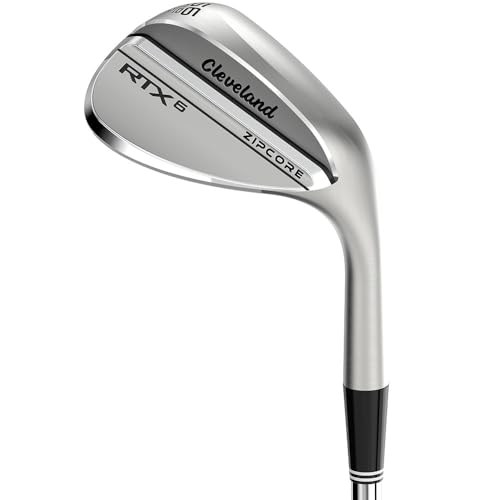
Cleveland Golf RTX 6 ZipCore 52° Wedge
Cleveland's RTX 6 ZipCore wedge combines an evolved low-density core with enhanced groove technology to deliver improved spin and consistency across green-side shots. The 52-degree loft makes it a versatile mid-range option for players seeking better control in the scoring zone.
Pros
- Significantly increased ZipCore material improves spin, distance, and feel
- Enhanced groove design channels debris better for shot consistency
- Reduced glare finish improves visual alignment at address
- Higher MOI adds forgiveness on off-center strikes
- Versatile 52-degree loft bridges approach and full-swing gaps
Cons
- No verified buyer reviews available to assess real-world performance claims
- Premium positioning suggests higher price point compared to previous RTX generations
- Tour-focused design may appeal more to skilled golfers than high-handicap players
Cleveland Golf RTZ 56 Degree Sand Wedge
Cleveland's RTZ 56-degree wedge combines Z-Alloy steel with advanced grooming tech (HydraZip, UltiZip) designed to deliver consistent spin in wet and challenging conditions. The ZipCore technology shifts weight strategically for improved forgiveness and feel across varied lies.
Pros
- Z-Alloy steel offers softer feel and better durability than traditional wedge materials
- HydraZip system maximizes spin performance in wet conditions through dynamic groove configuration
- UltiZip grooves cut through grass and debris for consistent contact from fairway, rough, or bunker
- ZipCore low-density core improves center of gravity placement and increases MOI for forgiveness
- Rust-resistant properties support long-term performance maintenance
Cons
- No verified buyer reviews available to assess real-world performance consistency
- 4.4 rating lacks sufficient review volume to validate claimed spin and forgiveness benefits
- Premium positioning may not justify cost difference versus standard wedge alternatives without verified user feedback
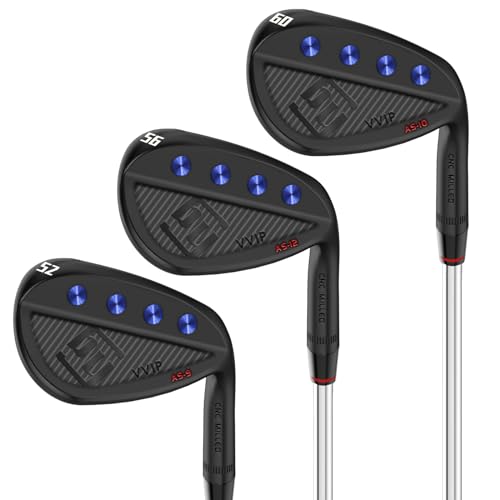
Yamato Forged Wedge Set 52/56/60 Degree
Yamato's forged wedge set features full-face grooves designed to maximize spin and forgiveness across all three lofts. The stainless steel construction targets golfers seeking consistent distance control and improved short-game accuracy.
Pros
- Aggressive full-face grooves extend across entire clubface for enhanced spin
- Forged premium materials built to withstand regular use
- Leading edge design helps reduce fat shots on mishits
- Complete three-loft set eliminates need for separate purchases
Cons
- No verified buyer reviews available to confirm real-world performance
- Premium pricing may not be justified without independent testing data
- Limited information on feel and feedback compared to competitor wedge sets
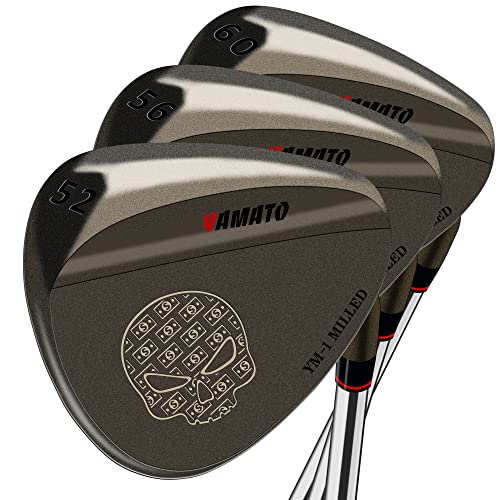
Yamato Forged Wedge Set 52/56/60 Degree
Yamato's forged carbon steel wedges feature wave scoring lines and a face blast design aimed at maximizing spin and control for short game shots. The set comes in tarnish or chrome finishes and targets golfers seeking versatility across chip, pitch, and bunker play.
Pros
- Wave scoring lines and face blast technology target improved spin and stopping power
- Forged carbon steel provides solid feel and feedback through impact
- Two finish options (chrome and tarnish) cater to different aesthetic preferences
- Three-piece set covers gap, sand, and lob wedge angles
- Tour-inspired design appeals to golfers seeking traditional wedge profiles
Cons
- No verified buyer reviews available to assess real-world performance or durability
- Tarnish finish durability claims lack independent verification
- Limited information on how wave scoring compares to competing wedge technologies
Tour Edge Hot Launch VibRCor 3 Wedge Pack
A three-wedge set (gap, sand, lob) designed with a beveled leading edge and cambered sole to reduce digging and improve turf interaction across different lies. USGA-maximum CNC grooves and centralized face weighting aim to deliver spin control and forgiveness for golfers of all levels.
Pros
- Beveled leading edge and cambered sole design helps players escape tough lies and bunkers
- USGA-maximum CNC grooves provide consistent spin and control around the greens
- Centralized weighting in upper face area maintains control on off-center strikes
- Versatile three-wedge configuration covers multiple approach shot distances
Cons
- No verified user reviews available to validate real-world performance claims
- Limited specifications provided on individual lofts and bounce angles for each wedge
- Beveled leading edge design may not suit golfers who prefer traditional wedge geometry
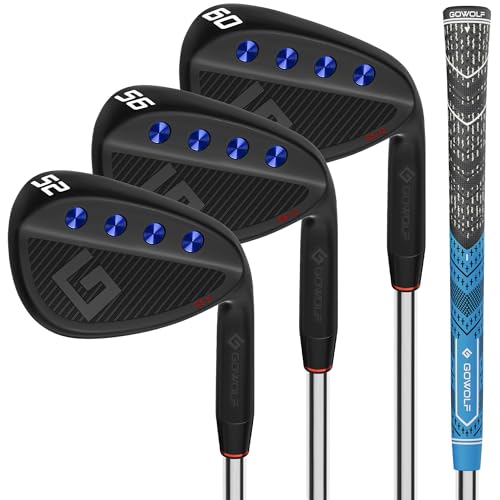
Gowolf 52/56/60 Wedge Set
A three-wedge set featuring full-face grooves and forged construction aimed at delivering spin and forgiveness across gap, sand, and lob shots. Designed as a budget-friendly alternative to premium brands, these clubs suit golfers from beginners to intermediate players seeking consistent performance.
Pros
- Full-face grooves deliver consistent spin across the entire clubface
- Forgiving design with leading edge that reduces fat shots
- Micro-milled faces support various skill levels
- Offers multiple loft options to customize your wedge setup
Cons
- No verified buyer reviews available to assess real-world performance
- Limited information on distance consistency between the three lofts
- Blade-style design may not suit players preferring cavity-back forgiveness
Golf Wedges Buying Guide
Picking the right golf wedge is not simply a matter of choosing the highest loft on the shelf.
Loft, bounce, grind, shaft, and face construction all interact in ways that vary dramatically depending on your swing, your typical course conditions, and the shot shapes you actually need.
This guide walks through each of the five most important decision points so you can match a wedge to your real game rather than a marketing spec sheet.
If you are also building out the rest of your set, our breakdown of golf clubs for every level and budget covers irons, hybrids, and woods as a useful companion reference.
Loft and Distance Gapping
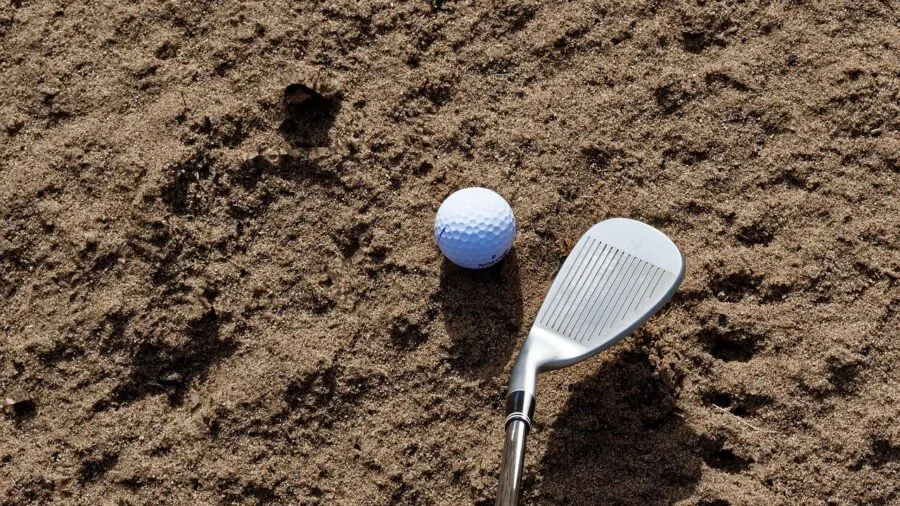
Most players need between two and four wedges to cover the distance range from their shortest iron down to a full lob shot.
A common mistake is buying wedges by loft number without first checking what loft their pitching wedge already plays.
If your pitching wedge is 45 degrees, jumping straight to a 56-degree sand wedge leaves a 20-degree gap that will produce a significant yardage hole at a critical scoring distance.
A well-gapped setup typically involves increments of four to six degrees between each wedge. Many golfers benefit from a 50 or 52-degree gap wedge, a 54 or 56-degree sand wedge, and a 58 or 60-degree lob wedge.
The sets from Yamato and Gowolf that appear in our list offer multiple loft combinations precisely to make this gapping exercise easier without buying each head individually.
For players who carry a full driver-to-wedge set, pairing loft selection with a review of drivers suited to every swing speed ensures the whole bag is dialed in, not just the short game.
Tour-level players often fine-tune gapping by one or two degrees using custom fitting, but recreational golfers can achieve excellent results by starting with a proven loft combination and adjusting based on actual carry distances on the course, not the range.
Bounce Angle and Sole Grind
Bounce is the angle between the leading edge and the trailing edge of the sole. It is arguably the most misunderstood spec in golf equipment.
A high-bounce wedge (12 degrees or more) prevents the leading edge from digging into soft turf or sand, which is why it suits players with steep, diggy swings and courses with fluffy bunker sand.
A low-bounce wedge (4 to 8 degrees) slides under the ball with minimal resistance, which benefits players with shallower swings and firm turf conditions.
Sole grinds take this a step further by removing material from specific areas of the sole to open or close the face without changing the effective bounce dramatically.
The Cleveland Golf RTX 6 Zipcore and the RTZ models in our lineup both offer purpose-specific grinds designed to help mid-handicap players execute a wider repertoire of shots without requiring a tour-level swing.
The TaylorMade HI-Toe 4 uses an extended-toe design that increases the usable face area, which makes it easier to open the face for flop shots without losing effective bounce support.
As a practical starting point: if you play most of your golf on parkland-style courses with soft turf and standard bunker sand, lean toward mid-to-high bounce options (10 to 14 degrees).
If you play links-style or desert courses with firm, tight lies, low bounce (6 to 8 degrees) will give you cleaner contact.
Face Construction and Spin Technology

Spin is what separates a wedge from a short iron, and face construction is the primary driver of spin generation. CNC-milled faces create precisely uniform micro-grooves that grip the ball at impact and impart backspin consistently across the face.
The Titleist Vokey SM10 is one of the most exhaustively engineered groove systems on the market, with groove geometry optimized by loft range to produce tour-calibre spin rates even from rough. Its 9.2 PF Score reflects that depth of refinement.
Budget-oriented options from Yamato and Gowolf also feature CNC milled faces, which is an impressive construction detail at their price point.
Expert review consensus notes that milled faces in this budget tier perform well for recreational players, though groove sharpness can degrade faster than on premium steel.
If you play frequently, inspect the face grooves annually and replace any wedge whose grooves have visibly rounded edges, as spin performance drops meaningfully before wear is obvious to the naked eye.
Full-face milled designs, such as the Yamato Full Face model and the Gowolf set, increase the high-spin hitting area significantly toward the toe and heel.
This is a meaningful advantage for players who do not always catch the ball out of the center of the face.
Forged vs. Cast Construction
Forged wedges are shaped from a single billet of soft carbon steel under high pressure, which produces a more homogeneous grain structure and is generally associated with a softer, more responsive feel at impact.
Tour professionals overwhelmingly play forged wedges for this reason. The Titleist Vokey SM10 and several Yamato models in this roundup are forged.
Cast wedges are formed by pouring molten metal into a mold, a process that allows for more complex sole geometries and cavity-back designs that push weight to the perimeter for forgiveness.
Cleveland Golf’s RTX series uses a ZipCore construction that combines a lightweight internal core with a denser outer body, which the brand’s published data shows increases low-CG performance and spin rate consistency compared to a traditional cast design.
For most golfers shooting above 90, the feel difference between forged and cast is subtle under real course conditions.
Prioritize the bounce and grind characteristics that suit your swing first, and treat forged feel as a secondary consideration unless you are a single-digit handicap player with a reliable ball-striking pattern.
Set vs.
Individual Wedge Purchase
Buying a pre-matched set of two or three wedges (typically 52/56/60 or 50/54/58) offers convenience and consistent aesthetics but limits customization.
Sets from Yamato and Gowolf are well suited to golfers rebuilding their short game on a budget, or beginners who want a coherent wedge system without the complexity of mixing and matching individual models.
Purchasing wedges individually gives you the freedom to mix grinds and bounces optimized for each loft, which is what most experienced players and tour professionals do.
You might pair a mid-bounce 52-degree gap wedge for full approach shots with a high-bounce 56-degree sand wedge tuned for soft bunkers, and add a low-bounce 60-degree lob wedge for tight chip shots off firm turf.
The Tour Edge Hot Launch Vibrcor 3-wedge pack occupies a middle ground, offering a matched trio with a focus on vibration-dampening technology that verified buyers consistently praise for comfort, particularly among golfers with wrist or elbow sensitivity.
Consider that trade-off carefully if feel and comfort during high-volume practice sessions matter to you.
Shaft, Grip, and Custom Fitting Considerations
Most stock wedges ship with a steel shaft in a weight between 115 and 130 grams, which is heavier and stiffer than typical iron shafts.
This extra weight is intentional: it promotes a smooth, controlled tempo on partial shots and dampens unwanted vibration.
Golfers who play graphite shafts throughout their irons should discuss wedge shaft options with a fitter before assuming the stock steel is appropriate, as the transition in feel and swing weight can affect consistency.
Grip size is often overlooked in wedge fitting. A grip that is too thick encourages a weaker grip pressure and can reduce the face rotation needed to hold shots on line.
Standard grips work well for most players, but golfers with larger hands may benefit from a mid-size grip specifically on their lob wedge to improve control on delicate chip shots.
If you are spending premium money on a Vokey SM10 or a TaylorMade HI-Toe 4, investing in even one session with a certified club fitter to verify loft, lie angle, and shaft flex is worthwhile.
Lie angle errors as small as two degrees can redirect short shots off line by several feet at short distances, undermining the precision these wedges are designed to deliver.
Why You Should Trust Us
ProductFind is an independent review publication. We do not accept payment from brands to influence rankings, and we have no financial relationship with any manufacturer featured in this guide.
We do not conduct our own product trials; our evaluations are grounded in research, published data, expert review consensus, and verified buyer feedback.
Every wedge in this roundup was assessed using a consistent PF Score framework on a scale of 0 to 10.
Criteria evaluated include face and sole engineering, construction quality, spin and feel performance data drawn from manufacturer specifications and published clubfitting research, expert review consensus from golf equipment specialists, and the volume and content of verified buyer feedback from confirmed purchasers across multiple retail channels.
No single data point determines a score; we look for agreement across multiple independent signals before assigning a final rating.
ProductFind may earn a commission when you purchase through links on this page. That affiliate relationship has no bearing on which products are included, how they are ranked, or what PF Score they receive.
Our editorial decisions are made independently of commercial considerations, and our recommendations would be identical with or without affiliate income.
Final Thoughts
After researching and scoring every model in this guide, a clear hierarchy emerges across price tiers and player types. Here are our editorial awards based on each product’s PF Score and real-world attributes.
- Best Overall: Titleist Vokey SM10 Gap Wedge earns our top spot with the highest PF Score in the roundup, reflecting an unmatched combination of groove engineering, grind variety, and tour-validated performance data that consistently places it among the most recommended wedges in expert consensus.
- Best for Versatility and Shot-Shaping: TaylorMade Golf HI-Toe 4 Wedge stands out for its extended-toe face design, which increases the usable spin surface and makes it easier to play open-faced flop shots without sacrificing effective bounce support, earning it the second-highest PF Score in our group.
- Best for Mid-Handicap Players: Cleveland Golf RTX 6 Zipcore Wedge combines a precision sole grind, ZipCore low-CG construction, and one of the strongest expert approval ratings in its tier, making it an outstanding choice for players who want tour-inspired engineering without paying a top-tier premium.
- Best Budget Set: Yamato Full Face Forged Golf Wedge Set delivers forged construction and a full-face milled design at a budget-friendly price, making it a compelling option for recreational golfers who want real short-game performance without the cost of individual premium heads.
- Best for Comfort-Conscious Golfers: Tour Edge Hot Launch Vibrcor 3 Wedge Pack is built around vibration-dampening technology that verified buyers with wrist and elbow sensitivity specifically praise, offering a complete three-wedge solution at an accessible price point.
Whichever wedge you choose, remember that even the best-rated model on our list will underperform if the bounce, grind, and loft gaps do not match your swing and course conditions.
Use the buying guide above to narrow your selection, and revisit your wedge setup each season as your swing evolves.
Frequently Asked Questions
How Many Wedges Should I Carry?
Most recreational golfers perform best with three wedges covering a gap wedge around 50 to 52 degrees, a sand wedge around 54 to 56 degrees, and a lob wedge around 58 to 60 degrees.
This configuration fills the distance range from a short iron down to a full lob shot without exceeding the 14-club limit.
Better players sometimes carry four wedges by adding a second sand wedge in a different grind, but three is the practical sweet spot for the majority of golfers.
What Is the Difference Between a Sand Wedge and a Lob Wedge?
A sand wedge typically plays between 54 and 56 degrees of loft and is designed with enough bounce to slide through bunker sand without digging.
A lob wedge runs from 58 to 64 degrees and is built for high-trajectory, short-distance shots that stop quickly, such as clearing a bunker lip from close range or landing a chip softly on a tight green.
Most golfers should be comfortable with the sand wedge before adding a lob wedge to the bag, as the higher loft requires more precise contact.
How Often Should I Replace My Wedges?
Published clubfitting research and manufacturer guidance generally suggest that groove performance in frequently used wedges degrades noticeably after 75 to 100 rounds of play.
For golfers playing two or more rounds per week, annual wedge replacement of at least the most-used lofts (typically the sand and lob wedge) is a reasonable baseline.
Inspecting the grooves visually under bright light can help: if the groove edges appear rounded rather than sharp, spin generation has already declined meaningfully.
Budget-tier wedges with thinner face steel may reach this wear threshold faster than premium forged options, which is one reason the cost-per-round calculation sometimes favors a more durable mid-range or premium wedge over replacing a cheap model every season.
Is a High-Bounce Wedge Always Better for Bunker Play?
High bounce is beneficial for standard, fluffy bunker sand, but not universally superior.
On courses with firm, compacted sand (common in links-style or drought-prone climates), a high-bounce sole can skip off the surface rather than sliding under the ball, leading to thin contact.
In those conditions, a mid-bounce wedge with an appropriate grind gives you more consistent results.
The best approach is to know the typical sand conditions where you play most often and choose bounce accordingly, rather than defaulting to the highest bounce number available.
Can Beginner Golfers Benefit from Premium Wedges?
Yes, with an important caveat. Premium wedges like the Titleist Vokey SM10 reward consistent ball-striking with exceptional spin and feel, but they do not compensate for fundamental swing errors.
A beginner whose technique is still developing will see less performance difference between a premium and a budget wedge than an experienced player will.
For new golfers, a forgiving milled-face set from Yamato or Gowolf offers solid real-world performance at a fraction of the price, and the money saved can go toward instruction, which delivers more measurable improvement at that stage.
Once your short game fundamentals are solid, upgrading to a tour-level wedge becomes genuinely worthwhile.
About the author
Bernard is a reviewer and writer for ProductFind who specializes in Golf. Bernard evaluates products through independent research: specifications, expert review consensus, and verified buyer feedback, and rates each one on the PF Score. Bernard focuses on helping readers pick the right golf for their needs and budget.