The 10 Best Automatic Fish Feeders
Vacation coming up or just tired of missing feedings? These automatic fish feeders keep your aquarium on schedule with reliable portions, moisture-proof drums, and options from nano tanks to full koi ponds.
 By John Mcdonalid
Updated July 23, 2026
By John Mcdonalid
Updated July 23, 2026
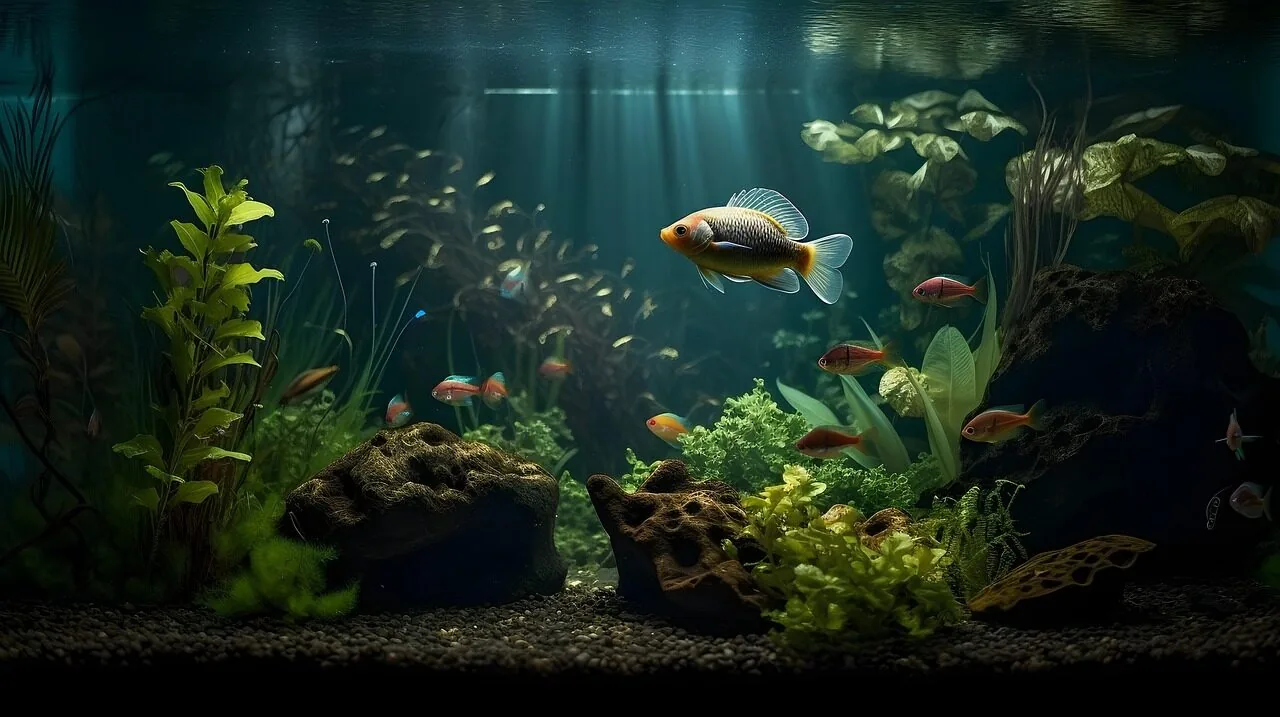
Keeping your fish on a consistent feeding schedule is one of the most important factors in maintaining a healthy aquarium, yet it’s also one of the easiest things to neglect during busy weeks or vacation travel.
An automatic fish feeder removes the guesswork, delivers precise portions at programmed intervals, and can mean the difference between a thriving tank and a stressful return home to cloudy water.
Whether you keep a compact betta setup, a large community aquarium, or an outdoor koi pond, there is a purpose-built feeder designed to match your needs and your budget.
Our team at ProductFind researched the full market for automatic fish feeders, synthesizing manufacturer specifications, expert review consensus across the aquarium hobby community, and verified buyer feedback from thousands of confirmed purchases.
The result is a focused shortlist of the top picks across price points and use cases, from affordable rechargeable dispensers to premium WiFi-connected units you can control from your phone.
Read on to see which feeders earned a place on our list.
| Award | Product | PF Score About PF ScoreThe PF Score is our own rating from 0 to 10, based on performance, design and build, ease of use, and value. It reflects independent research and is never influenced by manufacturers, retailers, or affiliate commissions. Learn more › | Price | |
|---|---|---|---|---|
| Best Overall |
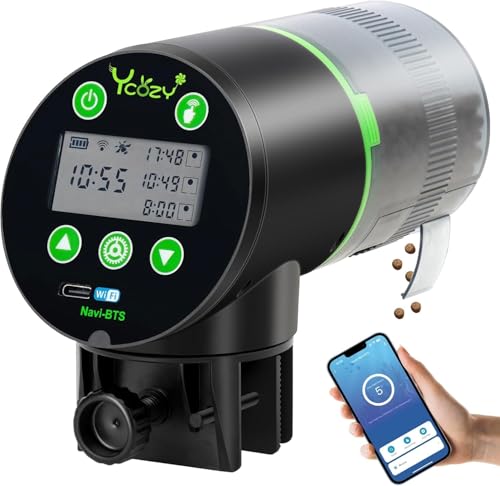 Ycozy WiFi Automatic Fish Feeder with App Control
|
8.3/10 | Buy | |
| Editor's Pick |
 Pond Guy KoiGrower 5-Gallon Automatic Fish Feeder
|
8.1/10 | Buy | |
| Best Value |
 EHEIM Everyday Programmable Automatic Fish Feeder
|
7.5/10 | Buy | |
| Top Rated |
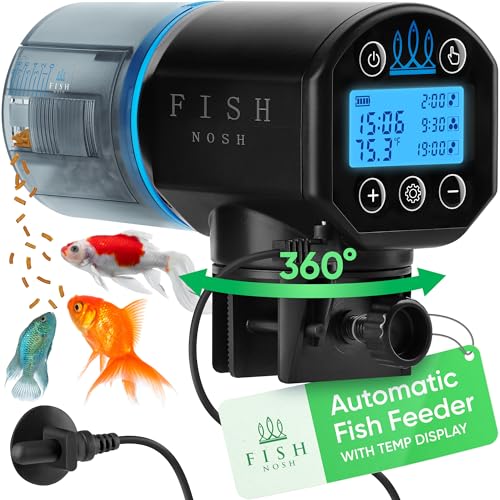 FISHNOSH Automatic Fish Feeder with Digital Thermometer
|
7.4/10 | Buy | |
 Fishkeeper 16-Grid Automatic Fish Feeder
|
7.2/10 | Buy | ||
 AQQA 200ML Automatic Fish Feeder with LCD Timer
|
6.6/10 | Buy | ||
 AQQA 200ML Automatic Aquarium Feeder with LCD Timer
|
6.5/10 | Buy | ||
 FISHNOSH ML Automatic Fish Feeder
|
6.4/10 | Buy | ||
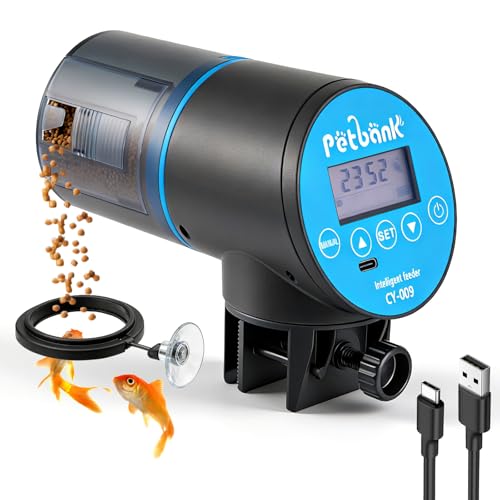 Petbank Automatic Fish Feeder, 200ml USB Rechargeable
|
6.3/10 | Buy | ||
 DXOPHIEX Automatic Fish Feeder with Dual Power
|
6.2/10 | Buy |
Ycozy WiFi Automatic Fish Feeder with App Control
WiFi-enabled automatic feeder lets you schedule and monitor feeding remotely via smartphone app, with 15 adjustable portion levels to prevent overfeeding. Requires constant power connection and 2.4GHz WiFi for stable operation.
Pros
- App-based scheduling and remote control from anywhere, with automatic feeding data records
- 15 adjustable levels allow fine control over portion sizes to match different fish species and tank sizes
- Dual installation options (adjustable clamp with 360-degree rotation or acrylic tape) accommodate various tank setups
- Sends offline notifications when power disconnects and auto-resumes upon restoration
- Accepts variety of food formats without requiring bucket removal for refilling
Cons
- Requires constant power supply to function; loss of electricity stops all feeding cycles until reconnection
- Only compatible with 2.4GHz WiFi networks; dual-band routers need manual configuration, which complicates initial setup
- No customer reviews available to verify real-world reliability and durability claims
Pond Guy KoiGrower 5-Gallon Automatic Fish Feeder
Solar and battery-powered automatic feeder designed for koi and goldfish with customizable schedules and a 5-gallon capacity. Built-in moisture control and animal-proof locking lid keep food fresh and secure, ideal for pond owners who travel or prefer hands-off feeding.
Pros
- Multi-modal power ensures reliable feeding even during power outages or cloudy days
- Animal-proof design protects feed from wildlife and weather damage
- Large 5-gallon capacity reduces refilling frequency
- Moisture-wicking desiccant system prevents feed degradation and mechanical jams
- Customizable schedules allow flexibility for vacation or daily automation
Cons
- No verified customer reviews available to assess real-world reliability and long-term durability
- 4.6 rating lacks review context, making it difficult to evaluate user satisfaction or common issues
- Requires pellet size within 3-10mm range, limiting food compatibility
EHEIM Everyday Programmable Automatic Fish Feeder
This programmable feeder automates daily fish feeding with minimal setup, ideal for aquarists who travel or prefer consistent feeding schedules. An integrated fan system protects food from moisture, though the lack of verified buyer feedback limits confidence in real-world reliability.
Pros
- Programmable scheduling for consistent, worry-free daily feeding
- Integrated fan and ventilation keeps food dry and fresh
- Compact design fits most aquarium setups at 2.5 x 2.5 x 5.5 inches
- Easy setup with included quick-start guide
- Suitable for both regular home use and extended absences
Cons
- No verified customer reviews available to assess long-term durability or performance reliability
- Limited information on portion control accuracy or feeder capacity
- Unclear compatibility details with different fish food types and sizes
FISHNOSH Automatic Fish Feeder with Digital Thermometer
This programmable feeder handles up to 3 daily feeding sessions with adjustable portion sizes and includes a built-in thermometer with temperature alerts. Best suited for aquarists seeking automated feeding while traveling or managing multiple tanks without daily intervention.
Pros
- Includes temperature monitoring with audible alerts to protect fish health
- Adjustable portion sizes via dual feeding windows accommodate different food types
- Programmable schedule flexibility for vacation use or daily automation
- Compact form factor doesn't disrupt tank aesthetics
Cons
- No verified customer reviews available to assess real-world reliability
- Limited to 3 daily feedings, which may not suit species requiring more frequent feeding
- Relatively small capacity suggests frequent refilling for larger tanks
Fishkeeper 16-Grid Automatic Fish Feeder
This rechargeable automatic feeder uses 16 compartments to dispense up to 15 separate meals daily, with preset or customizable timer modes and an 800mAh battery lasting up to 100 days. It's designed for small pellets and powder foods (0.1-4mm) with moisture-proof storage, making it practical for vacation feeding and routine scheduling.
Pros
- Large capacity battery eliminates daily charging and provides backup during outages
- Sealed compartments prevent moisture damage to stored food
- Flexible timer options accommodate different feeding schedules without resetting after power loss
- Multiple mounting methods work with various tank configurations and thicknesses up to 0.59 inches
Cons
- Not suitable for flake foods or shrimp, limiting food variety options
- Power-loss memory only works if battery retains charge; fully depleted battery requires schedule reset
- No customer reviews available to assess real-world reliability or longevity
AQQA 200ML Automatic Fish Feeder with LCD Timer
Cord-free automatic feeder with 200ML capacity and programmable LCD timer offering three feeding modes, from instant feed to up to 9 daily portions. Designed for small tanks and large aquariums with moisture-locking lid and silent motor operation.
Pros
- Three flexible feeding modes: instant feed, twice-daily auto (8:00 & 20:00), and multi-feed up to 9 times daily
- 200ML high-capacity design accommodates multiple fish food types including flakes, pellets, and strips
- Moisture-sealing lid blocks 95% humidity to keep food dry and prevent clumping
- Silent, vibration-free motor won't disturb sleep or stress fish
- Runs on 2 AA batteries for cord-free operation, suitable for 7-14 day vacations
Cons
- No verified customer reviews available to confirm real-world reliability
- Compact size may limit mounting flexibility on certain tank configurations
- Portion control dial adjustment requires trial and error to dial in exact portions for different fish species
AQQA 200ML Automatic Aquarium Feeder with LCD Timer
This automatic feeder offers three feeding modes (manual, timed twice-daily, and up to 9x daily) with portion control suited for various fish types. Its moisture-proof lid and quiet operation make it practical for most aquarium setups, though the lack of verified reviews limits confidence in real-world durability.
Pros
- Multiple feeding mode options accommodate different schedules and vacation needs
- Portion control dial allows precise adjustments for various fish types
- Sealed moisture-proof design prevents food degradation and caking
- Quiet operation minimizes disturbance to fish and household
Cons
- No verified buyer reviews available to confirm long-term reliability or motor durability
- Limited specification details on motor lifespan, power source type, or battery capacity
- Compact design may require frequent refilling for large aquariums with multiple fish
FISHNOSH ML Automatic Fish Feeder
A straightforward automatic feeder that handles up to 3 daily feedings for small to large aquariums without requiring complex setup. Best suited for travelers and busy owners who need reliable, hands-off feeding for flakes or pellets.
Pros
- Simple, user-friendly design that avoids overcomplicated controls
- Versatile compatibility with different tank sizes and food types
- Convenient for extended absences or consistent daily feeding schedules
- Refill window and spare components included for easy maintenance
Cons
- No display screen limits visibility into current settings or feeding status
- Limited to 1 round per feeding, offering less granular control than some competitors
- Zero verified customer reviews available to assess real-world reliability
Petbank Automatic Fish Feeder, 200ml USB Rechargeable
Petbank's rechargeable auto feeder holds 200ml and supports up to 4 daily feeding schedules with 1-3 pellets per session, ideal for weekend getaways or routine feeding. Long battery life spans 3-6 months per charge, though no verified buyer feedback is available yet to confirm real-world performance.
Pros
- USB charging eliminates repeated battery purchases and reduces waste
- Large 200ml capacity minimizes frequent refilling for vacation use
- Flexible scheduling with up to 4 daily feeding times and manual feed option
- Extended battery life of 3-6 months per charge supports extended travel
Cons
- No verified buyer reviews available, so durability and reliability claims cannot be independently confirmed
- Requires 10-hour initial charge to reach full voltage, limiting quick setup
- LCD interface and programming complexity not detailed in specifications
DXOPHIEX Automatic Fish Feeder with Dual Power
Dual-power automatic feeder designed for aquariums and turtle tanks, offering flexible feeding schedules every 8, 12, or 24 hours plus manual override. Includes two container sizes and dual mounting options for different tank setups.
Pros
- Two mounting options accommodate different tank configurations
- Hybrid power system ensures continuous operation if one source fails
- Adjustable feeding volume for portion control
- Includes two container sizes for flexibility
Cons
- Batteries not included, adding ongoing operational costs
- No verified buyer reviews available to assess real-world reliability
- USB cable length (6.6 feet) may limit placement options for some tank setups
Automatic Fish Feeders Buying Guide
Choosing the right automatic fish feeder comes down to matching the feeder’s design and feature set to your specific tank size, fish species, and lifestyle.
A feeder that works perfectly for a weekend trip might fall short during a two-week vacation, and a unit sized for a nano tank will struggle to keep up with a large koi pond.
The subsections below cover the criteria that matter most, so you can narrow down the field quickly and confidently.
Power Source and Reliability
Power source is the single most important reliability factor for any automatic feeder. Battery-operated models offer the broadest placement flexibility and will keep functioning even during a brief power outage, which is reassuring when you are away from home.
The tradeoff is that batteries can drain unpredictably, especially in humid environments near the waterline, so look for units that display a low-battery warning before service is interrupted.
USB rechargeable feeders have become increasingly popular at the budget end of the market because they eliminate the need to stock replacement batteries and often include a visible charge indicator on their LCD screens.
Plug-in models, such as the Ycozy WiFi feeder, draw constant power and are a strong choice for permanent setups where an outlet is already nearby.
For large outdoor installations like a koi pond, dedicated pond feeders such as the Pond Guy KoiGrower are engineered for weather exposure and extended autonomy in ways that indoor units simply are not.
Whatever power source you choose, always verify that the feeder has some form of backup memory so that your programmed schedule survives a power interruption.
A memory-retention feature, sometimes labeled “memory function” on product listings, prevents the unit from reverting to factory defaults every time the battery is swapped or a breaker trips.
Hopper Capacity and Food Compatibility
Hopper capacity determines how long you can leave a feeder unattended before refilling.
Most compact aquarium feeders in the budget-to-mid range offer hoppers in the 50 ml to 200 ml range, which is sufficient for one to four fish over a one- to two-week vacation if portions are calibrated correctly.
The AQQA large-capacity model, for instance, advertises a 200 ml drum, making it a better choice for longer absences or tanks with more mouths to feed.
Equally important is food compatibility. Most drum-style feeders handle standard pellets and granules well, but flakes can clump or jam the dispensing drum, especially in humid climates.
Look for moisture-proof or sealed drum designs if you keep your tank in a warm or steamy room.
Larger hopper openings accommodate bigger pellet sizes used for koi and goldfish, while smaller openings work best for micro pellets used with betta fish and other nano species.
Always check the manufacturer’s stated compatible food types before purchasing, particularly if you feed specialized diets like freeze-dried bloodworms or gel foods.
For outdoor pond feeding, capacity requirements scale dramatically.
The Pond Guy KoiGrower holds up to five gallons of food and is designed to feed large koi populations autonomously over extended periods, a fundamentally different class of product from its aquarium-oriented counterparts.
Pairing a high-capacity feeder with a well-chosen aquarium filtration system reduces the risk of water quality issues from uneaten food settling in the tank.
Scheduling Flexibility and Portion Control
The best automatic fish feeders allow you to set multiple feeding times per day, typically between two and six, and to adjust portion size independently for each scheduled feed.
This granularity matters because overfeeding is a leading cause of poor water quality in home aquariums. A feeder that only offers a single daily feed or a fixed portion size is a compromise, not a convenience.
Most mid-range models use a rotating drum with an adjustable opening size to control how much food drops per cycle.
The FISHNOSH models in this roundup both include digital timers with programmable schedules, and the version with an integrated digital thermometer adds at-a-glance water temperature monitoring alongside feeding data, a genuinely useful combination for aquarists who track tank parameters closely.
At the premium end, WiFi-connected feeders like the Ycozy open up remote scheduling via a smartphone app, letting you adjust feeding times, skip a meal, or trigger a manual feed from anywhere with a signal.
This level of control is particularly valuable when your travel plans change unexpectedly and you need to modify the feeding routine without asking a neighbor to intervene.
Moisture Protection and Build Quality

Aquarium environments are inherently humid, and moisture is the primary enemy of any feeder’s drum mechanism and electronic components. Food that absorbs moisture clumps together inside the drum, which can jam the dispensing mechanism entirely and leave your fish unfed.
Budget models without adequate sealing are particularly susceptible to this failure mode, which is why moisture-proof drum construction has become a key marketing claim across the category.
When evaluating build quality, look for tight-fitting drum lids, sealed electronics housings, and mounting clamps that attach securely to a variety of tank frame thicknesses.
A feeder that wobbles or sits at an angle will dispense food unevenly, potentially dropping it outside the water entirely.
The AQQA models in this roundup specifically highlight moisture-proof construction as a core feature, which aligns with verified buyer feedback noting consistent performance over extended use periods.
Build quality also extends to the mounting system. A well-designed clamp mechanism should accommodate both rimmed and rimless tanks without requiring additional hardware.
If you are setting up a new aquarium, it is worth thinking about the full ecosystem of accessories together: a sturdy aquarium tank with a stable rim makes mounting any automatic feeder significantly easier and more secure.
Display, Controls, and Ease of Setup
An LCD display is no longer a premium-only feature. Several models in the budget-to-mid tier now include backlit screens showing current time, scheduled feeding times, and battery or charge status.
This transparency is genuinely useful: you can confirm at a glance that the schedule is set correctly before leaving for a trip, rather than hoping the feeder remembered your settings.
Button layout and menu logic vary considerably between brands. Some units require cycling through multiple menus to adjust a single feeding time, while others use a more intuitive interface that new users can navigate without consulting the manual.
Verified buyer feedback consistently highlights programming difficulty as a pain point for certain models, so it is worth reading recent owner reviews focused specifically on setup experience rather than just overall satisfaction scores.
WiFi-enabled feeders shift setup complexity from the physical unit to a companion app. The Ycozy, for example, uses a smartphone interface that removes the need to navigate button menus entirely once the initial pairing is complete.
For less tech-savvy users, however, app dependency can introduce its own friction, particularly if the app requires an account, frequent updates, or a stable home network to maintain the connection.
Consider your comfort level with app-based control before paying the premium for a connected model.
Tank Size and Species Suitability
Not every feeder fits every tank. Nano tanks under ten gallons are best served by compact feeders with small drum openings and fine portion control, since even a slight overfeeding can destabilize water chemistry rapidly in a small volume.
The fishkeeper rechargeable model and the Petbank LCD feeder are both sized and priced appropriately for smaller setups and single-species tanks like betta or turtle habitats.
Larger community tanks with multiple species at different depth levels may benefit from feeders that can be programmed for multiple daily meals to replicate the natural foraging behavior of omnivorous fish.
For tanks above fifty gallons, higher-capacity drums and sturdier clamp systems become more important to ensure consistent coverage of the water surface. Outdoor pond feeders operate on a completely different scale and are not interchangeable with indoor aquarium units.
Species-specific dietary needs also influence feeder selection. Carnivorous species like oscars or cichlids that eat larger pellets need wider drum openings than betta fish that eat micro pellets.
Always cross-reference the feeder’s stated food size compatibility with the actual feed you use, rather than assuming any drum-style feeder will handle any food type.
Why You Should Trust Us
ProductFind is an independent review publication. We do not sell products, fulfill orders, or have any relationship with retailers beyond standard affiliate arrangements.
Every product on this list was evaluated through a structured research process covering manufacturer specifications, expert review consensus from the aquarium hobby community, and verified buyer feedback drawn from thousands of confirmed purchases across major retail platforms.
We do not conduct our own product trials; our evaluations are grounded in research, published data, expert review consensus, and verified buyer feedback.
Each product is scored using our PF Score system on a consistent 0 to 10 scale. The scoring criteria for automatic fish feeders weight reliability and moisture resistance heavily, alongside scheduling flexibility, ease of setup, and value relative to features.
Products are ranked by PF Score, with the highest-scoring option listed first. Scores reflect our assessment at the time of research and may be updated as new models enter the market or as sustained buyer feedback shifts the consensus picture.
ProductFind may earn a commission if you purchase through a link on this page. That affiliate relationship has no bearing on which products are included, how they are ranked, or what scores they receive.
Our editorial recommendations are made independently, and no brand has paid for placement or a higher score. If a product’s score drops based on updated research, it moves down the list accordingly.
Final Thoughts
The automatic fish feeder market covers a genuinely wide range of needs, from simple battery-operated dispensers for weekend trips to app-connected, plug-powered units designed for permanent use by serious hobbyists.
After synthesizing specifications, expert consensus, and verified buyer feedback across all ten models in this roundup, a few clear standouts emerge for different buyer profiles.
- Best Overall: Ycozy WiFi Automatic Fish Feeder earns the top spot with its combination of remote app control, reliable plug-in power, and broad compatibility with small tanks, betta setups, and turtle enclosures, making it the most versatile and connected option in the group.
- Best for Large Ponds: The Pond Guy KoiGrower is the only purpose-built pond feeder in this roundup, and its five-gallon capacity and durable construction put it in a category of its own for koi and large outdoor fish populations.
- Best Established Brand: EHEIM Everyday Fish Feeder has been a trusted name in the aquarium hobby for decades, and its programmable timer and consistent dispensing mechanism reflect years of refinement that newer entrants have yet to match.
- Best Budget Pick with Thermometer: FISHNOSH Auto Fish Food Dispenser with Digital Thermometer adds genuinely useful water temperature monitoring to an already capable feeder at a mid-range price, making it a smart buy for data-conscious aquarists on a tighter budget.
- Best for Vacation Use: fishkeeper Rechargeable Automatic Fish Feeder combines a moisture-proof design, rechargeable battery, and memory function that retains your schedule through power interruptions, precisely the reliability profile you want when you cannot monitor the tank yourself.
Whichever model you choose, pairing your feeder with a quality filtration setup is the single best way to protect water quality between your visits. A well-filtered tank is far more forgiving of minor overfeeding events than one running on an undersized or aging filter.
Frequently Asked Questions
How Many Times a Day Should an Automatic Fish Feeder Dispense Food?
Most freshwater community fish thrive on two to three feedings per day, while betta fish typically do well with one to two smaller meals.
Overfeeding is a more common problem than underfeeding in home aquariums, and uneaten food that sinks to the substrate breaks down quickly and degrades water quality.
Set your feeder to dispense small portions at consistent intervals rather than one large meal per day, and observe your fish for a week after initial setup to dial in the correct portion size for your specific tank and stocking level.
Can Automatic Fish Feeders Handle Flake Food?
Some can, but flake food is the most problematic food type for drum-style feeders. Flakes absorb ambient moisture rapidly, causing them to clump and jam the dispensing mechanism.
If you feed flakes, prioritize models with moisture-proof drum seals and consider crushing the flakes into smaller pieces before loading them into the hopper.
Pellets and granules of appropriate size for your fish are generally more reliable across all feeder types, and many experienced aquarists switch to a pelleted diet specifically to improve feeder compatibility.
Do WiFi Fish Feeders Work Without an Internet Connection?
This depends on the specific model and app architecture.
Most WiFi feeders, including the Ycozy, store the programmed feeding schedule onboard the device itself, meaning the feeder will continue to dispense food on schedule even if your home network goes down or the app loses connectivity.
However, remote control features such as triggering a manual feed or adjusting the schedule from your phone will not work without an active connection.
Before relying on a WiFi feeder for an extended absence, always confirm that the schedule is saved locally on the device and not solely dependent on a cloud connection.
How Do I Prevent My Automatic Feeder from Jamming?
Jamming is most often caused by moisture entering the food hopper or by loading food incompatible with the drum’s opening size.
To minimize the risk, choose a feeder with a sealed or moisture-resistant drum design, keep the hopper only as full as needed for the trip duration, and store spare food in an airtight container away from the tank.
Clean the drum and dispensing port regularly with a dry cloth or small brush to remove food dust and residue that can compact over time.
Some hobbyists also add a small food-safe desiccant packet inside the hopper during extended absences to absorb excess humidity, though this approach should be verified as safe for your specific feeder before trying it.
Are Automatic Fish Feeders Safe for Betta Fish?
Yes, provided you choose a model with fine portion control and use betta-appropriate micro pellets rather than large granules.
Bettas are susceptible to overfeeding and constipation, so setting the feeder to dispense a minimal amount once or twice daily is preferable to larger, less frequent meals.
Several models in this roundup, including the fishkeeper rechargeable feeder and the Petbank LCD unit, are specifically marketed for betta and small tank use, reflecting verified buyer feedback from the betta community.
If you also use a smart plug to control tank lighting on a schedule, combining it with an automatic feeder creates a largely automated daily routine for your betta’s environment.
What Is the Best Way to Set Up an Automatic Fish Feeder Before a Vacation?
Install and program the feeder at least one week before your departure so you can observe several full feeding cycles in person.
Watch where the food lands in the tank, confirm all your fish are finding and eating it, and adjust the drum opening and schedule as needed.
Verify that the power source (battery charge or wall connection) is stable, and double-check that any memory-retention feature is active so the schedule survives a potential power blip while you are away.
It is also worth doing a water change and filter maintenance immediately before leaving, since a clean tank with a well-maintained filtration system provides the widest safety margin during your absence.
About the author
John is a reviewer and writer for ProductFind who specializes in Fish & Aquariums. John evaluates products through independent research: specifications, expert review consensus, and verified buyer feedback, and rates each one on the PF Score. John focuses on helping readers pick the right fish & aquarium for their needs and budget.