The 8 Best Dog Training Collars
Choosing a dog training collar means matching collar type, range, and stimulation control to your dog's size and your training goals. Here are the top picks across every category.
 By Meghan Fernandez
Updated July 23, 2026
By Meghan Fernandez
Updated July 23, 2026

Finding the right dog training collar can make a meaningful difference in how effectively you communicate with your dog, whether you’re working on basic obedience, off-leash recall, or correcting persistent problem behaviors.
The market is crowded with options spanning remote e-collars, prong collars, vibration-only models, and multi-dog systems, each suited to different training philosophies, dog sizes, and handler experience levels.
Getting this choice wrong doesn’t just waste money; it can set back your training progress or, in the wrong hands, cause unnecessary stress for your dog.
To help you cut through the noise, our team at ProductFind researched and analyzed options across every major category of dog training collar, drawing on published specifications, expert trainer consensus, and verified buyer feedback from thousands of real owners.
The picks below represent the strongest performers at each price tier and use case. Scroll down for our top-ranked recommendations.
| Award | Product | PF Score About PF ScoreThe PF Score is our own rating from 0 to 10, based on performance, design and build, ease of use, and value. It reflects independent research and is never influenced by manufacturers, retailers, or affiliate commissions. Learn more › | Price | |
|---|---|---|---|---|
| Best Overall |
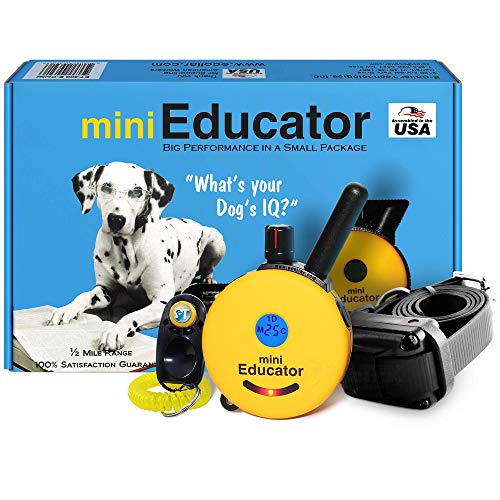 Educator ET-300 Electronic Training Collar, 1/2 Mile Range
|
8.2/10 | Buy | |
| Editor's Pick |
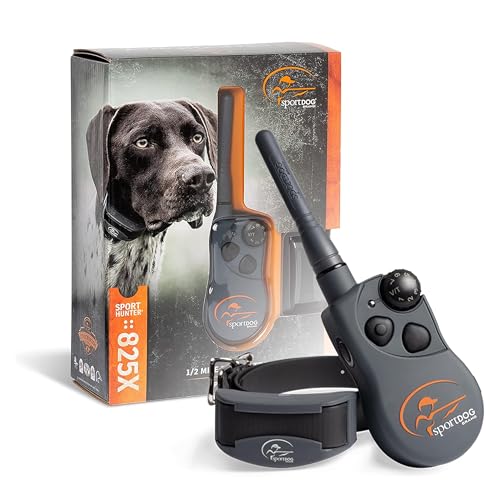 SportDOG SportHunter 825X Remote Dog Trainer
|
8.1/10 | Buy | |
| Best Value |
 Herm Sprenger Ultra-Plus 3.25mm Prong Collar
|
7.3/10 | Buy | |
| Top Rated |
 MariMoki Dual-Dog Training Collar, 4200FT Range
|
6.4/10 | Buy | |
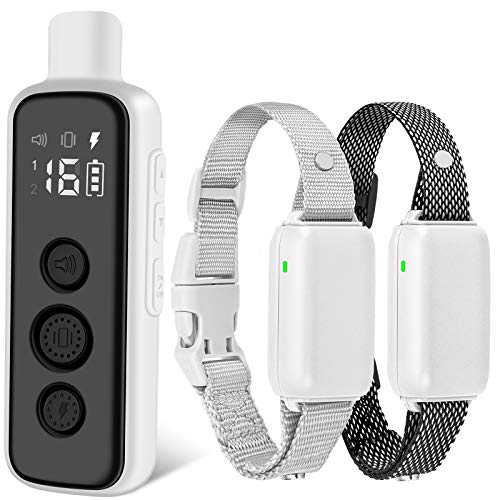 Bousnic Dual-Channel Dog Shock Collar, 1000FT Range
|
6.2/10 | Buy | ||
 HapTop 4500FT Dog Training Collar, Waterproof
|
6.1/10 | Buy | ||
 Aolulf 2-Dog Training Collar, 3300FT Range
|
5.9/10 | Buy | ||
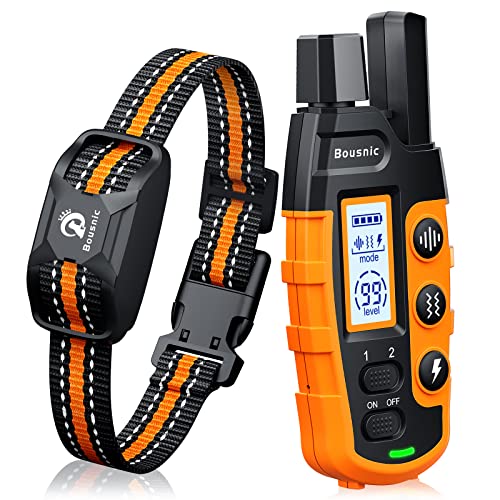 Bousnic Dog Training Collar 3300FT Range
|
5.8/10 | Buy |
Educator ET-300 Electronic Training Collar, 1/2 Mile Range
The Educator ET-300 is a waterproof e-collar system designed for dogs 15+ lbs, offering 100 stimulation levels with tone and vibration modes across a 1/2 mile range. It's built for trainers seeking precise control with expandable two-dog capability and built-in LED visibility for low-light sessions.
Pros
- Extensive 100-level stimulation range allows nuanced training adjustments for different dogs and behaviors
- Full waterproof protection up to 500 feet keeps both collar and remote functional in wet, muddy, or snowy conditions
- LED tracking light adds practical safety for evening and off-leash training sessions
- Two-dog expandability lets single users manage multiple dogs without purchasing separate systems
- Fast 2-hour recharge cycle minimizes downtime between training sessions
Cons
- 1/2 mile range is shorter than some premium competitors, limiting long-distance off-leash work
- No verified buyer reviews available on this data source, making real-world durability claims harder to validate
- Minimum 15 lb weight requirement excludes toy and small breed owners
SportDOG SportHunter 825X Remote Dog Trainer
The SportHunter 825X delivers half-mile range with 21 adjustable static levels, making it suited for field hunters and water work. Waterproof design and 50-70 hour battery life minimize interruptions during long training sessions.
Pros
- Extended range ideal for field hunters and dogs working in open terrain
- Waterproof submersible construction handles waterfowl and water blind training
- Battery efficiency means 50-70 hours of use per charge with quick 2-hour recharge
- Single-dial control for tone, vibration, and stimulation reduces complexity
- Expandable system allows training multiple dogs from one remote
Cons
- No customer reviews available to assess real-world durability and user satisfaction
- Add-A-Dog collars sold separately, adding cost for multi-dog households
- No feedback on how effectively the 21 stimulation levels differentiate in practical use
Herm Sprenger Ultra-Plus 3.25mm Prong Collar
German-made pinch collar with chrome plating and adjustable link design for medium-sized dogs. Built with a solid fastener plate for secure fastening and simple maintenance.
Pros
- Solid fastener plate provides reliable security during training
- Link-by-link adjustability allows precise fit customization
- Chrome finish offers durability and corrosion resistance
- German manufacturing suggests quality construction standards
Cons
- No verified buyer reviews available to assess long-term durability or real-world performance
- Pinch collar design may require professional guidance to use correctly
- Limited to specific neck size range, not suitable for all dog breeds
MariMoki Dual-Dog Training Collar, 4200FT Range
A professional-grade electronic training collar designed to control two dogs independently with dedicated controls for each. Features independent dual-channel architecture, 4 training modes, and an industry-leading 4200-foot range, making it suited for multi-dog households and outdoor training in large spaces.
Pros
- Simultaneous control of two dogs with separate left/right controls eliminates accidental corrections to the wrong dog
- Exceptional 4200-foot range and LED beacon enable training in large parks and wooded areas with confident dog location at night
- Multiple training modes (beep, vibration, static, light) with adjustable intensity levels provide flexible correction options
- IPX8 submersible rating allows unrestricted water activities and outdoor durability without performance loss
- Tactile design with raised platforms and bumps enables precise operation without visual confirmation
Cons
- No user reviews available to validate real-world performance, reliability, or ease of use claims
- Designed as manual training system requiring active handler operation, not suitable for automatic corrections
- Premium pricing typical of dual-dog professional systems may be a barrier for casual trainers
Bousnic Dual-Channel Dog Shock Collar, 1000FT Range
A rechargeable electronic training collar designed for up to two dogs simultaneously, featuring beep, vibration, and adjustable shock modes across an extended 1000-foot range. The lightweight receiver suits dogs from 8 to 120 pounds, though the shock function requires careful consideration for training philosophy.
Pros
- Extended 1000-foot range eliminates need for close proximity during training
- Lightweight, compact design (0.12 lbs) minimizes discomfort for small to large dogs
- Waterproof construction and rechargeable battery reduce maintenance hassle
- Three distinct training modes allow customization beyond shock alone
- Dual-channel capability enables simultaneous training of multiple dogs
Cons
- No verified buyer reviews available to assess real-world reliability or long-term durability
- Shock functionality raises ethical concerns for training-focused pet owners preferring positive reinforcement methods
- Rating of 4.9 stars with zero reviews suggests limited market validation data
HapTop 4500FT Dog Training Collar, Waterproof
This remote training collar offers 4500 feet of range and four customizable modes, making it versatile for dogs 10-120 lbs. IPX8 waterproof design and 35-day battery life support active outdoor use, though the shock function requires careful handling regardless of stated safety features.
Pros
- Extended 4500FT range enables training in large open spaces without line-of-sight limitations
- IPX8 waterproof rating allows unrestricted use in wet conditions and water environments
- Multiple training modes and customizable intensity levels (beep 1-8, vibration 1-16, shock 0-99) provide flexible correction options
- Dual-dog capability with memory function streamlines multi-dog household training
- Extended battery life minimizes charging frequency for frequent users
Cons
- No verified buyer reviews available to assess real-world reliability and user experience
- Shock collar functionality raises welfare concerns despite no-shock mode; requires responsible handler training
- Recommended 12-hour daily maximum wear limit may restrict use for full-time working dogs or outdoor dogs
Aolulf 2-Dog Training Collar, 3300FT Range
This dual-channel electronic training collar covers dogs from 10 to 120 lbs with three training modes: beep, vibration, and adjustable shock levels. The 3300-foot remote range and IPX7 waterproofing make it practical for multi-dog households, though the shock function remains a training approach some owners prefer to avoid.
Pros
- Extended 3300ft range gives dogs meaningful freedom while staying in communication
- Two-channel capability handles multi-dog training without separate devices
- Full waterproof protection rated IPX7, suitable for wet conditions and swimming
- Adjustable shock levels (1-18) and vibration modes allow graduated training approaches
- Fast charging and long standby battery life minimize downtime
Cons
- No verified buyer reviews available to assess real-world reliability and durability
- Shock training remains controversial; vibration and beep modes alone may not address all behavioral issues
- Safety lock only on remote, not on collar itself, limiting accidental activation prevention
Bousnic Dog Training Collar 3300FT Range
A remote dog training collar with three adjustable modes, beep, vibration, and shock levels, designed for dogs 5-120lbs across distances up to 3300 feet. The waterproof receiver and extended battery life make it practical for outdoor training in various conditions.
Pros
- Extensive control range, suitable for off-leash training at significant distances
- Multiple adjustment levels across all three modes allow precise training intensity customization
- Waterproof receiver design supports outdoor use regardless of weather
- Long battery runtime reduces need for frequent charging during outdoor activities
Cons
- No verified customer reviews available to assess real-world performance and durability
- Remote control is not waterproof, requiring care to keep it away from water
- Shock function may not be suitable for all training philosophies or dog temperaments
Dog Training Collars Buying Guide
Choosing among the many styles of dog training collars requires thinking carefully about your dog’s size and temperament, your training goals, and how much experience you have as a handler.
A collar that works brilliantly for a seasoned trainer working a hunting dog may be completely wrong for a first-time owner dealing with leash pulling.
The subsections below walk through the criteria that matter most, so you can match the right tool to your situation.
If you’re also evaluating everyday dog collars or looking at dog harnesses as a training alternative, those guides cover the overlap in detail.
Collar Type and Training Philosophy

Dog training collars fall into several distinct categories, and the right type depends heavily on your training approach.
Remote e-collars (also called electronic collars or shock collars) allow handlers to deliver a precise, timed stimulus from a distance, which is why they dominate professional hunting and obedience training.
Modern units offer dozens of stimulation levels alongside tone and vibration modes, so many trainers use the lowest effective level rather than relying on any aversive sensation at all.
Prong collars, such as the Herm Sprenger models favored by many professional trainers, work on pressure rather than electrical stimulation and are often recommended by balanced trainers for dogs that ignore flat collars entirely.
Vibration-only or beep-only modes on modern e-collars give positive-reinforcement trainers a gentler option that still provides timely feedback at a distance.
Understanding where your training philosophy sits on this spectrum will immediately narrow the field before you ever look at a spec sheet.
Whatever collar type you choose, pairing it with a consistent training routine matters far more than the hardware itself.
Many trainers also use dog leashes during early collar conditioning sessions to keep the dog close while they learn to associate the signal with the desired behavior.
Range and Signal Reliability

The rated range of a remote training collar is one of its most advertised specs, but real-world performance depends on terrain, interference, and antenna design.
For backyard obedience or neighborhood walks, a range of a quarter to a half mile is more than sufficient.
Hunters and field trainers working in open country with flushing dogs or retrievers typically need a half mile or more of reliable signal, which is where professional-grade units like the Educator ET-300 and SportDOG SportHunter 825X earn their reputations.
Budget-friendly units from brands like Bousnic, Aolulf, and HapTop advertise ranges of 3,000 feet or more, but verified buyer feedback consistently shows that thick vegetation, building materials, and radio interference can reduce effective range significantly.
If you plan to use the collar in open fields, prioritize units with a proven track record among hunting dog communities.
If you’re training in a fenced yard or on walks, the stated range of most mid-range collars will exceed what you actually need.
Stimulation Levels and Modes
The number of stimulation levels a collar offers directly affects how precisely you can calibrate the response for an individual dog.
Collars with 100 levels of blunt stimulation, like the Educator ET-300, allow trainers to find the exact working level for a sensitive small dog versus a high-drive working breed, without jumping between intensities that are too far apart.
Budget collars with 8 to 16 levels offer far coarser control, which can make it harder to keep stimulation at the lowest effective point.
Look for units that include at least three modes: tone (audible beep), vibration, and static stimulation.
Having tone and vibration as standalone modes means many training scenarios can be handled with no static stimulation at all, which is important for handlers who want the collar as a communication tool rather than a correction device.
Collars that offer a flashing light mode, such as several models in this roundup, also serve a practical safety function during low-light walks or early-morning sessions.
For multi-dog households, some remotes can control two collars simultaneously from one handset, which significantly simplifies training sessions when you’re working two dogs at once. Consider whether a single-dog or dual-dog system fits your current and future needs before committing.
Waterproofing and Build Quality

Waterproofing ratings matter far more for training collars than for most pet accessories.
Dogs that swim, retrieve, or work in wet grass will submerge the receiver regularly, and a collar that fails after one water encounter is a safety and cost problem.
Look for IPX7 or IPX8 ratings on both the collar receiver and the remote handset; IPX7 means the unit survives submersion up to one meter for 30 minutes, while IPX8 indicates a higher standard suitable for continuous submersion.
Professional-grade collars from Educator and SportDOG are built to withstand the punishment of daily hunting use, with rubberized contacts, reinforced housings, and rechargeable battery systems designed for longevity.
Budget units vary widely in actual waterproofing durability despite their ratings; verified buyer reports for the Aolulf and HapTop units in this lineup suggest the IPX7 and IPX8 claims hold up well for rain and splashing but should be approached more cautiously for swimming dogs.
Fit, Comfort, and Collar Sizing
A training collar that doesn’t fit correctly can’t work correctly. Receiver units must sit snugly against the dog’s neck with the contact points touching the skin, particularly on dogs with thick or double coats.
Many collars include multiple contact point lengths to accommodate different coat thicknesses. For small dogs under 15 pounds, always verify that the receiver unit is proportionate and that the collar strap adjusts down to a comfortable fit without excess bulk.
Prong collars like the Herm Sprenger require careful sizing to function as designed.
The collar should sit high on the neck just behind the ears, and the link count should be adjusted so the collar can open and close with appropriate tension. Many trainers recommend a professional fitting for first-time prong collar users.
Regardless of collar type, the fit should be checked regularly as puppies grow and as weight fluctuates in adult dogs. A properly fitted collar should be snug but allow you to slip two fingers underneath.
Training collars are typically used during supervised sessions only and should be removed when the dog is crated or unsupervised. For daily wear and identification tags, a separate standard dog collar is more appropriate.
Battery Life and Charging Convenience

Battery performance varies considerably across the price range. Higher-end collars from Educator and SportDOG typically use lithium-ion cells with charging systems designed for daily field use; hunters expect a full day of upland or waterfowl hunting without a mid-day charge.
Many budget units in this category claim several days of standby time, but active stimulation use drains batteries considerably faster than standby figures suggest.
USB-C charging has become more common even at lower price points, which is a genuine convenience improvement over proprietary charging cradles.
Check whether the remote and receiver charge separately or share a cable, since losing or breaking a proprietary charger can make the entire unit unusable.
For occasional pet owners using the collar during weekly training sessions, battery life is rarely a limiting factor; for professional trainers or hunters using the collar daily, invest in a collar with a proven full-day runtime.
Why You Should Trust Us
ProductFind is an independent review publication that evaluates consumer products using a structured research process rather than sales relationships or brand partnerships.
Every collar in this roundup was assessed against a consistent set of criteria covering training effectiveness, build quality, feature completeness, range reliability, and value.
Each product receives a PF Score on a scale of 0 to 10, which reflects how well it performs across those criteria relative to its category and price tier.
We do not conduct our own product trials; our evaluations are grounded in research, published data, expert review consensus, and verified buyer feedback.
Our sources include manufacturer-published specifications, professional dog trainer communities, sporting dog forums with verified hunting and field use reports, and aggregated verified purchaser reviews from major retail platforms.
We do not accept free product samples in exchange for favorable coverage, and our editorial team operates independently of our commercial relationships.
ProductFind may earn a commission when you purchase through links on this page. This affiliate relationship does not influence our rankings, scores, or editorial selections in any way.
Our recommendations are based entirely on the quality of our research and the merits of each product. We are not affiliated with any manufacturer listed in this article and cannot assist with purchases, returns, or warranty claims.
Final Thoughts
After evaluating the full field, a few standout picks emerge clearly for different buyer profiles.
Whether you’re a hunter needing professional-grade reliability, a pet owner wanting an affordable everyday training tool, or someone managing two dogs at once, the right collar is in this lineup.
Here are our top distinctions based on research findings and PF Scores:
- Best Overall: Educator ET-300 Mini E Collar. The highest PF Score in this roundup reflects what professional trainers and verified buyers consistently confirm: 100 levels of blunt stimulation, a reliable half-mile range, and a compact waterproof build that works for dogs from small terriers to large retrievers. It’s the benchmark that budget collars are measured against.
- Best for Hunting and Field Work: SportDOG SportHunter 825X. SportDOG’s reputation among hunting dog communities is well earned. The 825X is built for daily field abuse with a proven half-mile range and a remote ergonomics design that gloved hands can operate reliably. Verified field reports from waterfowl and upland hunters consistently praise its durability across seasons.
- Best Prong Collar: Herm Sprenger Ultra-Plus Prong Collar. For trainers who prefer mechanical pressure over electronic stimulation, the Herm Sprenger remains the gold standard in its category. Chrome-plated links, a smooth pinch action, and consistent quality control make it the prong collar that professional balanced trainers recommend by name.
- Best for Two Dogs on a Budget: MariMoki Next Gen Shock Collar for 2 Dogs. The MariMoki earned the highest PF Score among the budget multi-dog systems in this roundup, with a real-time dual-dog control interface, a claimed 4,200-foot range, and IPX8 waterproofing at a price point well below professional-grade alternatives.
- Best Single-Dog Budget Pick: Bousnic Dog Shock Collar (Two-Dog Version). Among the value-tier single-receiver options, the Bousnic B08KZZ81XB balances a practical feature set (beep, vibration, and static modes across a wide weight range) with rechargeable convenience and straightforward controls that new collar users find accessible.
If you’re building out a broader dog management setup alongside training, pairing your collar work with solid containment tools makes a real difference. Dog gates and dog playpens help establish boundaries during early training phases, while a reliable leash remains the foundation of every structured walking session.
Frequently Asked Questions
Are shock collars safe for dogs?
When used correctly at appropriate stimulation levels, modern e-collars are considered safe by many professional trainers and veterinary behaviorists, though opinion in the training community remains divided.
The key factors are using the lowest effective stimulation level, proper conditioning of the dog to the collar before use, and never using the collar as a primary punishment tool.
Dogs with heart conditions, seizure histories, or skin sensitivities should only use a training collar under veterinary guidance.
Budget collars with fewer stimulation levels carry a higher risk of accidental over-correction because the jump between levels is coarser.
Professional trainers consistently recommend higher-end collars with 100-level granularity, like the Educator ET-300, precisely because they allow dialing in the minimum effective level for each individual dog.
What age can I start using a training collar on my puppy?
Most professional trainers and manufacturers recommend waiting until a dog is at least six months old before introducing an e-collar, and many prefer to wait until the dog has a foundation of basic commands learned through positive reinforcement first.
Puppies younger than six months are still in critical developmental windows, and aversive stimuli during this period can cause lasting behavioral problems.
Prong collars carry similar age guidance. Starting collar conditioning with tone and vibration modes only, before introducing any static stimulation, is widely recommended regardless of the dog’s age at introduction.
How far away can I be from my dog when using a remote training collar?
Effective range depends on the unit and the environment. Professional-grade collars like the Educator ET-300 and SportDOG SportHunter 825X are rated for a half mile and perform reliably in open field conditions.
Budget units claiming 3,000 feet or more typically achieve those ranges in flat, open environments with minimal interference; in suburban neighborhoods with Wi-Fi networks, other radio devices, and building materials, effective range is often shorter.
For most pet owners training in a yard or on neighborhood walks, even a budget collar’s actual range far exceeds what you’ll need. If you train hunting dogs at distance in open country, invest in a collar specifically rated and reviewed for that use case.
Can I use a training collar alongside a standard harness or leash?
Yes, and many trainers recommend it, particularly during the conditioning phase when the dog is learning what the collar signals mean.
A well-fitted harness or a standard leash provides physical connection and guidance while the collar adds a distance communication layer. The two tools work on different principles and complement each other well in structured training sessions.
Avoid using a prong collar and an e-collar simultaneously without professional guidance, as combining two correction-based tools can create confusion for the dog about which stimulus means what.
How do I know which collar is right for my dog’s size?
Most e-collars in this roundup cover a broad weight range, typically from around 5 pounds up to 120 pounds, but receiver unit size and contact point spacing matter as much as the listed weight range.
For small dogs, look for compact receiver units with short contact points designed specifically for thin-coated or fine-necked breeds. For large working breeds with thick coats, longer contact points are needed to ensure reliable skin contact.
Prong collars are sized by link count and wire gauge. Lighter gauge (3.25 mm) links like those on the Herm Sprenger Ultra-Plus suit medium dogs well, while smaller dogs benefit from finer 2.25 mm links.
Always verify the collar’s adjustability against your dog’s actual neck measurement before purchasing, and consider how the dog’s regular environment and activity level affect collar wear.
Do I need a separate collar for everyday wear?
Yes, in almost all cases. Training collars, whether e-collars or prong collars, are session tools designed for supervised use.
Leaving them on a dog unsupervised, especially during crating or overnight, creates risks ranging from skin irritation at the contact points to entanglement hazards.
A standard flat collar for carrying ID tags and for daily wear keeps your dog safe between training sessions and extends the life of your training equipment.
If you’re looking for the right everyday option, our guide to dog collars for every breed and budget covers flat collars, martingales, and breakaway styles suited to daily wear.
About the author
Meghan is a reviewer and writer for ProductFind who specializes in Dogs. Meghan evaluates products through independent research: specifications, expert review consensus, and verified buyer feedback, and rates each one on the PF Score. Meghan focuses on helping readers pick the right dog for their needs and budget.