The 11 Best Self-Cleaning Litter Boxes
Tired of daily scooping? These self-cleaning litter boxes handle waste automatically, with strong odor control and safety sensors vetted across expert reviews and verified buyer feedback.
 By Wilma Austin
Updated July 23, 2026
By Wilma Austin
Updated July 23, 2026
Keeping a litter box clean is one of the least glamorous parts of cat ownership, yet it directly affects your cat’s health, your home’s air quality, and how often your cat actually uses the box.
Self-cleaning litter boxes automate the scooping cycle, reducing odors between cleans and giving busy owners one less daily chore to worry about.
The market has grown rapidly, with options ranging from budget-friendly open-top models to app-connected smart units with multi-layer odor filtration, and navigating the difference between a genuinely useful appliance and an overengineered gimmick takes real research.
This guide covers 11 self-cleaning litter boxes drawn from a synthesis of published specifications, expert review consensus across multiple publications, and verified buyer feedback.
Every model on this list has been evaluated against consistent criteria including cleaning reliability, odor control, safety sensor quality, capacity for multi-cat households, and long-term value.
Whether you have one cat or three, a small apartment or a large home, the picks below represent the strongest options available in 2026.
| Award | Product | PF Score About PF ScoreThe PF Score is our own rating from 0 to 10, based on performance, design and build, ease of use, and value. It reflects independent research and is never influenced by manufacturers, retailers, or affiliate commissions. Learn more › | Price | |
|---|---|---|---|---|
| Best Overall |
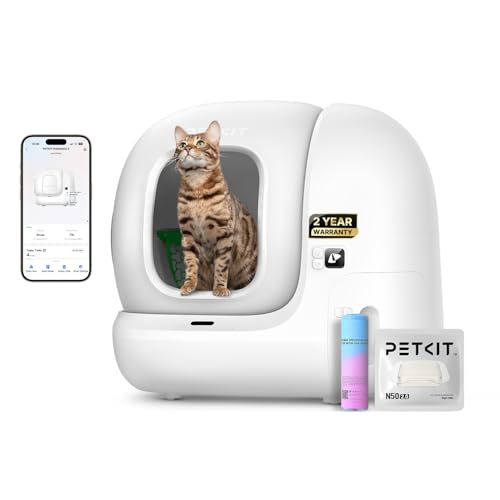 PETKIT PuraMax 2 Automatic Self-Cleaning Litter Box
|
8.3/10 | Buy | |
| Editor's Pick |
 PETKIT Purobot Max 3 Automatic Litter Box
|
7.8/10 | Buy | |
| Best Value |
 Loveepee Automatic Litter Box with App Control
|
7.3/10 | Buy | |
| Top Rated |
 PetCove PurrTek Automatic Self-Cleaning Litter Box
|
7.8/10 | Buy | |
 Vivirata Automatic Litter Box with App Control
|
7.6/10 | Buy | ||
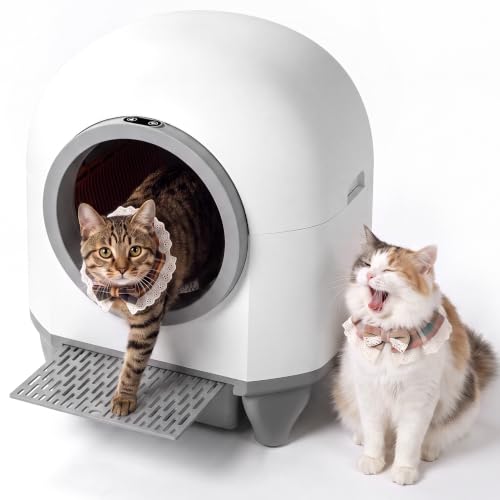 Greesum 90L Self-Cleaning Litter Box with App Control
|
7.0/10 | Buy | ||
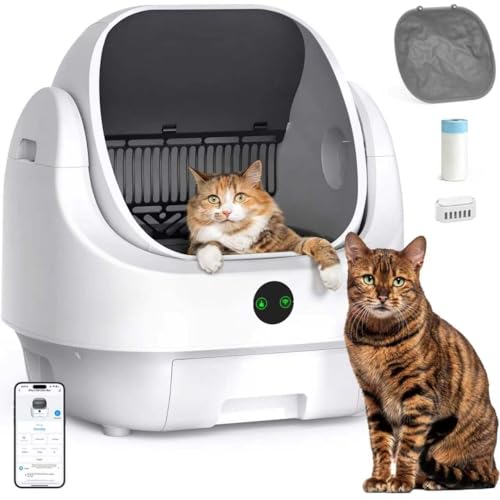 Ellenpent Open-Top Self-Cleaning Litter Box, 9L
|
7.3/10 | Buy | ||
 UBPET XX-Large Automatic Cat Litter Box with App Control
|
8.1/10 | Buy | ||
 FEELNEEDY 65L Automatic Self-Cleaning Litter Box
|
6.7/10 | Buy | ||
 Ovesong Automatic Cat Litter Box, 16.5" Open-Top
|
6.3/10 | Buy | ||
 Teweoa Open-Top Automatic Litter Box for Multiple Cats
|
6.1/10 | Buy |
PETKIT PuraMax 2 Automatic Self-Cleaning Litter Box
An app-controlled automatic litter box designed for multi-cat households, featuring infrared and weight sensors for safety, dual odor control, and health tracking via smartphone. The 76L capacity and low 7.87-inch entry make it accessible for older or mobility-limited cats.
Pros
- Comprehensive health monitoring through app tracks each cat's weight, frequency, and duration to identify health changes
- Safety-first design with multiple sensors that pause operation when cats approach, preventing injuries
- Anti-leakage waterproof pad with elastic edges handles urine around edges without spills
- Dual odor control system with sealed bin and N50 2.0 cartridge effectively reduces smell
- Basic bundle includes all essentials: litter sifter, magnetic remover, 20 trash bags, and accessories
Cons
- Cannot be placed on carpets or soft surfaces as sensors may malfunction, limiting placement flexibility
- No reviews available yet to verify real-world performance and longevity claims
- Not compatible with non-clumping litters, and K3 Smart Spray add-on is incompatible with this model
PETKIT Purobot Max 3 Automatic Litter Box
A self-cleaning litter box designed for multi-cat households with Wi-Fi monitoring, large entry opening, and a five-layer odor control system. Best suited for owners who want to reduce daily scooping and track their cats' bathroom habits remotely.
Pros
- Accommodates cats of all sizes with ergonomic large opening and roomy interior
- Comprehensive odor control through multi-layer system plus N50 and N60 odor eliminators
- Smart app connectivity tracks individual cat visits, duration, and weight data
- Tool-free magnetic design simplifies disassembly for deep cleaning
- Sealed waste drawer and triple-protection pad prevent leaks and spillage
Cons
- No verified buyer reviews available to confirm real-world performance and durability
- Requires hard flooring or rigid mat placement for accurate weight sensing functionality
- Large footprint (25.6 x 19.7 x 22 inches) may not fit smaller spaces
Loveepee Automatic Litter Box with App Control
A fully automated litter box with 8 sensors for safety and app-based scheduling, designed for multiple cats with a spacious 20x20 inch entrance. Compatible with most standard litters but not fine-grain or oversized varieties.
Pros
- Multiple sensor layers provide genuine safety assurance during automatic cycles
- Oversized entrance reduces stress for cats compared to compact designs
- Remote app scheduling offers convenience for multi-cat households
- Reusable liner and thickened silicone sleeve lower replacement costs
- Adequate 10-liter capacity handles multiple cats for extended periods
Cons
- Requires 2.4G WiFi only, not compatible with 5G networks
- Incompatible with long-grain, tofu-based, or granules over 8mm
- No verified buyer reviews available to confirm real-world reliability claims
PetCove PurrTek Automatic Self-Cleaning Litter Box
An automatic litter box that seals waste into bags after each use, eliminating daily scooping for multi-cat households. Features app control, odor neutralization via sealed bin and negative-ion system, and multi-sensor safety design.
Pros
- Eliminates daily scooping and reduces odor with sealed waste containment and negative-ion technology
- Smart app integration allows remote monitoring, weight tracking, and full-bin alerts from anywhere
- Multi-layer safety system with five sensors prevents injury and includes child-lock protection
- Large 12L waste bin extends intervals between bag changes, practical for busy households
- Quiet operation and spacious drum design accommodate natural cat behavior
Cons
- Requires specific clumping litter within manufacturer guidelines; incompatible with crystal, pine, or non-clumping varieties
- No customer reviews available to verify real-world reliability and durability claims
- Sealed bag system creates ongoing consumable costs for waste bags beyond initial investment
Vivirata Automatic Litter Box with App Control
A large-capacity self-cleaning litter box designed for multi-cat households, featuring dual safety sensors, app-based monitoring, and customizable cleaning modes. Best suited for owners seeking automated waste management with remote health tracking capabilities.
Pros
- Safety sensors automatically pause operation when cat is present, eliminating injury risk
- App integration provides real-time litter level alerts and health monitoring through usage statistics
- Kitten Mode and Sleep Mode allow customization for different household routines
- Large capacity suitable for multiple cats with sealed design to minimize odors
- Includes maintenance supplies and fully washable parts for easy upkeep
Cons
- No verified user reviews available to assess real-world reliability or common failure points
- Requires app connectivity and smartphone for full feature access, limiting convenience for non-tech users
- Large footprint (22.8 x 22.6 x 13.2 inches) may not fit compact spaces
Greesum 90L Self-Cleaning Litter Box with App Control
A fully enclosed self-cleaning litter box designed for large cats and multi-cat households, featuring triple-sensor safety, app-controlled cleaning modes, and 40dB ultra-quiet operation. Best suited for cat owners seeking minimal litter scatter and smart home integration without subscription fees.
Pros
- Multiple safety sensors (infrared, microwave radar, living-creature radar) prevent accidental cycling while cat is inside
- No recurring subscription costs, unlimited app features and usage tracking included for life of device
- Exceptional noise level at 40dB allows operation during night hours without disturbing household
- Works offline via control panel if WiFi unavailable
- Extra large capacity accommodates multiple cats and large breeds up to 33 lbs
Cons
- Only compatible with clumping litter under 15mm particle size, excludes crystal and non-clumping litters
- No verified buyer reviews available to assess real-world reliability and longevity
- Requires WiFi connection for full app functionality and remote monitoring features
Ellenpent Open-Top Self-Cleaning Litter Box, 9L
An automated litter box with open-top design for cat comfort and dual-layer odor control via sealed construction and deodorizer gel. Features Wi-Fi app monitoring, safety sensors, and arrives fully assembled with a 9L waste capacity rated for 10 days per cat.
Pros
- Fully assembled and plug-and-play setup requires no installation
- Large 9L waste capacity reduces frequent emptying
- Open-top layout accommodates large cats and eases transition from traditional boxes
- Safety sensors with automatic pause protect cats during cleaning cycles
- App-based health monitoring provides insights into litter box usage patterns
Cons
- No verified buyer reviews available to assess real-world reliability or user experience
- Open-top design may allow some odor to escape compared to fully enclosed models
- Requires Wi-Fi connectivity and smartphone for full smart features; app functionality depends on stable connection
UBPET XX-Large Automatic Cat Litter Box with App Control
This 106-liter self-cleaning litter box accommodates multiple cats and larger breeds with a low-entry design that reduces stress for senior or anxious cats. Four weight sensors and a patented anti-pinch structure prioritize safety, while app connectivity tracks up to 30 cats' health metrics remotely.
Pros
- Extra-large capacity and low entrance reduce accessibility barriers for older or anxious cats
- Safety features, four weight sensors, and anti-pinch design provide genuine injury protection
- App monitoring tracks bathroom frequency and weight changes for health insights across multiple cats
- Sealed waste compartment and deodorizer blocks effectively contain odors
- Quiet operation and detachable drum make maintenance straightforward
Cons
- No verified buyer reviews available yet to confirm real-world reliability and performance claims
- Requires 2.4GHz Wi-Fi connectivity for app features, limiting use without stable internet
- Premium pricing typical for automatic litter boxes may not suit budget-conscious buyers
FEELNEEDY 65L Automatic Self-Cleaning Litter Box
A WiFi-enabled self-cleaning litter box that separates waste automatically and stores it in an 11L bin, reducing scooping to roughly every 10-14 days. Features app monitoring, odor control via a three-layer system, and safety sensors to prevent trapping, though it requires clumping litter and involves manual emptying.
Pros
- Self-cleaning activation within 2 minutes eliminates daily hand scooping
- Real-time app monitoring tracks bathroom habits and alerts when trash is full
- Infrared and weight sensors pause cleaning if cat is present or curious about the waste bin
- Airtight waste storage with silicone gasket contains odors effectively
- No-tool setup and wide top opening simplifies litter refilling
Cons
- Requires clumping litter types; incompatible with non-clumping varieties
- Manual emptying of waste bin still necessary, just less frequently than daily scooping
- No verified buyer reviews available to confirm real-world reliability and user satisfaction
Ovesong Automatic Cat Litter Box, 16.5" Open-Top
An open-top self-cleaning litter box designed for multiple cats with dual safety sensors and app control via 2.4G WiFi. The spacious 16.5-inch entrance and 15L sealed waste bin appeal to multi-cat households seeking convenience and odor control.
Pros
- Spacious open-top design eliminates claustrophobic concerns common in enclosed boxes
- Comprehensive dual-layer safety protection with weight and infrared sensors prevents accidental activation
- Large 15L sealed waste bin reduces frequency of emptying for busy pet owners
- Smart app integration allows remote monitoring and scheduling through smartphone
- Reusable, leak-proof construction with included washable liner lowers long-term costs
Cons
- Requires 2.4G WiFi connectivity only, not compatible with 5G networks
- No verified customer reviews available to assess real-world reliability and durability
- Large footprint at 22.04" depth may require significant floor space in smaller homes
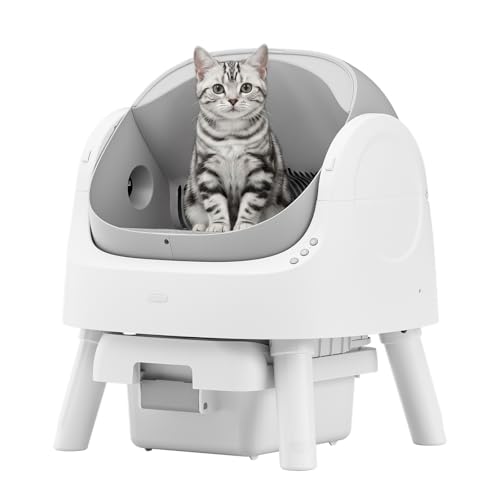
Teweoa Open-Top Automatic Litter Box for Multiple Cats
This automatic litter box uses infrared and Hall sensors to detect your cat and pause operation for safety, while maintaining quiet 32dB performance suitable for apartments. The open-top design accommodates cats of varying sizes without the confinement risk of side-entry models, though maintenance requires avoiding direct water contact with the motor base.
Pros
- Intelligent safety protection with infrared and Hall sensors to prevent injuries
- Whisper-quiet performance at 32dB minimizes household disruption
- Spacious open-top layout accommodates cats from 3-22 lbs without size conflicts
- One-touch emptying and removable construction reduce maintenance burden
- Supports unattended operation during short trips away from home
Cons
- No verified buyer reviews available to validate real-world performance claims
- Maintenance restricted to damp cloth wiping of main body; direct water exposure prohibited on motor base
- Large footprint at 21.5 x 20.27 x 24 inches may consume significant floor space in smaller homes
Self-Cleaning Litter Boxes Buying Guide
Choosing the right self-cleaning litter box involves more than picking the most popular model.
The features that matter most depend heavily on your household: how many cats you have, how much floor space you can spare, whether your cat is nervous around mechanical movement, and how involved you want to be in daily maintenance.
The six criteria below cover every major decision point and reflect what separates well-regarded models from those with high return rates and negative long-term reviews.
Cleaning Mechanism and Cycle Reliability
The core job of any self-cleaning litter box is to move clumps away from the clean litter efficiently and consistently.
The two dominant designs are rotating globe mechanisms, which tumble waste into a sealed drawer, and raking or sweeping arms, which push clumps toward a waste bin.
Rotating designs tend to produce a more thorough separation between clean and soiled litter, while raking systems are generally lower-profile and easier for cats to enter.
Cycle reliability is where many lower-cost models fall short. A cleaning arm that jams on larger clumps or a motor that struggles after a few weeks of use quickly negates any convenience benefit.
Verified buyer feedback over a period of three to six months is particularly useful here, as early reviews often miss the mechanical wear issues that emerge with daily use. Look for models with documented motor warranties and replacement part availability.
Cycle timing is also worth considering. Most app-controlled models like the PETKIT PuraMax 2 allow you to set custom delay intervals after litter box use, which reduces the risk of a cleaning cycle starting while a cat is still nearby.
Fixed-timer models offer less flexibility but are simpler to set up for owners who prefer a set-and-forget approach.
Odor Control System
Odor management is the feature most frequently cited in positive reviews of self-cleaning boxes, and also the one most often exaggerated in marketing copy.
Effective odor control relies on at least two layers: physical containment (an enclosed globe or deep waste bin that limits airflow from waste) and active filtration (activated carbon filters, ionic deodorizers, or sealed liner bags that trap odorous compounds before they escape).
Multi-cat households place a significantly higher demand on odor systems. A single-layer carbon filter adequate for one cat may become saturated within days when two or three cats use the box.
Models that advertise triple odor control, such as the PetCove PurrTek, combine physical sealing, active carbon filtration, and a secondary ionic or UV deodorizer layer.
Expert consensus consistently notes that enclosed designs outperform open-top designs on odor, though open-top models are preferable for large cats or those uncomfortable entering a tunnel entrance.
Filter replacement cost and frequency should factor into your total ownership calculation. A box priced at the mid-range tier with expensive monthly filter subscriptions may cost more over a year than a higher upfront model with washable or long-lasting filters.
Check manufacturer documentation for recommended replacement intervals before purchasing.
Safety Sensors and Cat Detection
Safety is the most critical specification in any automated litter box.
A cleaning cycle that triggers while a cat is inside or immediately re-entering poses a real injury risk.
Quality models use at least one of the following: infrared motion sensors at the entrance, weight sensors on the floor of the unit, or radar-based presence detection.
Dual-sensor systems that combine weight and infrared detection provide a meaningful redundancy, and expert reviewers consistently favor these over single-sensor designs.
The sensitivity and response time of safety sensors matters as much as their type.
A weight sensor calibrated for average adult cats may not reliably detect a kitten under a threshold weight, and a motion sensor with a short detection window may miss a cat that entered quickly.
Models with app-based controls often allow users to adjust sensor sensitivity thresholds, which is worth checking before purchase if you have a particularly small or large cat.
Verified buyer feedback is especially informative here. Units with sensor reliability issues tend to generate consistent complaint patterns around false starts, mid-cycle stops, or missed detections.
Models with strong long-term safety records, like the PETKIT PuraMax 2 and the Loveepee self-cleaning box, tend to dominate expert consensus picks precisely because their sensor systems hold up over months of daily use.
Capacity and Multi-Cat Suitability

Litter box capacity is measured both in the volume of the usable litter space and the size of the waste bin.
A box marketed for multiple cats needs sufficient globe or tray space for a cat to move and turn comfortably, plus a waste bin large enough to hold several days of accumulated waste without requiring daily emptying.
Verified buyer feedback from multi-cat households is the most reliable guide to real-world bin capacity, since manufacturer claims often reflect single-cat use patterns.
The UBPET XXXL model and the Greesum 90L XL are both positioned for larger households, with expanded internal volumes compared to standard-sized competitors. Larger capacity generally means a larger physical footprint, so measure your available floor space carefully.
A unit that is too large to fit comfortably in a bathroom corner or laundry room will often end up placed in a suboptimal location, reducing the cat’s willingness to use it consistently.
App Connectivity and Smart Features

Wi-Fi and Bluetooth connectivity has become nearly standard on mid-range and premium self-cleaning litter boxes. App control allows owners to trigger manual cleaning cycles, review usage logs, monitor litter levels, and receive notifications when the waste bin needs emptying.
For multi-cat households, usage logs can help identify changes in litter box frequency that may signal a health issue in one animal, which is a feature that veterinary behaviorists have noted as a practical health monitoring tool.
App quality varies significantly between brands. A well-designed app with a reliable Bluetooth or 2.4GHz Wi-Fi connection adds genuine value; a poorly coded app that disconnects frequently or requires constant re-pairing creates frustration that quickly sours the ownership experience.
Expert reviewers and verified buyers consistently note app reliability as a key differentiator. PETKIT’s companion app has received broadly positive marks across multiple publications for stability and feature depth.
If your home router operates exclusively on 5GHz, confirm whether a model supports 5GHz Wi-Fi before purchasing, as many budget and mid-range units only connect via 2.4GHz.
It is worth noting that app features should be considered a convenience bonus rather than a core requirement.
If your internet connection is unreliable or you prefer a simpler setup, several models on this list include manual timer controls and work perfectly well without an active app connection.
A dependable [wireless security camera](https://productfind.com/best-wireless-security-cameras/) placed near the litter box area can also serve as a low-tech backup for monitoring usage if app connectivity is not a priority.
Ease of Maintenance and Running Costs
The long-term appeal of a self-cleaning litter box depends entirely on how easy it is to maintain beyond the daily automated cycle.
The waste bin needs to be emptied and the liner replaced on a regular basis, and the litter chamber itself needs periodic deep cleaning to prevent bacteria buildup.
Models with detachable, dishwasher-safe components and smooth interior surfaces that resist litter adhesion make deep cleaning significantly easier.
Running costs include compatible litter bags or liners, replacement filters, and any proprietary litter the manufacturer recommends. Most models work with standard clumping bentonite litter, which is widely available at competitive prices.
Some premium units recommend or require specific litter types to function correctly, which can substantially increase monthly operating costs. Confirm litter compatibility in the product documentation before committing to a purchase.
Noise level during cleaning cycles is a maintenance-adjacent consideration that directly affects both cat and owner experience.
Ultra-quiet motor designs are particularly important for skittish cats, who may refuse to use a box that startles them with grinding or rattling sounds.
Expert reviewers regularly compare decibel levels across models, and verified buyer feedback from owners of anxious cats is worth seeking out specifically. Keeping your home environment calm for pets pairs well with other quality-of-life upgrades.
Just as a good [HEPA air purifier](https://productfind.com/best-hepa-air-purifiers/) can reduce allergens that bother both cats and owners, a quiet litter box reduces stress for the animals sharing your space.
Why You Should Trust Us
ProductFind is an independent editorial platform. We do not conduct our own product trials; our evaluations are grounded in research, published data, expert review consensus, and verified buyer feedback.
Every self-cleaning litter box in this article was assessed against a consistent set of criteria: cleaning mechanism reliability, odor control system depth, safety sensor quality, capacity and multi-cat suitability, app connectivity, and total cost of ownership.
Each model receives a PF Score on a scale of 0 to 10, reflecting its overall performance against these criteria relative to others in the category.
Our research draws on published specifications from manufacturers, aggregated expert review consensus across multiple independent publications, and verified buyer feedback patterns observed over time.
We weight long-term reliability reports more heavily than short-term impressions, because a self-cleaning litter box needs to perform consistently over months and years, not just in the first week of use.
ProductFind may earn a commission if you purchase through a link in this article. That affiliate relationship has no influence on our rankings, PF Scores, or product selection.
Products are included and ranked based on the quality of our research findings, not on commission rates. We do not accept payment for placement and do not receive free products from manufacturers.
Final Thoughts
The self-cleaning litter box market covers a wide range of designs, price tiers, and feature sets.
After evaluating 11 models against consistent criteria, a clear picture emerges: the best options share a common set of strengths in cleaning reliability, odor management, and safety sensor quality, with differentiation coming from capacity, app feature depth, and overall value at a given price tier.
Here are our standout picks by category:
- Best Overall: PETKIT PuraMax 2 Automatic Self-Cleaning Cat Litter Box earns the top PF Score in this group with its combination of reliable 2.4GHz app control, triple odor filtration, anti-leakage design, and well-regarded safety sensor system that holds up over extended multi-cat use.
- Best Premium Pick: PETKIT Purobot Max 3 Automatic Litter Box represents the top of PETKIT’s current lineup, delivering advanced odor control and a refined cleaning mechanism for owners who want the most capable option regardless of price tier.
- Best Mid-Range Value: Loveepee Self Cleaning Litter Box strikes a strong balance between triple sensor protection, a fully open design that suits larger cats, a generous 10L waste bin, and a price point that sits well below the premium tier without sacrificing core reliability.
- Best Budget-Conscious Pick: Petcove PurrTek Automatic Self Cleaning Litter Box offers 5GHz Wi-Fi connectivity, triple odor control, and quiet operation at a price point accessible to owners who want smart features without committing to a premium spend.
- Best for Large Households: UBPET XXXL Automatic Litter Box provides one of the largest interior volumes in this group, making it particularly well suited for homes with three or more cats where capacity and waste bin size are the primary concern.
Whichever model fits your household, the shift to an automated litter box consistently ranks among the most impactful quality-of-life upgrades cat owners make.
Paired with attentive nutrition and a clean home environment, it is a straightforward way to improve daily life for both you and your cats.
If you are also looking to improve air quality in the room where the litter box lives, a capable [air purifier](https://productfind.com/best-hepa-air-purifiers/) with HEPA filtration is a natural complement to an odor-controlled litter setup.
Frequently Asked Questions
Are Self-Cleaning Litter Boxes Safe for Cats?
Yes, when used correctly and maintained properly. All reputable models include safety sensors that detect cat presence and pause or cancel cleaning cycles if a cat enters the unit.
Dual-sensor designs combining weight sensors and infrared detection provide an additional layer of redundancy.
It is important to monitor your cat’s comfort with the box during the first week of use, as some cats need an adjustment period before they accept the noise and movement of automated cycles.
How Often Do Self-Cleaning Litter Boxes Need to Be Emptied?
The waste bin in most self-cleaning litter boxes needs to be emptied roughly every three to seven days for a single-cat household, and more frequently for two or more cats.
Actual frequency depends on the bin volume of the specific model and your cats’ usage patterns. App-connected models typically send a notification when the bin approaches capacity.
Deep cleaning of the full unit is generally recommended every two to four weeks to prevent bacterial buildup in the litter chamber.
What Type of Litter Works Best in These Boxes?
The vast majority of self-cleaning litter boxes are designed for standard clumping bentonite litter, which forms firm clumps that the cleaning mechanism can move without crumbling.
Fine-grain bentonite litters tend to produce tighter clumps and perform better in rotating globe designs. Silica crystal litter is compatible with some raking-style models but not with rotating ones. Non-clumping litters are generally not compatible with self-cleaning mechanisms.
Always confirm litter compatibility in your specific model’s documentation before switching litter types.
Do Self-Cleaning Litter Boxes Actually Eliminate Odor?
They reduce odor significantly compared to a manually scooped box, but they do not eliminate it entirely.
The faster waste is moved from the litter to a sealed waste bin after each use, the less time odorous compounds have to volatilize into the room.
Models with multi-layer filtration systems, sealed waste bins, and ion or carbon deodorizers perform noticeably better than those with basic carbon filters alone.
For rooms where odor control is a priority, pairing a quality self-cleaning box with a [HEPA air purifier](https://productfind.com/best-hepa-air-purifiers/) rated for the room size is an effective combination.
Is Wi-Fi or App Control Necessary?
No. App connectivity adds genuine convenience, particularly the ability to view usage logs, adjust cleaning schedules remotely, and receive bin-full notifications. However, every model on this list functions as a self-cleaning litter box without an active app connection.
If your home has an unstable Wi-Fi setup or you prefer fewer connected devices, models with manual timer controls work perfectly well as standalone appliances.
The app becomes more valuable as the number of cats in your household increases, since usage monitoring across multiple cats provides useful health data over time.
Can Kittens Use Self-Cleaning Litter Boxes?
Most manufacturers recommend waiting until kittens are at least six months old and above a minimum weight threshold before introducing a self-cleaning box.
Younger kittens may fall below the minimum weight that weight-based safety sensors are calibrated to detect reliably, which creates a potential safety gap.
Additionally, kittens are more likely to be startled by automated movement and sounds, which can cause litter box aversion that persists into adulthood.
Introduce the box with the automated cleaning cycle turned off initially, allowing the kitten to explore it as a static object before activating the motor.
About the author
Wilma is a reviewer and writer for ProductFind who specializes in Cats. Wilma evaluates products through independent research: specifications, expert review consensus, and verified buyer feedback, and rates each one on the PF Score. Wilma focuses on helping readers pick the right cat for their needs and budget.