The 8 Best USB-C Car Chargers
Fast charging in the car depends on more than wattage. We researched USB-C car chargers across output accuracy, safety features, and real-world performance to find the models that actually deliver.
 By Marsha Rogers
Updated July 23, 2026
By Marsha Rogers
Updated July 23, 2026
Your car’s 12V socket is one of the most underrated power sources you own.
Whether you’re navigating unfamiliar highways, managing a long commute, or keeping multiple devices alive on a road trip, a capable USB-C car charger can mean the difference between a fully charged phone and a dead battery at the worst possible moment.
Older USB-A adapters simply cannot deliver the wattage that modern iPhones, Android flagships, and even compact laptops demand, and a charger that advertises “fast charging” without proper Power Delivery (PD) support often falls short in real-world use.
ProductFind researched and evaluated dozens of USB-C car chargers by analyzing published specifications, synthesizing expert review consensus across the category, and reviewing verified buyer feedback to surface the options that genuinely deliver on their charging claims.
We assessed power output, thermal management, port configuration, build quality, and overall value to build a ranked list that serves everyone from light phone-chargers to power users who need to top off a MacBook between meetings.
Read on to see our top picks, and jump into the buying guide below for everything you need to choose the right charger for your setup.
| Award | Product | PF Score About PF ScoreThe PF Score is our own rating from 0 to 10, based on performance, design and build, ease of use, and value. It reflects independent research and is never influenced by manufacturers, retailers, or affiliate commissions. Learn more › | Price | |
|---|---|---|---|---|
| Best Overall |
 Anker 75W Nano Car Charger with Retractable Cable
|
8.7/10 | Buy | |
| Editor's Pick |
 LISEN 90W USB-C Car Charger with 60-Inch Coiled Cable
|
8.4/10 | Buy | |
| Best Value |
 UGREEN 130W USB-C Car Charger with 100W PD
|
8.2/10 | Buy | |
| Top Rated |
 LISEN 200W Triple-Port Car Charger with 140W USB-C
|
8.1/10 | Buy | |
 Anker 30W 2-Port USB-C Car Charger
|
7.8/10 | Buy | ||
 MRGLAS 125W Dual-Port Car Charger
|
7.1/10 | Buy | ||
 KENHAO 67W 3-Port Car Charger with Dual USB-C
|
6.4/10 | Buy | ||
 KENHAO 67W 3-Port USB-C Car Charger
|
6.3/10 | Buy |
Anker 75W Nano Car Charger with Retractable Cable
This compact car charger delivers 75W of total power across a built-in retractable USB-C cable and a separate USB-C port, letting you charge two devices simultaneously without compromise. The retractable design keeps your car clutter-free while the robust build quality backs up Anker's reputation for reliable mobile accessories.
Pros
- Dual charging capability (45W built-in cable + 30W USB-C port) handles laptops and tablets simultaneously
- Retractable cable extends over 2 inches and retracts with minimal effort, reducing cable clutter
- Lightweight at 0.11 pounds and compact dimensions fit most car power outlets without obstruction
- Anker's established track record in charger reliability and customer service
Cons
- No verified buyer reviews available to confirm real-world performance and durability claims
- Limited to single car outlet installation, so won't work for vehicles with multiple charging needs in different locations
- Product Group listed as 'Wireless' despite being a wired charger, suggesting possible data classification inconsistency
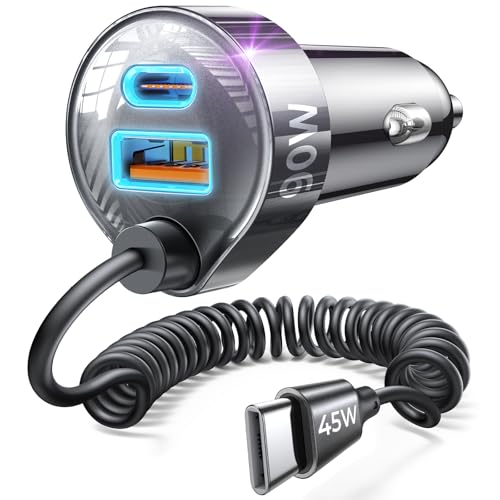
LISEN 90W USB-C Car Charger with 60-Inch Coiled Cable
This 90W car charger delivers fast charging for iPhones 17/16/15 and Android devices with a retractable 60-inch cable that minimizes clutter. The three simultaneous device ports and UL/CE/FCC certifications make it practical for family road trips, though the built-in cable limits flexibility for older iPhone models.
Pros
- Fast 90W output significantly reduces charging time during commutes
- Built-in 60-inch coiled cable eliminates need for separate charging cables and reduces console clutter
- Three charging ports handle multiple devices at once, reducing device conflicts on road trips
- Multiple safety certifications provide confidence in device protection
- Ambient light design improves usability in low-light conditions
Cons
- iPhone 14 and earlier models require original Lightning cables to access fast charging, reducing universal compatibility
- No independent user reviews available to verify real-world performance claims
- Built-in cable design means replacements require purchasing new unit rather than swapping cables
UGREEN 130W USB-C Car Charger with 100W PD
A dual-port car charger delivering 130W total output across two USB-C ports (100W + 30W), designed for simultaneous charging of laptops, tablets, and phones. Built-in safety certifications and a included 100W USB-C cable make it a practical choice for multi-device road trips.
Pros
- Dual high-power ports eliminate the need for multiple chargers on long drives
- Comprehensive safety certification and protection features reduce risk of device damage
- Included 100W cable eliminates extra purchase and ensures compatibility
- Universal compatibility across major brands and recent device generations
- Practical design with LED indicator for nighttime usability
Cons
- No user reviews available to verify real-world performance and reliability
- Requires a functioning cigarette lighter socket, limiting use in some vehicle types
- 130W spec relies on both ports being used simultaneously, individual port output not independently documented
LISEN 200W Triple-Port Car Charger with 140W USB-C
A high-capacity multi-device car charger built on GaN technology that delivers up to 140W via USB-C for laptops and 60W for Samsung flagships. Best suited for professionals and power users who need simultaneous fast charging across multiple devices during commutes.
Pros
- Exceptional 140W USB-C output covers most laptops and tablets without separate chargers
- Dedicated Samsung 60W fast charging and broad Android compatibility via QC 4.0+ and PPS
- Metal body with GaN efficiency minimizes heat, supporting long driving sessions
- Universal device recognition across iPhone, MacBook, iPad, and Samsung ecosystems
- Includes 240W USB-C cable and safety certifications for peace of mind
Cons
- No user reviews available yet to verify real-world performance and reliability claims
- Three simultaneous charging reduces individual port output below maximum specs (170W total versus 200W rated)
- Relatively bulky form factor due to metal housing and high power output may limit compatibility with some vehicle cup holders
Anker 30W 2-Port USB-C Car Charger
A compact dual-port car charger delivering 30W via USB-C for fast iPhone 15 charging while supporting a second device through USB-A. Built with multiple safety protections and intelligent power distribution for reliable simultaneous charging.
Pros
- Fast charging speed for modern iPhones with 30W USB-C output
- Two simultaneous charging ports eliminate choosing between devices
- Compact form factor doesn't obstruct dashboard or consume excessive space
- Comprehensive safety protections for reliable operation
Cons
- No user reviews available to confirm real-world performance consistency
- USB-A port limited to standard speeds, only USB-C provides the 30W fast charging
- Dual charging may require negotiating power between ports depending on connected devices
MRGLAS 125W Dual-Port Car Charger
This compact cigarette lighter charger delivers PD 65W on USB-C and QC 60W on USB-A, designed to charge multiple devices simultaneously in vehicles. The all-metal construction and pull-ring design make it practical for daily use, though fast charging speeds require both ports to be used separately.
Pros
- High power output covers modern phones and tablets efficiently
- Metal construction feels durable and dissipates heat better than plastic alternatives
- Truly compact size avoids protruding from lighter outlet while driving
- Safety features include multiple certifications and intelligent chip protection
Cons
- Both USB ports cannot deliver maximum fast charging simultaneously; USB-A port achieves 60W only in 20V vehicles
- No verified customer reviews available to validate real-world performance claims
- Limited to vehicles with standard 12V/20V electrical systems
KENHAO 67W 3-Port Car Charger with Dual USB-C
A multi-port car charger built for simultaneous charging of multiple devices via two USB-C ports and one USB-A port, delivering up to 67W total output. Equipped with PD and QC 3.0 technology, it's designed for road trips and daily commutes across most modern phones, tablets, and laptops.
Pros
- Dual USB-C ports plus USB-A allows simultaneous charging of three devices
- Metal construction with heat dissipation for durability
- Broad device compatibility including recent iPhone and Samsung models
- Intelligent chip provides overcurrent, overvoltage, and overheating protection
Cons
- No verified buyer reviews to confirm real-world reliability or heat performance
- Compact design may cause port crowding if using thick charging cables
- Product group labeled as 'Wireless' despite being a wired charger, indicating potential spec inconsistency
KENHAO 67W 3-Port USB-C Car Charger
A multi-device car charger with 67W total output across USB-C and dual USB-A ports, designed to handle simultaneous charging for phones, tablets, and laptops. Combines PD and QC fast charging protocols with broad device compatibility, though it lacks verified user feedback to confirm real-world performance claims.
Pros
- 67W total output with dedicated PD (37W) and QC (30W) channels for simultaneous multi-device charging
- Wide compatibility spans iPhones, Samsung Galaxy series, iPads, Google Pixel, and most USB-A/USB-C devices
- Includes safety protections against over-current, over-voltage, over-heating, and short-circuit
- Comes with 3FT USB-C cable and 1-year replacement guarantee
- Compact three-port design consolidates charging needs for travel
Cons
- No verified customer reviews available (4.5 rating with 0 reviews) makes performance claims unvalidated
- Product specifications list it under 'Wireless' category despite being a wired charger, suggesting possible data inconsistency
- Actual charging speeds depend on device compatibility and power delivery support, which varies significantly across older models
USB-C Car Chargers Buying Guide
Not all USB-C car chargers are created equal. A charger’s wattage label on the box tells only part of the story.
To find a model that actually keeps pace with your devices, you need to understand a handful of key specifications and how they interact with your specific gadgets.
The sections below break down the criteria ProductFind weighs most heavily when evaluating this category.
Total Wattage and Power Delivery Standards

Wattage is the single most important number on any USB-C car charger, but it only matters if it’s backed by the right charging protocol.
USB Power Delivery (PD) is the universal standard that allows a charger and a device to negotiate the optimal voltage and current, enabling genuinely fast charging rather than a trickle feed.
For smartphones, a port that outputs at least 18W via PD is the baseline for fast charging.
For tablets or compact laptops like the iPad Pro or a MacBook Air, you’ll want at least one port capable of 65W or more.
GaN (gallium nitride) technology has become increasingly common in higher-wattage car chargers because it allows more power to flow through a smaller component with less heat generated.
Chargers like the LISEN 200W GaN model in our list demonstrate how far this technology has come, delivering laptop-grade charging speeds from a cigarette lighter socket.
If your use case is strictly smartphones, a well-designed 30W to 45W PD charger is more than enough and tends to be more compact and affordable.
If you regularly plug in a tablet or ultrabook, look at GaN models in the 65W to 140W range.
Samsung Galaxy users should also check whether a charger supports PPS (Programmable Power Supply), which is required for Samsung’s Super Fast Charging 2.0 protocol.
Standard PD chargers will still charge a Galaxy phone quickly, but PPS unlocks the highest possible speeds on compatible devices. This distinction matters most when comparing mid-range and budget chargers that may advertise high wattage without full PPS compliance.
Port Configuration and Multi-Device Use
A single USB-C port is fine if you only ever need to charge one device at a time, but most drivers benefit from at least two ports.
The key trade-off to understand is power sharing: when two devices are plugged in simultaneously, most chargers split or reduce the available wattage across both ports.
A charger rated at 90W on a single port might drop to 45W per port when both are occupied.
This behavior is normal and expected, but it’s worth checking the spec sheet before assuming you’ll get maximum speed on both channels at once.
Dual USB-C configurations work well for households where everyone has a modern device.
Mixed USB-C and USB-A configurations are more practical for rideshare drivers or families with older accessories, since USB-A ports can still charge legacy cables and accessories at reasonable speeds.
The three-port models from KENHAO in our list, for example, target users who need to juggle multiple devices including both USB-C and USB-A connections simultaneously.
If you’re building out a complete mobile kit alongside a portable charger for off-the-car top-offs, matching the port types across both accessories avoids cable confusion.
Built-In vs. Detachable Cables
Most car chargers use detachable cables, which is generally the more flexible arrangement.
You can swap in a longer cable to reach a back-seat passenger, replace a damaged cable without buying a new charger, or use a higher-rated cable if your original one is limiting power delivery.
This is the standard setup across the majority of picks in our list.
Retractable built-in cables, however, solve a genuine usability problem. Loose cables sliding around on the center console or getting tangled in seat mechanisms is a daily annoyance, and a retractable design eliminates that entirely.
The Anker 75W model with a built-in retractable cable is a strong example of this done well, offering both convenience and a meaningful 75W output without sacrificing desk-drawer tidiness.
The trade-off is that if the cable itself degrades or the connector type becomes obsolete, the whole unit needs replacing.
For most buyers, detachable cables win on long-term flexibility. Retractable designs are the right call if cable management is a persistent frustration or if you frequently share the charger between different people without wanting to manage loose cables.
Build Quality and Thermal Safety
A car charger lives in a hot, vibrating environment and draws power from a circuit shared with other vehicle electronics. Build quality and thermal management therefore matter more here than in a home wall charger context.
Look for models that mention over-temperature protection, over-current protection, and short-circuit protection in their specifications. These safety certifications indicate that internal circuitry actively monitors the charging state and shuts down before damage occurs.
Metal housing, like what the MRGLAS all-metal charger offers, dissipates heat more effectively than plastic. Higher-wattage GaN chargers tend to run warmer by nature, so thermal venting or a wider body profile is worth checking on models above 100W.
Verified buyer feedback is particularly useful for surfacing heat-related complaints that don’t show up in spec sheets, and this is one area where ProductFind’s review synthesis process pays dividends over relying on marketing copy alone.
Profile and Fit in the Socket
Car chargers come in two broad form factors: compact flush-mount designs that barely protrude from the socket, and taller cylindrical designs that are easier to grip and remove but take up more visual space.
If your vehicle has a recessed or partially covered 12V socket, a low-profile flush-mount charger is often necessary to avoid blocking adjacent controls. If your socket is open and accessible, the form factor matters less.
Higher-wattage models tend to be physically larger simply because they require more internal components. A 200W GaN charger will inevitably be bulkier than a 30W single-port adapter.
Consider whether the charging power you’re paying for is actually relevant to your devices before opting for the largest, most powerful option on the market.
A thoughtfully chosen 30W charger often outperforms an oversized 200W model in day-to-day usability for someone who only charges a phone.
Value and Price-to-Performance Ratio

USB-C car chargers span a wide price range, from budget adapters to premium multi-port GaN hubs. The most expensive option is not automatically the best for your needs.
ProductFind evaluates value by considering whether the charger’s actual feature set and verified real-world performance justify its price relative to alternatives.
A well-regarded brand like Anker commands a modest price premium over lesser-known brands, and that premium generally reflects more consistent quality control and better long-term reliability based on aggregated buyer feedback.
Budget picks from brands like KENHAO can deliver acceptable charging performance for light users, but they tend to fall short in thermal safety features and multi-device power allocation compared to mid-range options.
If you’re outfitting a rideshare vehicle or need a charger that will run for many hours daily, investing in a mid-range or premium model from a reputable brand is a better long-term decision than cycling through cheaper replacements.
Pairing a reliable car charger with quality wireless charging accessories at home creates a seamless charging ecosystem that keeps all your devices topped up without hunting for cables.
Why You Should Trust Us
ProductFind is an independent review publication. We do not manufacture, sell, or distribute any of the products we evaluate, and we have no financial relationship with the brands in our recommendations beyond standard affiliate arrangements described below.
Every product in this roundup was evaluated using the ProductFind research methodology.
We analyze published technical specifications, synthesize expert review consensus from across the category, study verified buyer feedback to surface real-world performance patterns, and cross-reference publicly available data from manufacturer documentation and regulatory filings.
We do not conduct our own product trials; our evaluations are grounded in research, published data, expert review consensus, and verified buyer feedback.
Each product receives a PF Score on a 0 to 10 scale reflecting this multi-source assessment across consistent criteria including output accuracy, build quality, safety features, port configuration, and value.
ProductFind may earn a commission when you purchase through links on this page. That affiliate relationship has no bearing on which products appear in our rankings, what PF Scores they receive, or how we describe their strengths and weaknesses.
Our editorial independence is non-negotiable. Rankings reflect research quality, not commission rates.
Final Thoughts
After evaluating this field against criteria that matter in real driving conditions, a few standout performers deserve special recognition. Here are our category awards based on PF Scores and verified performance profiles:
- Best Overall: Anker 75W Fast Charging USB C Car Charger with Retractable Built-in Cable earns the top spot with the highest PF Score in this roundup, combining Anker’s well-established reliability with a genuinely useful retractable cable design and 75W output that handles both smartphones and tablets with ease.
- Best for iPhone and iPad Users: LISEN 90W USB C Car Charger is purpose-built for Apple’s ecosystem, delivering fast PD charging optimized for iPhone 15, 16, and 17 series as well as iPad, with a compact profile and strong PF Score that reflects consistent buyer satisfaction.
- Best High-Wattage Pick: UGREEN 130W USB C Car Charger offers dual USB-C ports with serious combined output, making it one of the most capable options for users who need to charge a laptop and a phone simultaneously without compromise.
- Best for Power Users and Laptop Charging: LISEN 200W GaN Car Charger pushes the boundaries of what a cigarette lighter socket can deliver, with GaN technology enabling 140W PD output in a form factor that remains manageable. It’s the right call for anyone who needs to keep a MacBook or large tablet meaningfully charged on the go.
- Best Budget-Friendly Option: Anker 30W 2-Port PowerIQ 3.0 USB C Car Charger makes a compelling case for buyers who don’t need triple-digit wattage. It delivers reliable 30W PD charging at a budget-friendly price point, backed by Anker’s quality control and a PF Score that reflects solid real-world performance for everyday phone charging.
Whatever your charging needs on the road, the options in this list cover the full spectrum from minimalist single-port adapters to full-power GaN multi-port hubs.
If you’re assembling a complete mobile power setup, pairing one of these picks with a capable portable power bank ensures you’re never caught without a charge, whether you’re in the car or away from it.
Frequently Asked Questions
How many watts do I actually need to fast-charge my phone in the car?
For most modern smartphones, a USB-C port delivering 18W to 30W via Power Delivery is enough to trigger fast charging. iPhones fast-charge at up to 27W, while many Android flagships top out at 25W to 45W depending on the model.
Going above 30W on a single phone port yields diminishing returns for smartphone-only users, though higher-wattage ports don’t cause any harm since devices only draw what they’re designed to accept.
If you also plan to charge a tablet or compact laptop, look for at least one port rated 65W or higher. The UGREEN 130W and LISEN 200W GaN options in our list are built for exactly this kind of mixed-device use case.
Will a high-wattage car charger drain my car battery when the engine is off?
In most vehicles, the 12V socket cuts power when the ignition is off, so there’s no passive drain to worry about.
In vehicles where the socket remains live regardless of ignition state, leaving any charger plugged in while parked can draw a small standby current over time.
The risk of a meaningful battery drain from standby consumption alone is low for short periods, but it’s a good habit to unplug chargers when leaving the car for extended periods, particularly in older vehicles with smaller batteries.
Is it safe to use a third-party car charger with my iPhone or Samsung phone?
Yes, provided the charger supports the correct Power Delivery standard and carries appropriate safety certifications. Both Apple and Samsung devices communicate with the charger via their respective charging protocols to regulate voltage and current.
A reputable charger that genuinely supports PD will not damage your device. The risk comes from extremely cheap unbranded chargers that falsely claim PD compliance but deliver unregulated power, which can stress battery cells over time.
Sticking with established brands like Anker, UGREEN, or LISEN, all of which appear in our list, significantly reduces that risk.
Expert review consensus and verified buyer feedback across thousands of units consistently show stable charging behavior and no adverse effects on device batteries for these brands.
What is the difference between GaN car chargers and standard ones?
GaN (gallium nitride) is a semiconductor material that replaces the traditional silicon found in standard charger components.
GaN transistors are more efficient, meaning they convert more of the incoming electricity into useful charging power and generate less heat as a byproduct.
This allows manufacturers to pack higher wattage into a smaller, lighter housing without the thermal issues that used to limit car charger output.
In practical terms, a GaN car charger rated at 100W or more can deliver genuine laptop-grade charging speeds from your 12V socket, something that was difficult to achieve reliably with older silicon-based designs.
The LISEN 200W GaN model in our list illustrates how dramatically the technology has raised the ceiling for in-car charging performance.
Can I charge a laptop with a USB-C car charger?
Yes, for many thin-and-light laptops. MacBook Air models, for example, charge comfortably at 30W to 65W via USB-C PD, which is within the range of several chargers in this roundup.
MacBook Pro and larger Windows laptops may require 65W to 140W for effective charging rather than merely maintaining battery level under load. Always check your laptop’s USB-C charging specification before assuming any charger will charge it at full speed.
It’s also worth noting that charging a laptop via a car charger while using it heavily, such as running video playback or video calls, may result in slow net charging or battery-neutral operation rather than a meaningful increase in battery level, since the laptop consumes power as fast as it receives it.
For lighter workloads or screen-off charging, even a mid-range 65W charger makes a real dent on long drives.
Do I need a special cable to take advantage of USB-C fast charging in my car?
Yes. A USB-C cable’s internal wiring and rating determine how much power it can safely carry.
For charging above 60W, you need a cable rated for at least 5A (often labeled as 100W or 240W cables per the updated USB-C specification).
Using a standard 3A cable with a 100W charger will cap actual power delivery at 60W regardless of what the charger can output.
For smartphone charging up to 45W, most quality USB-C cables are fine. For tablet and laptop charging above 60W, always verify your cable’s wattage rating before blaming the charger for underwhelming speeds.
Bundled cables included with mid-range to premium chargers are generally rated appropriately for the charger’s advertised output, but replacement or third-party cables are worth double-checking.
About the author
Marsha is a reviewer and writer for ProductFind who specializes in Mobile & Accessories. Marsha evaluates products through independent research: specifications, expert review consensus, and verified buyer feedback, and rates each one on the PF Score. Marsha focuses on helping readers pick the right mobile & accessorie for their needs and budget.