The 12 Best Air Bikes
Air bikes deliver full-body cardio by combining fan-driven resistance with dual-action handlebars. Find the right model for your training style, space, and budget.
 By Chad Owens
Updated July 23, 2026
By Chad Owens
Updated July 23, 2026

Air bikes have earned a permanent spot in serious home gyms, and for good reason.
Unlike traditional stationary bikes, air bikes use a large fan-driven wheel that generates resistance proportional to your effort: the harder you push, the harder you work.
Combined with dual-action handlebars that engage your arms, shoulders, and core alongside your legs, they deliver a genuine full-body cardio workout in a compact footprint.
Whether you are chasing high-intensity interval training, steady-state aerobic conditioning, or low-impact rehabilitation, air bikes adapt to your fitness level in a way that few other machines can match.
Options from brands like Valor Fitness, Tunturi, FORZA, Eryntix, and Marcy cover a wide price spectrum, from budget-friendly entry points all the way up to commercial-grade machines.
At ProductFind, we researched this category thoroughly, analyzing published specifications, synthesizing expert review consensus, and reviewing verified buyer feedback across each model before assigning a PF Score.
If you are also exploring other cardio equipment for your home setup, treadmills for every home and budget and folding treadmills are worth considering alongside an air bike.
The picks below represent the strongest air bikes currently available across a range of price points and use cases.
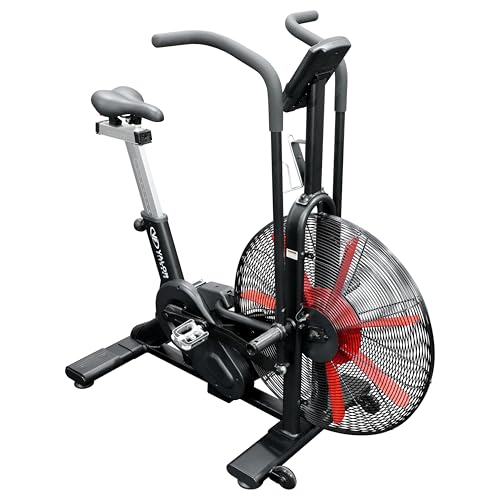
Valor Fitness Air Bike with Digital Monitor
A full-body air bike designed for HIIT and cardio training, with arm and leg engagement across a competition-grade display. The quiet belt drive and 21-position adjustable seat make it practical for varied home gym setups, though its 330-pound weight demands dedicated floor space.
Pros
- Quiet belt drive operation unlike chain-driven alternatives
- Competition-grade digital monitor with multiple performance metrics
- Extensive seat adjustment options (10 horizontal, 11 vertical positions)
- Transport wheels and rubber grip feet for stability and mobility
- Engages multiple muscle groups simultaneously for efficient full-body workouts
Cons
- 330-pound weight requires significant floor space and may be difficult to reposition frequently
- No verified buyer reviews available to assess real-world durability and user experience
- Dimensions of 49 x 25.25 x 50 inches limit placement in smaller home gyms despite storage claims

Tunturi Platinum Pro Air Bike, 165kg Capacity
A self-generating air bike designed for both home and commercial use, with heart rate-controlled training programs and a sturdy frame rated for users up to 165kg. Generous warranty coverage and included setup make it accessible for fitness newcomers, though it lacks verified user feedback to assess real-world performance.
Pros
- Lifetime frame warranty for home users provides long-term value
- Self-generating power eliminates need for wall outlet or battery replacement
- High weight capacity of 165kg accommodates diverse user sizes
- Integrated heart rate control training takes guesswork out of workout intensity
- Full-service delivery with assembly and setup included
Cons
- No verified buyer reviews available, making real-world durability and comfort claims unverifiable
- Warranty requires registration within 30 days, adding administrative step for coverage activation
- Limited specification details on resistance levels, seat adjustability, or noise level
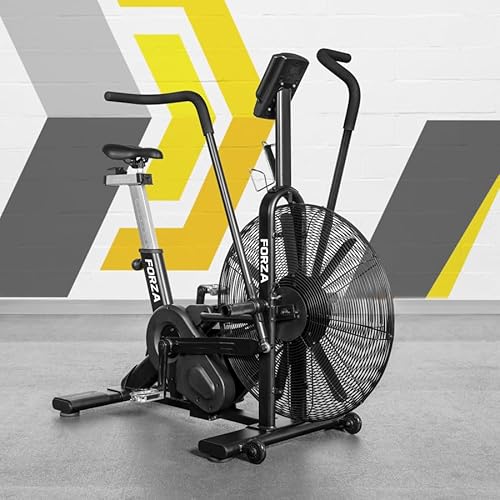
FORZA Air Bike with Digital Monitor, 300lb Capacity
A heavy-duty stationary air bike with belt and chain drive system, backlit digital display tracking key metrics, and adjustable foam-padded seat. Suited for home gym users seeking quiet cardio workouts with customizable resistance and built-in training programs.
Pros
- Quiet operation with smooth belt and chain drive system suitable for shared spaces
- Digital monitor displays comprehensive workout data including watts and RPM
- Accommodates users up to 300 lbs with stable oversized steel frame
- One-press seat adjustment allows quick customization for different users
- Portable design with front wheels and non-slip feet
Cons
- No verified customer reviews available to assess real-world durability and performance
- Weighs 388 pounds, making it heavy despite wheel mobility
- Fan blade resistance may create noise during intense high-RPM workouts
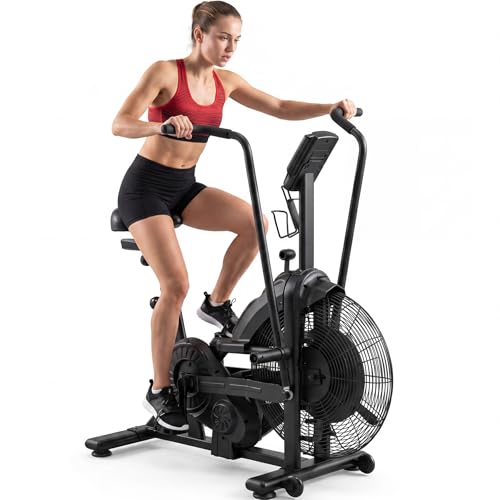
Eryntix Dual Resistance Air Bike with App Connection
This hybrid air and magnetic resistance bike combines adjustable intensity levels with dual-action handlebars for full-body HIIT workouts. Wide user fit range and smart app integration appeal to home gym enthusiasts, though the lack of verified buyer feedback means real-world durability remains unconfirmed.
Pros
- Hybrid dual-resistance design accommodates both explosive HIIT and steady-state cardio without resistance gaps
- Full-body engagement through dual-action handlebars plus isolated upper-body training option via leg rests
- Wide adjustability (seat slide and height settings) accommodates taller users up to 7'2"
- Smart app integration with customizable interval training and wireless monitor sync capabilities
- Eco-certified materials and generous warranty coverage provide reassurance on product safety and longevity
Cons
- Zero verified customer reviews on record, making real-world reliability and durability claims unvalidated
- 4.2 rating appears to be placeholder data rather than actual buyer feedback
- Relatively heavy at 105 lbs and large footprint (46 x 20.9 x 49.6 inches) may challenge apartment-dwellers or shared spaces
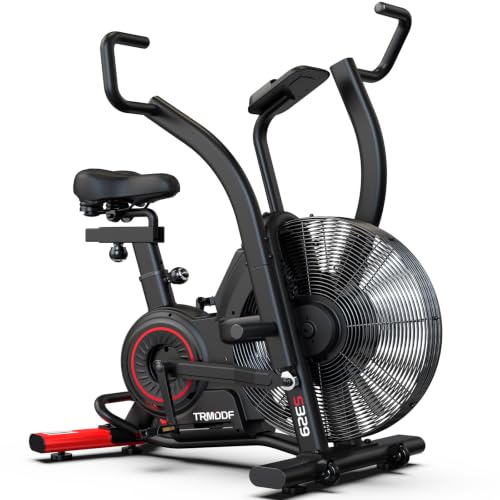
TRMDDF Air Resistance Exercise Bike, 350 lb Capacity
A full-body air bike with dual-action handlebars and Bluetooth connectivity that combines infinite resistance with a 12:1 gear ratio for intense cardio workouts. Suits users 5'1" to 6'3" with adjustable seating and real-time performance tracking.
Pros
- Infinite air resistance adapts naturally to workout intensity without manual adjustment
- Full-body engagement through synchronized arm and leg movement burns calories efficiently
- Extensive seat adjustability (7-height, 5 fore-aft positions) accommodates diverse body types
- Dual-layer transmission system ensures stable, quiet operation during high-intensity intervals
- Bluetooth integration expands training options beyond built-in monitor functions
Cons
- No verified customer reviews available yet to assess real-world durability and long-term performance
- 91-pound weight and large footprint (49" x 27" x 54") requires dedicated space and careful placement
- Air resistance creates noise during workouts, which may disturb household occupants in shared living spaces

Winfita Air Resistance Exercise Bike with Dual-Action
A dual-action air bike designed for full-body cardio workouts with unlimited air resistance that scales with effort intensity. The 350-lb weight capacity, adjustable seat for users up to 6'5", and app connectivity make it suitable for varied fitness levels, though it lacks verified user feedback to confirm real-world durability.
Pros
- Effort-based air resistance provides naturally progressive difficulty without manual adjustment
- Full-body workout capability with independent upper and lower body control
- Robust construction with high weight capacity and protective fan design for safety
- Wide seat adjustability suits diverse user heights and builds
- App integration allows workout customization and performance trend tracking
Cons
- No verified customer reviews available to assess long-term reliability or real-world performance
- Heavier at 85.9 lbs, which may limit portability for home spaces
- Bluetooth connectivity and app features require separate mobile device and compatible software

Wenoker Air Bike 350LBS Capacity with Smart App
An air resistance stationary bike designed for full-body HIIT workouts with dual-action handlebars and smart app integration. Best suited for users seeking variable resistance training and interactive workout tracking across a broad weight range.
Pros
- Dual-motion capability targets arms, legs, and back independently or together for true full-body engagement
- Unlimited air resistance adapts instantly to effort level, scaling from beginners to advanced athletes
- Smart app integration offers workout customization, goal tracking, and interactive challenges beyond the built-in monitor
- High weight capacity and robust steel construction support long-term use for varied users
- Belt-drive system delivers quiet operation suitable for home gym environments
Cons
- No verified buyer reviews available to confirm real-world durability or performance consistency
- Smart app features and compatibility details are not specified, creating uncertainty around setup and device support
- Heavier unit at 101.4 pounds may be challenging to relocate or store in smaller spaces

Pooboo Air Resistance Exercise Bike with Dual-Action Handlebars
A full-body air bike designed for HIIT and cardio workouts, featuring dual-action handlebars that engage upper and lower body simultaneously. The belt and chain drive system operates quietly while an air resistance fan adjusts difficulty based on your effort, plus Bluetooth connectivity lets you track metrics and sync with fitness apps.
Pros
- Versatile full-body workout capability with independent or simultaneous upper/lower body targeting
- Quiet operation thanks to belt-drive system, suitable for home use
- Sturdy construction with 350-pound weight capacity for serious training
- Bluetooth connectivity with customizable interval training programs and real-time feedback
- Fan-based air resistance provides progressive difficulty and cooling airflow during intense sessions
Cons
- No verified user reviews available yet to validate real-world performance or durability claims
- Substantial footprint at 45x25x44 inches and 90-pound weight may require dedicated space
- Preset interval programs lack detail in product data, limiting ability to assess customization depth

pooboo Air Bike with Dual-Action Handlebars
A full-body fan bike with dual-action handlebars that work upper and lower body simultaneously or separately, paired with Bluetooth performance tracking and customizable interval programs. Best suited for home gym enthusiasts seeking intense cardio and CrossFit-style workouts without breaking the bank.
Pros
- Versatile workout targeting legs, arms, and back independently or together
- Natural air resistance produces cooling airflow during intense sessions
- Bluetooth connectivity and app integration for structured training plans
- Durable 90-lb frame accommodates a wide range of user sizes and workout intensities
Cons
- No verified customer reviews available to assess real-world reliability and durability claims
- Requires assembly with some pre-assembled screws, adding setup complexity
- Larger footprint at 45 x 25 x 44 inches may challenge space-limited home gyms
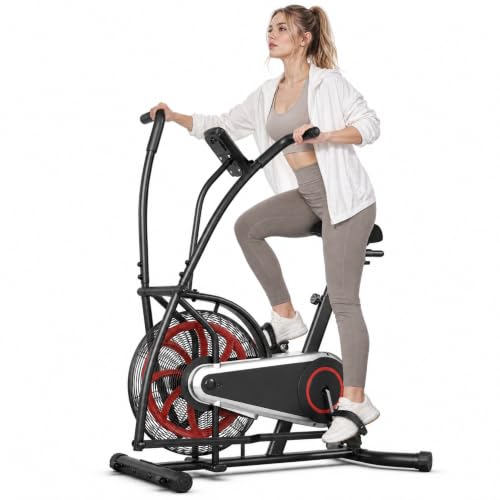
HOMGX Air-Resistance Exercise Bike with Dual Handlebars
This air-resistance exercise bike uses an 8-blade fan for unlimited resistance and whisper-quiet operation, making it suitable for home workouts in shared spaces. It features adjustable seating for different heights, real-time performance tracking, and built-in wheels for easy storage.
Pros
- Quiet fan-based resistance system won't disturb family or neighbors during workouts
- Unlimited air resistance adjusts naturally to workout intensity without manual settings
- Comprehensive seat adjustability accommodates users of varying heights across 10 levels
- LCD monitor with device holder provides essential performance metrics and entertainment access
- Lightweight wheels enable easy repositioning and storage in compact spaces
Cons
- No verified buyer reviews available to validate real-world durability or performance claims
- 58-pound weight and 41 x 50 x 23-inch footprint may challenge placement in smaller rooms despite wheels
- Dual-action handlebars and air resistance system complexity could extend initial setup time despite included manual
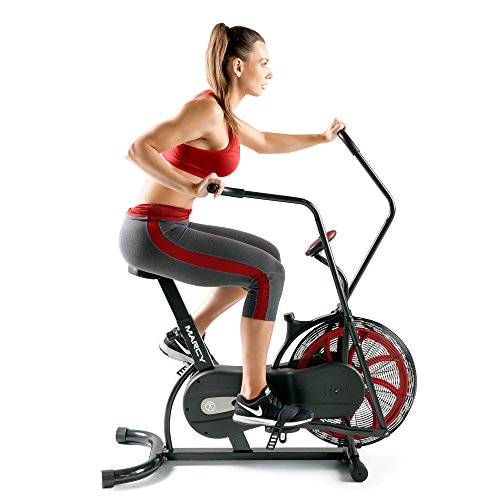
Marcy NS-1000 Fan Exercise Bike with Dual-Action Arms
This stationary bike combines lower-body cardio with upper-body engagement through dual-action arms, plus an air resistance system that keeps you cool during workouts. The adjustable seat, handlebars, and LCD tracker make it a practical home gym option for users seeking full-body conditioning.
Pros
- Full-body workout capability with moving arms, not just leg-focused
- Air resistance provides natural cooling during exercise
- Comfortable ergonomic seating reduces back strain and muscle soreness
- User-friendly LCD interface tracks essential workout metrics
- Relatively portable with transport wheels for home placement flexibility
Cons
- No verified customer reviews available to assess real-world durability and comfort claims
- Heavy at 58 pounds, which may limit portability despite transport wheels
- Air resistance system noise levels not documented in specifications

ERGOLIFE Dual Resistance Exercise Bike, 300lbs Capacity
This compact stationary bike combines air and magnetic resistance across 8 levels, designed to fit homes with limited space while supporting users up to 300 pounds. Best suited for those prioritizing a quiet, space-saving workout machine with adjustable fit for different heights (4'11" to 6'4").
Pros
- Hybrid dual resistance system offers flexibility between air cooling and magnetic intensity control
- Space-efficient design with transport wheels makes it practical for apartments and smaller homes
- Wide user height range (4'11" to 6'4") with ergonomic adjustments accommodates multiple family members
- Solid 300-pound weight capacity with sturdy 51.8-pound frame construction
- Quiet belt drive system suitable for any time of day workouts
Cons
- No verified buyer reviews available yet to assess real-world reliability and durability claims
- Compact design may limit seat travel range or handlebar positioning options compared to larger models
- Exclusive app integration mentioned but no details on compatibility, subscription requirements, or user experience
Air Bikes Buying Guide
Choosing the right air bike is about more than picking the one with the highest watt output or the flashiest display.
Durability, ride quality, resistance feel, and how well a machine fits your body all play critical roles in whether you actually use it consistently.
The sections below break down the key criteria our research identified as most important when evaluating air bikes.
Frame Construction and Weight Capacity

The frame is the foundation of any air bike, and it is where you should start your evaluation. Commercial-grade air bikes use heavy-gauge steel tubing with powder-coat or electroplate finishes to resist corrosion and surface wear.
A heavier overall machine weight (typically above 100 lbs) generally signals more robust construction and contributes to stability during hard sprint intervals, when lateral forces on the frame are at their greatest.
Weight capacity is a practical spec that also reflects frame strength. Most reputable air bikes in this category support between 300 lbs and 350 lbs.
If you are close to the listed limit, go with a machine rated at least 50 lbs above your body weight to preserve longevity and maintain safe operation.
Several picks in this guide, including the Eryntix and Wenoker models, specifically advertise a 350 lb capacity, which gives heavier users meaningful headroom.
Also check the width of the base and whether the machine includes transport wheels or a handle bar. Air bikes are not light, so ease of repositioning matters for home gym setups where floor space is shared.
A wide, stabilizing base beats a narrow footprint every time when sprint intervals are involved.
Drive System: Belt, Chain, or Hybrid

The drive system determines how smoothly power transfers from your pedaling to the fan, and how loud the machine is in operation.
Belt-drive systems are quieter and require less maintenance than chain-drive setups, making them preferable for home environments where noise is a concern.
Chain drives can deliver a more raw, mechanical feel that some athletes prefer, but they require periodic lubrication and can become noisy as they wear.
Several newer models in this guide advertise a dual-layer transmission system, a configuration that uses a layered belt arrangement to improve power transfer efficiency and reduce vibration. The pooboo, TRMDDF, and Winfita bikes all cite this design.
Verified buyer feedback on those models is broadly positive about ride smoothness, though some reviewers note that the feel is slightly different from traditional single-belt commercial air bikes.
If silence is a top priority, whether because you share walls with neighbors or train before others in the household are awake, prioritize belt-drive machines over chain-drive options.
Pairing a quiet air bike with a smart scale for tracking body composition can help you monitor progress without disrupting your home routine.
Resistance Type and Feel
Pure air resistance is the defining characteristic of the category: a fan blade spins against air, and resistance increases exponentially with speed.
This means there is no ceiling on how hard you can work, which is why air bikes are a staple of high-intensity interval training protocols. The trade-off is that there is no fixed easy setting.
At low speeds the resistance feels light, but you cannot dial in a specific wattage output without a performance monitor that estimates it from speed and cadence data.
Some bikes in this guide, including the Eryntix and ERGOLIFE models, combine air resistance with magnetic resistance.
This hybrid approach adds a baseline resistance level that you can adjust mechanically, which some users find useful for low-intensity recovery rides or rehabilitation work where they want consistent, predictable resistance without needing to maintain a high pedaling speed.
For pure HIIT performance and the most authentic air bike experience, a fan-only setup is typically preferred. For users who want flexibility across intensity zones, a magnetic-plus-air hybrid can offer more versatility.
Consider your primary training style before deciding which configuration suits you best.
Monitor and Connectivity Features

Air bike monitors range from simple LED dashboards displaying time, distance, calories, and RPM to full-color LCD screens with Bluetooth connectivity and companion app support.
At the budget end, expect a basic console that covers the essentials. Mid-range and premium models increasingly offer app connectivity that lets you track workout history, set interval programs, and sometimes follow guided workouts on a smartphone or tablet.
Several bikes in this guide, including the pooboo, Winfita, TRMDDF, Wenoker, and Eryntix models, include app connectivity via Bluetooth.
The quality of the companion apps varies considerably, so it is worth researching user reviews of the specific app before making a decision based on connectivity features alone.
A bike with a reliable, responsive display and solid Bluetooth is more valuable than one with an impressive app that crashes frequently.
If you plan to mount a tablet or phone for entertainment or workout tracking, check whether the bike includes a dedicated tablet holder and where it is positioned relative to the handlebars.
Some designs place the holder so high that it blocks the monitor readout during use, which buyers in the verified feedback for several budget models have flagged as a frustration.
Seat Adjustability and Ergonomics
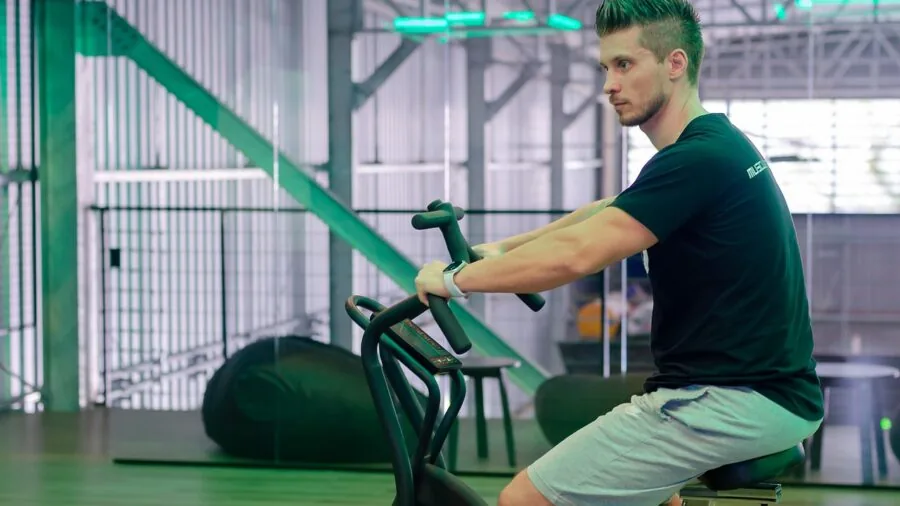
Air bikes are not one-size-fits-all machines.
Vertical seat adjustment is standard across the category, but the best models also offer horizontal (fore-aft) adjustment, which matters significantly for taller or shorter riders who need to optimize their knee extension angle during pedaling.
Improper seat position leads to knee discomfort and reduced power output over time, so this is not a detail to overlook.
Handlebar style also affects comfort. The push-pull handlebars on air bikes vary in grip angle, length, and padding.
Some models include fixed foot pegs that let you isolate the upper body by pedaling with your arms only, or rest your feet while your legs recover between intervals.
This feature is particularly useful for athletes who use air bikes as a recovery tool or for upper-body-focused conditioning.
If you are buying an air bike for a household with multiple users of different heights, look specifically for multi-position seat adjustment systems.
The Valor Fitness model in this guide, for instance, highlights an adjustable seat design alongside foot pegs as part of its core feature set.
Price Tier and Long-Term Value
Air bikes span a wide price spectrum in this guide, from entry-level budget machines to a premium commercial-grade option from Tunturi that sits firmly at the high end of the market.
Entry-level picks like the Marcy NS-1000 and ERGOLIFE models are accessible starting points, but they come with lighter frames, simpler monitors, and shorter warranty coverage than mid-range and premium options.
Mid-range picks from FORZA, Eryntix, Winfita, and Wenoker offer a meaningful step up in frame quality, monitor sophistication, and feature sets while remaining within reach for most home gym budgets.
At the premium tier, the Tunturi Platinum Pro targets commercial and prosumer users who want a machine built to withstand daily, heavy use with minimal maintenance intervention.
Warranty terms are a reliable signal of manufacturer confidence. Look for at least a one-year warranty on parts and labor, and prefer options that extend frame coverage to two years or more.
If you are building a home gym and weighing how to allocate your budget across equipment, note that an air bike covers cardio and strength conditioning simultaneously, potentially reducing the need for additional equipment.
For those who also want low-impact walking or running options, under-desk treadmills complement an air bike well in a home office setup.
Why You Should Trust Us
ProductFind is an independent review publication. We do not manufacture, sell, or distribute the products we evaluate, and we have no commercial relationship with any brand that influences our rankings or scores.
Every air bike in this guide was assessed through structured research: we analyzed published specifications, synthesized expert review consensus from fitness professionals and equipment specialists, reviewed verified buyer feedback from confirmed purchasers, and cross-referenced published data from recognized sources.
We do not conduct our own product trials; our evaluations are grounded in research, published data, expert review consensus, and verified buyer feedback.
Each product receives a PF Score on a scale of 0 to 10, reflecting how well it performs across consistent criteria including build quality, resistance system, ergonomics, monitor and connectivity features, value for price, and warranty coverage.
Scores are assigned independently and are not influenced by brand relationships or advertising. ProductFind may receive an affiliate commission if you purchase through a link in this article.
That commercial arrangement has no bearing on which products are included, how they are ranked, or what PF Score they receive. Our editorial decisions are made solely on the basis of research quality and relevance to the reader.
Final Thoughts
After a thorough review of the air bike category, here are our top picks with the attributes that earned them their standing:
- Best Overall: Valor Fitness Air Bike earns the top spot with the highest PF Score in this group, combining a heavy-duty frame, adjustable ergonomics, foot pegs, a belt drive for quiet operation, and a performance monitor, making it the most well-rounded option for serious home gym users.
- Best Premium Pick: Tunturi Platinum Pro Air Bike is built for commercial environments and prosumer athletes who demand the highest durability standards, professional-grade construction, and white-glove delivery with assembly and commissioning included.
- Best Mid-Range Value: FORZA Air Bike delivers a heavy-duty build and a digital monitor at a mid-range price, making it a strong choice for home gym owners who want commercial-inspired construction without the premium price tag.
- Best Dual-Resistance Option: Eryntix Dual Resistance Air Bike stands out for combining magnetic and air resistance in a single machine with ISCC PLUS certification, a 350 lb capacity, and app connectivity, ideal for athletes who want adjustable baseline resistance alongside air-driven intensity.
- Best Budget Starting Point: Marcy Fan Exercise Bike NS-1000 offers a straightforward entry into air bike training at an accessible price, suitable for beginners exploring the format before committing to a higher-tier machine.
Whichever model fits your budget and training goals, an air bike is one of the most versatile pieces of cardio equipment you can add to a home gym.
If you are rounding out your setup, pairing your air bike with a reliable body composition smart scale gives you meaningful data to track your conditioning progress over time.
Frequently Asked Questions
What is an air bike and how does it differ from a regular exercise bike?
An air bike uses a large fan wheel at the front instead of a weighted flywheel. Resistance is generated by air pushing against the fan blades as they spin, which means resistance increases automatically the harder and faster you pedal.
There is no motor and no fixed resistance dial.
Additionally, air bikes feature dual-action push-pull handlebars that engage your arms, shoulders, and core simultaneously, turning what would be a lower-body-only workout on a standard stationary bike into a full-body conditioning session.
Are air bikes good for HIIT workouts?
Air bikes are exceptionally well-suited to high-intensity interval training. Because resistance increases with effort, you can instantly shift from a recovery pace to maximum exertion without touching any controls.
Classic HIIT protocols like 20-second all-out efforts followed by 40-second rest periods translate directly to the air bike format. The full-body engagement also means you are burning more calories per unit of time compared with lower-body-only cardio machines.
Athletes from combat sports, CrossFit, and general conditioning training regularly use air bikes as a cornerstone of their interval work.
How much space does an air bike require?
Most air bikes in this guide have footprints roughly 50 inches long and 20 to 25 inches wide, though exact dimensions vary by model.
You should also account for at least 24 inches of clearance on each side and behind the machine for safe operation during vigorous intervals. In total, plan for a space of roughly 4 feet by 6 feet minimum.
Air bikes are significantly more compact than treadmills, and unlike folding options, they do not require floor space to unfold.
If floor space is at a premium, air bikes compare favorably to many cardio machines in terms of active footprint versus workout output.
What weight capacity should I look for in an air bike?
Most quality air bikes in this guide support between 300 lbs and 350 lbs.
As a general guideline, choose a machine rated at least 50 lbs above your body weight to ensure the frame and components operate within a safe stress range and maintain longevity.
Several picks here, including the Eryntix, Wenoker, and TRMDDF models, are specifically rated to 350 lbs, giving heavier users and athletes who carry significant muscle mass more confidence in the machine’s durability.
Do air bikes require a lot of maintenance?
Air bikes are generally low-maintenance compared with motorized cardio equipment. Belt-drive models require little more than periodic inspection and occasional belt tension checks. Chain-drive models need more frequent lubrication and should be checked for wear regularly.
The fan and bearings on quality machines are sealed and do not typically require user servicing.
Wiping down the frame and handlebars after workouts, keeping the fan guard clear of debris, and checking all bolts periodically are the primary maintenance tasks most users need to perform.
A machine with a strong warranty provides additional peace of mind should any component issues arise.
Can beginners use air bikes, or are they only for advanced athletes?
Air bikes are suitable for all fitness levels. Because resistance is self-regulating, a beginner pedaling at a comfortable pace faces only light resistance, while an advanced athlete sprinting at maximum effort faces significantly higher resistance from the same machine.
There are no complicated settings to configure. The learning curve is minimal: sit, adjust the seat, grip the handlebars, and pedal.
Beginners should start with shorter sessions and moderate pacing, then gradually increase duration and intensity as their cardiovascular fitness improves.
The dual-resistance models that include a magnetic baseline can be particularly helpful for beginners who want a consistent, predictable feel at lower intensities.
About the author
Chad is a reviewer and writer for ProductFind who specializes in Cardio & Conditioning Equipment. Chad evaluates products through independent research: specifications, expert review consensus, and verified buyer feedback, and rates each one on the PF Score. Chad focuses on helping readers pick the right cardio & conditioning equipment for their needs and budget.