The 8 Best Cable Machines
Cable machines offer more exercise variety per square foot than almost any other home gym equipment. Here are the options that consistently deliver across every budget and space.
 By Amelia Crawford
Updated July 23, 2026
By Amelia Crawford
Updated July 23, 2026

Cable machines are among the most versatile pieces of strength equipment you can add to a home gym.
A single station can cover lat pulldowns, chest flyes, tricep pushdowns, seated rows, face pulls, cable curls, and woodchops, all with constant tension through the full range of motion that free weights simply cannot replicate.
That combination of versatility and joint-friendly resistance makes cable machines a legitimate cornerstone investment rather than an optional add-on, whether you train for hypertrophy, rehabilitation, or general fitness.
If you have ever debated pairing your barbell work with adjustable dumbbells or going all-in on a cable station, the cable machine almost always offers a wider movement menu.
The challenge is that the market spans an enormous range, from wall-mounted pulley systems under a couple hundred dollars to full commercial functional trainers priced like a used car.
Picking the wrong format for your space and goals is the most common source of buyer regret in this category.
At ProductFind, we narrowed the field by analyzing published specifications, synthesizing consensus from experienced fitness equipment reviewers, and combing through verified buyer feedback to surface the options that consistently over-deliver at each price point. Scroll down for our ranked picks.
| Award | Product | PF Score About PF ScoreThe PF Score is our own rating from 0 to 10, based on performance, design and build, ease of use, and value. It reflects independent research and is never influenced by manufacturers, retailers, or affiliate commissions. Learn more › | Price | |
|---|---|---|---|---|
| Best Overall |
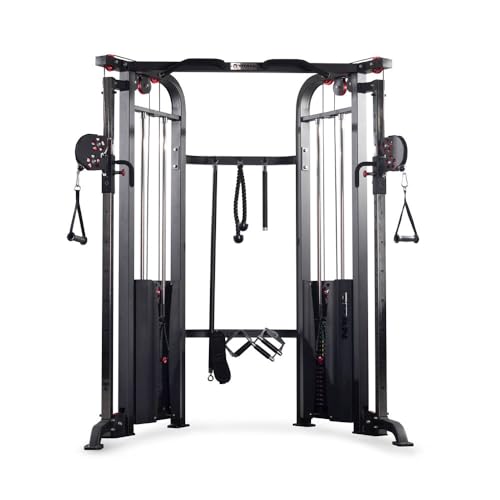 Titan Fitness Functional Trainer with 200 LB Dual Stacks
|
8.6/10 | Buy | |
| Editor's Pick |
 Valor Fitness Plate-Loaded LAT Pulldown & Row Machine, 770 lb
|
7.8/10 | Buy | |
| Best Value |
 JELENS CC01 Cable Crossover Machine with Dual Pulley
|
7.2/10 | Buy | |
| Top Rated |
 YOLEO 2-in-1 Rowing Cable Machine, 450 lb Capacity
|
6.7/10 | Buy | |
 GarveeLife Wall Mount Cable Station, 19-Position Dual Pulley
|
6.5/10 | Buy | ||
 Mikolo G3 Wall-Mount Cable Machine, 19 Positions
|
6.4/10 | Buy | ||
 VEVOR 2-in-1 LAT Pull Machine, 500 lbs Capacity
|
6.3/10 | Buy | ||
 Goimu LS01 LAT Tower, 730 lbs Capacity
|
5.8/10 | Buy |
Titan Fitness Functional Trainer with 200 LB Dual Stacks
A commercial-grade cable crossover machine built for serious home gym setups, featuring dual 200-pound weight stacks and 20 adjustable pulley heights for varied exercise angles. Substantial steel construction and included accessories support full upper-body training, though assembly requires two people and significant floor space.
Pros
- Adjustable pulley heights across 20 positions enable targeted muscle isolation and core engagement
- Dual weight stacks and multiple handle attachments provide extensive exercise variety from one machine
- Heavy-duty steel frame with wide footprint delivers stability for intense training sessions
- Commercial-grade cables rated for smooth, consistent resistance without snagging
Cons
- Requires two-person assembly due to 672-pound total weight and size
- Substantial footprint of 82" tall x 64" wide x 44" deep limits placement options in smaller home gyms
- No verified buyer reviews available to assess real-world durability or long-term satisfaction
Valor Fitness Plate-Loaded LAT Pulldown & Row Machine, 770 lb
A commercial-grade dual-pulley cable machine built for serious upper body training with a heavy steel frame, adjustable positioning, and compatibility with standard and Olympic plates. Best suited for those with dedicated gym space who want versatile lat, row, and cable work without stacking plates.
Pros
- Heavy-duty construction with 10-gauge steel and high-density padding provides stable, controlled movement for lat pulldowns and rows
- Accepts both 1" standard and 2" Olympic plates, offering flexibility in weight loading and equipment compatibility
- Multiple exercise options through dual pulley design and adjustable components support comprehensive upper body training
- Optional floor mounting adds stability for serious lifters and higher volume training
Cons
- No verified buyer reviews available to confirm real-world durability and performance claims
- Requires significant dedicated space (54 x 53 x 99 inches) and is not suitable for compact home gyms
- Plates sold separately, making total investment higher than advertised machine cost alone
JELENS CC01 Cable Crossover Machine with Dual Pulley
A compact functional trainer designed for small home gyms, offering full-body cable exercises through a triangular frame with 15 adjustable height levels. The 64-inch training space and included accessories support everything from lat pulldowns to pull-ups, though it requires 1.5 hours assembly and lacks verified buyer feedback to confirm real-world durability.
Pros
- Triangular frame design maximizes stability while minimizing floor footprint, fitting apartments better than traditional crossover machines
- Comprehensive exercise range supports full-body training from back and chest to legs and arms with seated rowing, lat pulldowns, cable flyes, and pull-ups
- Commercial-grade steel construction with high load capacity (210 lbs cable system, 500 lbs detachable pull-up bar) suggests durability for serious training
- 15 pulley height levels provide flexibility across multiple movement patterns without repositioning the frame
- Includes all essential accessories (bars and handles) ready to use without additional purchases
Cons
- No verified customer reviews available to validate claims about long-term durability or actual build quality consistency
- Requires 1.5 hours assembly time with 2-3 people, creating significant setup friction for solo buyers
- Limited information on cable replacement or maintenance costs, which may be necessary after extended use given the heavy-duty pulley demands
YOLEO 2-in-1 Rowing Cable Machine, 450 lb Capacity
A dual-function cable machine combining rowing and lat pulldown functionality in one foldable frame, designed for home gyms with limited space. Built with heavy-gauge steel and 13 height positions, it suits users pursuing both strength and cardio training.
Pros
- Hybrid design eliminates need for separate rowing and cable machines
- Substantial weight capacity and commercial-grade construction minimize wobble
- Extensive adjustment range accommodates different body types and exercise angles
- Comprehensive attachment kit covers major muscle groups without additional purchases
- Vertical folding design genuinely useful for apartment or small home gym setups
Cons
- No verified buyer reviews available to assess real-world reliability and assembly difficulty
- Footprint remains large during use at 81.5 x 73.3 inches, limiting smaller spaces
- Slide-lock transition between modes may require repeated seat repositioning during mixed workouts
GarveeLife Wall Mount Cable Station, 19-Position Dual Pulley
A space-efficient wall-mounted cable machine designed for home gyms, featuring 19 adjustable height positions and a dual pulley system rated for 400 lbs maximum load. Comes with multiple attachments including lat pulldown bar, triceps rope, and T-bar for varied upper body exercises.
Pros
- Impressive 400 lbs dual cable capacity with heavy-duty aviation-grade cables for serious training
- 19 adjustable positions enable targeting different muscle groups and exercise ranges
- Space-conscious design sits flush against wall when footplate is lowered, ideal for home gyms
- Versatile attachment bundle supports 10+ exercise types from lat pulldowns to face pulls
- Accommodates standard 1-inch and 2-inch weight plates for convenient progression
Cons
- No verified buyer reviews available yet to assess real-world durability and assembly difficulty
- Requires wall mounting and may need professional installation for optimal stability and safety
- Weight bar capacity not explicitly stated, creating uncertainty for maximum plate loading
Mikolo G3 Wall-Mount Cable Machine, 19 Positions
A compact wall-mounted cable crossover system designed for home gyms with dual adjustable pulleys across 19 height positions. Built on a commercial-grade steel frame rated for 400 pounds, it includes three attachments and rotating pulley brackets for varied muscle-group targeting.
Pros
- Robust construction with aircraft-quality nylon-coated cables and commercial-grade powder-coated steel
- Versatile 19-position pulley system enables unilateral and bilateral exercises targeting multiple muscle groups
- Compact footprint (26.9 x 25.6 x 82 inches) maximizes usable gym space
- Multiple included attachments reduce need for separate purchases
- H-shaped base design prevents equipment movement during workouts
Cons
- No verified buyer reviews available to confirm real-world durability and assembly experience
- Requires wall mounting and secure installation, limiting portability and relocation
- 400-pound weight capacity may feel limiting for serious strength training compared to commercial cable machines
VEVOR 2-in-1 LAT Pull Machine, 500 lbs Capacity
A dual-function cable machine combining lat pulldowns and seated rows in one compact frame. Built with heavy-gauge steel tubing and adjustable components for multiple body types, it targets lats, shoulders, triceps, and core with a 500-pound weight capacity.
Pros
- Heavy-duty construction with 1.5 mm carbon steel eliminates wobbling during intense workouts
- Flexible adjustability in seat height and leg roller accommodates users of various sizes
- Dual plate compatibility removes need for adapters or conversion sleeves
- Simple setup process with clear manual means minimal assembly friction
Cons
- Zero verified buyer reviews available, making real-world durability and usability claims unvalidated
- 2-in-1 design may compromise optimization compared to dedicated single-function machines
- Footprint and weight require dedicated floor space that limits placement flexibility
Goimu LS01 LAT Tower, 730 lbs Capacity
A compact 3-in-1 cable machine that combines lat pulldowns, seated rows, and ab crunches in under 3.2 square feet. Built with 2mm steel tubing and rated for 730 lbs, it's designed for home gyms where space is limited but durability matters.
Pros
- Versatile 3-in-1 design covers multiple muscle groups without needing separate machines
- Heavy-duty steel frame with 730 lbs capacity handles serious training loads
- Excellent space efficiency at 3.12 sq.ft, practical for home gym constraints
- Comes with essential attachments included, reducing upgrade costs
- Adjustable seat accommodates a wide range of user heights
Cons
- No customer reviews available to validate real-world performance and durability
- Assembly and installation details not provided in product data
- Weight attachment system limited to 1" or 2" standard plates only
Cable Machines Buying Guide
Before committing to any model, it pays to understand the mechanical and practical differences that separate a frustrating purchase from a machine you will still be using five years from now.
The criteria below reflect the factors that matter most across this category, informed by expert consensus and real owner experience.
Machine Format and Footprint

Cable machines come in several fundamentally different formats, and choosing the wrong format is more consequential than choosing the wrong brand.
Functional trainers (dual-stack crossover machines) give you independent cable arms that travel across a full vertical range, which unlocks the widest movement variety.
Standalone lat pulldown and low-row stations prioritize vertical pulling and seated rowing, covering back and bicep development efficiently in a smaller footprint.
Wall-mounted pulley stations sacrifice the footprint almost entirely, bolting flush to a wall so they disappear when not in use.
Plate-loaded cable machines use weight plates you already own rather than a proprietary weight stack, which can lower the upfront cost considerably if you have a collection of plates.
Measure your available floor space carefully before settling on a format. A full-size dual-stack functional trainer typically requires several feet of clearance on each side plus enough room to stand back and perform cable flyes.
A wall-mounted station from a brand like Mikolo or GarveeLife can deliver surprising movement variety in a fraction of that space.
If square footage is the binding constraint, a wall-mount or a compact 2-in-1 folding machine is almost always the smarter starting point.
Weight Stack Capacity and Cable Ratio
Weight stack or plate capacity is quoted prominently in marketing, but the cable ratio is the number that actually tells you how heavy the machine will feel.
A 2:1 cable ratio means every pound on the stack delivers half a pound of resistance at the handle, so a 200-lb stack produces a maximum of 100 lb of effective resistance per side.
That arrangement improves mechanical advantage and makes cable movement smoother, but it also means you need more stack to move serious weight. A 1:1 system puts full stack weight at the handle and generally feels stiffer in the pulley system.
For most home gym athletes training at an intermediate to advanced level, a genuine effective resistance of 150 to 200 lb per side is enough for virtually any exercise. Beginners and general fitness users will rarely need to approach those numbers.
Plate-loaded designs like the Valor Fitness unit give you near-unlimited resistance ceiling as long as you own enough plates, which matters for heavier athletes who have outgrown selectorized stacks on other machines.
Pulley Quality and Cable Smoothness
The pulley system is the single most important differentiator between a machine you will enjoy using every day and one that ends up ignored.
Ball-bearing pulleys rotate with minimal friction, producing a gliding feel that veteran lifters associate with commercial equipment. Cheap nylon bushings or undersized sheaves create friction, sticking, and jerking that disrupts form and concentrates stress on the cable, shortening its lifespan.
Expert reviewers consistently flag pulley quality as the reason commercial-grade machines justify their higher prices.
Look for pulleys specified with sealed ball bearings and a sheave diameter of at least two to three inches. The cable itself should be aircraft-grade stainless or nylon-coated steel. Budget machines frequently use undersized pulleys that accelerate cable fraying.
Verified buyers across multiple platforms regularly cite cable or pulley failure as the leading long-term complaint on lower-priced options, so this is a component worth scrutinizing before purchase rather than after.
Adjustability and Range of Positions
A cable machine’s movement library is only as large as its adjustment range. Dual-stack functional trainers with continuously adjustable arms cover the most ground, enabling anything from floor-level cable kickbacks to overhead tricep extensions without awkward repositioning.
Wall-mounted stations typically offer a fixed number of indexed positions on a vertical column. More positions mean more exercise variety, but also a more complex pulley carriage to maintain.
Pay attention to how the adjustment mechanism works in practice. Pin-in-slot systems on weight stacks are fast and easy. Carabiner-and-strap systems on wall mounts take a few seconds more but are reliable.
Some budget 2-in-1 stations require repositioning multiple components to switch between high and low pulley work, which becomes annoying during supersets.
Verified buyers frequently note that adjustment ease has a direct impact on how many different exercises they actually perform on a machine over time.
Build Quality and Frame Stability

Frame gauge, weld quality, and base stability determine whether the machine stays planted during heavy pulls or rocks and shifts. Commercial-grade steel is typically 11-gauge or thicker, which resists flex and vibration during max-effort sets.
Lighter 14-gauge frames save manufacturing cost but can wobble noticeably when you load higher-end plate capacities.
Functional trainers in particular need a wide, bolted base or the option to anchor to the floor, because dual-cable movements create asymmetric lateral forces that a lightweight frame cannot resist.
Wall-mounted stations transfer much of the load to the wall studs, which reduces the importance of their own frame mass but raises the critical question of installation.
A machine like the GarveeLife wall mount or the Mikolo station must be anchored into structural studs or masonry, not just drywall.
Verified buyers who skip proper anchoring frequently report wobble and safety concerns, while those who install correctly praise the rigidity. Factor installation hardware and potential professional fitting into the true cost of any wall-mount purchase.
Attachments and Long-Term Value

Cable attachments dramatically expand what a single machine can do. A straight bar, D-handle, rope, ankle strap, and tricep bar together open up dozens of distinct movement patterns. Higher-priced machines from Titan Fitness often ship with a comprehensive attachment set.
Budget models from brands like VEVOR and GOIMU may include only the basics, requiring separate purchases to unlock the full versatility of the station.
Check connector standard compatibility before buying additional attachments. Most modern machines use a standard carabiner clip that accepts universal cable attachments sold on Amazon.
Proprietary connectors on some machines lock you into the manufacturer’s ecosystem and can be both limiting and expensive over time.
If you are the type who enjoys pairing a cable machine with kettlebells for circuit work, having a versatile attachment system matters even more because you will be switching exercises frequently.
Why You Should Trust Us
ProductFind is an independent review publication.
Every product in this guide was assessed using our structured research process: we analyze published specifications, synthesize expert review consensus from experienced fitness equipment reviewers, and evaluate verified buyer feedback across thousands of ownership reports.
We do not conduct our own product trials; our evaluations are grounded in research, published data, expert review consensus, and verified buyer feedback.
Each product receives a PF Score on a scale of 0 to 10, awarded consistently across the same criteria regardless of brand or price point. That score reflects the totality of the evidence, not any single data point.
ProductFind may earn a commission if you purchase through a link in this article. That affiliate relationship has no influence on which products are included, how they are scored, or how they are ranked.
Our only obligation is to the reader. Products are ranked on merit as reflected by the PF Score, and nothing else.
Final Thoughts
The right cable machine depends on your available space, your training goals, and how much you expect to grow into the equipment. After synthesizing the full body of evidence across each model in this guide, here is how we would award the key distinctions.
- Best Overall: Titan Fitness Functional Trainer Cable Crossover Machine earns the top position with the highest PF Score in the group. Its dual 200-lb weight stacks, 2:1 cable pull ratio, and comprehensive attachment package represent genuine commercial-grade performance in a home gym wrapper, and expert consensus is consistently strong on its pulley quality and frame rigidity.
- Best Heavy-Duty Plate-Loaded Option: Valor Fitness Heavy-Duty LAT Pulldown and Low Row Machine is the pick for athletes who already own a substantial plate collection and want a 770-lb capacity frame that will not become a bottleneck as strength improves. Its dual pulley system and commercial build quality set it apart from lighter plate-loaded competitors.
- Best Mid-Range Crossover: JELENS CC01 Fitness Cable Crossover Machine delivers a high-and-low pulley crossover setup with a pull-up bar at a significantly more accessible price than the Titan, making it the sensible step-up for buyers who want crossover functionality without the full flagship investment.
- Best Wall-Mount Station: GarveeLife Wall Mount Cable Station stands out among compact options for its 19-position dual pulley system, included footplate, T-bar, and generous attachment bundle, offering more exercise variety per square foot than almost any freestanding alternative at a comparable budget-friendly price.
- Best Budget Entry Point: VEVOR LAT Pull Down Machine offers a 2-in-1 lat and row setup with adjustable seat and height at the lowest price point in the group, making it the most accessible entry into cable training for users who prioritize cost and do not yet need advanced movement variety.
Whichever model fits your situation, cable machines reward the investment with a level of exercise variety that no other single piece of home gym equipment can match.
Take time to get your format, capacity, and space requirements right before committing, and the machine will repay you with years of productive training.
Frequently Asked Questions
What is the difference between a functional trainer and a lat pulldown machine?
A functional trainer features two independent cable arms that can be positioned anywhere along a vertical rail, enabling crossover exercises, unilateral training, and cable movements at every angle from floor to overhead.
A lat pulldown machine is a dedicated single-function station with a fixed overhead pulley designed specifically for vertical pulling movements like pulldowns and seated rows.
Functional trainers are more versatile; lat pulldown machines are more space-efficient and often more affordable for users whose training is focused on back and bicep development.
How much weight stack capacity do I actually need for a home gym cable machine?
For most recreational and intermediate lifters, a machine with an effective resistance of 100 to 150 lb per side at the handle is more than sufficient for any cable exercise.
Remember to account for the cable ratio: a machine advertising a 200-lb stack with a 2:1 ratio delivers 100 lb of effective resistance. Only advanced athletes performing heavy cable rows or specialized movements are likely to need more.
If you anticipate significant strength gains, a plate-loaded design gives you an essentially unlimited resistance ceiling without needing to upgrade the machine.
Are wall-mounted cable machines safe for home use?
Yes, when installed correctly into structural studs or masonry anchors rated for the machine’s load capacity. The risk comes from improper installation into drywall alone, which cannot support the dynamic forces generated during cable exercises.
Always locate studs with a reliable stud finder, use hardware specified or rated above the machine’s maximum load, and follow the manufacturer’s mounting instructions precisely.
Verified buyers who install properly consistently rate wall-mounted stations as stable and safe; those who cut corners on installation report safety concerns and frame movement.
Can I build a complete physique training only on a cable machine?
A full-featured cable machine covers a surprisingly complete range of muscle groups.
You can train chest with cable flyes and cross-body presses, back with pulldowns and seated rows, shoulders with lateral raises and face pulls, biceps and triceps with curls and pushdowns, and even legs with cable kickbacks and hip abductions.
For most hypertrophy-focused goals, a cable machine combined with bodyweight exercises covers the majority of movement patterns.
Pairing the machine with a quality set of adjustable dumbbells fills in the remaining gaps and gives you one of the most complete home gym setups possible without a dedicated barbell rack.
How do I maintain a cable machine to make it last longer?
Regular maintenance extends cable machine lifespan considerably. Inspect the cable for fraying at the attachment points every few months and replace it at the first sign of wear rather than waiting for a break.
Keep pulleys clean and lubricate them with a silicone-based lubricant annually or according to the manufacturer’s schedule. Periodically check that all bolts and frame connections are tight, because vibration from repeated heavy use gradually loosens fasteners.
Weight stack guide rods benefit from occasional wiping and light lubrication to prevent sticking. Most expert reviewers note that machines neglected on maintenance fail in the pulley and cable system first, while consistently maintained units run smoothly for many years.
What attachments should I buy first for a new cable machine?
If your machine ships with only basic attachments, prioritize a rope attachment for face pulls and tricep work, a straight or EZ-curl bar for pulldowns and rows, a set of D-handles for unilateral exercises and cable curls, and an ankle strap for lower-body cable movements.
Those four additions unlock the majority of cable exercises performed in most training programs. A tricep pushdown bar and a wide-grip lat bar round out a comprehensive attachment collection without significant additional expense.
Verify that any attachments you purchase use a standard carabiner clip compatible with your machine before ordering.
About the author
Amelia is a reviewer and writer for ProductFind who specializes in Home Gym & Strength Training. Amelia evaluates products through independent research: specifications, expert review consensus, and verified buyer feedback, and rates each one on the PF Score. Amelia focuses on helping readers pick the right home gym & strength training for their needs and budget.