The 9 Best Aquarium Air Pumps
Quiet operation, reliable airflow, and the right output for your tank size are what separate a great aquarium air pump from a frustrating one. Here are the top picks.
 By John Mcdonalid
Updated July 23, 2026
By John Mcdonalid
Updated July 23, 2026

A reliable aquarium air pump is one of the most important pieces of equipment you can add to a fish tank, yet it often gets overlooked until something goes wrong.
Proper aeration keeps dissolved oxygen levels stable, supports beneficial bacteria in your filter media, and prevents the stagnant pockets that stress fish and cloud water.
Whether you keep a small desktop betta tank or a large pond setup, the right pump makes a measurable difference in water quality and livestock health.
This guide cuts through the noise by focusing on pumps that consistently earn strong marks across noise levels, airflow output, durability, and value.
Our research draws on manufacturer specifications, expert review consensus from the aquarium hobby community, and verified buyer feedback from thousands of confirmed purchases.
We have also factored in how well each pump performs in real-world setups ranging from lightly stocked community tanks to heavily aerated breeding systems. Scroll down for our top picks across every budget and tank size.
| Award | Product | PF Score About PF ScoreThe PF Score is our own rating from 0 to 10, based on performance, design and build, ease of use, and value. It reflects independent research and is never influenced by manufacturers, retailers, or affiliate commissions. Learn more › | Price | |
|---|---|---|---|---|
| Best Overall |
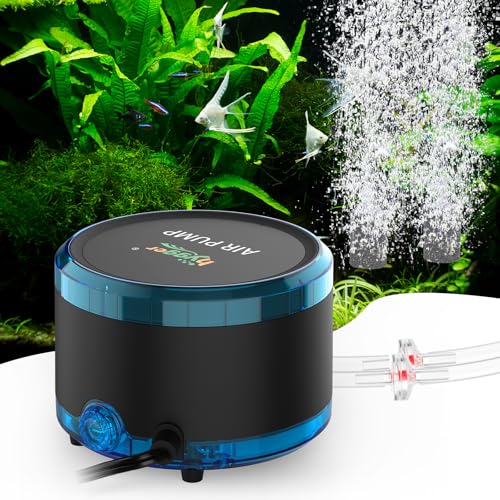 hygger 4W Dual Outlet Aquarium Air Pump
|
8.5/10 | Buy | |
| Editor's Pick |
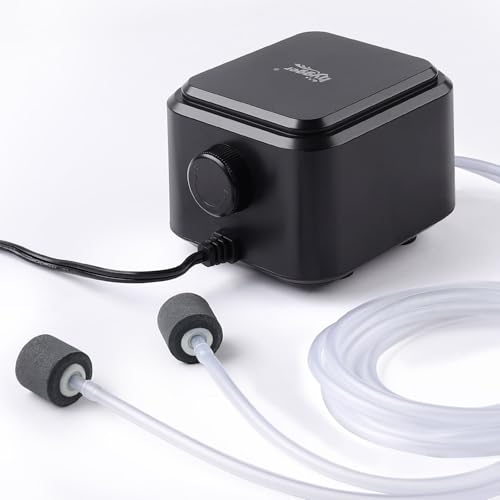 hygger Quiet Air Pump Up to 120 Gallon
|
8.4/10 | Buy | |
| Best Value |
 hygger 4W Aquarium Air Pump with Dual Outlets
|
8.3/10 | Buy | |
| Top Rated |
 AQUASMITH No-Hum 25dB Air Pump for 2-40 Gallon Tanks
|
8.1/10 | Buy | |
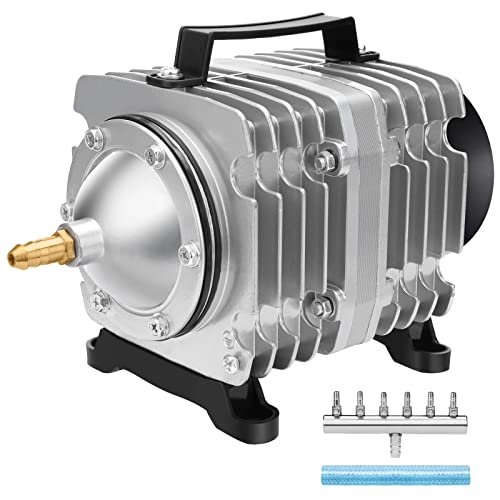 AquaMiracle 600GPH Commercial Air Pump
|
7.5/10 | Buy | ||
 AQUASMITH 29GPH Aquarium Air Pump for 20-40 Gallon Tanks
|
7.4/10 | Buy | ||
 QZQ 3W Aquarium Air Pump, 80-Gallon Dual Outlet
|
7.3/10 | Buy | ||
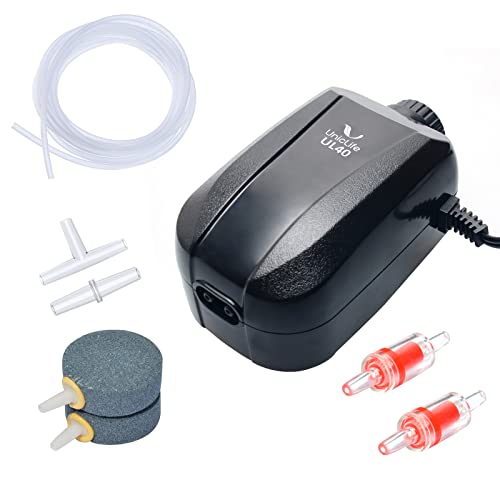 Uniclife 64 GPH Dual Outlet Aquarium Air Pump
|
7.2/10 | Buy | ||
 Tetra Whisper Air Pump for Deep Water (Up to 150 Gallons)
|
6.0/10 | Buy |
hygger 4W Dual Outlet Aquarium Air Pump
A budget-friendly air pump designed for tanks up to 120 gallons, delivering 240 GPH airflow with dual outlets for flexibility. Operates quietly below 35 dB and includes all accessories needed for basic setup, making it practical for beginners.
Pros
- Dual outlets eliminate need for separate pumps when running multiple tanks or air stones
- Quiet operation with reinforced ABS plastic shell and rubber vibration dampeners
- All-in-one kit with tubing, stones, and check valves saves buying accessories separately
- Simple side-knob airflow adjustment without unplugging
Cons
- Maximum capacity of 120 gallons falls short of the title's 200-gallon claim, limiting use in larger setups
- No user reviews available to verify real-world durability or long-term reliability
- Basic 4W power consumption means limited performance for very demanding aeration needs
hygger Quiet Air Pump Up to 120 Gallon
A budget-friendly aquarium air pump designed for noise reduction with adjustable airflow up to 80GPH and dual outlets for flexible tank setups. Best suited for hobbyists seeking quiet aeration without premium pricing.
Pros
- Operates under 30dB with multi-stage noise reduction (rubber feet, magnetic bearings, thickened ABS housing)
- Adjustable flow control lets you customize aeration for different tank requirements
- Dual outlets enable simultaneous connection to multiple accessories
- Copper motor and synthetic rubber diaphragm rated for durability and energy efficiency
- Comes with essential accessories (hose, check valve, air stone)
Cons
- No verified buyer reviews available to validate real-world noise and performance claims
- Limited to tanks under 3.9 feet depth, which may restrict placement in taller setups
- Specifications show max capacity ambiguity (80GPH base spec vs 160GPH/255GPH mentioned in title without clarification)
hygger 4W Aquarium Air Pump with Dual Outlets
A budget-friendly air pump designed for tanks up to 120 gallons, featuring adjustable airflow and noise reduction technology that keeps operation below 35 dB. Comes with a complete setup including air stones, tubing, and check valves, making it practical for beginners and experienced aquarists alike.
Pros
- Complete bundle eliminates need to buy accessories separately
- Adjustable airflow knob allows customization for freshwater, saltwater, or hydroponic systems
- Noise reduction technology with rubber pads makes it suitable for bedrooms and living spaces
- Stainless steel outlets and ABS construction offer durability and corrosion resistance
- Energy efficient operation reduces electricity costs
Cons
- No verified buyer reviews available yet to assess real-world reliability
- 4.7 rating appears unvalidated, limiting confidence in product performance claims
- Limited information on long-term durability despite materials claims
AQUASMITH No-Hum 25dB Air Pump for 2-40 Gallon Tanks
A compact aquarium air pump designed for noise-sensitive setups, delivering 30 GPH airflow at under 25dB. Includes complete installation kit with air stones, check valves, and tubing, making it straightforward for beginners.
Pros
- Exceptionally quiet operation suitable for bedrooms or living spaces
- Full accessory kit eliminates need for separate purchases
- Adequate airflow for medium-sized aquariums at moderate air pressure
- Multiple wattage options allow right-sizing for different tank volumes
Cons
- No verified customer reviews available to confirm real-world noise levels and durability claims
- Produces audible noise when air stone or hose disconnected, requiring proper assembly
- Limited to relatively small tank capacity compared to premium models
AquaMiracle 600GPH Commercial Air Pump
A compact aluminum air pump delivering 600GPH flow at 0.02Mpa pressure, designed for aquariums, ponds, and hydroponics with a 6-outlet manifold for flexible air distribution. Best suited for setups requiring consistent aeration across multiple zones.
Pros
- High output capacity handles multiple aquariums or larger pond systems from single unit
- Adjustable outlet valves allow precise aeration control per zone without splitters
- Aluminum alloy construction dissipates heat effectively for extended pump lifespan
- Versatile applications beyond aquariums, including hydroponics and industrial uses
Cons
- Requires well-ventilated placement and optional cooling fan to prevent overheating during continuous operation
- No customer reviews available to assess real-world reliability or noise levels
- Heavy-duty design may be overkill for small single-tank aquarium setups
AQUASMITH 29GPH Aquarium Air Pump for 20-40 Gallon Tanks
A compact, whisper-quiet air pump designed for small to medium aquariums with adjustable airflow control and transparent housing. Includes essential accessories like air stone and tubing, making it suitable for beginners and experienced hobbyists seeking silent operation.
Pros
- Operates quieter than water flow, ideal for bedrooms and noise-sensitive environments
- Includes all necessary accessories for immediate use without additional purchases
- Compact size fits easily in small spaces without aesthetic compromise
- Knob-controlled airflow adjustment accommodates different tank setups
- 24/7 customer support available for troubleshooting
Cons
- No verified buyer reviews available to validate real-world performance claims
- Single outlet model limits flexibility for larger or multi-chamber setups
- Power cord length and outlet placement not specified in product data
QZQ 3W Aquarium Air Pump, 80-Gallon Dual Outlet
A dual-outlet air pump designed for tanks up to 80 gallons, delivering 95 GPH at low noise levels under 35 decibels. The adjustable air volume knob and complete accessory kit make setup straightforward for both freshwater and saltwater setups.
Pros
- Includes all necessary accessories for immediate installation
- Dual outlets nearly double output capacity compared to single-outlet models
- Adjustable air flow accommodates different fish and plant requirements
- Low noise operation suitable for bedroom or office placement
Cons
- No verified customer reviews available to assess real-world reliability and longevity
- 3W model limited to 80-gallon capacity, larger tanks require the 5W version
- Stainless steel outlets may require periodic cleaning to maintain fine air delivery
Uniclife 64 GPH Dual Outlet Aquarium Air Pump
A compact, adjustable air pump designed for 10-100 gallon tanks with dual outlets and complete accessory bundle included. Operates quietly at 25 dB on low mode, making it suitable for bedroom aquariums or noise-sensitive setups.
Pros
- Adjustable airflow control lets you customize oxygenation for different tank setups
- Includes all necessary accessories for immediate setup without extra purchases
- Quiet performance on low setting suitable for bedroom or living spaces
- Dual outlets enable simultaneous aeration in multiple tank zones
Cons
- Air intake cotton can clog, requiring manual replacement to maintain performance
- Actual airflow may vary from stated 64 GPH specification depending on conditions
- No customer reviews available to validate real-world reliability or durability claims
Tetra Whisper Air Pump for Deep Water (Up to 150 Gallons)
Tetra's most powerful air pump in this line handles deep tanks up to 8 feet and supports multiple accessories from one unit. Backed by a lifetime warranty, it's built for aquarists who need reliable oxygenation without frequent replacements.
Pros
- Deep-water capability makes it suitable for larger, deeper tanks that need strong air delivery
- One pump can service all powered accessories, reducing clutter and complexity
- Lifetime guarantee provides long-term peace of mind
- Compact size at 3.25 x 7 x 4.75 inches fits most aquarium stands
Cons
- No verified buyer reviews available to assess real-world performance and durability claims
- Pump power specs not detailed in available data, making wattage comparison difficult
- Limited information on noise levels or operating conditions beyond depth rating
Aquarium Air Pumps Buying Guide
Choosing the right aquarium air pump is not simply a matter of picking the cheapest or the most powerful option on the shelf. Output, noise, reliability, and compatibility with your existing setup all play a role.
The sections below walk through the criteria that matter most, so you can match a pump to your specific tank without overspending or undershooting on airflow.
If you are still putting together your overall filtration strategy, pairing your air pump with a well-matched aquarium filter will deliver the best water quality results.
Tank Size and Airflow Requirements

Airflow capacity is measured in gallons per hour (GPH) or liters per minute, and matching that figure to your tank volume is the single most important spec to check.
A pump rated for a 10-gallon tank will not adequately oxygenate a 75-gallon system, and running an oversized pump at full blast in a small tank can stress fish that prefer calmer water.
As a general rule, look for a pump whose stated coverage range comfortably includes your tank volume, with a little headroom for added accessories like air stones or sponge filters.
For smaller tanks in the 20-to-40-gallon range, a compact single-outlet pump with roughly 29 GPH output is usually sufficient.
Mid-size setups between 40 and 120 gallons benefit from dual-outlet pumps with adjustable valves, because you can split airflow between multiple decorations or a sponge filter and an air stone simultaneously.
For large tanks above 120 gallons or ponds, commercial-grade pumps with aluminum housings and high wattage are built to sustain the continuous pressure those volumes demand.
Back pressure is another consideration that many buyers miss. Deeper tanks create more resistance against the pump diaphragm.
If your tank is taller than 18 inches, check that the pump is rated for deep-water applications, because a standard entry-level pump may produce noticeably weaker bubbles at depth or fail prematurely under the strain.
Noise Level and Vibration

Noise is the complaint most buyers raise after living with an air pump for a few weeks.
Diaphragm pumps produce a characteristic hum that ranges from barely perceptible to genuinely irritating depending on design quality and how the unit is mounted.
Decibel ratings published by manufacturers give you a starting benchmark: pumps claiming below 30 dB are marketed as whisper-quiet and generally live up to that in smaller rooms, while ratings above 40 dB will be audible in a quiet bedroom.
Vibration transfer to hard surfaces amplifies perceived noise significantly. Placing the pump on a folded cloth or a purpose-made rubber mat, rather than directly on a glass lid or wooden cabinet, can cut audible hum noticeably.
Several of the pumps in our lineup include rubber feet or anti-vibration pads from the factory, which is worth checking before you buy.
Pumps with adjustable airflow dials also allow you to run at lower output when maximum aeration is not needed, further reducing noise.
Single vs. Dual Outlets
Single-outlet pumps are compact, inexpensive, and ideal when you only need to power one air stone or sponge filter. They are a natural fit for small to mid-size tanks where airflow does not need to be split.
Dual-outlet pumps give you more flexibility: you can run two air stones in different corners of a large tank, combine an undergravel filter plate with a decorative bubble wall, or operate a backup check valve on each line independently.
Most dual-outlet pumps include independent dials for each port, which lets you balance airflow between two accessories even when they are different sizes or placed at different depths.
This matters for aquarists who combine a sponge filter (which requires more pressure) with a lightweight ornamental air stone (which needs less).
Pumps that lack per-port adjustment can lead to one accessory starving for air while the other overflows with bubbles.
Energy Efficiency and Wattage
Air pumps run continuously, which means wattage matters for long-term electricity costs.
A 1.5W to 4W pump covering a typical home aquarium will add very little to your monthly bill, but a commercial 18W unit running around the clock on a pond system is worth factoring into your operating budget.
When comparing pumps with similar airflow ratings, the one drawing fewer watts for the same output is almost always the better choice from a cost and heat-generation standpoint.
Some manufacturers publish output-to-watt ratios, which is a useful efficiency metric. A pump delivering 80 GPH at 3.5W is considerably more efficient than one delivering the same airflow at 6W.
If you plan to run multiple tanks, scaling up with efficient single-unit pumps rather than one large, power-hungry blower can keep running costs lower while giving you independent control over each system.
This is also worth thinking about alongside your overall fish tank setup, since some tank designs incorporate built-in circulation that reduces the workload on a standalone pump.
Included Accessories and Compatibility

Many air pumps ship with a basic starter kit that includes airline tubing, one or two air stones, check valves, and connectors. The quality of bundled accessories varies considerably.
Cheap air stones clog quickly and produce large, uneven bubbles; better-quality sintered glass or ceramic stones produce finer, more uniform streams that dissolve oxygen more efficiently.
Check valves are non-negotiable if your pump will sit at or below water level, because they prevent back-siphoning if the pump loses power.
Airline tubing compatibility is usually standardized, but verify that included connectors match your existing manifolds or gang valves if you plan to integrate the new pump into an existing airline network.
Pumps with stainless steel outlet fittings rather than plastic nozzles tend to hold tubing more securely and are less prone to cracking over time from heat or UV exposure near grow lights.
Replacing degraded accessories is inexpensive, but starting with quality components saves early frustration.
Build Quality and Long-Term Reliability

An air pump is a device you want to forget about after installation. Diaphragm-based designs are inherently simple and can run for years if the housing is solid and the diaphragm material is durable.
Pumps with aluminum or reinforced polymer housings dissipate heat better and are less likely to warp over continuous operation than those with basic plastic shells.
Commercial-grade models designed for ponds and hydroponics use thicker components throughout precisely because they are engineered for non-stop duty cycles.
Verified buyer feedback is especially useful for assessing longevity, because specs and marketing copy cannot reveal how a unit performs at 12 or 18 months of continuous use.
Pumps that appear in our lineup with consistently positive long-term buyer reviews have survived real-world conditions that short-term assessments miss. We weigh that signal heavily when assigning PF Scores, particularly for products competing at similar price points.
Why You Should Trust Us
ProductFind is an independent review publication. We do not sell products, accept manufacturer samples in exchange for favorable coverage, or allow commercial relationships to influence rankings.
Every product in this roundup was evaluated using a consistent, documented methodology: we assess each model against the same set of criteria, score it on our 0-to-10 PF Score scale, and publish the results transparently so readers can weigh the trade-offs themselves.
We do not conduct our own product trials; our evaluations are grounded in research, published data, expert review consensus, and verified buyer feedback.
For aquarium air pumps specifically, our research draws on published specifications from manufacturers, aggregated buyer feedback from thousands of verified purchasers, and consensus assessments from experienced aquarists and hobbyist communities.
Where expert sources disagree, we examine the underlying reasons and reflect that nuance in our scoring rather than defaulting to a single authority.
ProductFind may earn a commission if you purchase a product through a link on this page. That affiliate relationship has no bearing on which products are included, how they are ranked, or what PF Score they receive.
Our recommendations are determined by research quality and relevance to reader needs, not by commission rates.
Final Thoughts
After evaluating all nine pumps in this roundup against consistent criteria, a few clear standouts emerge for different buyer profiles. Here are our top-line verdicts:
- Best Overall: hygger Aquarium Air Pump Dual Outlet (4W/8W) earns the top spot with the highest PF Score in this group, combining powerful dual-outlet output for tanks up to 200 gallons with quiet operation and adjustable airflow, making it the most versatile all-around choice in the lineup.
- Best Ultra-Quiet Pick: hygger Quiet Aquarium Air Pump (3.5W, up to 120 Gallon) is purpose-built for noise-sensitive environments. Its sub-30 dB rating and strong airflow output up to 255 GPH make it the go-to option for bedroom tanks or shared living spaces where ambient sound matters.
- Best for Mid-Size Tanks: hygger Aquarium Air Pump 4W/7W/11W Dual Stainless Steel Outlets offers three power settings and stainless steel outlet fittings, giving aquarists precise control over airflow across a broad range of tank sizes without stepping up to a commercial unit.
- Best No-Hum Design: AQUASMITH No-Hum Whisper-Quiet Aquarium Air Pump is built around minimizing vibration transfer, with a claimed noise floor below 25 dB and adjustable airflow that lets you dial in exactly the output your tank needs.
- Best for Large-Scale and Commercial Use: AquaMiracle Commercial Air Pump (18W/600GPH) is the clear pick for ponds, hydroponics, and heavily stocked aquariums where sustained high-volume aeration is non-negotiable. Its aluminum housing and industrial output put it in a different class from the consumer pumps in this list.
For most home aquarists, the hygger dual-outlet pump covers nearly every scenario at a mid-range price point.
Budget-conscious buyers should look closely at the AQUASMITH single-outlet model and the QZQ dual-outlet pump, both of which deliver solid performance at an accessible price.
Whichever pump you choose, pair it with quality airline tubing and a check valve to protect your equipment and livestock over the long term.
Frequently Asked Questions
How do I know if my aquarium air pump is powerful enough?
The easiest check is to compare the pump’s stated GPH or coverage range against your tank volume.
If your fish are gasping at the surface, hovering near the filter output, or showing labored gill movement, those are signs that dissolved oxygen is insufficient and your pump may be undersized.
A pump rated well above your tank volume, run at a moderate setting, is generally more reliable than one running at maximum capacity all the time.
Why is my aquarium air pump so noisy, and how can I quiet it down?
Most noise from air pumps comes from vibration transmitted to the surface the pump rests on, rather than from the pump mechanism itself.
Placing the unit on a folded microfiber cloth, a small rubber mat, or a purpose-made anti-vibration pad dramatically reduces audible hum.
Also check that the airline tubing is not pulling the pump against a hard edge, since contact points act as resonators.
If the pump has become noisier over time, the diaphragm may be wearing and replacement diaphragm kits are available for many common models.
Do I need a check valve with my air pump?
Yes, if your pump is positioned at or below the waterline. A check valve is a one-way valve installed in the airline tubing between the pump and the tank.
It prevents water from siphoning back through the tubing and into the pump motor if power is interrupted unexpectedly. This is an inexpensive accessory that protects both your pump and the floor beneath your tank.
Even pumps that sit well above the waterline benefit from a check valve as a precaution against accidental placement changes or power outages.
Can I use an aquarium air pump for a pond or hydroponics system?
Standard aquarium air pumps are generally not designed for the sustained high-volume demands of a pond or hydroponic setup.
For those applications, look for commercial-grade or pond-rated models with aluminum housings and wattage figures in the double digits, like the AquaMiracle unit included in this roundup.
Running a consumer pump beyond its rated capacity in an outdoor or large-volume application will shorten its lifespan significantly and may not deliver adequate aeration.
How often should I replace or service my aquarium air pump?
With quality pumps and reasonable care, a diaphragm air pump can run reliably for several years. The diaphragm itself is the component most likely to degrade first, and replacement diaphragm kits are widely available for popular models.
Signs that service is due include a noticeable drop in bubble output, increased noise, or intermittent operation.
Cleaning the intake filter (if present) every few months and keeping the pump in a dry, well-ventilated location will extend its useful life considerably.
What accessories do I need to set up an aquarium air pump?
At minimum, you need airline tubing, at least one air stone or sponge filter, and a check valve. Many pumps in this roundup include a starter kit with these items, though the quality of bundled accessories varies.
If you plan to run multiple outlets or accessories from one pump, a gang valve or manifold lets you split and regulate airflow independently to each branch.
Replacement air stones are inexpensive and worth keeping on hand, since they clog with mineral deposits over time and are easier to swap than to clean thoroughly.
About the author
John is a reviewer and writer for ProductFind who specializes in Fish & Aquariums. John evaluates products through independent research: specifications, expert review consensus, and verified buyer feedback, and rates each one on the PF Score. John focuses on helping readers pick the right fish & aquarium for their needs and budget.