The 11 Best Baby Room Air Purifiers
Clean nursery air matters more than most parents realize. Here are the quietest, most effective air purifiers for baby rooms, covering every budget and nursery size.
 By Leonard Perez
Updated July 23, 2026
By Leonard Perez
Updated July 23, 2026
Clean air in a baby’s room is not a luxury; it is a genuine health consideration.
Newborns and infants breathe significantly faster than adults, making them far more vulnerable to airborne irritants like dust, pet dander, pollen, volatile organic compounds (VOCs), and ultrafine particles.
A quality air purifier designed for nursery use can meaningfully reduce these exposures, support deeper sleep, and give parents peace of mind during those early, sleep-deprived months.
Whether you are outfitting a nursery from scratch or upgrading an existing room, the market has expanded rapidly, and sorting through the options is genuinely confusing.
At ProductFind, our editorial team researched the baby room air purifier category by analyzing published specifications, synthesizing expert review consensus across the industry, and reviewing verified buyer feedback from confirmed purchasers.
We focused on criteria that matter most in a nursery context: filtration effectiveness, noise output at sleep settings, room coverage relative to a typical nursery footprint, and thoughtful design features like dimmable night lights and auto-off timers.
The picks below represent the strongest options available across budget tiers, from affordable compact units to smart, app-connected purifiers purpose-built for nursery use. Scroll down for our top recommendations.
| Award | Product | PF Score About PF ScoreThe PF Score is our own rating from 0 to 10, based on performance, design and build, ease of use, and value. It reflects independent research and is never influenced by manufacturers, retailers, or affiliate commissions. Learn more › | Price | |
|---|---|---|---|---|
| Best Overall |
 Levoit Sprout Smart Air Purifier for Bedrooms
|
8.7/10 | Buy | |
| Editor's Pick |
 Canopy Bedside Air Purifier with Night Light
|
8.5/10 | Buy | |
| Best Value |
 Momcozy 4-in-1 HEPA Air Purifier for Nursery
|
8.4/10 | Buy | |
| Top Rated |
 Shark NeverChange Compact Pro 250 sq ft Air Purifier
|
8.2/10 | Buy | |
 Levoit Core 300-P Air Purifier, 1073 sq ft
|
7.8/10 | Buy | ||
 Blueair Blue Pure 511 HEPA Air Purifier, 432 sq ft
|
7.5/10 | Buy | ||
 Honeywell HPA125W Compact HEPA Air Purifier
|
7.4/10 | Buy | ||
 Levoit LV-H132 Compact Air Purifier for Bedrooms
|
7.2/10 | Buy | ||
 YARIKI P60 2-Pack Bedroom Air Purifier with H13 HEPA
|
6.8/10 | Buy | ||
 AROEVE MK01 Medium Air Purifier for Bedrooms
|
6.1/10 | Buy | ||
 FULMINARE H13 HEPA Air Purifier for Bedroom
|
5.3/10 | Buy |
Levoit Sprout Smart Air Purifier for Bedrooms
The Sprout combines air quality monitoring with nursery-friendly features like a blue light-free night light and ambient sounds. AHAM-certified HEPA filtration captures 99.9% of particles down to 0.01 microns, making it suitable for bedrooms and small living spaces.
Pros
- AHAM certified with independently tested air cleaning performance and safety standards
- Comprehensive 7-factor air quality detection helps you understand indoor environment in detail
- True HEPA filter with 99.9% particle capture rate, including dust, pollen, and smoke
- Thoughtfully designed for sleep with blue light-free night light and calming ambient sounds
- Compact footprint at 8.7 x 8.7 x 14 inches makes it suitable for nurseries and bedrooms
Cons
- No customer reviews available yet to validate real-world performance and reliability
- Limited information on filter replacement costs and availability
- Smart features require additional setup and may require app connection for full functionality
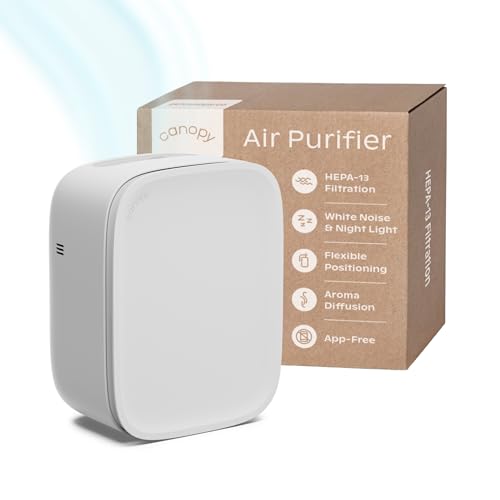
Canopy Bedside Air Purifier with Night Light
A compact H13 HEPA air purifier designed for bedrooms and small spaces, combining air filtration with white noise and adjustable night lighting. Features quiet operation and automatic air quality monitoring, though it lacks app control and requires filter replacement every 6 months.
Pros
- All-in-one wellness device combines air purification with sleep aids (white noise, night light)
- Automatic air quality monitoring adjusts performance without manual intervention
- Simple setup and maintenance with dishwasher-safe parts and touch-free filter ejection
- Quiet operation engineered specifically for bedroom use
- No connectivity requirements, making it straightforward to use
Cons
- No user reviews available yet to verify real-world performance claims
- Filter replacement every 6 months adds ongoing maintenance costs
- Limited coverage area suitable only for bedrooms and small spaces, not whole-home purification
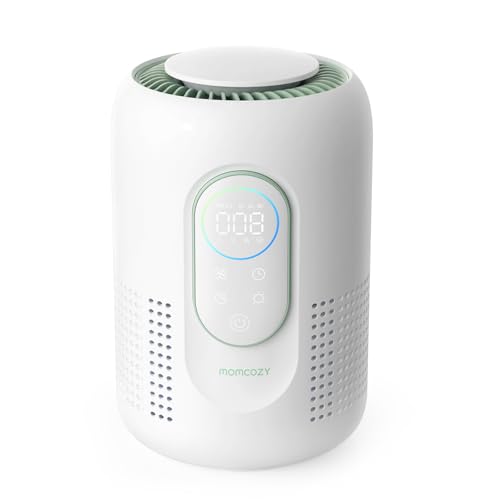
Momcozy 4-in-1 HEPA Air Purifier for Nursery
A compact air purifier designed for bedrooms and nurseries, featuring a quad-layer filtration system with H13 HEPA and activated carbon, real-time PM2.5 monitoring, and a 21dB sleep mode. Smart auto mode adjusts fan speed based on air quality, while a dimmable night light supports nighttime caregiving without disrupting rest.
Pros
- Quad-layer filtration system exceeds standard 3-layer designs, with silver ion coating for added safety around infants
- Real-time PM2.5 monitor with color-coded feedback eliminates guesswork about air quality
- Genuinely quiet at 21dB in sleep mode, suitable for light sleepers and frequent nighttime check-ins
- Smart auto mode reduces manual adjustments while maintaining consistent air purification
- Space-saving compact form factor doesn't dominate small nursery or bedroom footprints
Cons
- No customer reviews available to assess real-world durability, filter replacement frequency, or long-term noise consistency
- Coverage limited to 250 sq ft, making it less suitable for large open-concept spaces or multi-room use
- Dimmable night light brightness range and color options not detailed in specifications
Shark NeverChange Compact Pro 250 sq ft Air Purifier
This compact air purifier covers up to 250 square feet and exceeds HEPA standards with a filter designed to last years without replacement. Real-time air quality display and ultra-quiet operation make it suitable for bedrooms and home offices, though no verified buyer feedback is available yet to confirm long-term performance.
Pros
- Long-lasting NeverChange filter reduces ongoing replacement costs significantly
- Filtration exceeds HEPA standards with 99.98% particle capture across multiple size ranges
- Real-time air quality monitoring with visual feedback eliminates guesswork
- Lightweight and space-efficient for small rooms, dorms, and compact apartments
- Washable pre-filter reduces strain on main HEPA filter and simplifies maintenance
Cons
- No verified buyer reviews available to validate real-world durability or actual filter lifespan claims
- Coverage limited to 250 square feet, requiring multiple units for larger homes
- Long-term cost savings depend on filter actually lasting the claimed years without performance degradation
Levoit Core 300-P Air Purifier, 1073 sq ft
AHAM verified air purifier with a 56W motor and 143 CFM CADR designed for large rooms up to 1,073 square feet. Operates at 24dB in Sleep Mode and includes a 3-in-1 HEPA filter that captures 99.97% of fine particles, making it suitable for homes with pets and allergies.
Pros
- AHAM VERIFIDE certification with independently verified CADR ratings for smoke, dust, and pollen
- Covers large spaces efficiently, refreshing a 1,073 sq ft room once per hour
- Near-silent operation at 24dB in Sleep Mode with optional display light-off feature
- 99.97% filtration efficiency for particles 0.1 to 0.3 micrometers, including pet dander and allergens
- Multiple filter options available, including Pet Allergy, Toxin Absorber, and Smoke Remover variants
Cons
- Limited to 120V US-only operation, not suitable for international use
- Product carries 4.7 rating with zero verified reviews, making long-term reliability difficult to assess
- Requires genuine Levoit replacement filters for optimal performance, as off-brand alternatives may reduce efficiency
Blueair Blue Pure 511 HEPA Air Purifier, 432 sq ft
Blueair's Blue Pure 511 combines compact design with HEPASilent dual filtration to remove 99.97% of particles down to 0.1 microns, making it suitable for bedrooms, nurseries, and home offices. Energy Star certified and whisper-quiet at 24 dB on low speed, it cleans medium rooms efficiently without consuming much power.
Pros
- Highly efficient particle removal down to 0.1 microns captures dust, pollen, smoke, and pet dander
- Compact footprint at 7.9 x 7.9 x 13.9 inches fits easily into small spaces
- Quiet operation makes it suitable for bedrooms and nurseries without disruption
- Energy Star certification confirms low power consumption
- Personalized design with three washable pre-filter color options
Cons
- No customer reviews available yet to validate real-world performance claims
- Designed for North America only, requires 110-120V input limiting international use
- Coverage limited to 432 sq ft maximum, may require multiple units for larger homes
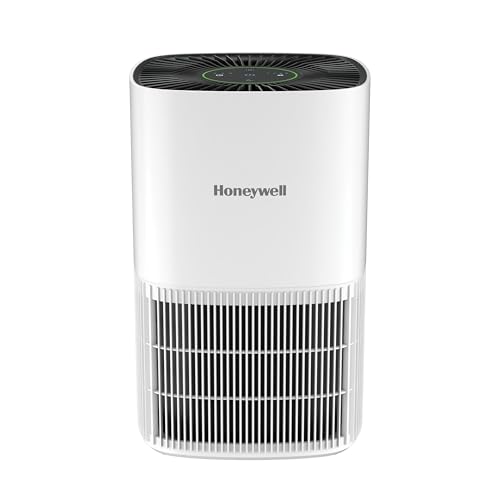
Honeywell HPA125W Compact HEPA Air Purifier
A slim, tabletop air purifier designed for small rooms up to 530 sq ft, featuring an auto mode with air quality sensor and whisper-quiet sleep mode. The 3-in-1 HEPA filter captures allergens and odors, making it suitable for bedrooms, dorms, and offices.
Pros
- Very quiet operation ideal for bedrooms and nurseries, with sleep mode as low as 20.81 dBA
- Compact footprint (7 x 7 x 11 inches) suitable for apartments, dorms, and small offices
- Automatic air quality monitoring adjusts fan speed without manual intervention
- AHAM Verified performance ensures reliable allergen and odor reduction
- 3-in-1 filter system addresses multiple air quality concerns in one unit
Cons
- Limited coverage in larger rooms; at 530 sq ft, filtration drops to 1x per hour versus 4.8x per hour in 110 sq ft spaces
- Product has no verified buyer reviews available, limiting real-world user feedback
- Pre-filter requires regular maintenance for optimal pet hair capture
Levoit LV-H132 Compact Air Purifier for Bedrooms
A compact, AHAM-certified air purifier designed for bedrooms and pet owners, featuring a three-stage filter system and exceptionally quiet operation at 28dB. Best suited for small to medium rooms where noise-free air cleaning is a priority.
Pros
- AHAM certified for verified air cleaning performance and energy efficiency
- Extremely quiet at 28dB, enabling comfortable continuous nighttime operation
- Three-layer filtration system effectively captures dust, pollen, smoke, and airborne particles
- Compact and lightweight design suits bedrooms, small offices, and pet areas
Cons
- No customer reviews available to assess real-world performance and durability
- Compact size suggests limited coverage area, best for smaller rooms only
- Replacement filters must be genuine Levoit model LV-H132-RF for optimal performance
YARIKI P60 2-Pack Bedroom Air Purifier with H13 HEPA
Compact 450 sq ft air purifier designed for bedrooms, featuring whisper-quiet 24dB operation, H13 HEPA filtration for pet dander and PM2.5, plus built-in essential oil diffuser and night light. Rated 4.5 stars with solid after-sales support, though it arrives as a 2-pack which may not suit single-room needs.
Pros
- Genuinely quiet at 24dB, suitable for light sleepers and nurseries
- H13 HEPA filtration effectively targets pet owners' top concern (dander and hair)
- Integrated essential oil slot adds aromatherapy without buying separate diffuser
- Filter replacement reminder system (red light at 1500 hours) prevents missed changes
- Comes with multiple certifications (EPA, CE, FCC, RoHS)
Cons
- Sold as 2-pack only, inflexible if you need just one unit for a bedroom
- No verified buyer reviews yet (4.5 rating with zero reviews) limits real-world feedback on durability and performance claims
- Essential oils not included, requiring separate purchase for aromatherapy feature
AROEVE MK01 Medium Air Purifier for Bedrooms
A compact, budget-friendly HEPA purifier designed for bedrooms and small offices, with dual-channel filtration covering up to 287 sq ft and a quiet sleep mode that operates at just 22 dB. The aroma pad feature adds customization, though filter replacements are needed every 3-6 months for optimal performance.
Pros
- Low noise level in sleep mode makes it ideal for bedrooms without sleep disruption
- Dual-channel air intake with 360-degree design ensures comprehensive room coverage
- Aroma pad allows for customizable scent enhancement without added cost of scented filters
- Replacement filter indicator removes guesswork on maintenance timing
Cons
- Requires frequent filter replacements every 3-6 months, adding ongoing maintenance costs
- No customer reviews available to verify real-world performance or durability
- Essential oils not included; requires separate purchase for aroma feature to function
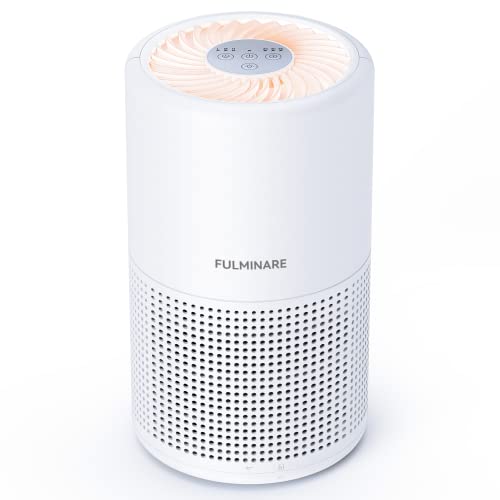
FULMINARE H13 HEPA Air Purifier for Bedroom
A compact, quiet air purifier with H13 HEPA filtration and dual-channel design that refreshes air up to 5 times per hour in rooms up to 215 sq ft. Built-in night light and multiple timer options make it practical for bedrooms and nurseries, though it requires filter replacements every 3 months.
Pros
- H13 HEPA filter captures fine particles effectively for cleaner indoor air
- Ultra-quiet operation at 24dB in sleep mode, ideal for light sleepers
- Dual-channel 360-degree air outlet covers rooms up to 215 sq ft with 5 air changes per hour
- Integrated night light and 5-timer settings (2, 4, 8, 10, 12 hours) add convenience
- Portable and compact design fits easily in bedrooms, offices, or living spaces
Cons
- No verified buyer reviews available to confirm real-world performance claims
- Requires filter replacement every 3 months, adding ongoing maintenance costs
- Limited coverage area of 215 sq ft restricts use to smaller rooms only
Baby Room Air Purifiers Buying Guide
Shopping for a baby room air purifier involves a different set of priorities than picking a general-purpose unit for a living room or home office.
Nurseries are typically smaller spaces, but the stakes are higher: the occupant cannot tell you the air smells off, cannot leave the room, and spends the majority of every 24 hours breathing in that environment.
The following criteria will help you zero in on the right purifier for your nursery, budget, and lifestyle.
If you are also setting up the rest of the nursery, our guide to baby cribs covers sleep surface safety in the same level of depth.
Filtration Technology and Particle Capture
The single most important specification to check is whether the purifier uses a genuine H13 True HEPA filter or, at minimum, a certified HEPA filter meeting AHAM (Association of Home Appliance Manufacturers) standards.
True HEPA filters are rated to capture 99.97% of airborne particles at 0.3 microns, while H13 HEPA goes one step further, capturing 99.95% of particles at the most penetrating particle size.
In a nursery, this distinction matters because fine particles, including tobacco smoke residue, wildfire ash, and traffic-related ultrafine particulates, pass directly into infant lung tissue.
Many of the strongest picks in this roundup, including the Levoit Sprout, the Momcozy nursery purifier, and the Canopy Bedside unit, pair HEPA-grade mechanical filtration with an activated carbon layer to tackle odors and VOCs from paint, off-gassing furniture, and diaper smells.
A 3-in-1 or 4-in-1 filter system (pre-filter, HEPA layer, carbon layer, sometimes an additional antimicrobial layer) offers the most comprehensive coverage without the bulk of separate filter stages.
Always verify that replacement filters are readily available and reasonably priced before committing to a unit, since filter costs can rival or exceed the purifier’s price over a two-year ownership cycle.
Some brands market purifiers with “HEPA-type” or “HEPA-style” filters. These are NOT equivalent to certified HEPA and typically capture far fewer fine particles.
Avoid them for a nursery application unless the product also holds an AHAM VERIFIDE certification, which independently confirms the claimed filtration performance under standardized conditions.
Noise Level and Sleep Mode
Sound is arguably the second most critical factor for a nursery purifier, and it cuts both ways.
You want the unit quiet enough not to wake a sleeping infant, but many parents also rely on the soft white noise of a fan to help mask household sounds and extend sleep stretches.
A purifier rated at or below 25 dB on its lowest speed is generally considered whisper-quiet.
For context, normal conversation runs around 60 dB and a library is approximately 40 dB, so a 21 to 25 dB rating is genuinely close to the threshold of human hearing.
Look for a dedicated “Sleep Mode” that automatically dims display lights, reduces fan speed to the quietest setting, and, in smarter units, uses an onboard air quality sensor to stay quiet when the air is already clean and ramp up only when a pollutant spike is detected.
The Momcozy purifier in this roundup advertises a 21 dB sleep mode, and the Canopy Bedside unit explicitly markets its quiet fan as a feature for sleep, doubling as gentle white noise.
If white noise is important to you, verify that the purifier’s fan produces a consistent, smooth tone rather than a buzzy or rattling sound at low speeds, a distinction that verified buyer reviews often surface better than spec sheets alone.
Room Coverage and CADR Ratings

CADR (Clean Air Delivery Rate) is the standardized metric, established by AHAM, that measures how quickly a purifier removes smoke, dust, and pollen from a space. Higher CADR numbers mean faster air cleaning.
For a nursery, which is typically between 100 and 250 square feet, you do not necessarily need the highest CADR unit available.
In fact, a unit with a CADR rated for a much larger room running on high speed may be louder than necessary.
The goal is a unit whose coverage area comfortably exceeds the nursery footprint by 20 to 30 percent, so it can clean the room on a mid or low fan setting, keeping noise down while maintaining effective air exchange.
A commonly cited guideline is to achieve at least four to five air changes per hour (ACH) in the room.
For a 150-square-foot nursery with 8-foot ceilings, this translates to moving roughly 800 to 1,000 cubic feet of air per minute at peak output, though running at 50 to 70 percent of max capacity is more realistic for quiet overnight use.
The Levoit Core300-P in this roundup, for example, covers up to 1,073 square feet and holds AHAM VERIFIDE certification, meaning its claims have been independently confirmed rather than self-reported.
Units with independently verified coverage ratings are worth prioritizing, especially if you plan to move the purifier between rooms as your child grows.
Smart Features and Air Quality Sensors

For parents who want more than a set-it-and-forget-it device, real-time air quality monitoring adds meaningful reassurance.
An onboard PM2.5 sensor can detect fine particulate spikes caused by cooking smoke drifting from the kitchen, outdoor air quality events, or even a dusty diaper change.
The sensor data typically powers an Auto Mode that adjusts fan speed automatically, keeping the room quiet when air quality is good and ramping up when it detects a change.
The Momcozy nursery purifier includes real-time PM2.5 monitoring and four fan speeds to make this automatic adjustment practical.
Wi-Fi connectivity and companion app support, as found on the Levoit Sprout (our top-scored pick), let you monitor air quality remotely, set schedules, and check filter life from your phone without entering the nursery.
This is especially convenient during nap times. The Canopy Bedside unit adds an onboard air quality sensor and night light combination that is purpose-designed for bedside and nursery placement.
If smart features are not a priority or budget is tight, a non-connected purifier with Auto Mode driven by a local sensor strikes a reasonable middle ground.
Design, Safety, and Nursery-Specific Features

A nursery purifier should be designed with safety in mind from the ground up. Look for units with a stable, low center of gravity that resist tipping if bumped by a curious toddler.
Intake and exhaust grilles should have narrow slots that small fingers cannot penetrate. A child lock feature, available on several units in this roundup, prevents settings from being changed accidentally or deliberately once you leave the room.
Built-in night lights with adjustable brightness or dimmable displays are a practical bonus: they eliminate the need for a separate nightlight, reduce the number of devices plugged in near the crib, and help orient a parent during a 3 a.m. feeding without fully illuminating the room.
The Canopy Bedside unit and the FULMINARE compact purifier both incorporate night light functionality.
A timer or auto-off setting is also useful for daytime naps when you want the purifier to run for two to four hours without having to re-enter the room.
Finally, consider filter replacement indicators that alert you when the filter is saturated, since an overloaded HEPA filter can actually release trapped particles back into the air.
Filter Replacement Costs and Long-Term Value

The sticker price of an air purifier tells only part of the ownership story.
Replacement filters typically need to be swapped every six to twelve months depending on usage level and local air quality, and filter costs vary enormously between brands.
Some budget-priced units use proprietary filters that cost a disproportionate amount to replace, quickly eroding any upfront savings.
Before purchasing, search the ASIN or model number of the replacement filter and calculate a two-year total cost of ownership including at least two filter changes.
Brands like Levoit and Blueair maintain broad filter availability through major retailers and their own direct channels, which reduces the risk of being stuck without a replacement.
Smaller or newer brands may have gaps in filter availability, especially for older model years.
For families investing in a higher-end unit like the Shark NeverChange Compact Pro, the “NeverChange” filter claim is worth scrutinizing carefully in verified buyer reviews to understand what the long-term maintenance reality looks like in practice.
Why You Should Trust Us
ProductFind is an independent editorial review platform. We do not sell products, manage orders, or have any relationship with the brands we evaluate beyond the standard affiliate arrangements disclosed below.
Every product in this roundup was assessed using our structured research methodology: we analyze published specifications, synthesize expert review consensus drawn from across the industry, examine verified buyer feedback from confirmed purchasers, and reference published data from independent organizations including AHAM.
We do not conduct our own product trials; our evaluations are grounded in research, published data, expert review consensus, and verified buyer feedback.
Each product receives a PF Score on a 0 to 10 scale, derived by weighting multiple criteria relevant to the specific product category.
For baby room air purifiers, those criteria include filtration effectiveness, noise performance, room coverage accuracy, smart feature quality, design safety, and filter replacement value.
The PF Score is calculated consistently across every product in the roundup, so scores are directly comparable. Products are ranked by PF Score from highest to lowest, with the top-scoring unit earning the Best Overall designation.
ProductFind participates in affiliate programs, which means we may earn a commission if you purchase through a link on this page. This affiliate relationship has no influence whatsoever on our scores, rankings, or editorial selections.
We do not accept payment for placement, and no brand can purchase a higher PF Score or a more favorable review. Our recommendations reflect what our research indicates are the genuinely strongest products for the intended use case.
Final Thoughts
Baby room air quality is one of those nursery investments that pays dividends every single night.
The purifiers in this roundup span a wide range of budgets and feature sets, from compact, no-frills units to fully connected smart devices with real-time air quality monitoring.
Here is how the top picks break down by use case and strengths:
- Best Overall: LEVOIT Smart Air Purifier Sprout earns the top PF Score in this roundup for its combination of smart connectivity, nursery-specific design, and strong filtration performance, making it the most complete package for parents who want a purpose-built nursery purifier with app control.
- Best for Bedside Use: Canopy Bedside Air Purifier is purpose-designed for placement on a nightstand or dresser directly adjacent to a crib, pairing an air quality sensor and built-in night light with whisper-quiet fan operation and H13 HEPA-13 filtration.
- Best for Real-Time Air Monitoring: Momcozy Air Purifier stands out for its 4-in-1 filtration system, onboard PM2.5 monitor, 21 dB sleep mode, and dimmable night light, delivering a data-rich nursery experience at a mid-range price point.
- Best for Larger Nurseries: Shark NeverChange Compact Pro brings HEPA-exceeding filtration and strong coverage to nurseries and home offices alike, and its low-maintenance filter design appeals to parents who want fewer routine tasks on their schedule.
- Best Mid-Range Value: LEVOIT Core300-P combines AHAM VERIFIDE certification, a 3-in-1 filter, and sleep mode into a well-priced package that covers a wide range of nursery sizes and has a strong track record among verified buyers.
Regardless of which unit you choose, running your nursery air purifier consistently, including during the day when windows are closed, gives it the best opportunity to maintain clean baseline air quality before bedtime.
Pair your purifier with good nursery ventilation habits and regular filter maintenance for the best long-term results.
Frequently Asked Questions
Is an air purifier actually necessary for a baby’s room?
Not strictly necessary in every home, but widely recommended by pediatric and indoor air quality researchers for families with pets, allergies, asthma, smokers in the household, or homes near high-traffic roads.
Infants breathe at two to three times the adult respiratory rate, meaning they inhale proportionally more airborne particles per pound of body weight.
A quality HEPA purifier can measurably reduce particulate load in a small enclosed room like a nursery, which is a meaningful benefit given how much time infants spend sleeping.
For households with no specific air quality concerns and good ventilation, the benefit is smaller but still positive.
Where should I place an air purifier in a nursery?
Place the unit at least three to six feet away from the crib to avoid directing airflow directly at the sleeping infant.
Corner placement or a position against the wall opposite the crib is typically ideal, as it allows the unit to draw stale air from across the room and circulate filtered air broadly.
Elevating the unit slightly on a dresser or shelf (if the design and stability allow) can improve air circulation in smaller rooms.
Keep the area around the unit clear of curtains, furniture, or blankets that could obstruct the air intake grilles.
How often do I need to replace the filter in a nursery air purifier?
Most manufacturers recommend filter replacement every six to twelve months under normal use.
In a nursery context where the purifier runs continuously or near-continuously, lean toward the six-month end of that range, especially if you have pets or live in an area with high outdoor particulate levels.
Many units include a filter replacement indicator light that tracks cumulative runtime and alerts you when the filter is near saturation.
Replacing the filter on schedule is critical: a fully loaded HEPA filter loses efficiency and can begin releasing trapped particles back into the air, which is the opposite of what you want in a baby’s room.
Are air purifiers with ionizers or UV-C light safe for babies?
This is a genuinely important question. Ionizer-equipped purifiers, including those that produce ozone as a byproduct, are generally not recommended for use in nurseries.
The EPA and American Lung Association have both flagged ozone emissions as a respiratory irritant, and infant airways are particularly sensitive.
UV-C light as an add-on feature in purifiers is largely harmless when contained inside a sealed chamber, but the sterilization benefit of UV-C in consumer-grade units is modest compared to a well-specified HEPA filter.
If you see an ionizer toggle on a purifier, leave it switched off in the nursery. Stick to mechanical HEPA filtration combined with activated carbon for the safest and most effective nursery air cleaning approach.
Can I use the same air purifier for the nursery and other rooms as my child grows?
Yes, and it is a smart way to extend the value of your investment.
Units with higher CADR ratings and larger coverage areas, like the LEVOIT Core300-P or the Blueair Blue Pure 511, will perform well in a nursery at lower fan speeds and can be moved to a living room, bedroom, or home office as needs change.
Compact bedside-style units are purpose-sized for small rooms and are less versatile if you anticipate needing broader coverage later.
Consider your home’s overall layout and any home safety priorities when deciding whether a portable or room-dedicated setup makes more sense for your family long-term.
What is the difference between a HEPA filter and an H13 True HEPA filter?
Standard HEPA filters are certified to capture 99.97% of particles at 0.3 microns, the most penetrating particle size.
H13 True HEPA, a classification drawn from European EN 1822 standards, is rated to capture 99.95% of particles at the most penetrating particle size with a more stringent evaluation protocol that evaluates the entire filter, not just a sample section.
In practical terms, both are highly effective for a nursery. The distinction becomes more meaningful in environments with very high particulate exposure, such as homes in wildfire-prone regions or those with heavy smokers.
For most nursery applications, a certified standard HEPA unit like the Blueair Blue Pure 511 with its HEPASilent technology is entirely sufficient, while H13-rated units like the Momcozy and YARIKI options offer an extra margin of assurance for families who want the highest available filtration standard.
About the author
Leonard is a reviewer and writer for ProductFind who specializes in Nursery & Sleep. Leonard evaluates products through independent research: specifications, expert review consensus, and verified buyer feedback, and rates each one on the PF Score. Leonard focuses on helping readers pick the right nursery & sleep for their needs and budget.