The 11 Best Crawling Toys
Crawling toys that actually motivate movement vary widely in quality. We researched the top options by age range, floor type, and budget to help you find one that genuinely works.
 By Luke Ryan
Updated July 23, 2026
By Luke Ryan
Updated July 23, 2026

Crawling is one of the most important physical milestones in a baby’s first year, strengthening core muscles, improving bilateral coordination, and building the spatial awareness that underpins later walking.
Yet many babies need a little encouragement to get moving, and the right toy can turn tummy time from a frustration into an irresistible chase.
The market for crawling toys has grown considerably, ranging from simple push-along vehicles to sensor-equipped animals that change direction on their own, which makes finding a genuinely useful option harder than it looks.
This guide draws on product specifications, expert review consensus across pediatric and parenting publications, and verified buyer feedback to narrow a crowded field down to the picks most worth your attention.
We assessed each option for movement quality, sensory engagement, durability, and developmental appropriateness before assigning a PF Score.
Whether you are shopping for a newborn gift or looking for something to motivate a cautious sitter who has shown no interest in crawling, the ranked list below covers the strongest options across every budget and age range.
| Award | Product | PF Score About PF ScoreThe PF Score is our own rating from 0 to 10, based on performance, design and build, ease of use, and value. It reflects independent research and is never influenced by manufacturers, retailers, or affiliate commissions. Learn more › | Price | |
|---|---|---|---|---|
| Best Overall |
 Baby Einstein Ocean Explorers Go Opus 4-in-1 Activity Toy
|
8.8/10 | Buy | |
| Editor's Pick |
 Fisher-Price Poppity Pop Turtle Push Toy
|
8.2/10 | Buy | |
| Best Value |
 SOSUSHOE 3-in-1 Musical Crawling Turtle Toy
|
8.1/10 | Buy | |
| Top Rated |
 JoySpark Musical Crawling Crab, 50 Songs with Recording
|
7.9/10 | Buy | |
 SAIMAND Interactive Crawling Crab Toy with 40 Songs
|
7.8/10 | Buy | ||
 Fisher-Price Sit & Tap Rolligator
|
7.7/10 | Buy | ||
 hahaland Musical Bouncing Crab Toy for 6+ Months
|
7.6/10 | Buy | ||
 Pbooo Infrared Sensing Walking Crab Toy
|
7.4/10 | Buy | ||
 Jyusmile Musical Crawling Turtle Toy, 6-12 Months
|
7.3/10 | Buy | ||
 Tsomtto Musical Light Up Duck Toy
|
7.1/10 | Buy | ||
 Bright Starts Oball Easy Grasp Rattle Sports Car
|
6.5/10 | Buy |
Baby Einstein Ocean Explorers Go Opus 4-in-1 Activity Toy
A convertible learning toy that adapts through four modes as babies grow from 3 months to 5 years, with touchable plush arms that trigger lights, sounds, and movement. Packed with 150+ songs and phrases plus sensor-based Chase mode, though it requires 3 AA batteries and has no user reviews yet to validate durability claims.
Pros
- Grows with baby through multiple modes addressing different developmental stages
- Rich educational content teaching numbers, shapes, colors, and cause-and-effect
- Touch-activated design encourages fine motor skill development and exploration
- Chase mode with object detection adds interactive, dynamic play value
Cons
- No verified buyer feedback available to confirm long-term reliability or build quality
- Requires ongoing battery replacement for sustained use
- Limited to standard features without evidence of distinctive advantages over competing toys in the category
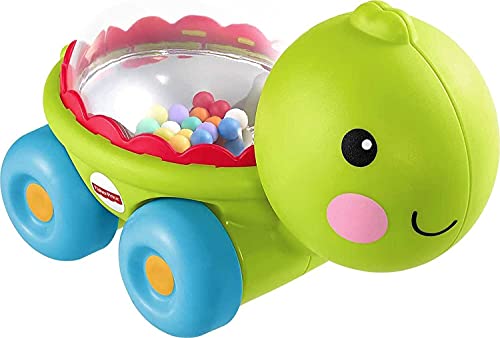
Fisher-Price Poppity Pop Turtle Push Toy
This turtle-shaped push toy combines colorful bouncing balls with popping sounds to encourage crawling and gross motor development in infants 6 months and up. It introduces cause and effect through simple rolling mechanics that engage a baby's senses.
Pros
- Combines visual, auditory, and tactile stimulation through balls, reflections, and sounds
- Motivates babies to crawl by encouraging them to push and follow the toy
- Compact size (3.5 x 5.9 x 6.5 inches) makes it easy to store and transport
- Simple mechanics with no batteries or electronic components needed
Cons
- No verified buyer reviews available to assess durability or long-term performance
- Limited interaction once baby understands the basic rolling mechanism
- Ball movement and sound effects are driven solely by manual pushing, which may not sustain engagement for extended periods
SOSUSHOE 3-in-1 Musical Crawling Turtle Toy
A multifunction baby toy combining obstacle-avoiding crawling mechanics with sensory play and sleep features for infants 0-12 months. The smart navigation encourages tummy time development while pop-bubble buttons and rest mode sounds provide tactile engagement and soothing transitions.
Pros
- Motivates crawling and core strength through active chase play
- Multifunctional design addresses play, learning, and bedtime routines
- Sensory shell develops fine motor skills through tactile feedback
- Parent-friendly volume control protects sensitive hearing
Cons
- Requires 3 AA batteries, not included with purchase
- No verified buyer reviews available to confirm real-world performance
- Compact dimensions may limit crawling range on larger play surfaces
JoySpark Musical Crawling Crab, 50 Songs with Recording
An interactive plush crab that crawls, dances, and records for babies 6-18 months, combining sensory play with 50 built-in songs. The dual-mode design lets infants toggle between recording their own voice and bouncing to music, making it suitable for developmental milestones like crawling and language skills.
Pros
- Dual play modes offer variety: infants can record their voice or listen to pre-loaded songs with bouncing animation
- USB rechargeable design eliminates need for constant battery replacements
- Multiple tactile elements, crinkle sounds, and squeakers support sensory and auditory development
- Machine washable plush cover with removable core adds convenience for caregivers
- Encourages crawling and gross motor skills through chase-and-follow play
Cons
- No verified customer reviews available yet, so real-world durability and performance feedback is limited
- Voice recording feature's sound quality and storage capacity not detailed in specifications
- Requires USB cable charging, which may not be as convenient for on-the-go play without a portable charger
SAIMAND Interactive Crawling Crab Toy with 40 Songs
This plush crawling crab encourages babies and toddlers to chase and develop motor skills while offering 40 built-in songs plus voice recording for interactive play. USB rechargeable design eliminates constant battery changes, making it convenient for daily use.
Pros
- Voice recording feature creates personalized, interactive engagement for curious babies
- USB rechargeable eliminates battery waste and repeated purchases
- Soft plush construction is safe and gentle for young children
- Compact 6-inch size makes it portable for tummy time and travel
- Supports developmental milestones through chasing and crawling encouragement
Cons
- No verified buyer reviews available to confirm durability or long-term battery performance
- Limited to one color option (blue), reducing customization choice
- Small 6-inch size may be less engaging for some active toddlers seeking larger interactive toys
Fisher-Price Sit & Tap Rolligator
A dual-mode activity toy that grows with your baby from sitting to crawling, featuring hammer-tap mechanics and rolling balls to encourage motor skill development. The 2-in-1 play design keeps engagement across different developmental stages.
Pros
- Two distinct play modes accommodate different developmental stages, from seated play to crawling
- Includes squeaker hammer and 3 balls, providing varied tactile and interactive elements
- Encourages hand-eye coordination, gross motor skills, and sensory exploration
- Alligator design adds visual appeal and thematic engagement for infants and toddlers
Cons
- No verified customer reviews available to assess real-world durability or parent satisfaction
- Limited to ages 9 months and older, narrowing the age range for younger infants
- Small parts (balls) require supervision to prevent choking hazards
hahaland Musical Bouncing Crab Toy for 6+ Months
A soft plush crab that combines music, movement, and interactive sound recording to encourage tummy time and crawling. Built-in USB rechargeable battery eliminates the need for disposables, though it requires a power adapter for charging.
Pros
- 48 songs plus repeat-back recording feature supports early communication and cause-and-effect learning
- Gentle bouncing motion and music keep babies engaged during tummy time and floor play
- USB rechargeable battery removes the hassle of battery replacements
- Soft plush texture with colorful details designed for safe tactile exploration
- Appropriately sized at approximately 5 inches for small hands to grasp and hold
Cons
- Power adapter not included in the box, requiring separate purchase for charging
- No verified buyer reviews available to assess real-world durability and performance
- 400mAh battery capacity may require frequent recharging with regular daily use
Pbooo Infrared Sensing Walking Crab Toy
An interactive crab toy with infrared obstacle detection that crawls away and dances to music, designed to encourage tummy time and motor skill development in babies 3-12 months. Made from durable ABS plastic with bright colors and movement patterns to hold infant attention.
Pros
- Infrared obstacle detection encourages active play and crawling exploration
- Durable ABS construction with smooth edges provides safe play experience
- Engaging music, colors, and movement patterns hold infant attention during tummy time
- Compact size makes it portable and easy to store
Cons
- Cannot be used in water or humid environments, limiting play settings
- No verified buyer reviews available to assess long-term durability or parental satisfaction
- Limited age range appeal, primarily designed for 3-12 month infants
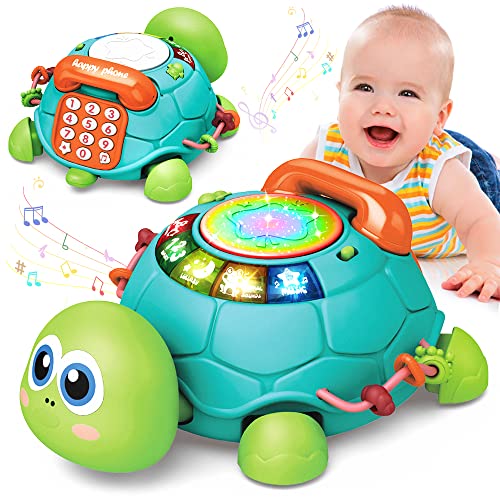
Jyusmile Musical Crawling Turtle Toy, 6-12 Months
An interactive crawling toy designed to encourage infants aged 6-12 months to move and explore through light, sound, and tactile play. Combines multiple learning modes including music, numbers, letters, and a pretend phone feature, though it requires batteries not included in the package.
Pros
- Promotes physical activity and motor skill development with moving, nodding action
- Diverse sensory input with lights, multiple sound modes, and tactile beads
- Two volume levels help protect infant hearing during extended play
- Safe construction using shatterproof ABS with smooth edges and soft lighting
Cons
- Requires 3 AAA batteries not included with purchase
- No verified buyer reviews available to assess real-world durability or performance
- Limited age range focus (targets 6-12 months primarily, with some features suited to older toddlers)
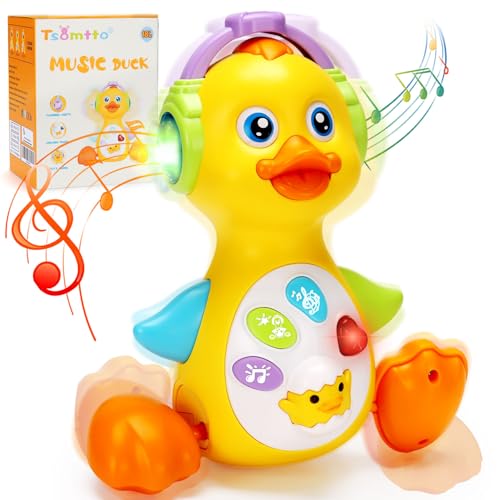
Tsomtto Musical Light Up Duck Toy
A compact, battery-powered duck toy designed for tummy time and early crawling stages, featuring five interactive buttons that produce lullabies, animal sounds, and light effects. The non-toxic ABS construction and soft audio/lighting levels aim at sensory development, though its appeal may be limited to younger infants before independent mobility develops.
Pros
- Multiple sensory inputs (sound, light, movement) support auditory and visual development
- Safe material construction with no reported toxins or sharp edges
- Encourages crawling behavior and large motor skill practice through waddling motion
- Compact 6.7-inch size makes it easy for small hands to handle
Cons
- No verified customer reviews available to confirm real-world durability or battery life
- Limited to younger developmental stages; appeal diminishes as babies become mobile crawlers
- Single color option (yellow) may have limited aesthetic appeal for some parents
Bright Starts Oball Easy Grasp Rattle Sports Car
A soft, flexible rattle toy designed for infants 3 months and up, featuring easy-to-grip Oball construction and rattling tires filled with colorful beads. The push-and-go design encourages early motor skill development with minimal setup or maintenance required.
Pros
- Ergonomic Oball shape makes it genuinely easy for infants to hold and manipulate
- Sensory engagement through both tactile (flexible material) and auditory (rattling beads) feedback
- Encourages active play and early motor skill development
Cons
- No verified buyer reviews available to assess long-term durability or real-world parental satisfaction
- Limited weight and size may offer less developmental challenge as infants grow beyond 6 months
- Single-function toy with minimal play variation once novelty wears off
Crawling Toys Buying Guide
Not every toy that moves qualifies as an effective crawling motivator. The best options balance floor compatibility, sensory engagement, age-appropriateness, and safety in ways that simple novelty toys do not.
The subsections below cover the criteria that matter most when comparing models, drawing on the same framework we use when assigning PF Scores.
Movement Mechanism and Floor Performance
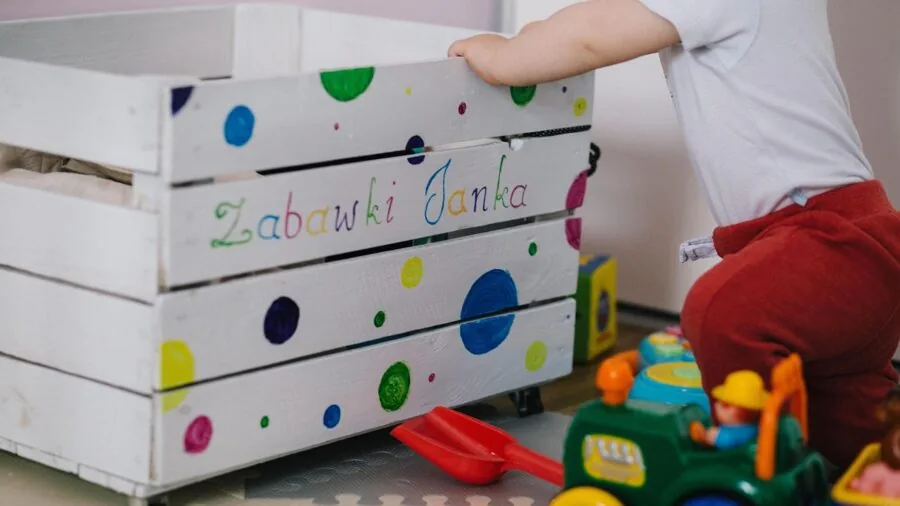
The way a toy moves is the single biggest factor in whether it actually motivates crawling.
Battery-powered models with automatic obstacle avoidance are generally the most effective because they redirect away from walls and furniture rather than stalling in a corner. This keeps the chase going without requiring a parent to constantly reposition the toy.
Sensor-based avoidance systems, used in several of the picks in this list, are meaningfully better than basic bump-and-turn mechanisms because they react before a collision rather than after.
Floor surface matters more than most buyers realize. Press-and-go or friction-powered toys lose momentum quickly on carpet and work best on hardwood or tile.
Battery-powered motorized toys tend to handle low-pile carpet reasonably well, though thick rugs can slow even the strongest motors.
If most of your home is carpeted, prioritize models with rubberized wheels or high-torque motors, and check verified buyer reviews specifically from carpet households.
Pairing the toy with a firm sensory play setup on a thin play mat can also improve performance for lighter models.
Speed calibration is equally important. A toy that moves too fast for a pre-crawler will simply disappear across the room, removing the motivating “almost got it” tension that drives real effort.
Models pitched at the six-to-nine-month range typically move at a pace that stays just out of reach without outrunning the baby entirely, which is the sweet spot for developmental benefit.
Sensory Engagement: Lights, Sounds, and Textures

Effective crawling toys use a layered sensory approach.
Flashing or color-changing lights attract visual attention from a distance, music and sound effects reward the baby when they catch or touch the toy, and varied surface textures provide tactile feedback during close exploration.
The combination of all three keeps engagement across multiple sessions rather than producing a one-day novelty that gets ignored by week two.
Volume control is a feature that parents consistently rate as a dealbreaker in verified buyer feedback. Fixed-volume toys that cannot be muted or turned down become genuinely problematic during nap-adjacent play or in smaller living spaces.
Look for models that include at least a low/high toggle, and consider a mute option a meaningful upgrade.
Several of the musical crab and turtle models in this roundup include recording features that let babies hear their own voice played back, which research on early childhood learning suggests can extend attention spans during play.
Song variety is worth comparing directly.
Toys bundled with 40 or 50 tracks cycle through content far more slowly than those with eight to ten clips, reducing the chance that a particular jingle becomes grating before the toy has served its developmental purpose.
If music is a priority, cross-reference the song count in product specifications and note whether tracks include both instrumental and vocal content, since variety holds attention better than repetition alone.
Babies who are also spending time with cloth books benefit from this same multi-sensory variety across their overall toy rotation.
Age Range and Developmental Stage Fit
Crawling toys span a wider age window than their category name implies.
Some models, including the Baby Einstein Go Opus Go, are designed to start at three months as tummy time motivators and continue adding value through toddlerhood via multiple play modes.
Others are purpose-built for the six-to-twelve-month crawling window and offer little engagement once a child is walking.
Matching the toy to your child’s current and near-future developmental stage determines how long it will hold interest and how much value you extract per dollar spent.
Tummy time readiness is a useful pre-crawling signal. Babies who can lift their head and chest during tummy time are generally ready to begin chasing a slow-moving visual target.
For babies who have not yet reached this stage, stationary light-and-sound toys placed just beyond arm’s reach are more appropriate than rolling or walking models.
Pairing a crawling toy with soft baby books during floor play gives caregivers a flexible way to alternate between active motivation and quieter sensory exploration during the same session.
Multi-stage designs are the most cost-efficient choice for gift-givers who want longevity.
A toy that functions as a tummy time prop at three months, a crawling motivator at seven months, and a push-along walker at twelve months effectively spans three separate product categories.
Review the manufacturer’s stated age range carefully and cross-check it against verified parent reports, since marketing age windows sometimes overstate longevity.
Materials, Safety Certifications, and Durability
All toys in this category should be BPA-free and meet ASTM F963 or EN71 safety standards at minimum.
For the youngest users, three months and up, check that all small parts are securely enclosed and that battery compartments are screwdriver-secured rather than snap-open.
Babies in the crawling stage mouth everything they can reach, so surface materials matter as much as structural safety.
Plush-body crawling toys, including the interactive crab designs from Pbooo and hahaland, offer a softer impact surface if a baby falls forward onto the toy during a chase.
Hard plastic models are generally louder on tile floors and can feel less inviting to grab.
Neither material type is universally superior, but soft-body options earn consistently higher comfort ratings in verified buyer reviews from parents of younger crawlers in the six-to-nine-month range.
Battery life and compartment accessibility are durability factors that product pages underreport. Models that consume AA or AAA batteries at high rates become expensive to run within weeks.
Check whether rechargeable battery compatibility is mentioned and whether the battery door is accessible without tools. Toys with USB-C or micro-USB charging ports eliminate this problem entirely, though they are still uncommon in this price range.
Play Mode Variety and Long-Term Value
Single-mode toys that roll or walk in a fixed pattern tend to lose a baby’s interest faster than models that offer behavioral variety.
The most durable picks in this category either change movement patterns automatically, respond to touch with different sounds, or include secondary play features such as pop-up balls, shape sorters, or a detachable component that works as a standalone toy.
A toy that can be used in two or three different ways extends its useful window without requiring parents to purchase a replacement.
Recording and playback features, found on several models here including the SAIMAND and JoySpark options, represent genuine play mode expansion.
Hearing a caregiver’s voice played back by the toy while it moves away from the baby introduces a social-emotional layer that pure music playback does not provide.
Pediatric occupational therapists frequently note that familiar voices are among the strongest motivators for infant movement, which makes this feature more than a marketing add-on.
Value and Budget Considerations
Crawling toys span a wide price spectrum, and higher cost does not automatically mean better developmental outcomes.
The Fisher-Price Poppity Pop Turtle sits at the budget end of this list and earns a strong PF Score because its core mechanic, popping balls propelled by the baby’s movement, is genuinely effective at holding attention without requiring batteries for the primary play feature.
At the other end of the spectrum, the Baby Einstein Go Opus Go justifies a higher price through four play modes and a multi-year age range that budget alternatives cannot match.
For gift purchases, consider the recipient’s home setup before defaulting to the highest-rated option. A motorized toy that performs well on hardwood may frustrate a family with all-carpet floors.
A larger multi-mode activity toy may be ideal for a dedicated playroom but impractical in a studio apartment.
Budget-range picks like the Oball Rattle and Roll, while simpler in function, are lightweight, portable, and durable enough for travel, which makes them legitimate choices for specific contexts even at a lower PF Score.
Why You Should Trust Us
ProductFind is an independent review publication. Every product in this roundup was assessed using a structured research process that draws on manufacturer specifications, expert review consensus from pediatric and parenting sources, and verified buyer feedback from confirmed purchasers.
We do not conduct our own product trials; our evaluations are grounded in research, published data, expert review consensus, and verified buyer feedback.
Each model receives a PF Score on a scale of 0 to 10, calculated against a consistent set of criteria including movement effectiveness, sensory design quality, age-range value, materials safety, and long-term durability. Scores are assigned before any commercial relationship is considered.
ProductFind may earn a commission if you purchase through a link in this article, but affiliate arrangements have no influence on PF Scores, rankings, or which products are included or excluded. Our recommendations reflect research quality, not commission rates.
Final Thoughts
The crawling toys in this list cover a meaningful range of ages, budgets, and developmental needs, and the right pick depends heavily on where your baby is right now.
Here are the standout designations from our research, each tied to the PF Score earned through our evaluation process.
- Best Overall: Baby Einstein Ocean Explorers Go Opus Go earns the top position thanks to its four distinct play modes, an age window that runs from early tummy time through toddlerhood, and the highest PF Score in this roundup. It is the most versatile single purchase in the category.
- Best Budget Pick: Fisher-Price Poppity Pop Turtle delivers reliable crawling motivation through a satisfying ball-popping mechanic that does not depend entirely on batteries, making it an exceptionally durable value choice for families who want a simple, proven design.
- Best for Multi-Sensory Development: SOSUSHOE 3-in-1 Musical Crawling Turtle combines smart obstacle avoidance, a push-and-pop sensory shell, and a sleep-soothing mode in one compact frame, addressing tummy time, active crawling, and wind-down in a single product.
- Best for Music-Focused Play: JoySpark Toys Musical Crawling Crab leads the plush crab category with 50 songs and a recording feature that lets caregivers capture their own voice for playback, producing a social-emotional motivation layer that simpler music-only models cannot replicate.
- Best Interactive Design: Fisher-Price Sit and Tap Rolligator stands apart from the musical toy majority with a tap-activated rolling mechanic that rewards cause-and-effect exploration, making it a strong pick for babies who respond better to action than to sound-driven cues.
If you are building out a broader early-play collection alongside a crawling toy, pairing your pick with a set of baby rattles gives babies a complementary grip-and-shake experience during the rest breaks between active floor sessions.
The combination of motivational crawling toys and quieter sensory objects supports more complete developmental coverage across a single play period.
Frequently Asked Questions
At What Age Should I Introduce a Crawling Toy?
Most crawling toys are designed for babies six months and up, which aligns with when the majority of infants develop enough core strength to push up and begin pre-crawling movements.
However, several models in this list, including the Baby Einstein Go Opus Go, are rated from three months onward as tummy time aids.
If your baby is younger than six months, look specifically for models that include a stationary mode or a stand-up play position so they offer value before active crawling begins.
Pediatric guidelines from the American Academy of Pediatrics note that babies can begin crawling anywhere between six and thirteen months, so there is a wide normal range.
A crawling toy introduced at five months as a visual motivator during tummy time can continue serving its purpose well into the ten-month range without becoming developmentally obsolete.
Do Crawling Toys Actually Help Babies Learn to Crawl Faster?
Crawling toys do not accelerate motor development in a clinical sense, but they increase the frequency and duration of floor time, which is the environment where crawling develops naturally.
A baby who spends more time on their stomach chasing a moving toy is getting more repetitions of the muscle-strengthening movements that precede crawling.
In that sense, a good crawling toy functions as an environmental motivator rather than a developmental shortcut.
Expert review consensus consistently favors toys that maintain a pace just slightly faster than the baby can match, creating what researchers describe as a zone of proximal motivation.
Toys that move too slowly fail to prompt effort, while toys that move too quickly become discouraging. Models with adjustable speed or built-in obstacle avoidance that keeps the toy in the room tend to perform best for sustained engagement.
Are Musical Crawling Toys Safe for a Baby’s Hearing?
Toys that comply with ASTM F963 or EN71 standards are required to stay below 85 decibels at a specified distance from the sound source. Most reputable brands in this category meet that threshold.
However, verified buyer feedback consistently raises volume as a concern, and volume levels can feel louder in hard-floored rooms with reflective surfaces.
Choosing a model with a volume control toggle or a mute option gives caregivers practical control regardless of the manufacturer’s nominal decibel rating.
Keep play sessions in line with general guidance from pediatric audiologists, who recommend limiting exposure to sustained noise above 70 decibels for extended periods.
Short active play sessions with a musical crawling toy followed by quieter exploration with sensory books or simple fabric toys keeps the overall auditory environment balanced.
What Is the Difference Between Obstacle Avoidance and Bump-and-Turn Crawling Toys?
Bump-and-turn toys rely on physical contact with an obstacle to trigger a directional change. The toy rolls or walks until it hits a wall or piece of furniture, then rotates and continues in a new direction.
This mechanism is simple, inexpensive, and reliable, but it means the toy must make contact before changing course, which can result in it becoming wedged or stalling in tight corners.
Infrared or ultrasonic obstacle avoidance systems, used in models like the Pbooo Crawling Crab, detect objects before contact and redirect accordingly.
This produces smoother movement patterns that stay in open play areas longer, which translates directly into more sustained crawling motivation. The trade-off is slightly higher cost and the addition of sensor hardware that can malfunction if dirty or obstructed.
For most buyers, the improvement in play continuity justifies the modest price difference between the two mechanism types.
How Do I Clean a Plush Crawling Toy Safely?
Plush crawling toys with electronic internals should not be submerged in water or machine washed unless the manufacturer explicitly states the electronic module is removable and the shell is washer-safe.
For most models, spot cleaning with a damp cloth and mild soap is the recommended approach. Remove batteries before any cleaning to prevent moisture damage to the compartment.
High-contact areas such as the feet, antenna, or any part the baby consistently mouths should be wiped down after each session.
Verified buyer feedback for the plush crab models in this roundup frequently mentions that outer fabric holds up well to repeated spot cleaning over a six-month use period, which aligns with the age window during which these toys see heaviest use.
Can These Toys Be Used on Carpet?
Performance on carpet varies significantly by model. Battery-powered motorized toys with higher torque motors handle low-pile carpet reasonably well, while press-and-go and lighter motor designs lose speed and can stall on anything thicker than a thin play mat.
If your home is primarily carpeted, prioritize models with rubberized traction wheels and check verified buyer reviews specifically from carpet users before purchasing.
A firm, low-pile play mat placed on carpet can improve performance for most models and has the additional benefit of giving the baby a defined, comfortable crawling surface.
This is a practical workaround for households where replacing flooring is not an option and the preferred crawling toy is not rated strongly for thick carpet performance.
About the author
Luke is a reviewer and writer for ProductFind who specializes in Baby Toys & Infant Development. Luke evaluates products through independent research: specifications, expert review consensus, and verified buyer feedback, and rates each one on the PF Score. Luke focuses on helping readers pick the right baby toys & infant development for their needs and budget.