The 9 Best High-Back Booster Seats
Safety, fit, and comfort all depend on picking the right high-back booster seat. This guide covers the top options for kids from 40 to 120 lbs across every budget.
 By Martha Hoffman
Updated July 23, 2026
By Martha Hoffman
Updated July 23, 2026
Choosing the right high-back booster seat is one of the most important decisions parents make for school-age children.
Once a child outgrows a five-point harness, a quality booster seat ensures the vehicle’s seatbelt positions correctly across the shoulder and lap, which directly affects how well it protects in a collision.
With dozens of options on the market, ranging from budget-friendly convertibles to premium seats packed with safety technology, the differences between a mediocre pick and a great one are real and worth understanding before you buy.
This guide covers the top high-back booster seats available right now, evaluated through ProductFind’s research-based approach: we analyze published specifications, synthesize expert review consensus, and weigh verified buyer feedback to surface the seats that genuinely deliver on safety, comfort, and long-term value.
Whether you’re shopping for a budget pick under fifty dollars or a premium seat built to last through multiple children, the options below represent the strongest choices across price ranges.
Scroll down to see our full ranked list of top picks.
| Award | Product | PF Score About PF ScoreThe PF Score is our own rating from 0 to 10, based on performance, design and build, ease of use, and value. It reflects independent research and is never influenced by manufacturers, retailers, or affiliate commissions. Learn more › | Price | |
|---|---|---|---|---|
| Best Overall |
 Chicco MyFit 2-in-1 Harness + Booster Car Seat
|
8.7/10 | Buy | |
| Editor's Pick |
 Graco TurboBooster 2.0 Highback Booster Seat
|
8.4/10 | Buy | |
| Best Value |
 Graco Nautilus 2.0 LX 3-in-1 Booster Car Seat
|
7.6/10 | Buy | |
| Top Rated |
 Diono Cambria LE 2-in-1 Booster Seat, 40-120 lb
|
7.4/10 | Buy | |
 Joie Basil 2-in-1 Booster Seat, 40-120 lbs
|
7.3/10 | Buy | ||
 Diono Cambria 2 XL Booster Seat, 40-120 lb
|
7.2/10 | Buy | ||
 Safety 1st Grow and Go 2-in-1 Booster, 40-100 lbs
|
6.8/10 | Buy | ||
 Safety 1st Grand 2-in-1 Booster Car Seat (40-100 lbs)
|
6.7/10 | Buy | ||
 Britax Highpoint Backless Booster Seat
|
8.6/10 | Buy |
Chicco MyFit 2-in-1 Harness + Booster Car Seat
A convertible forward-facing car seat that transitions from 5-point harness for toddlers to belt-positioning booster for older children, featuring flame retardant-free materials and advanced side impact protection. The slim profile fits three across in most backseats while offering adjustable comfort features like a 9-position headrest and 4-position recline.
Pros
- 2-in-1 design extends usability from toddler through early school years without repurchasing
- Advanced Side Impact Protection (ASIP) meets federal safety standards for side collision scenarios
- Flame retardant-free construction with GREENGUARD Gold certification reduces chemical exposure
- Easy installation with LATCH connectors, LockSure system, and RideRight bubble levels ensure proper fit
- Slim, contoured ErgoBoost seat with dual-density foam padding fits tight backseat configurations
Cons
- No verified buyer reviews available to assess real-world reliability or long-term durability feedback
- Higher end of mid-range pricing may not appeal to budget-conscious buyers
- At 25 pounds, the seat is moderately heavy for frequent repositioning between vehicles
Graco TurboBooster 2.0 Highback Booster Seat
A convertible 2-in-1 booster that transitions from highback to backless, designed for children ages 4-10 (40-100 lbs). Safety features include crash-tested engineering and belt guides to help position seat belts correctly.
Pros
- Crash-tested design provides proven safety across multiple collision scenarios
- Flexible 2-in-1 configuration extends usability as child grows
- Adjustable components ensure proper fit and comfort for different heights
- Belt guide system reduces improper seat belt positioning
- Compact, lightweight construction aids in vehicle transfers
Cons
- No verified customer reviews available to confirm real-world durability and ease of use
- Convertible design may require learning proper transition between highback and backless modes
- Limited color options with single Freya color variant shown
Graco Nautilus 2.0 LX 3-in-1 Booster Car Seat
A convertible booster that grows from forward-facing harness through backless mode, spanning ages toddler to big kid with a steel-reinforced frame built for 10 years of use. The No-Rethread harness system and InRight LATCH attachment simplify installation and adjustment as your child grows.
Pros
- Extended lifespan covers multiple stages, reducing need to replace booster as child grows
- Simplified adjustment system eliminates rethreading hassle during transitions
- InRight LATCH ensures secure, audible installation confirmation
- Recline and headrest flexibility adapts to different seating positions
- Two cup holders and soft quilted materials add practical comfort
Cons
- No verified customer reviews available to assess real-world reliability and ease of use
- 17.4-pound weight may be cumbersome for frequent transfers between vehicles
- Limited color option listed (Hex 2.0 only in provided data)
Diono Cambria LE 2-in-1 Booster Seat, 40-120 lb
A convertible booster that switches between high-back and backless modes for children 40 to 120 pounds, with side impact protection and six headrest positions. At just 12 pounds, it's designed to move easily between vehicles.
Pros
- Converts between two configurations, reducing need for multiple seats as child grows
- Lightweight and portable design simplifies transfers between cars
- Six headrest positions allow gradual height adjustment over time
- Side impact protection adds an extra safety layer
Cons
- No verified customer reviews available to confirm real-world performance
- 17-inch width may be snug in some vehicle seats with limited space
- Conversion between modes requires manual adjustment rather than automatic toggle
Joie Basil 2-in-1 Booster Seat, 40-120 lbs
A convertible booster that switches between highback and backless modes to grow with your child from 40 to 120 pounds. Lightweight at under 9 pounds with a 7-position adjustable headrest and removable, machine-washable cover for easy upkeep.
Pros
- Converts from highback to backless, extending usability across a wide weight range (40-120 lbs)
- One-hand headrest adjustment makes it simple to customize fit as your child grows
- Removable cover and easy-clean cup holders simplify maintenance
- Lightweight construction makes it practical for shared vehicles or frequent travel
- Belt guides help prevent incorrect buckling, reducing safety concerns
Cons
- No verified buyer reviews available to confirm long-term durability or real-world performance
- Maximum child height limit of 47 inches may be restrictive for taller children before reaching the weight limits
- LATCH system adds installation steps compared to belt-only booster seats
Diono Cambria 2 XL Booster Seat, 40-120 lb
A spacious booster designed for older children and preteens, the Cambria 2 XL grows from high-back to backless mode with a 7-position headrest and dual latch connectors. The wide XL design prioritizes comfort with padded armrests and removable, machine-washable fabrics, making it practical for families seeking a long-term single booster solution.
Pros
- Extended weight range (40-120 lb) eliminates need for seat replacement as child grows
- XL design prioritizes comfort and space, reducing typical booster seat squeeze
- Removable, machine-washable upholstery keeps seat hygienic long-term
- Convertible high-back to backless mode extends usability through preteen years
- Layered foam padding and Side Impact Protection provide structural support
Cons
- No verified user reviews available, limiting real-world feedback on durability and long-term satisfaction
- Larger footprint (16.1 x 20.1 x 29.9 inches) may limit portability between vehicles
- Dual latch installation complexity not detailed in provided specifications
Safety 1st Grow and Go 2-in-1 Booster, 40-100 lbs
A convertible booster that transitions from high-back to backless as your child grows, with an expandable ComfortWings design that accommodates taller kids up to 57 inches. Compact and foldable for families needing a space-efficient seat across multiple vehicles.
Pros
- Dual-mode design eliminates need to buy separate backless booster later
- Expandable seat width and adjustable 10-position headrest grow with child
- Narrow footprint maximizes rear seat space in compact cars
- Removable, washable components simplify maintenance
- Belt guides help children position seatbelt correctly without adult intervention
Cons
- No customer reviews available to validate real-world durability and comfort claims
- ComfortWings may still feel snug in older vehicles with narrow back seats
- Lightweight construction could mean less cushioning compared to heavier boosters
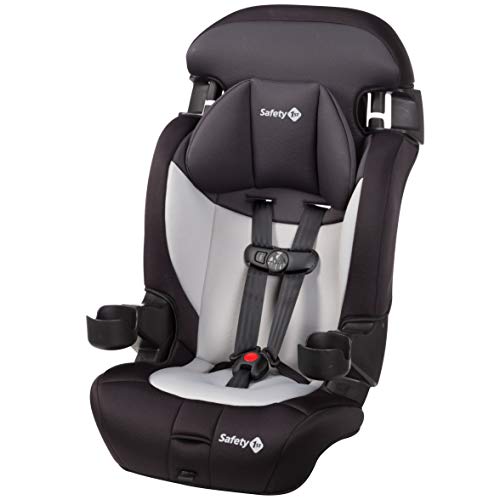
Safety 1st Grand 2-in-1 Booster Car Seat (40-100 lbs)
A convertible booster that transitions from harness to belt-positioning mode as your child grows, designed to fit three across in most vehicles. Best suited for families managing multiple children or frequent car switches who prioritize flexibility over premium features.
Pros
- Converts from high-back harness booster (40-65 lbs) to belt-positioning mode (40-100 lbs), extending usability as children grow
- Slim profile fits three seats across in standard vehicle back seats, practical for larger families and carpools
- Lightweight at 8 pounds with portable design, making it easy to move between vehicles
- Adjustable headrest grows with child, machine-washable seat pad, and dishwasher-safe cup holders simplify maintenance
- Budget-friendly option for families needing a long-range booster solution
Cons
- No verified buyer reviews available to assess real-world durability or performance reliability
- 5-point harness converts away in belt-positioning mode, limiting safety features for larger children
- Limited to 100-pound weight capacity, which may be restrictive for taller or heavier children compared to some alternatives
Britax Highpoint Backless Booster Seat
A lightweight, slim backless booster designed for bigger kids with higher weight and height limits than most competitors. The machine-washable cover and no added flame-retardant chemicals set it apart for parents seeking practical, safer materials.
Pros
- Slim profile allows three seats to fit across most vehicle rows
- Machine-washable cover eliminates hand-washing hassle and air-dry wait times
- Naturally flame-retardant materials without added FR chemicals
- Higher capacity accommodates larger children longer than standard boosters
- Lightweight and portable for easy transfer between vehicles
Cons
- No customer reviews available yet to verify real-world performance
- Backless design offers less head and neck support than high-back alternatives
- 10-position headrest adjustment requires manual repositioning as child grows
High-Back Booster Seats Buying Guide
High-back booster seats occupy a critical window in child passenger safety: they bridge the gap between a harnessed car seat and a backless booster, typically serving children weighing between 40 and 120 pounds depending on the model.
Understanding what separates a well-engineered seat from a merely acceptable one can make a meaningful difference in both safety outcomes and day-to-day usability.
The criteria below reflect the factors that matter most according to child passenger safety technicians (CPSTs), published safety data, and real-world parent feedback.
Weight and Height Range

The first thing to confirm is whether a seat’s weight and height limits match your child’s current size and anticipated growth.
Most high-back boosters support children from 40 pounds up to anywhere between 100 and 120 pounds in high-back mode, but the upper height limit (typically measured to the child’s ear relative to the headrest top) is often the binding constraint before the weight limit is reached.
A seat with generous headroom gives you more years of use before needing to switch to a backless configuration.
Convertible 2-in-1 and 3-in-1 models, such as the Graco Nautilus 2.0 LX and the Diono Cambria 2 XL, extend usability by allowing the backrest to be removed once the child outgrows the high-back mode.
This flexibility can significantly improve overall value, especially for families who want a single seat to last through the booster years entirely. Always verify that both high-back and backless configurations meet your vehicle’s headrest geometry requirements.
Seatbelt Fit and Positioning
The core job of any booster seat is to position the vehicle’s seatbelt correctly: the shoulder belt should cross the center of the chest and collarbone, not the neck, and the lap belt should lie across the upper thighs, not the soft abdomen.
Look for seats with a dedicated belt guide or belt-positioning arm that locks the shoulder belt in place without allowing the child to slip it behind their back.
Poor belt routing is one of the most common installation errors and significantly reduces protection in a crash.
Premium seats like the Chicco MyFit 2-in-1 and the Britax Highpoint use integrated belt guides and reinforced belt paths that consistently earn praise from CPSTs for accurate positioning.
Budget models can still achieve good belt routing, but it requires more careful installation and regular checks as your child grows and shifts position during a trip.
If your child has a habit of tucking the shoulder belt behind them, prioritize seats with a locking belt positioner.
Side-Impact Protection
Federal minimum standards (FMVSS 213) do not require side-impact performance evaluation for booster seats sold in the United States, which means this protection level varies dramatically between models.
Several manufacturers voluntarily conduct side-impact evaluations or incorporate energy-absorbing foam and deep side wings into their headrest and torso sections to improve lateral protection.
Britax, Chicco, and Diono are among the brands that publish supplemental side-impact data or incorporate proprietary foam technologies specifically designed to manage side-crash forces.
When reviewing seat designs, look for deep headrest side wings that sit close to the child’s head without touching it, and dense EPS or EPE foam lining in the torso section.
These structural features are visible and can be cross-referenced against any brand-published safety documentation.
Families who frequently travel on highways or in urban environments with high side-collision risk should weight this criterion heavily when selecting from the options in this guide.
Pairing a well-chosen booster with kids’ safety wearables for older children is another layer many parents find reassuring on longer trips.
Headrest Adjustability and Ease of Use
A headrest that adjusts with one hand and in clear, defined increments is a meaningful convenience feature, not a luxury.
Children grow quickly, and a seat that requires tools or wrestling to reposition will simply not be adjusted as often as it should be.
The Diono Cambria 2 XL offers seven headrest positions, while the Diono Cambria LE provides six, both accommodating a wide growth range.
The best designs move the shoulder belt guide simultaneously with the headrest, so the belt path stays accurate throughout every adjustment.
Ease of installation is equally important.
Seats that include LATCH or dual LATCH connectors (such as several Diono and Graco models reviewed here) stay more securely in place during a trip, which prevents the booster from shifting and compromising belt geometry.
Note that LATCH on booster seats is used for vehicle stability rather than crash energy management, but a seat that doesn’t wobble is easier for children to buckle consistently and correctly.
If you travel frequently between vehicles, lightweight designs from Joie and Safety 1st make seat transfers noticeably less cumbersome.
Comfort and Padding for Longer Trips

A child who is uncomfortable in their booster will squirm, shift the belt out of position, and create distractions for the driver.
Quality padding in the seat base and backrest, along with adequate lumbar support and a recline option, meaningfully reduces fatigue on longer drives.
The Chicco MyFit 2-in-1 earns consistently strong marks in verified buyer feedback for plush cushioning that holds up over time, while the Graco TurboBooster 2.0 Highback is frequently praised for its wide seating surface that accommodates kids in heavier winter clothing.
Look for removable and machine-washable seat padding, since spills and crumbs are inevitable.
Seats with a simple cover removal process, like a zipper or snap system rather than fabric that must be threaded through plastic components, make cleaning far less tedious.
Cup holders that detach for cleaning are a small but frequently appreciated detail in buyer feedback.
For families planning road trips, comfortable seating pairs well with thoughtful in-car organization overall, much like selecting a stroller that prioritizes ergonomics for extended use.
Vehicle Fit and Width Considerations
Not every seat fits every vehicle equally well.
A wide, heavily padded booster may not allow a third passenger to sit comfortably alongside it in a sedan’s rear bench, while a narrow profile design can enable true three-across seating in a minivan or SUV.
The Safety 1st Grow and Go 2-in-1 advertises an 19-inch width with a slim profile explicitly to address this use case. Similarly, the Diono Cambria LE is 17 inches wide, which Diono markets as compatible with three-across configurations.
Always measure your vehicle’s rear seat width before purchasing, and cross-reference the seat’s listed dimensions. Online vehicle fit guides maintained by manufacturers and NHTSA’s Ease-of-Use ratings (published at nhtsa.gov) are reliable starting points for confirming compatibility.
A booster that earns high marks in every other category but doesn’t fit your specific vehicle is simply not the right choice, regardless of its overall rating.
Families juggling multiple child seats should also consider how the booster’s height interacts with their vehicle’s headrests and rear-facing seats placed alongside it.
Why You Should Trust Us
ProductFind is an independent review publication. We do not sell products, have no customer service role in purchases, and are not affiliated with any retailer or manufacturer. Every recommendation in this guide reflects our editorial judgment, not commercial relationships.
Each seat in this guide was assessed using ProductFind’s structured research methodology.
We analyze published product specifications, cross-reference expert review consensus from child passenger safety professionals and automotive safety organizations, and evaluate verified buyer feedback patterns to understand how each seat performs across real-world households.
We do not conduct our own product trials; our evaluations are grounded in research, published data, expert review consensus, and verified buyer feedback.
Every product receives a PF Score on a 0 to 10 scale, applied consistently across the same criteria for every seat in the category, so scores are genuinely comparable.
ProductFind may earn a commission when you purchase through links in this article. That affiliate relationship has no influence on which products are included, how they are ranked, or what PF Score they receive.
Our rankings are determined entirely by research quality and the criteria described above, not by commission rates or brand relationships.
We update our evaluations as new models launch and as buyer feedback accumulates, so the recommendations here reflect the current landscape of the category.
Final Thoughts
The high-back booster seat market in 2026 spans a genuinely wide range of quality and price, and the right pick depends on your child’s size, your vehicle, and how much you value features like side-impact protection, LATCH stability, and cover washability.
Across our research, a handful of standout options consistently emerged as the most defensible choices for different needs and budgets. Here are our editorial awards for this category:
- Best Overall: Chicco MyFit 2-in-1 Harness + High Back Booster Car Seat earns the top spot with the highest PF Score in this group, combining a harness-to-booster transition, excellent belt positioning, and premium build quality that verified buyers consistently rate as outstanding.
- Best Runner-Up: Britax Highpoint Backless Belt-Positioning Booster Seat earns a strong PF Score for its robust side-impact protection engineering and SafeWash fabric, making it a compelling choice for safety-focused families willing to invest in a premium option.
- Best Budget Pick: Graco TurboBooster 2.0 Highback Booster Car Seat delivers one of the highest PF Scores in this guide at a budget-friendly price, with a wide seating surface, easy belt routing, and a track record of strong buyer satisfaction that makes it a reliable everyday choice.
- Best for Growing Kids: Graco Nautilus 2.0 LX 3-in-1 Forward Facing Car Seat stands out for its three-stage versatility, InRight LATCH system, and generous upper weight limit that extends usability well beyond most high-back boosters in this price range.
- Best Lightweight Design: Joie Baby Basil Lightweight 2-in-1 Belt-Positioning Highback and Backless Booster is the go-to option for families who frequently transfer the seat between vehicles, offering a 2-in-1 configuration without the bulk that typically accompanies convertible boosters.
Whatever your priorities, the seats above represent the strongest options available based on our current research.
If your child is approaching booster-seat age and you’re simultaneously thinking through your broader travel setup, our guides to lightweight strollers and umbrella strollers cover companion gear worth considering for the same travel-ready family.
Frequently Asked Questions
When should a child move from a harnessed car seat to a high-back booster?
The American Academy of Pediatrics recommends keeping children in a five-point harness seat for as long as the seat’s height and weight limits allow before transitioning to a booster.
Most children make this transition between ages 4 and 7, but developmental readiness matters as much as physical size.
A child should be able to sit with their back against the seat back, feet flat on the floor or foot rest, and keep the seatbelt in position for an entire trip without repositioning it.
Do not rush this transition based on age alone. Many harnessed seats accommodate children up to 65 or even 90 pounds, and a properly harnessed child is generally better protected than one in a belt-positioning booster.
When your child does outgrow the harness limits, a high-back booster is typically the correct next step before a backless booster.
Do high-back booster seats need to be installed with LATCH?
LATCH connectors on booster seats serve a vehicle-stability function rather than a crash-protection function.
They keep the seat from tipping or sliding when the child is getting in and out, but in a crash, the vehicle’s seatbelt (not the LATCH) is what restrains the child.
That said, seats with LATCH or dual LATCH connectors, such as several Diono and Graco models reviewed here, tend to remain better positioned day to day, which supports consistent belt routing.
If your vehicle does not have accessible lower LATCH anchors in the outboard rear seating positions, a booster without LATCH installed correctly with the seatbelt around the unoccupied seat is a perfectly safe alternative. Always follow the specific manufacturer instructions for your seat and vehicle.
How do I know when a high-back booster no longer fits my child?
The primary indicator is the headrest height limit, not the weight limit.
When the tops of your child’s ears reach the top of the headrest, they have outgrown the seat in high-back mode even if they are still within the weight range.
At that point, switch to backless mode if the seat converts, or transition to a dedicated backless booster that positions the shoulder belt correctly without relying on the seat’s side wings.
Secondary signs include the shoulder belt consistently falling off the shoulder despite adjustment, or the child’s knees extending well past the front edge of the seat cushion, which can affect posture and belt routing on longer trips.
Regular checks at each new clothing season, when children often grow noticeably, help catch these changes before they become a safety issue.
Can a high-back booster seat be used on an airplane?
Most high-back booster seats are not FAA-approved for aircraft use because they require a lap-and-shoulder belt to function correctly, and aircraft seats provide only a lap belt.
FAA approval requires a label stating “This restraint is certified for use in motor vehicles and aircraft.” Before traveling by air with a booster seat, check the specific FAA approval label on your seat and confirm with your airline’s policies.
A compact, gate-checked stroller is often the more practical choice for airport travel when an approved child restraint is not available.
What is the difference between a high-back booster and a backless booster seat?
A high-back booster provides head and neck support from the seat back itself, offers side-impact protection through its side wings, and is the appropriate choice when a vehicle’s rear seat does not have a headrest or has a headrest that falls below the child’s head.
A backless booster positions the seatbelt correctly but relies entirely on the vehicle’s own seat back and headrest for head support.
Children who are younger, lighter, or transitioning earlier from a harness almost always benefit from the additional structure of a high-back design.
Many seats in this guide, including options from Diono, Safety 1st, and Joie, convert between both modes. This gives you flexibility as your child grows and as you move the seat between vehicles with different headrest configurations.
Once your child has clearly outgrown the high-back mode, the backless configuration extends the seat’s useful life for several more years at no additional cost.
About the author
Martha is a reviewer and writer for ProductFind who specializes in Strollers & Car Seats. Martha evaluates products through independent research: specifications, expert review consensus, and verified buyer feedback, and rates each one on the PF Score. Martha focuses on helping readers pick the right strollers & car seat for their needs and budget.