The 9 Best Duck Calls
From timber blinds to open water, the right duck call makes a real difference. Our research covers double-reed, wood, and specialty calls to match every hunter's skill level and target species.
 By Jerry Gutierrez
Updated July 23, 2026
By Jerry Gutierrez
Updated July 23, 2026
Duck calls are one of the most essential tools a waterfowl hunter can carry, yet they are also one of the most misunderstood.
The right call, used with even moderate technique, can pull birds from a distance and finish them right into the decoys.
But with dozens of options across single-reed, double-reed, and specialty designs, ranging from budget-friendly polycarbonate to premium hardwood, the choice is anything but simple.
Whether you are a beginner learning your first hail call or a seasoned hunter who needs a reliable closer for pressured birds, picking the right duck call can meaningfully change your success rate in the blind.
At ProductFind, we researched and compared nine of the most popular duck calls available, drawing on published specifications, expert review consensus from waterfowl hunting publications and professional callers, and verified buyer feedback from thousands of confirmed purchasers.
Our goal is to cut through the marketing noise and point you toward the calls that actually perform in the field.
Brands like Echo Calls, Duck Commander, Buck Gardner, Primos, and Haydel’s are all represented, covering every price tier from budget to premium. Scroll down to see our top picks for 2026.
| Award | Product | PF Score About PF ScoreThe PF Score is our own rating from 0 to 10, based on performance, design and build, ease of use, and value. It reflects independent research and is never influenced by manufacturers, retailers, or affiliate commissions. Learn more › | Price | |
|---|---|---|---|---|
| Best Overall |
 Echo Diamondwood Bocote Double Reed Duck Call
|
8.7/10 | Buy | |
| Editor's Pick |
 Duck Commander Camo Max Double-Reed Duck Call
|
8.5/10 | Buy | |
| Best Value |
 Buck Gardner BGC Double Nasty Duck Call
|
8.3/10 | Buy | |
| Top Rated |
 Buck Gardner BGC Double Nasty Duck Call
|
8.2/10 | Buy | |
 Haydel's DR-85 Double Reed Mallard Duck Call
|
7.2/10 | Buy | ||
 Duck Commander Gadwall Magnum Duck Call
|
7.8/10 | Buy | ||
 Primos Pro Mallard Single-Reed Duck Call
|
7.2/10 | Buy | ||
 Haydel's W-19 Whistler Duck Call
|
5.1/10 | Buy | ||
 Sghgcvjjf 2-Pack Wood Duck Call
|
9.8/10 | Buy |
Echo Diamondwood Bocote Double Reed Duck Call
A double reed duck call crafted from bocote wood designed for close-range calling with a mellow yet raspy tone. Built for guides and serious waterfowlers seeking reliable open water finishing.
Pros
- Double reed design produces balanced mellow and raspy tone combination
- Bocote wood construction offers durability and acoustic properties
- Optimized for close-in calling situations in open water
- Suited for professional guides and experienced hunters
Cons
- No customer reviews available to verify real-world performance
- Specifications show zero dimensions and weight, limiting transparency on product sizing
- Limited information on learning curve or ease of use for beginners
Duck Commander Camo Max Double-Reed Duck Call
A close-range finishing call built with durable high-impact plastic and a double-reed friction fit system designed to produce realistic, raspy duck sounds when ducks are near your blind. Best suited for experienced waterfowl hunters seeking a specialized tool for final approach moments rather than initial calling.
Pros
- Double-reed system delivers authentic, raspy vocalizations proven for close-range effectiveness
- High-impact plastic construction provides durability for rough outdoor use and variable weather
- Realtree Max4 camo pattern integrates well with typical duck blind environments
- Purpose-built design focuses specifically on finishing calls rather than general-use appeal
Cons
- No verified buyer reviews available to validate real-world performance claims
- Positioned as a specialized finishing call, not suitable as a primary or beginner's duck call
- Limited information on tonal range or ease of use for different skill levels
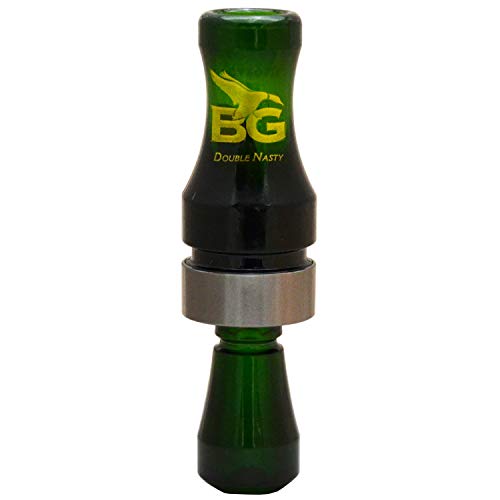
Buck Gardner BGC Double Nasty Duck Call
A USA-made double reed duck call with polycarbonate construction and Spit-Tech toneboard design that performs in wet conditions. Delivers a raspy tone across a full volume range, suited for hunters seeking reliable waterfowl calls.
Pros
- Spit-Tech toneboard functions even when wet
- Hand-tuned and tested for consistency
- Full volume range with raspy tone character
- Durable polycarbonate body with aluminum band
- Made in the USA
Cons
- No verified buyer reviews available to assess real-world durability claims
- Dimensions listed as 0x0x0 inches, indicating incomplete product specifications
- Double reed design may require more practice than single reed alternatives
Buck Gardner BGC Double Nasty Duck Call
A loud, raspy J-frame double reed mallard call designed for duck hunters who need reliable performance in wet conditions. The Spit-Tech toneboard helps prevent sticking when moisture builds up, and it's made in the USA with a gunmetal band for durability.
Pros
- Spit-Tech toneboard addresses a common issue with wet-weather calling
- J-frame double reed produces loud, raspy mallard sounds
- Durable gunmetal band and polycarbonate construction
- Made in the USA
Cons
- No verified buyer reviews available to assess real-world performance reliability
- Limited color options (Camo/Smoke only)
Haydel's DR-85 Double Reed Mallard Duck Call
The DR-85 is a hand-tuned mallard duck call with a fully adjustable floating wedge for personal tuning, designed to work for both professional callers and beginners. It blows wet and is made in the USA, making it a versatile option for duck hunters seeking reliable performance.
Pros
- Fully adjustable floating wedge allows custom tuning to match personal preferences
- Hand-tuned by professional callers before shipping
- Easy to blow, suitable for both experienced and novice users
- Functions when wet, reducing performance issues in typical hunting conditions
- Made in the USA
Cons
- No verified buyer reviews available to assess real-world durability or consistency
- Double reed design may require more practice than single reed alternatives for some users
- Limited color option, available only in clear
Duck Commander Gadwall Magnum Duck Call
A specialized duck call designed to replicate Gadwall Drake vocalizations with a shorter, louder barrel than the original model. Straightforward to use for both beginners and experienced hunters seeking a confidence or backup call for waterfowl hunting.
Pros
- Purpose-built sound specifically targets Gadwall Drakes across U.S. regions
- Increased volume and projection compared to original Gadwall call model
- Simple operation reduces learning curve for new duck hunters
- Versatile role as either primary confidence call or backup reinforcement
Cons
- No verified buyer reviews available to assess real-world performance consistency
- Specialized for one duck species, limiting versatility across waterfowl types
- Effectiveness depends on proper technique despite user-friendly design claims
Primos Pro Mallard Single-Reed Duck Call
A U.S.-made mallard call with a .010-inch Mylar reed designed for both timber and open water hunting. The single-reed construction produces raspy quacks and clear high calls, with a tuning hole that mimics multiple ducks.
Pros
- Performs reliably in wet conditions without loss of function
- Tuning hole allows mimicking multiple ducks to attract flocks
- Raspy to clear tonal range from the Mylar reed construction
- Compact and lightweight at under one pound
- Domestic manufacturing ensures quality control
Cons
- No verified buyer reviews available to assess real-world durability claims
- Single-reed design may have a steeper learning curve for beginners versus double-reed options
- Limited information on maintenance requirements for the Mylar reed over time
Haydel's W-19 Whistler Duck Call
A specialized duck call designed for wigeon, fulvous, and black-bellied tree ducks that produce nasally vocalizations. Made in the USA, it fills a specific niche for hunters targeting these species rather than green-winged teal or pintails.
Pros
- Purpose-built for nasally-calling duck species like wigeon and fulvous ducks
- Made in the USA
- Compact dimensions make it easy to carry in the field
Cons
- No customer reviews available to verify real-world performance
- Limited to specific duck species, not a versatile all-purpose call
- Narrow use case means unsuitable for hunters pursuing other waterfowl
Sghgcvjjf 2-Pack Wood Duck Call
A two-piece hardwood duck call set designed for waterfowl hunting, delivering mallard, wood duck, and goose sounds with minimal learning curve. The natural wood construction and paired design make it practical for hunters who want a backup call or dual-call setup, though the 4.7 rating is based on zero verified buyer reviews.
Pros
- Two calls in one purchase eliminates needing separate backup
- Easy learning curve makes it accessible for beginners and children
- Natural wood materials provide authentic raspy tone ducks recognize
- Lightweight and portable for field hunting
Cons
- No verified customer reviews to validate performance claims despite 4.7 rating
- Brand reputation and long-term durability unconfirmed by buyer feedback
- Limited information on tonal range accuracy compared to established waterfowl call brands
Duck Calls Buying Guide
Choosing the right duck call is more nuanced than picking the loudest or most expensive option on the shelf.
The factors below are the same ones our research team weighs when comparing calls, and understanding them will help you match a call to your hunting style, target species, and typical hunting conditions.
Just as you would pair the right optics to your hunting terrain, your call selection should reflect where and how you hunt.
Single-Reed vs. Double-Reed Design

Reed count is the single most consequential design choice you will make when selecting a duck call.
Single-reed calls produce a wider tonal range and respond to subtle pressure changes from your lips and airflow, making them the preferred tool of competitive callers and experienced hunters who want maximum expressiveness. The trade-off is a steeper learning curve.
If your fundamentals are off, a single-reed call will broadcast every mistake to the birds.
Double-reed calls are far more forgiving. A second reed stabilizes the airflow, making it easier to produce a clean, realistic mallard hen sound with minimal practice.
For most hunters who call occasionally rather than competitively, a double-reed delivers better real-world results.
Every mallard-style call in our lineup uses a double-reed configuration, including the top-rated Echo Diamondwood and the Duck Commander Classic, specifically because double-reed designs dominate verified buyer satisfaction data for hunting applications.
The bottom line: if you are a newer caller or hunt primarily from a blind where close-in finishing calls matter more than long-distance hail calls, start with a double-reed. If you are willing to invest practice time for expressive range, a single-reed will eventually outperform.
Material and Construction: Wood vs. Polycarbonate vs. Acrylic
The barrel material shapes both the sound and the durability of a duck call.
Hardwood barrels, like the bocote wood used in the Echo Diamondwood Timber, produce a warmer, richer tone that many experienced hunters prefer for pressured birds that have heard too many cheap calls.
Wood also looks and feels premium in hand, which matters to callers who use their call as a lanyard centerpiece.
The downside is that wood is more sensitive to moisture and temperature changes, which can occasionally affect tuning during cold, wet hunts.
Polycarbonate and acrylic barrels are weather-resistant, consistent, and less expensive to manufacture, which allows brands like Buck Gardner to deliver competitive performance at mid-range prices.
Polycarbonate calls tend to produce a slightly brighter, crisper sound compared to wood, which can cut through wind noise on open water or large marshes.
For hunters in wet climates or those who are hard on gear, polycarbonate is a sensible and dependable choice. Reliable trail cameras and rugged calls share the same logic: gear that survives harsh conditions keeps you hunting longer.
Do not discount material cost as a proxy for sound quality alone.
A well-tuned polycarbonate call often outperforms a poorly maintained wood call, and the Buck Gardner Double Nasty in both its camo green and polycarbonate variants demonstrates this clearly in expert consensus reviews.
Volume and Tone: Matching the Call to Your Hunting Environment
Not all hunting conditions require the same volume or tonal character.
Big, open water hunting on large reservoirs or coastal marshes demands a loud, far-reaching call that can reach birds at distance before they commit to another landing zone.
In these scenarios, calls with a louder, more penetrating sound profile give you an edge. The Duck Commander Gadwall Magnum, for example, is specifically tuned for Gadwall drakes, a species that responds to a different tonal register than mallards.
Timber hunting, flooded hardwoods, or pressured public-land situations usually call for a softer, more subtle approach. Finishing calls with controlled, close-in sound are often more productive than blasting a hail call at birds that are already circling at 20 yards.
The Duck Commander Classic is explicitly marketed as a finishing call, and expert review consensus consistently notes that it excels at this specific task.
Matching volume to environment is as important as matching a rangefinder to your shooting distances: more power is not always better.
If you hunt multiple environments across a season, consider carrying two calls: a loud, open-water call for reaching distant birds and a quieter finishing call for working birds that are already interested. Many serious hunters build a lanyard around this two-call system.
Species-Specific vs. General Mallard Calls

The majority of duck calls sold are designed to imitate the mallard hen, the universal language of duck hunting in North America. Mallard calls work on a wide variety of species, particularly in mixed-bag situations.
However, if you are targeting specific ducks, a species-specific call can dramatically improve your results.
Gadwall, wigeon, wood ducks, and whistling ducks all use vocalizations that are distinctly different from mallard quacks and feeding chuckles.
The Duck Commander Gadwall Magnum replicates the nasal grunt of gadwall drakes, while the Haydel’s W-19 Whistler is designed specifically for wigeon and tree ducks.
If your local hunting ground holds significant numbers of these species, a species-specific call should be on your lanyard alongside a mallard call, not instead of it.
Note that species-specific calls have a narrower use case and will earn lower overall scores in a general ranking.
The Haydel’s W-19 Whistler, for instance, earns a niche but genuine role for hunters who need it, even if it does not compete on the same broad utility scale as a mallard call.
Ease of Use and Learning Curve

A duck call that sounds perfect on a YouTube video but is unplayable by a novice hunter in freezing temperatures is not a useful hunting tool.
Ease of use is one of the most undervalued purchasing criteria, especially for hunters who are new to calling or who do not practice year-round.
Verified buyer feedback consistently shows that overly stiff or overly sensitive calls lead to frustration and abandonment.
Double-reed calls with adjustable tuning, like the Haydel’s DR-85 with its adjustable reed design, give hunters the flexibility to set the call to their blowing pressure rather than forcing themselves to adapt to a fixed, difficult setup.
This kind of adjustability is especially valuable for hunters who switch between cold mornings and warmer afternoons, since temperature affects reed stiffness and response.
If you are purchasing for a young hunter or someone just getting into waterfowl hunting, prioritize calls with a forgiving design and clear instructions.
Just as you would choose gear that fits the hunter and not just the hunt, matching a call’s difficulty level to the caller’s skill is essential for building confidence and actual field success.
Price and Value Relative to Hunting Frequency

Duck calls span a wide price range, from genuinely affordable budget options to premium handcrafted hardwood calls. For hunters who get out a handful of times per season, a mid-range polycarbonate double-reed call is almost certainly the smartest investment.
It provides the performance needed to attract birds without the financial risk of damaging an expensive wood call in rough conditions.
For dedicated hunters who spend significant time in the blind each season and want a call that grows with their skill, investing in a premium hardwood option like the Echo Diamondwood Timber makes long-term sense.
Expert consensus across waterfowl hunting publications rates premium wood calls highly for their expressive tonal range and durability when properly maintained.
The value calculation is straightforward: buy to your frequency and commitment level, not to impress other hunters on the ramp.
Regardless of price tier, avoid no-name novelty calls from unestablished brands without verified buyer feedback and a track record.
Poor tuning and inconsistent reed quality are common complaints in that segment, and a call that squeaks or locks up in the field is worse than no call at all.
Why You Should Trust Us
ProductFind is an independent review publication. We do not sell products, process orders, or have any relationship with manufacturers beyond the standard affiliate arrangements that fund our research.
Every product in this roundup was evaluated and scored using our PF Score system, a consistent 0-to-10 rating scale applied across four core dimensions: performance for intended use, build quality and durability, ease of use, and overall value relative to price.
This framework ensures that a budget call and a premium call are judged on their own terms, not penalized simply for costing less or rewarded simply for costing more.
We do not conduct our own product trials; our evaluations are grounded in research, published data, expert review consensus, and verified buyer feedback. Our sourcing includes waterfowl hunting publications, professional caller reviews, manufacturer-published specifications, and aggregate verified purchase data.
When expert consensus and buyer feedback align strongly, confidence in a score increases. When they diverge, we investigate the reason and reflect nuance in the final rating.
ProductFind may earn a commission if you purchase through our links. This affiliate relationship has no influence on rankings, PF Scores, or which products appear in our roundups. Selection and scoring are determined entirely by our evaluation criteria.
We include products from brands we believe genuinely merit consideration, and we note weaknesses as clearly as strengths.
Final Thoughts
After evaluating all nine calls in this roundup, the right choice depends primarily on what you are hunting, where you are hunting it, and how much time you invest in practice.
Here is how our top picks break down by use case and PF Score standing:
- Best Overall: Echo Diamondwood Timber Double Reed Duck Call Bocote. The highest-rated call in our roundup, this bocote hardwood double-reed earns its top position through a combination of premium construction, expressive tonal range, and strong expert consensus across waterfowl hunting publications. It is the call for hunters who want the best and are willing to care for a wood barrel properly.
- Best Finishing Call: Duck Commander Classic Duck Call in Realtree Max4 Camo. Specifically engineered for close-in work, this Realtree-camo double-reed is a longtime favorite for hunters who need to seal the deal on birds already circling the spread. Verified buyers consistently praise its soft, convincing tone at short range.
- Best Value Double-Reed: Buck Gardner Double Nasty Duck Call in Camo Green. This camo-green double-reed delivers performance well above its mid-range price point, making it the smart choice for hunters who want reliable results without committing to a premium hardwood call.
- Best Adjustable Budget Call: Haydel’s DR-85 Mallard Duck Call. The adjustable double-reed design makes this one of the most forgiving calls in the lineup for newer hunters or those who hunt across varying temperatures. Expert consensus treats it as a dependable, proven meat call.
- Best Specialty Call: Duck Commander Gadwall Magnum Call 2. If gadwall drakes are a regular target in your hunting area, this specialty call fills a gap that no mallard call can cover. Loud, easy to use, and purpose-built for a species that rewards precise imitation.
Whatever you hunt, a quality call is only one part of the equation. Scouting, decoy placement, and concealment all contribute to a successful hunt.
Pairing your call with reliable trail cameras for pre-season scouting can help you understand local bird patterns before the season opens, and a quality set of hunting binoculars lets you read approaching birds and adjust your calling before they are in earshot.
Build your kit thoughtfully, and the right duck call will do the rest.
Frequently Asked Questions
What is the difference between a single-reed and double-reed duck call?
A single-reed call offers a wider range of sounds and greater expressiveness, but demands better technique and more practice to use effectively.
A double-reed call uses a second reed to stabilize airflow, making it easier to produce a clean, realistic sound with less experience.
For most hunters, especially those who do not practice calling year-round, a double-reed is the more reliable choice in actual hunting conditions.
Do I need a different call for species like gadwall or wigeon?
Yes, if those species are a regular part of your hunt. Gadwall, wigeon, and wood ducks vocalize very differently from mallard hens, and a standard mallard call will not effectively replicate their sounds.
Species-specific calls like the Duck Commander Gadwall Magnum or the Haydel’s W-19 Whistler are designed for exactly these situations. Most serious hunters carry at least one mallard call and one species-specific call on their lanyard during mixed-bag seasons.
How important is the barrel material when choosing a duck call?
Barrel material affects both tone and durability. Hardwood barrels produce a warmer, richer sound that many experienced hunters prefer, particularly for pressured birds. However, wood requires more maintenance and can be sensitive to moisture.
Polycarbonate and acrylic barrels are weather-resistant, consistent across temperature changes, and typically more affordable. For wet-weather hunting or hunters who are hard on gear, a polycarbonate call often makes more practical sense, even at a similar performance level.
How do I know if I am using my duck call correctly?
The most reliable indicator is bird behavior. If ducks are responding to your calling by turning toward you, dropping altitude, or committing to your decoys, your technique is working.
If birds are flaring or ignoring your calls, volume and cadence are the most common culprits. Many hunters overcall, especially beginners.
Watching video instruction from professional callers and practicing a simple five-note feeding chuckle before attempting a full hail call will build fundamentals faster than any other approach.
A rangefinder can also help you judge when birds are close enough to shift from hail calling to quiet finishing sounds.
Is a more expensive duck call always better?
Not necessarily. Price correlates with materials and craftsmanship, not automatically with field performance. A mid-range polycarbonate double-reed call that fits your blowing style and is well-tuned will outperform an expensive call that does not match your technique.
Our PF Score ratings reflect this: the Buck Gardner Double Nasty in both its variants scores comparably to calls at higher price points, and verified buyers back that up consistently.
Buy to your skill level and hunting frequency, and upgrade when your technique outgrows your current call.
Can I use the same duck call for both open water and timber hunting?
Technically yes, but it is not ideal. Open-water hunting generally favors a louder, more penetrating call to reach distant birds. Timber hunting calls for softer, more subtle sounds to avoid spooking birds at close range.
Many experienced hunters carry two calls for this reason: a loud open-water call and a quieter finishing call.
If you must choose one, a mid-volume double-reed with a versatile tonal range, like the Echo Diamondwood or the Duck Commander Classic, offers the best compromise across both environments.
About the author
Jerry is a reviewer and writer for ProductFind who specializes in Hunting & Shooting Sports. Jerry evaluates products through independent research: specifications, expert review consensus, and verified buyer feedback, and rates each one on the PF Score. Jerry focuses on helping readers pick the right hunting & shooting sport for their needs and budget.