The 10 Best Robotic Lawn Mowers
Wire-free navigation, LiDAR mapping, and AI obstacle avoidance have transformed robotic lawn mowers into genuinely capable tools. Our research ranks the top picks by slope handling, edge cutting, and real-world setup ease.
 By Heidi Moreno
Updated July 23, 2026
By Heidi Moreno
Updated July 23, 2026
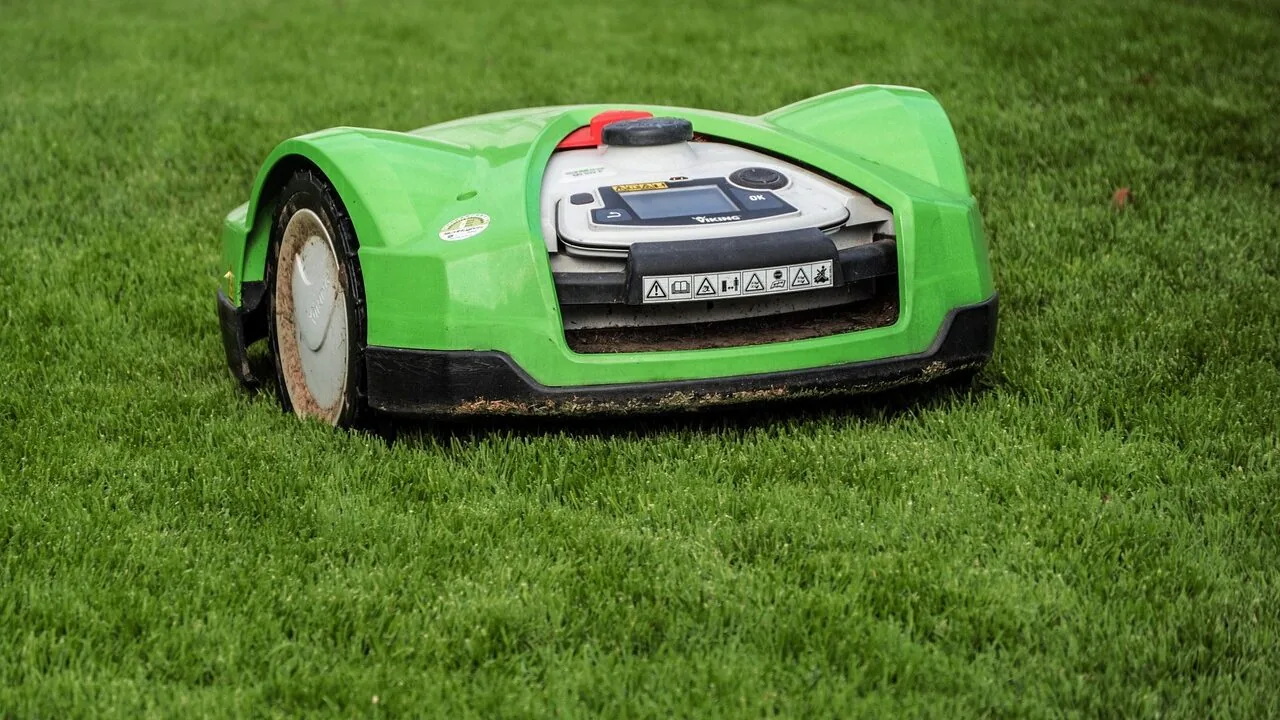
Robotic lawn mowers have moved well beyond novelty status.
Wire-free navigation, LiDAR mapping, AI obstacle avoidance, and all-wheel-drive drivetrains are now standard features on mid-range models, making it genuinely practical to let a robot handle your lawn every week without planting boundary cables or babysitting the machine.
If you have been putting off the switch because early robots seemed unreliable or limited to flat, simple yards, the current generation is a different product entirely.
This guide cuts through the noise by focusing on what actually matters for real yards: navigation accuracy, slope capability, edge-cutting quality, and how much setup pain you will actually endure.
ProductFind researched each model by synthesizing manufacturer specifications, expert review consensus across multiple publications, and verified buyer feedback from confirmed purchasers, then scored every pick on our 0-to-10 PF Score scale.
Whether you manage a compact suburban lawn or a sprawling multi-zone property, the ranked picks below give you a clear starting point.
| Award | Product | PF Score About PF ScoreThe PF Score is our own rating from 0 to 10, based on performance, design and build, ease of use, and value. It reflects independent research and is never influenced by manufacturers, retailers, or affiliate commissions. Learn more › | Price | |
|---|---|---|---|---|
| Best Overall |
 Mammotion LUBA 3 AWD Robot Mower, 0.37 Acre
|
9.3/10 | Buy | |
| Editor's Pick |
 ECOVACS GOAT A2000 LiDAR PRO Robot Mower, 1/2 Acre
|
9.1/10 | Buy | |
| Best Value |
 Dreame A3 AWD Robot Mower, 80% Slopes, No-Wire
|
8.7/10 | Buy | |
| Top Rated |
 WORX Landroid Vision WR320 Robot Mower, 1/2 Acre
|
8.5/10 | Buy | |
 Segway Navimow i215 Wire-Free Robot Mower
|
8.4/10 | Buy | ||
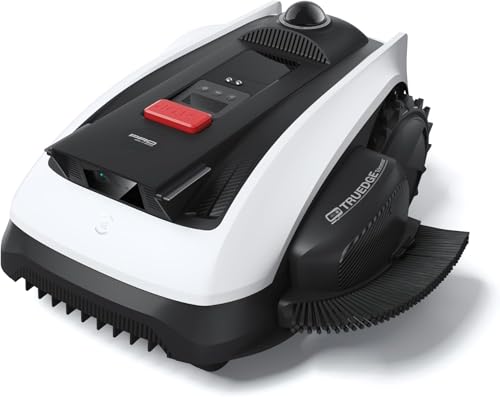 ECOVACS GOAT O1000 LiDAR PRO Wire-Free Robot Mower
|
8.3/10 | Buy | ||
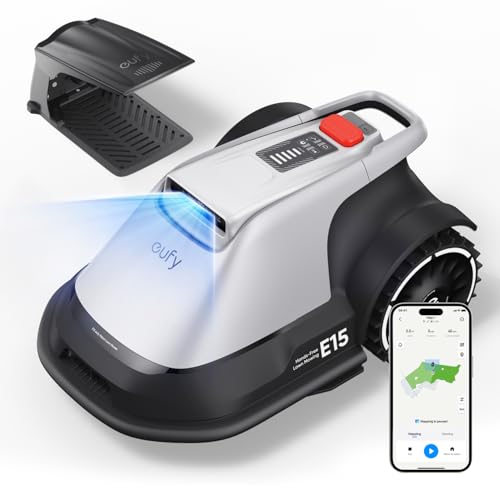 eufy E15 Robot Lawn Mower, 0.2 Acre
|
8.1/10 | Buy | ||
 Segway Navimow i110N Wire-Free Robotic Mower
|
7.2/10 | Buy | ||
 YARDCARE M800Plus Robot Mower, GPS & 3D Vision, 8611 sq.ft
|
6.8/10 | Buy | ||
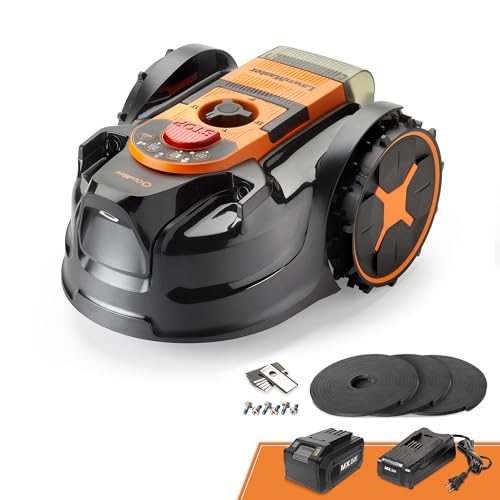 LawnMaster OcuMow 400 Robot Mower with Optical Navigation
|
5.9/10 | Buy |
Mammotion LUBA 3 AWD Robot Mower, 0.37 Acre
A premium robotic mower built for challenging terrain, featuring 360-degree LiDAR mapping, dual-camera AI vision, and all-wheel drive capable of handling 80-percent slopes. Best suited for larger properties with complex layouts and steep inclines.
Pros
- Exceptional slope capability and all-terrain performance thanks to four independent motors and omni-wheel design
- Precise navigation combining LiDAR scanning with dual-camera AI vision and intelligent path optimization
- Versatile zone management system with multiple cutting patterns (zigzag, checkerboard, adaptive) for efficient coverage
- Robust obstacle detection and avoidance using advanced AI processing
Cons
- No verified buyer reviews available yet to assess real-world reliability and durability
- Premium positioning suggests significant investment for a 0.37-acre coverage capacity
- Garage ships separately, requiring additional setup and coordination
ECOVACS GOAT A2000 LiDAR PRO Robot Mower, 1/2 Acre
A wire-free robotic mower that uses dual-LiDAR mapping instead of perimeter wires, making it simpler to set up for yards up to half an acre. Built-in edge trimming and a 32V motor handle thick grass, though the 50-minute charge time limits coverage for larger properties.
Pros
- Eliminates wire installation, which is a major barrier to robot mower adoption
- Built-in trimmer saves time on post-mowing cleanup and edge refinement
- LiDAR positioning works reliably where GPS fails, including under trees and near structures
- Smart app gives granular control over mowing patterns and schedules
Cons
- 50-minute battery life limits effectiveness for yards larger than half an acre
- No verified buyer reviews available, making real-world performance hard to assess
- Premium positioning may not justify cost over traditional or budget robot mowers for smaller yards
Dreame A3 AWD Robot Mower, 80% Slopes, No-Wire
Wire-free robotic mower equipped with 360° LiDAR and AI dual vision for hands-off yard maintenance on lawns up to 0.25 acre. All-wheel drive tackles steep slopes and obstacles, while 45-minute fast charging and quiet operation make it practical for regular use.
Pros
- Exceptional slope capability (80%) suits hilly terrain that standard mowers cannot handle
- True wire-free operation eliminates installation labor and boundary maintenance
- Obstacle detection identifies over 300 objects including pets and toys
- Fast recharge time (45 minutes) enables full lawn completion in one day
- Built-in security features with 4G connectivity and HDR camera
Cons
- Limited coverage capacity (0.25-0.5 acre) restricts suitability for larger properties
- Precision edge trimming requires optional separate trimmer module for best results
- No verified customer reviews available for independent performance validation
WORX Landroid Vision WR320 Robot Mower, 1/2 Acre
A no-perimeter-wire robotic mower that uses RTK cloud navigation and vision AI to map yards automatically and avoid obstacles intelligently. Best suited for homeowners willing to embrace cloud-connected automation for hands-off lawn care.
Pros
- Eliminates installation hassle of traditional perimeter wires
- RTK cloud accuracy maintains straight, even mowing stripes without local antenna setup
- Vision AI understands boundary types for cleaner edge-cutting and closer border following
- Extended RadioLink connectivity reaches beyond standard Wi-Fi range on larger properties
- Flexible app controls let you customize zones, mowing patterns, and no-go areas on demand
Cons
- No existing customer reviews available to validate real-world performance and reliability
- Requires reliable cloud connectivity and Wi-Fi coverage for full functionality
- Premium pricing reflects advanced navigation tech, making it a significant investment for smaller yards
Segway Navimow i215 Wire-Free Robot Mower
A wire-free robotic mower that maps itself via LiDAR and vision sensors, handling slopes up to 45 degrees without boundary wires. Best for homeowners with moderate yards (0.37 acre capacity) who want hands-free setup and don't mind the learning curve on obstacle detection.
Pros
- True drop-and-mow setup with no perimeter wires needed, one-tap auto mapping gets it working fast
- LiDAR and vision dual fusion navigation works day or night without GPS dependency
- Handles steep terrain up to 45 percent slopes with off-road wheels and electronic stability control
- Detects 200+ obstacle types with 0.4 inch accuracy, reducing random collisions
- Quiet operation at 59 dB(A), minimal noise disturbance compared to traditional mowers
Cons
- No verified buyer reviews available yet to validate real-world performance claims
- Limited to 0.37 acre coverage, excluding larger residential properties
- Premium pricing tier with ongoing app-dependent operation and maintenance requirements
ECOVACS GOAT O1000 LiDAR PRO Wire-Free Robot Mower
A wire-free robotic mower that uses dual-LiDAR mapping and AI obstacle detection to handle yards up to 1/4 acre without perimeter wiring. Its narrow frame navigates tight spaces and integrated edge trimmer reduce manual cleanup, though complex corners may still need occasional touch-ups.
Pros
- Wire-free setup eliminates perimeter installation and maintenance
- Precise LiDAR navigation works in shaded areas and under trees where GPS fails
- Built-in edge trimmer reduces need for manual string trimming after mowing
- Advanced 3D obstacle detection with 5 cm precision provides safer operation around pets and toys
- Compact design navigates narrow spaces and complex lawn layouts other mowers cannot access
Cons
- Highly complex corners and raised edges may still require occasional manual trimming despite integrated trimmer
- Initial setup and fine-tuning through app may need several adjustments to optimize for unique lawn layouts
- No verified buyer reviews available to assess real-world performance and durability
eufy E15 Robot Lawn Mower, 0.2 Acre
A wire-free robot mower that uses stereo cameras and AI navigation to map and mow autonomously without boundary installation. Best suited for smaller lawns up to 0.2 acres with gentle slopes, offering app control and obstacle avoidance for hands-off lawn maintenance.
Pros
- No wire burial required, eliminating installation complexity
- Advanced 3D perception system detects and avoids obstacles intelligently
- Precise parallel cuts with automatic missed-spot detection
- GPS security and automatic base station recall in poor conditions
- Multi-zone management with virtual boundaries and exclusion areas
Cons
- Limited to lawns 0.2 acres or smaller, not suitable for larger properties
- Incompatible with St. Augustine and dense Zoysia grass types
- Requires 4G data subscription for full coverage if Wi-Fi doesn't reach entire yard
- Not yet verified by consumer reviews (0 reviews at time of listing)
Segway Navimow i110N Wire-Free Robotic Mower
A perimeter-wire-free robotic mower that uses RTK positioning and AI vision to navigate complex lawns up to 1/4 acre with centimeter-level accuracy. Setup happens entirely through your smartphone with automatic boundary mapping, making it ideal for homeowners seeking hands-off lawn maintenance without traditional perimeter wire installation.
Pros
- Wire-free installation saves setup time compared to traditional robotic mowers
- RTK plus vision system provides reliable navigation in challenging terrain and under trees
- AI mapping automatically identifies lawn boundaries, simplifying initial configuration
- Advanced obstacle detection using camera and AI algorithms rather than basic bumpers
- Systematic mowing patterns with direction changes minimize visible lawn tracks
Cons
- Limited to 1/4 acre coverage, unsuitable for larger properties
- No verified customer reviews available yet to assess real-world reliability
- Optional 4G anti-theft tracking requires additional purchase
YARDCARE M800Plus Robot Mower, GPS & 3D Vision, 8611 sq.ft
YARDCARE's M800Plus uses GPS and 3D vision to navigate lawns up to 8611 square feet without boundary wires, offering app control and obstacle avoidance for hands-off lawn maintenance. Best suited for properties with clear visual boundaries and grass kept under 2.6 inches initially.
Pros
- Wire-free operation using vision-based navigation eliminates installation hassle
- Magnetic stripe NO-GO zones offer flexible boundary control without digging
- App-based scheduling and remote management provide convenient automation
- Handles steep terrain up to 35% slope with stable operation
- Adjustable cutting height and spiral mowing mode for lawn customization
Cons
- Requires grass under 2.6 inches initially, necessitating manual pre-trimming for overgrown lawns
- Vision-based system works best with clear visual boundaries, limiting effectiveness in yards with poor visual definition
- No verified buyer reviews yet to confirm real-world performance and reliability
LawnMaster OcuMow 400 Robot Mower with Optical Navigation
A budget-friendly robotic mower designed for small to medium lawns up to 2,600 sq. ft., featuring optical navigation with camera guidance and ultrasonic obstacle avoidance. Best suited for users seeking a hands-off mowing solution that requires minimal setup and no smartphone app.
Pros
- Advanced optical navigation handles variable lighting without relying on GPS
- Substantial slope capability up to 35 percent suits uneven terrain
- Simple setup with magnetic boundary strips requires no digging or electrical work
- Comprehensive package includes battery, charger, strips, and spare blades
- Edge-cutting technology addresses the perimeter mowing challenge
Cons
- Requires clearly defined lawn perimeter and may need manual edge trimming despite included technology
- No smartphone app control limits remote monitoring or scheduling flexibility
- Limited to smaller lawns, 2,600 sq. ft. coverage may require longer runtimes for larger properties
Robotic Lawn Mowers Buying Guide
Choosing a robotic lawn mower is not simply a matter of picking the most expensive model or the one with the longest battery.
The technology varies enormously between price tiers, and buying the wrong type for your yard geometry or terrain can result in a machine that misses strips, gets stuck, or needs constant manual intervention.
The six criteria below are the ones our research consistently identified as the biggest differentiators between a satisfying purchase and a frustrating one.
Think of them the same way a careful shopper thinks about picking a quality robot vacuum: the underlying navigation platform matters far more than any single spec number.
Navigation System: Wire-Free vs. LiDAR vs. GPS-RTK

Navigation technology is the single most important specification on any robotic lawn mower, and it is where the clearest quality gaps exist.
Older boundary-wire systems require you to bury or stake a perimeter cable around your entire lawn before the robot can operate.
That installation can take several hours, the wire is vulnerable to damage from digging or edging tools, and reconfiguring zones is tedious. Most new models in our list skip wire entirely.
GPS-RTK navigation (as found on the Segway Navimow i110N) uses real-time kinematic satellite positioning to achieve centimeter-level accuracy outdoors.
It works well on open lawns but can drift under heavy tree canopy or near tall structures that block satellite signals.
LiDAR-based navigation (used by the Segway Navimow i215, ECOVACS Goat A2000, Mammotion LUBA 3 AWD, and Dreame A3 AWD) builds a real-time three-dimensional map of the yard and is generally more reliable in shaded or signal-poor environments.
Dual-fusion systems that combine LiDAR with camera vision represent the current performance peak: the ECOVACS Goat A2000 LiDAR PRO, for instance, pairs Dual-LiDAR mapping with AIVI 3D obstacle avoidance for a level of situational awareness that pure GPS robots cannot match.
When comparing robots in a similar price tier, always confirm which navigation system is actually under the hood. A robot marketed as “wire-free” may still use a basic vision-only system without LiDAR, which performs less consistently in low-light conditions or near fences and hedges.
Slope and Terrain Capability

Slope handling is one of the most frequently underestimated specifications. Most entry-level and mid-range robots are rated for slopes in the 20 to 35 percent (roughly 11 to 19 degree) range, which covers the majority of suburban lawns.
If your yard has a hill, a raised bed border, or a sloped side yard, you need to measure the actual grade before buying.
A robot rated at 25 percent slope will lose traction, stall, or fail to return to its dock reliably on anything steeper.
The Mammotion LUBA 3 AWD and the Dreame A3 AWD are currently the standout performers here, both rated at 80 percent slope capability thanks to all-wheel-drive drivetrains with dedicated traction control.
That is a dramatically higher ceiling than most of the competition and explains why those two models command premium prices. The Segway Navimow i215 is rated for 45 percent slopes, which is comfortably above average.
If your yard is relatively flat, spending extra for AWD capability is unnecessary, but for hilly properties it can be the deciding factor.
Terrain type matters beyond slope angle. Rocky or root-crossed surfaces, thick wet grass, and soft soil after rain can all challenge robots with lower ground clearance or standard two-wheel drive. Check the wheel design and ground clearance spec alongside the slope rating.
Coverage Area and Multi-Zone Management
Every robotic lawn mower is rated for a maximum coverage area, typically expressed in square feet or fractions of an acre.
This rating reflects how much area the robot can mow on a single charge during a session, not simply the size of lawn it can physically navigate.
A robot rated for a quarter acre will still work on a half-acre lawn, but it will need multiple charging cycles per mow and may take several days to complete the full area, which is usually not ideal.
Multi-zone management is increasingly important for yards with separated sections divided by paths, driveways, or garden beds.
Models like the Mammotion LUBA 3 AWD support up to 15 separate zones, while the eufy Robot Lawn Mower E15 and the ECOVACS Goat A2000 both offer robust multi-zone mapping through their companion apps.
If your yard is a single open rectangle, zone management is irrelevant. But for irregularly shaped or partitioned properties it is a genuine usability feature, not a marketing checkbox.
Always add roughly 15 to 20 percent buffer above your measured lawn area when matching it to a robot’s coverage rating, to account for the robot’s inefficiencies in navigating around obstacles and returning to dock.
Edge Cutting Performance

Edge cutting is the most common complaint category in verified buyer reviews for robotic lawn mowers, and it is easy to understand why.
Most robots use a central blade deck positioned under the chassis, which means they cannot cut right up to a fence line, garden border, or path edge.
The result is a strip of uncut grass along every boundary that requires manual trimming after each mow.
The ECOVACS Goat A2000 addresses this with its built-in TruEdge edge trimmer, a dedicated offset cutting mechanism that extends the cutting reach to within a few centimeters of hard boundaries.
This is a meaningful practical advantage and one of the primary reasons the A2000 scores so highly in our research. The ECOVACS Goat O1000 also includes smart edge mowing capability at a lower price point.
For robots without dedicated edge hardware, look for models that offer a “perimeter pass” mode in the app, which instructs the robot to make one or more passes close to the boundary before random or systematic mowing.
If you currently rely on a string trimmer to neaten up edges after every mow, factor the time savings of a genuine edge-cutting robot into your purchasing decision. It is not a luxury feature if it eliminates a weekly chore.
Setup Complexity and App Control

Initial setup time varies enormously across the category. Wire-based robots require physical installation of a boundary cable, which can take several hours and involves specialized tools.
Wire-free robots that rely on GPS-RTK or LiDAR mapping are considerably faster to set up: place the charging dock, connect to Wi-Fi, and let the robot complete an auto-mapping run.
The WORX Landroid Vision Cloud earned consistent praise in expert reviews for its particularly smooth out-of-box experience, with cloud-assisted RTK navigation that reduces the need for precise dock placement.
App quality is genuinely variable. Look for apps that offer: scheduled mowing, real-time GPS tracking on a satellite map view, zone editing with virtual boundaries, mow history, and rain-delay settings.
The Mammotion, ECOVACS, Segway, and eufy companion apps all scored positively in buyer feedback for intuitiveness. The YARDCARE app received more mixed reviews regarding reliability of firmware update delivery.
Just as with robot vacuum and mop combos, a polished app transforms a capable machine into one you actually enjoy using day to day.
Also check whether the robot supports geofencing anti-theft protection via GPS. The eufy E15 and Mammotion LUBA 3 both include GPS anti-theft as a standard feature, which is valuable for robots that operate unsupervised on front yards or unfenced properties.
Noise Level and Scheduling

Robotic lawn mowers are inherently quieter than petrol mowers, but the difference between models is still audible. Most robots in this guide operate between 55 and 65 dB(A), which is roughly equivalent to a quiet conversation at a few meters distance.
The Segway Navimow i110N is rated at 58 dB(A) and the i215 at 59 dB(A), both of which can run comfortably during morning hours without disturbing neighbors.
Budget models or those with older blade designs tend to sit at the higher end of the noise range.
Because robotic mowers work by mowing frequently in short sessions rather than cutting all at once like a traditional mower, they are ideally suited to daily or every-other-day schedules.
This high-frequency approach keeps grass consistently short and reduces clipping volume, so most models mulch clippings back into the lawn rather than collecting them.
That approach is actually better for lawn health than infrequent heavy cuts, but it does mean the robot needs reliable scheduling and rain-sensing to avoid mowing on wet grass, which can compact soil and damage the blade mechanism.
Why You Should Trust Us
ProductFind is an independent review publication.
Every product in this guide was evaluated by our editorial team using a consistent, multi-factor research methodology: we analyze published manufacturer specifications, cross-reference expert review consensus from multiple specialist publications, and weight verified buyer feedback from confirmed purchasers to surface real-world performance patterns that spec sheets alone do not reveal.
We do not conduct our own product trials; our evaluations are grounded in research, published data, expert review consensus, and verified buyer feedback.
Each product receives a PF Score on a 0-to-10 scale, calculated against the same criteria set applied to every other product in the category. That means scores are directly comparable across models and price tiers.
For robotic lawn mowers, our scoring framework weights navigation system quality and real-world mapping accuracy most heavily, followed by terrain and slope handling, edge-cutting performance, coverage area relative to price, setup experience, app reliability, and noise level.
Products with stronger showings across verified buyer feedback on long-term reliability receive a scoring boost, because a robot that performs well in the first month but degrades in the first season is not a good recommendation.
ProductFind may earn a commission when you purchase through links in this article. That affiliate relationship has no influence on our rankings, PF Scores, or which products we include or exclude.
Our recommendations are determined by editorial assessment, not by commission rates. We apply the same independence to our coverage of smart home devices, cordless vacuums, and every other category on the site.
Final Thoughts
The robotic lawn mower market in 2026 has reached genuine maturity at the upper-mid price tier, with wire-free LiDAR navigation, AI obstacle avoidance, and multi-zone management now available from multiple competing brands.
The right pick depends heavily on your yard’s size, slope, and shape, not simply on brand reputation or headline feature count. Here is how our top-scoring picks break down by use case:
- Best Overall: Mammotion LUBA 3 AWD 1500H earns the top PF Score in this group by combining the broadest feature set with the most capable hardware available at consumer pricing. All-wheel drive, 360-degree LiDAR with dual-camera AI vision, 15-zone management, and an 80 percent slope rating make it the most versatile robot mower currently available, ideal for anyone with a challenging or complex property.
- Best for Large and Complex Yards: ECOVACS Goat A2000 LiDAR PRO stands out for its half-acre coverage rating, Dual-LiDAR auto mapping, and the built-in TruEdge edge trimmer that genuinely eliminates the uncut-border problem. Its AIVI 3D obstacle avoidance received strong marks in expert consensus reviews.
- Best for Steep Slopes and All-Terrain Use: Dreame A3 AWD 1000 matches the LUBA 3’s 80 percent slope rating in a slightly lower price tier, with 360-degree 3D LiDAR, dual-vision AI, and a notably fast 45-minute charge cycle that keeps it productive on hilly properties.
- Best for Easiest Setup: WORX Landroid Vision Cloud WR320 consistently earned praise in verified buyer feedback for its low-friction out-of-box experience. Cloud-assisted RTK navigation and AI obstacle avoidance at a mid-range price make it the most accessible wire-free option for first-time robot mower buyers.
- Best Budget Pick: LawnMaster OcuMow 400 Series is the most accessible entry point in this lineup, suited to small, relatively simple lawns where advanced LiDAR navigation and slope capability are not priorities. Expectations should be calibrated accordingly, but it represents a genuine automated mowing upgrade over a manual schedule.
If you are still weighing whether a robotic mower fits into a broader smart yard setup, it pairs naturally with other automation tools.
Many buyers who move to robot mowing also upgrade their smart home ecosystem at the same time, scheduling both through a single app platform.
For indoor equivalents of the same set-and-forget automation philosophy, robot vacuum and mop combos apply the same logic to floors.
Frequently Asked Questions
Do Robotic Lawn Mowers Really Work Without Boundary Wires?
Yes, the current generation of wire-free robots uses GPS-RTK, LiDAR, or computer vision to define virtual boundaries through a smartphone app.
You draw your lawn’s perimeter on a satellite map, place the charging dock, and the robot builds its own route without any physical cable installation.
The technology has matured significantly: top-tier LiDAR models like the ECOVACS Goat A2000 and Mammotion LUBA 3 AWD operate with centimeter-level boundary accuracy in most real-world conditions.
GPS-RTK systems can experience reduced accuracy under dense tree canopy or near tall structures that obstruct satellite signals. If your yard has significant shading, a LiDAR-primary or dual-fusion navigation system is a more reliable choice than a GPS-only model.
How Often Does a Robot Mower Need to Run?
Most manufacturers and agronomists recommend daily or every-other-day sessions during the active growing season. Because robotic mowers cut only a few millimeters of blade at each pass, they mulch microclippings back into the turf rather than leaving visible clumps.
This high-frequency approach is actually healthier for most grass types than a weekly heavy cut, and it keeps the lawn consistently neat without visible session lines.
During slow-growth periods in late autumn or early spring, most robots can be scheduled less frequently or set to a smart seasonal mode that reduces run frequency automatically based on growth rate sensors or calendar settings.
Can a Robot Mower Handle Obstacles Like Toys, Hoses, and Pet Waste?
AI-powered obstacle avoidance has improved substantially in recent model generations.
Robots with 3D vision and LiDAR, such as the eufy E15, ECOVACS Goat A2000, and Dreame A3 AWD, can reliably detect and navigate around garden furniture, hoses, children’s toys, and similar objects in most lighting conditions.
They classify obstacles and reroute rather than stopping completely, which keeps mow sessions efficient.
Pet waste remains a limitation for the category as a whole. Most robots can detect the object but may not reliably avoid every instance, particularly in low-light early-morning sessions.
Clearing the lawn of waste before a scheduled run is still recommended regardless of how capable the obstacle avoidance system is.
Is a Robotic Lawn Mower Worth It for a Small Yard?
For yards under roughly 2,000 square feet, the value calculation depends on how much you dislike mowing and how much you value consistent lawn appearance.
A capable robot at a mid-range price will pay for itself in time savings and lawn-care service costs within a few seasons.
The LawnMaster OcuMow 400 Series is the most accessible option for compact, simple lawns, while the eufy E15 adds pure-vision navigation and AI obstacle avoidance for slightly larger or more complex spaces.
Small-yard buyers should pay particular attention to charging dock placement and the robot’s ability to navigate narrow passages between garden beds or structures, since compact lawns often have proportionally more obstacles relative to open cutting area than larger properties.
How Do Robotic Lawn Mowers Compare to Traditional Mowers for Lawn Health?
Frequent light mowing with a robot tends to produce healthier, denser turf than weekly heavy cuts with a traditional mower. The mulching of microclippings returns nitrogen to the soil, reducing the need for supplemental fertilizer.
Grass maintained by a robot also typically shows fewer stress lines and browning associated with scalping during infrequent heavy cuts.
The trade-off is that robotic mowers do not collect clippings, so they are not ideal for lawns that require regular debris removal (such as properties with heavy leaf fall).
Most homeowners find that running a cordless vacuum or leaf blower over hard surfaces adjacent to the lawn handles any overspray from mowing sessions.
For indoor cleaning after yard work, a capable robot vacuum handles the floor traffic that active outdoor seasons bring inside.
What Maintenance Does a Robotic Lawn Mower Require?
Robotic lawn mowers have lower maintenance requirements than petrol mowers but are not zero-maintenance.
The primary recurring task is blade replacement: most robots use small, replaceable razor-style blades on a rotating disc, and manufacturers typically recommend replacing the blades every two to three months during the active season depending on lawn size and grass type.
The process usually takes under five minutes and replacement blades are inexpensive.
Additional routine maintenance includes cleaning the chassis and blade disc of grass clippings and soil buildup, clearing the dock’s charging contacts, and checking wheel and sensor condition at the start of each season.
Robots with LiDAR or camera sensors benefit from occasional lens cleaning to maintain obstacle-detection accuracy, particularly after dusty or muddy mowing conditions.
About the author
Heidi is a reviewer and writer for ProductFind who specializes in Lawn & Garden. Heidi evaluates products through independent research: specifications, expert review consensus, and verified buyer feedback, and rates each one on the PF Score. Heidi focuses on helping readers pick the right lawn & garden for their needs and budget.