The 11 Best Montessori Toys
Montessori toys build real skills, but not all live up to the label. We researched top picks across age groups to help you choose materials that genuinely support independent, hands-on learning.
 By Chester Bryant
Updated July 23, 2026
By Chester Bryant
Updated July 23, 2026

Montessori toys have moved well beyond specialty education stores.
Parents, pediatric occupational therapists, and early-childhood educators increasingly point to open-ended, hands-on play materials as one of the most effective ways to build fine motor skills, concentration, and independent problem-solving in children from birth through the early school years.
With hundreds of options flooding the market at wildly varying price points, ranging from budget-friendly shape sorters to elaborately crafted wooden activity boards, it can be genuinely hard to separate the toys that deliver real developmental value from those that simply look the part on a shelf.
This guide cuts through the noise. Our team at ProductFind researched and assessed each pick through a synthesis of product specifications, expert review consensus from child development specialists and parenting publications, and verified buyer feedback from thousands of confirmed purchasers.
Whether you are shopping for a newborn, a curious one-year-old, or a preschooler ready for counting and matching challenges, the selections below represent the strongest options available at every budget.
Scroll down to see our full ranked list of top picks.

Adena Montessori Object Permanence Box for 6-12 Months
This Montessori toy introduces object permanence through three textured balls (wooden, plastic, and soft foam) that babies drop into holes on a tray. Designed for infants 6-12 months, it combines sensory exploration with fine motor skill development through grasping and insertion activities.
Pros
- Multi-sensory design with wooden, plastic, and soft foam balls provides varied tactile experiences
- Encourages focus and concentration through intentional manipulation activities
- Sturdy construction built to handle active infant play
- Appropriately sized balls (1.77 inches diameter) for safe infant handling
- Educational value aligns with Montessori learning principles
Cons
- No verified customer reviews available to confirm real-world durability or age appropriateness
- Limited to three balls, which may reduce long-term engagement variety
- Relatively niche product category with no comparative data against similar object permanence toys
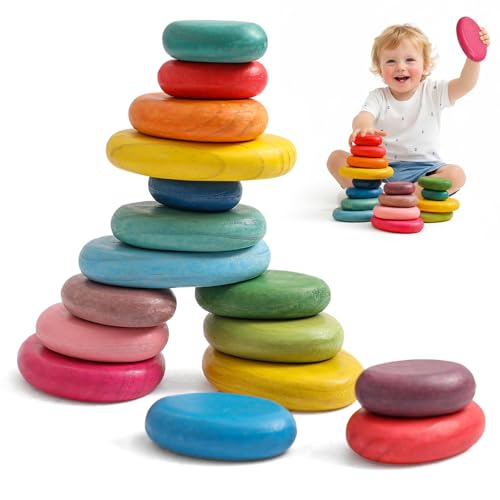
OESSUF 16-Piece Wooden Stacking Rocks for Toddlers
A set of 16 jumbo wooden balancing stones designed for toddlers ages 1-3, featuring smooth, BPA-free construction and Montessori-inspired open-ended play. Handcrafted from FSC-certified wood, these pieces support fine motor skills and sensory development while doubling as stress relief for adults.
Pros
- Safety-focused design with smooth finish and BPA-free materials appropriate for young toddlers
- Durable construction from solid FSC-certified wood that resists fading
- Supports multiple developmental areas including motor skills, focus, and creative play
- Versatile use cases spanning solo play, family activities, and stress relief for adults
Cons
- No verified buyer reviews available to assess real-world durability or performance over time
- Limited information on individual stone weight or stability when stacked at height
- Color variety described as multicolor but specific shade details not provided

Oomloid Counting Animals Montessori Set, 36 Pieces
A colorful sorting and counting toy set designed for preschoolers that combines animal recognition, color matching, and fine motor skill development. Includes 36 animals, 6 sorting bowls, tweezers, and a storage bucket for organized play and learning.
Pros
- Comprehensive learning tool covering counting, color sorting, and animal identification in one set
- Develops fine motor skills through tweezers use and hand-eye coordination during sorting activities
- Non-toxic, washable materials with storage bucket for easy cleanup and portability
- Suitable age range of 3-8 years provides extended play value across multiple developmental stages
Cons
- No verified buyer reviews available to validate durability and quality claims despite 4.7 rating
- Small pieces (animals and tweezers) require adult supervision and pose choking hazard for very young toddlers
- Limited information on whether materials withstand repeated washing and long-term wear

Tonberless Wooden Shape Sorter, 20-Piece Montessori Set
A wooden sorting and stacking toy designed for toddlers 1-3 years old, featuring 20 pieces across five shapes and colors. Built with high-quality wood and water-based paint, it targets early shape and color recognition through tactile play.
Pros
- Safe materials with water-based paint and smooth edges suitable for ages 1-3
- Multiple play configurations encourage imagination and shape/color sorting skills
- Well-packaged and positioned as gift-ready for birthdays and holidays
- Appropriate size for toddler hands to manipulate independently
Cons
- No verified buyer reviews available to assess real-world durability and long-term use
- Limited to 20 pieces, which may become familiar quickly for advanced toddlers
- Wooden material requires regular cleaning and proper storage to prevent warping

LiKee 36-Piece Wooden Shape Puzzle with Pattern Cards
This Montessori-style wooden puzzle set combines 36 shape blocks with 60 pattern cards, letting kids follow designs or create their own. Made from smooth, natural wood meeting CPSC safety standards, it targets spatial reasoning and color recognition for ages 3+.
Pros
- Comes with 60 pattern cards for guided and open-ended play
- Smooth natural wood construction with no sharp edges, meets safety standards
- Includes 2 iron storage tins for convenient organization
- Develops multiple skills: spatial awareness, shape recognition, hand-eye coordination, problem-solving
- Compact small size makes it portable and easy to store
Cons
- No verified buyer reviews available to assess real-world durability or quality consistency
- Limited information on whether pattern cards are age-appropriate or difficulty-tiered
- Small dimensions may limit design complexity for older or more advanced children

TOHIBEE Baby Sensory Toy Set, 0-12 Months
A colorful silicone teether and sensory toy designed for infants from newborn through 12 months, featuring textured balls, rattle rings, and clicking elements to support early motor development. Built from soft silicone and ABS plastic, it's compact enough for travel and meets CPSC safety standards.
Pros
- Multi-sensory design with 12 bright colors and varied textures to engage developing senses
- Soft silicone construction suitable for gum pain relief during teething
- Lightweight and compact (0.25 lbs, 4.13 x 4.13 x 2.76 inches) for portable entertainment
- Meets ASTM F963-23 and CPSIA safety certifications
- Encourages grasping and reaching to develop gross motor skills
Cons
- No verified customer reviews available to confirm real-world durability or parent satisfaction
- Limited interactive features beyond basic rattle, clicking, and rotating functions
- Single color option (blue) restricts customization preference

Play-Act Farm Train Toy with 9 Animals & Sorting Barns
A colorful Montessori-inspired train set designed for toddlers ages 1-3, combining numbered barn sorting with farm animal figures that double as hand puppets. The detachable roof and stackable design encourage interactive play and basic learning skills through hands-on exploration.
Pros
- Multi-functional design blends learning (colors, numbers, sorting) with creative play
- Farm animal figures as puppets add imaginative role-play beyond basic train play
- Portable size (4x5x2 inches) makes it practical for travel and small spaces
- Numbered barns align with Montessori learning principles for early toddlers
Cons
- No verified buyer reviews available to assess real-world durability or build quality
- Small dimensions may limit play variety for older toddlers or group play
- Product categorized as 'Trains & Trams' but functions primarily as a sorting toy, which may not match all purchase expectations
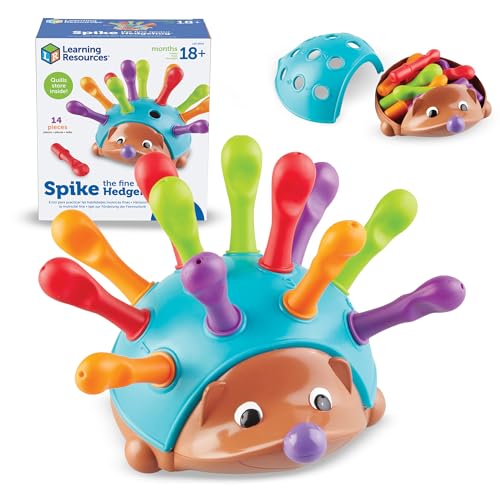
Learning Resources Spike Fine Motor Hedgehog
A Montessori-inspired stacking toy with 12 textured quills that grows from simple sensory play for toddlers to color and number learning for preschoolers. Numbered holes and easy-grip pieces build fine motor skills and hand-eye coordination starting at 18 months.
Pros
- Versatile design adapts from toddler sensory play to preschool color and pattern activities
- Textured quills with easy-grip design reduce frustration for developing hands
- Storage compartment inside prevents lost pieces during travel or storage
- Supports multiple developmental areas: motor skills, color recognition, number identification
Cons
- No customer reviews available to assess real-world durability or user experience
- Limited to 12 quills may feel repetitive for older toddlers after initial novelty
- Relatively small footprint (10x10x4 inches) may limit play surface for group activities

KMTJT Montessori Wooden Toy Set for Toddlers 1-3
A multi-activity wooden toy set combining shape sorting, carrot pulling, and color recognition in one compact package. Designed for ages 1-3 with safety-focused materials, though the 4.8-star rating comes with no verified purchase reviews to validate real-world durability.
Pros
- Multiple play modes (shape sorting, fruit recognition, worm catching, pulling carrots) extend engagement beyond single-activity toys
- Non-toxic water-based paint and polished edges address common parent safety concerns for toddlers
- Develops fine motor skills and hand-eye coordination through varied manipulative tasks
- Includes substantial accessories (12 fruit blocks, 8 carrots, 10 worms) for extended play value
- Appropriately sized pieces (large particles) designed for toddler hands
Cons
- No verified buyer reviews available despite 4.8-star rating, limiting confidence in long-term durability claims
- Five-sided cart design and multiple small components may require significant adult supervision as explicitly warned
- Limited assessment of whether farm-themed gameplay actually sustains toddler interest versus novelty wear-off

MTYOKILN Magnetic Color Maze Puzzle Board for Toddlers
A Montessori-style wooden puzzle board with 55 magnetic beads in 10 colors designed to teach counting and color matching for ages 2-4. The magnetic pen control develops fine motor skills and hand-eye coordination during extended play sessions.
Pros
- Multi-skill learning in one toy: combines color matching, counting, and motor skill development
- Premium materials (natural basswood, non-toxic paint, quality acrylic) ensure durability and safety
- Portable size and magnetic pen control keep toddlers engaged for extended periods
- Montessori-inspired design encourages independent learning and problem-solving
Cons
- No verified buyer reviews to assess real-world durability or magnetic bead security over time
- Limited to ages 2-4 due to small magnetic components, restricting long-term play value
- Single-design maze format may offer limited variety once children master the basic tracks

HarVow LED Busy Board, 13 Switches for Toddlers
A wooden sensory board designed for ages 1-3 featuring 13 tactile switches controlling 24 LED light patterns, paired with alphabet and number engravings on the back. Compact and travel-friendly, it targets color recognition and fine motor skills through interactive play.
Pros
- Durable solid wood build avoids cheap veneer materials
- Multiple light patterns and switches maintain engagement without overstimulation
- Portable design makes it genuinely suitable for travel and car rides
- Thoughtful LED brightness prevents eye strain in young children
- Dual-function back with letters and numbers extends learning value
Cons
- Requires 2 AAA batteries not included in package
- No verified buyer reviews available to assess real-world durability and battery life claims
- Dimensions listed inconsistently in specs (6.7x5.3x1.1 vs 7.8x1.1x0.1 inches)
Montessori Toys Buying Guide
Choosing the right Montessori-style toy is less about brand name and more about matching the toy’s design intent to your child’s current developmental window.
The six criteria below reflect what consistently separates genuinely educational picks from toys that merely borrow the Montessori label for marketing purposes.
If you are also exploring broader educational play, our roundup of STEM toys for kids covers complementary options that build on similar developmental principles.
Age Appropriateness and Developmental Stage Alignment

The single most important factor when evaluating any Montessori toy is whether it is calibrated to the child’s current stage, not just a broad age range printed on the box.
A toy designed for a six-month-old focuses on object permanence and basic cause-and-effect, while a toy meant for a three-year-old should challenge counting, matching, and early sequencing skills.
Misaligning the two leads either to frustration or boredom, both of which undermine independent engagement.
Genuine Montessori design philosophy holds that a child should be able to identify when a task is complete without an adult telling them.
Look for toys with a clear “control of error” built in: a shape sorter hole that only accepts the correct block, a stacking stone that will topple if balanced carelessly, or a puzzle card set where the child can self-check their answer.
This self-correcting quality is what drives repeated, focused play rather than one-and-done engagement.
Materials, Safety Certification, and Durability

Traditional Montessori philosophy strongly favors natural materials, particularly wood, because they offer genuine tactile feedback that plastic cannot replicate. Smooth, rounded wooden pieces connect children to real-world weight and texture.
More practically, well-made wooden toys outlast plastic alternatives by years, making them cost-effective even when the upfront price is higher.
For safety, prioritize toys that carry ASTM F963 (US) or EN71 (EU) certification. For painted or stained wooden pieces, look for non-toxic, water-based finishes.
Babies and young toddlers who are still mouthing objects need pieces large enough that no individual part poses a choking hazard.
Verified buyer reviews are a particularly valuable signal here: parents who have used a toy daily for months will report peeling paint, loose joints, or sharp edges far more reliably than any printed spec sheet.
For parents also shopping in related categories, cloth diapers and baby shampoos for sensitive skin follow similar material-safety logic when building a non-toxic early environment for infants.
Open-Ended Play Value Versus Single-Use Design
One of the clearest dividing lines between a genuine Montessori toy and a novelty item is how many ways it can be used.
Balancing stones, for example, can be stacked, sorted by color, counted, used in imaginative play, or incorporated into sensory exploration. A toy that can only be used one way exhausts its developmental potential quickly and tends to be abandoned.
Open-ended design also scales with the child. A simple shape sorter that engages a twelve-month-old through color recognition can re-engage a three-year-old through sorting speed challenges or pattern-matching games invented by the child themselves.
When assessing a toy’s longevity, ask whether the play potential grows or shrinks as the child develops. This is the same principle behind good science kits for kids, where curiosity-driven exploration rather than a fixed outcome drives engagement.
Sensory Engagement and Fine Motor Skill Development

Montessori education places sensory experience at the core of early learning. Toys that engage multiple senses simultaneously, touch, visual contrast, weight, sound, tend to produce stronger developmental outcomes than single-channel stimulation.
A wooden puzzle with varied textures and bold, contrasting colors works multiple cognitive pathways at once. A hedgehog toy with removable spines in different shapes builds pincer grip while simultaneously reinforcing color and shape recognition.
Fine motor milestones, including the pincer grasp, bilateral coordination, and hand-eye precision, are consistently identified by occupational therapists as foundational skills for later writing and self-care.
Toys that require deliberate, controlled hand movements to complete a task (inserting a ball into a slot, threading a bead, placing a weighted stone) are more effective at building these skills than passive or button-press activities.
This also informs how we evaluate electronic options: lights and sounds can be engaging, but they tend to reward passive watching rather than active manipulation.
Simplicity Versus Feature Overload
A consistent finding in expert consensus around early childhood development is that simpler toys produce richer, longer-lasting play. Toys that do too much for the child remove the cognitive effort that generates learning.
When a toy lights up, plays a song, and announces the correct answer, the child’s role is reduced to observer. Montessori design inverts this: the toy is quiet, the child is active.
This does not mean electronic features are categorically off the table. A magnetic maze or LED busy board can legitimately build cause-and-effect reasoning and fine motor control if the interaction requires the child to problem-solve rather than passively watch.
The relevant question is always: who is doing the thinking, the toy or the child? For children who are ready for more structured learning challenges, coding toys for kids apply this same principle at a higher developmental level.
Value, Price Range, and Longevity

Montessori toys span from very affordable to premium-priced, and price does not map neatly onto educational value.
Some of the highest-impact picks in this roundup sit in the budget-friendly tier, while a few premium options justify their higher cost through exceptional build quality or a design that serves children across multiple developmental stages.
When calculating value, factor in play lifespan. A toy that costs more but engages a child meaningfully for two to three years represents better value than a cheap novelty discarded in a week.
Also consider ease of cleaning (sealed wood versus fabric versus plastic) and whether replacement parts are available if pieces are lost.
Verified buyer reviews consistently flag longevity and durability as the most decisive factors in whether parents would repurchase or recommend a toy, which is why we weight that feedback heavily in our scoring methodology.
Why You Should Trust Us
ProductFind is an independent review publication. We do not sell toys, manage inventory, or have commercial relationships with the brands featured in this guide.
Every product in this roundup was evaluated through our structured research methodology and assigned a PF Score on a 0 to 10 scale based on consistent, documented criteria.
Our PF Score for each product reflects a synthesis of four data streams: published product specifications and safety certifications, expert review consensus drawn from child development specialists and parenting publications, verified buyer feedback aggregated from confirmed purchasers, and publicly available comparative data.
We do not conduct our own product trials; our evaluations are grounded in research, published data, expert review consensus, and verified buyer feedback.
This approach allows us to assess a wide range of products with consistency and to update our findings as new verified feedback accumulates.
ProductFind may earn a commission if you purchase through links in this article. That affiliate relationship has no influence on which products appear in this guide, how they are ranked, or what scores they receive.
Our rankings are determined entirely by research quality and PF Score, not by commission rates or brand partnerships. We apply the same standard to every product, regardless of price tier or manufacturer.
Final Thoughts
After comprehensive research across specifications, expert guidance, and verified buyer experience, a clear picture emerges: the best Montessori toys reward deliberate, child-led play with materials that are safe, durable, and genuinely calibrated to developmental stage.
Whether you are buying for a newborn’s first months or a preschooler ready for counting and matching, there is a strong pick in this list at every budget level.
Brands like Adena Montessori, OESSUF, LiKee, Tonberless, and Oomloid all deliver solid options, while Learning Resources and Play-Act round out the field with accessible, well-reviewed choices.
Here are our standout picks by category:
- Best Overall: Adena Montessori Object Permanence Box with Tray earns the top spot with the highest PF Score in this roundup. It targets one of the most important cognitive milestones in early infancy, object permanence, through a beautifully simple wooden design that encourages focused, self-directed interaction from six months onward.
- Best Wooden Shape Puzzle: LiKee Wooden Shape Puzzle with 36 Blocks and 60 Cards stands out for its exceptional play-value-to-price ratio. The combination of physical blocks and a large card set gives children aged three and up a genuinely scalable challenge that grows with their skills.
- Best for Sensory and Balancing Play: OESSUF Extra-Large Stacking Rocks for Toddlers delivers open-ended sensory engagement through its jumbo smooth wooden stones. Verified buyers consistently highlight the generous size, which makes it accessible to younger toddlers, and the clean, natural finish.
- Best Budget Pick: Tonberless Wooden Learning Puzzles Shape Sorter punches well above its modest price point. For parents building a Montessori-friendly toy collection on a tighter budget, this shape sorter delivers reliable developmental value with a verified buyer approval rate that rivals pricier alternatives.
- Best for Early Counting Skills: Oomloid Counting Animals Montessori Toys bridges the gap between sensory play and early numeracy for children aged three to five. The hands-on animal figures make abstract counting concepts tangible, and at a budget-friendly price it is one of the most accessible picks in this category.
If your child is approaching school age and ready for more structured learning challenges, exploring coding toys for kids or a broader set of STEM toys can build naturally on the independent problem-solving habits that good Montessori play establishes early.
Frequently Asked Questions
What Makes a Toy Genuinely Montessori Rather Than Just Marketed as One?
Authentic Montessori design has a few hallmarks that go beyond materials. The toy should be self-correcting, meaning a child can identify success or failure without adult input. It should encourage focused, independent engagement rather than passive entertainment.
It should be purposefully simple, removing bells, whistles, and automatic rewards that do the thinking for the child. Wood and natural materials are preferred but not required; the design philosophy matters more than the label.
The “Montessori” label carries no regulatory definition, so any toy can use it. Evaluating the actual design against these criteria, rather than relying on packaging, is the most reliable approach.
Verified buyer reviews from parents who use the toy daily are one of the best signals of whether a toy delivers on its developmental claims in practice.
At What Age Should I Start Introducing Montessori Toys?
Montessori-style play can begin from birth. For newborns and young infants, simple sensory toys such as high-contrast visual stimulators, soft rattles, and teethers that allow safe mouthing and exploration are appropriate starting points.
Object permanence boxes become relevant around six months, when infants begin understanding that objects continue to exist when out of sight. Shape sorters and stacking toys typically become engaging from twelve to eighteen months onward.
The key is matching the toy’s challenge level to the child’s current window rather than rushing to the next stage. A toy that is too advanced produces frustration; one that is too simple produces boredom.
Both outcomes undermine the independent, self-directed engagement that defines quality Montessori play.
Are Wooden Montessori Toys Worth the Higher Price Compared to Plastic Alternatives?
For most families, yes, when longevity and safety are factored in. Well-constructed wooden toys carry genuine weight and tactile texture that engages children differently than plastic. They tend to be more durable, surviving multiple children and years of daily use.
They are also less likely to contain plasticizers or chemical additives that parents may want to avoid for very young children who mouth their toys frequently.
That said, several strong wooden options in this roundup are priced competitively with quality plastic alternatives, making the material upgrade accessible even on a modest budget.
The decisive question is build quality, not material alone: a cheaply made wooden toy with peeling paint and loose joints is worse than a well-engineered plastic one.
How Many Montessori Toys Does a Child Actually Need?
Fewer than most parents assume. Montessori philosophy actively discourages toy overload, which can fragment attention and reduce the depth of engagement with any single material.
A small, curated collection of high-quality, developmentally appropriate toys will consistently outperform a large bin of mixed items in producing focused, purposeful play.
A practical approach is to rotate toys in and out of availability. Keeping only a handful of toys accessible at any given time maintains novelty and encourages children to explore each one more deeply before moving on.
Parents who apply this rotation strategy frequently report longer, more engaged independent play sessions even with toys the child has had for months.
Can Montessori Toys Work Alongside More Traditional or Electronic Toys?
Yes. Montessori play does not require an all-or-nothing commitment. Many families blend open-ended wooden toys with select electronic or interactive options, particularly as children grow into the preschool years and develop an appetite for more varied stimulation.
The useful filter is whether any given toy, electronic or not, requires the child to think, manipulate, and problem-solve actively or simply rewards passive watching.
As children move toward school age, structured learning tools including science kits for kids and introductory coding toys can complement Montessori fundamentals by channeling the same curiosity-driven, hands-on ethos into more complex subject matter.
What Is the Difference Between Montessori Toys and STEM Toys?
Montessori toys emphasize sensory exploration, independence, and child-led discovery with an emphasis on the process rather than a predetermined outcome. STEM toys are typically designed around specific subject domains, science, technology, engineering, and mathematics, and often involve structured challenges with measurable results.
In practice, the categories overlap considerably. Many of the best Montessori picks in this roundup, including counting, sorting, and building toys, build directly on the early numeracy and spatial reasoning skills that quality STEM toys develop further at later ages.
Treating them as complementary rather than competing categories tends to produce the richest developmental outcomes across early childhood.
About the author
Chester is a reviewer and writer for ProductFind who specializes in Educational & STEM Toys. Chester evaluates products through independent research: specifications, expert review consensus, and verified buyer feedback, and rates each one on the PF Score. Chester focuses on helping readers pick the right educational & stem toy for their needs and budget.