The 8 Best Wooden Puzzles for Kids
Wooden puzzles build real skills, but the right pick depends on your child's age and play style. Here are the formats and sets worth buying right now.
 By Chester Bryant
Updated July 23, 2026
By Chester Bryant
Updated July 23, 2026

Wooden puzzles have earned their place as a staple of early childhood development for good reason. Unlike digital alternatives, they build fine motor skills, spatial reasoning, and problem-solving habits through direct, tactile interaction.
Whether you are shopping for a toddler just learning to grip or a grade-schooler ready for multi-piece challenges, the range of options available today spans pegged chunky sets, classic jigsaw formats, tangram brain teasers, and shape-sorting cards, so finding the right fit takes a little guidance.
For parents who value screen-free play and durable, eco-conscious materials, the category of wooden puzzles for kids consistently delivers on all fronts.
At ProductFind, we research each pick by analyzing published specifications, synthesizing expert review consensus from parenting and child development sources, and weighing verified buyer feedback from confirmed purchasers.
We then score every product on our 0-to-10 PF Score scale so you can compare quality at a glance.
If you are also building out a broader educational toy collection, our roundup of STEM toys for kids covers complementary picks across multiple learning categories.
Below you will find our top-ranked wooden puzzles for kids, ready to compare side by side.
| Award | Product | PF Score About PF ScoreThe PF Score is our own rating from 0 to 10, based on performance, design and build, ease of use, and value. It reflects independent research and is never influenced by manufacturers, retailers, or affiliate commissions. Learn more › | Price | |
|---|---|---|---|---|
| Best Overall |
 SYNARRY Wooden Puzzles 6-Set with Storage Rack
|
8.5/10 | Buy | |
| Editor's Pick |
 SYNARRY 60-Piece Wooden Puzzles, 4-Pack with Frames
|
7.5/10 | Buy | |
| Best Value |
 SYNARRY Dinosaur Wooden Puzzles 4-Pack, 24 Pieces
|
8.3/10 | Buy | |
| Top Rated |
 LiKee 36-Piece Wooden Shape Puzzle with Pattern Cards
|
7.9/10 | Buy | |
 Melissa & Doug Safari Wooden Puzzle, 8 Pieces
|
7.8/10 | Buy | ||
 Nashrio 4-Pack Wooden Jigsaw Puzzles, 20 Pieces
|
7.6/10 | Buy | ||
 Coogam 40-Piece Wooden Tangram Puzzle Block Set
|
7.2/10 | Buy | ||
 Jerify 5-Pack Wooden Hexagon Tangram Puzzle
|
7.1/10 | Buy |
SYNARRY Wooden Puzzles 6-Set with Storage Rack
A set of six animal-themed wooden puzzles designed for toddlers ages 1-4, featuring large pieces, durable paint, and an included storage rack. Best suited for parents seeking Montessori-style learning toys that combine fine motor development with animal recognition.
Pros
- Large, thick pieces reduce choking risk and are easier for small hands to manipulate
- Durable waterproof coating withstands daily wear and moisture from toddler play
- Storage rack keeps multiple puzzles organized and reduces clutter, supporting learning habits
- 6-puzzle set offers variety without excessive bulk, suitable for different skill levels
- Bright, vibrant artwork with animal themes supports visual engagement and early learning
Cons
- No verified buyer reviews available to assess real-world durability or age-appropriateness consistency
- Storage rack size and assembly details not specified, unclear if it fits all puzzle types efficiently
- Total piece count (54 pieces across 6 puzzles) may vary per puzzle, limiting size predictability
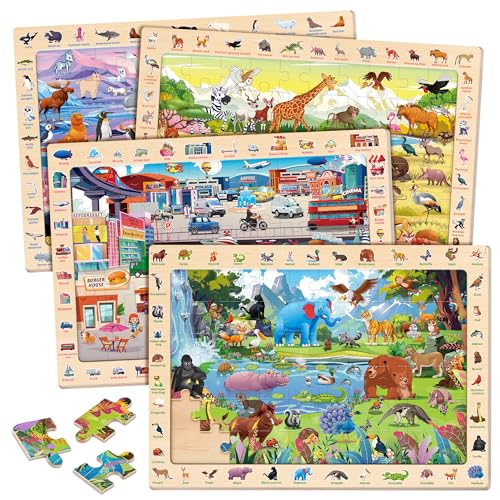
SYNARRY 60-Piece Wooden Puzzles, 4-Pack with Frames
A four-puzzle set featuring 60 wooden pieces each with jungle, polar, savanna, and city themes designed for ages 4-8. Thicker-than-standard pieces, self-correcting shapes, and included reference posters support independent learning, though there are currently no verified buyer reviews to assess real-world durability.
Pros
- Thicker pieces (2x industry standard) reduce breakage and splinter risk for younger hands
- Unique self-correcting shapes naturally guide correct placement without trial-and-error frustration
- Four diverse themed puzzles encourage repeated play and learning across different habitats and environments
- Wooden frames keep pieces contained during and between play sessions
- Removable reference posters support independent completion without adult assistance
Cons
- No verified customer reviews available to confirm durability claims or real-world performance after extended use
- 4.6-star rating appears placeholder with zero reviews, limiting confidence in quality assessment
- Four-puzzle set may feel bulky for storage despite keepsake box presentation
SYNARRY Dinosaur Wooden Puzzles 4-Pack, 24 Pieces
A set of four wooden dinosaur-themed jigsaw puzzles with 24 pieces each, designed for kids ages 3-6. Features thicker wood construction, polished edges, and removable paper guides underneath for reference, making them durable for repeated use.
Pros
- Durable construction withstands repeated use by young children
- Removable paper guides underneath help with assembly and learning
- Thicker pieces easier for small hands to grasp and manipulate
- Four puzzles provide variety and extended play value
- Wooden frame keeps pieces organized during assembly
Cons
- No verified buyer reviews available to assess real-world durability and satisfaction
- 24 pieces per puzzle may be challenging for children on the younger end of the 3-5 range
- Limited information on whether all four puzzles are actually different or repeated designs
LiKee 36-Piece Wooden Shape Puzzle with Pattern Cards
This Montessori-style wooden puzzle set combines 36 shape blocks with 60 pattern cards, letting kids follow designs or create their own. Made from smooth, natural wood meeting CPSC safety standards, it targets spatial reasoning and color recognition for ages 3+.
Pros
- Comes with 60 pattern cards for guided and open-ended play
- Smooth natural wood construction with no sharp edges, meets safety standards
- Includes 2 iron storage tins for convenient organization
- Develops multiple skills: spatial awareness, shape recognition, hand-eye coordination, problem-solving
- Compact small size makes it portable and easy to store
Cons
- No verified buyer reviews available to assess real-world durability or quality consistency
- Limited information on whether pattern cards are age-appropriate or difficulty-tiered
- Small dimensions may limit design complexity for older or more advanced children
Melissa & Doug Safari Wooden Puzzle, 8 Pieces
A chunky wooden puzzle featuring eight safari animals designed for toddlers ages 2 and up. The thick, easy-to-grasp pieces promote fine motor skills and screen-free play while introducing animal names and shapes.
Pros
- Thick, durable pieces are genuinely easy for toddlers to grasp and manipulate
- FSC-certified wood supports responsible forestry practices
- Screen-free learning format encourages independent play and fine motor development
- Compact size (approximately 12 x 11 inches) stores easily
Cons
- No verified buyer reviews available to confirm real-world durability or age appropriateness
- Limited to eight pieces, so puzzle complexity is minimal for older preschoolers
- Relies on pegged holes, which may not suit all children's grip strengths
Nashrio 4-Pack Wooden Jigsaw Puzzles, 20 Pieces
A budget-friendly set of four wooden puzzles with dinosaur, space, transportation, and animal themes designed for preschoolers ages 3-6. Each puzzle comes in a sturdy wooden storage tray with guides, making assembly and cleanup straightforward for young learners.
Pros
- Four different puzzle themes provide variety without buying separately
- Wooden construction with rounded edges designed specifically for toddler safety
- Built-in storage trays and removable guides simplify assembly and cleanup
- Developmentally appropriate piece count for preschool-age coordination
Cons
- No verified buyer reviews available to confirm durability claims in real-world use
- 20-piece puzzles may feel too simple for advanced 5-6 year olds
- Limited information on wood material sourcing or finish specifications
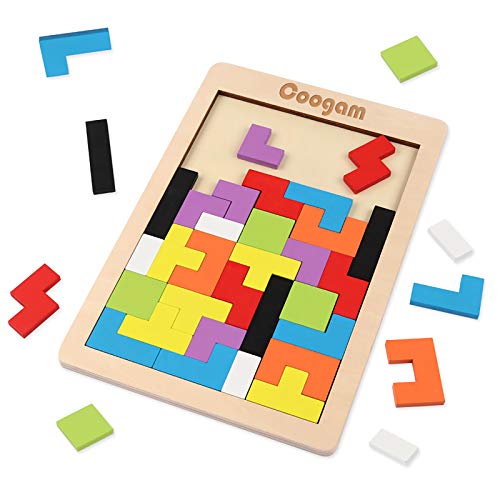
Coogam 40-Piece Wooden Tangram Puzzle Block Set
A 40-piece wooden block puzzle that combines tangram and Russian block mechanics, offering multiple shape configurations from animals to geometric forms. Made from smooth basswood with non-toxic paint, it appeals to both kids seeking creative play and adults looking for a fidget toy.
Pros
- Open-ended gameplay with numerous shape possibilities, rewarding creativity and problem-solving
- Safe materials: natural basswood with harmless paint suitable for young children
- Addresses both STEM learning and relaxation needs, versatile across age groups
- Reasonable board dimensions make it portable without being too small to handle
Cons
- No verified buyer reviews available to confirm durability or actual play experience
- Limited detail on difficulty levels or guidance for different age groups
- Physical dimensions of individual blocks not specified, making it unclear if pieces suit small hands
Jerify 5-Pack Wooden Hexagon Tangram Puzzle
A set of five wooden tangram puzzles in hexagon format designed to build spatial reasoning and pattern recognition in young learners. Made from quality wood with smooth finishes, these brain teasers work for both beginners and experienced puzzle solvers.
Pros
- Multiple puzzle designs prevent boredom and offer progressive challenges
- Quality wood construction with smooth surfaces and no burrs
- Teaches geometric concepts and spatial reasoning through play
- Works as both learning tool and entertainment for different skill levels
Cons
- Contains small parts requiring adult supervision for children under 3 years old
- No customer reviews available to assess real-world durability and piece retention
- Limited information on storage or carrying case for the five-pack set
Wooden Puzzles for Kids Buying Guide
Choosing the right wooden puzzle comes down to matching the product’s design and difficulty level to a child’s developmental stage and interests.
The picks in this list span a wide age range and several puzzle formats, so understanding the key criteria below will help you zero in on the best option for your child rather than defaulting to the highest piece count or the lowest price.
Age Appropriateness and Piece Count

Piece count is the single most important starting point. Toddlers between one and three years old thrive with chunky pegged puzzles featuring four to twelve large pieces they can grasp and place without frustration.
As a general benchmark, most child development guidelines suggest introducing puzzles with more than twenty pieces only after a child consistently completes simpler formats independently.
For preschoolers aged three to five, puzzle sets with twelve to sixty pieces in clear thematic categories such as animals, vehicles, or dinosaurs maintain engagement without overwhelming.
Kids aged four and up can begin exploring forty-piece jigsaws or logic-based tangram formats that require rotation and spatial planning.
Always check the manufacturer’s stated age range, which is determined partly by small-piece choking hazard thresholds set by consumer product safety standards.
Multi-pack puzzle sets that include several boards at varying difficulty within a single purchase are especially practical. They let one child grow into harder puzzles over months, or accommodate siblings of different ages without needing separate purchases.
A developmentally appropriate early toy lays the groundwork for the visual discrimination skills puzzles build on later.
Material Quality and Wood Construction
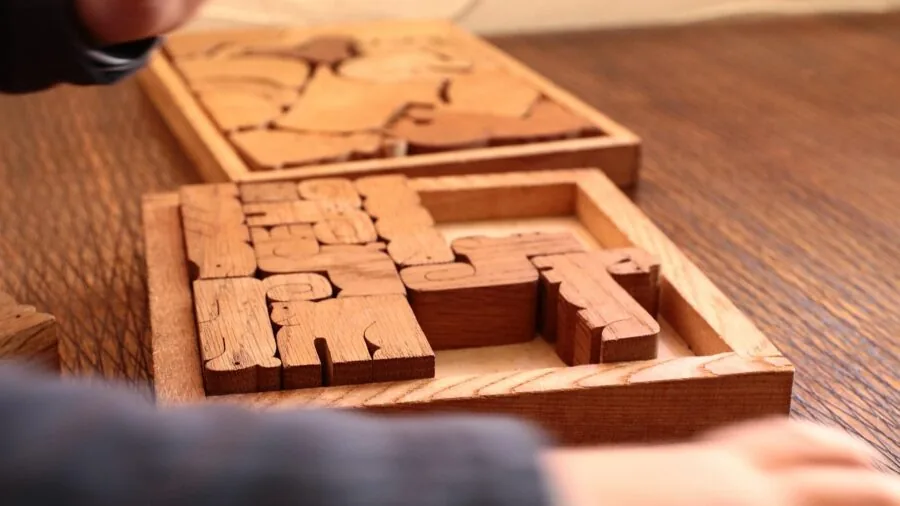
The weight and finish of the wood matter more than many buyers expect. Thicker pieces cut from solid basswood or birch plywood resist warping and chipping far better than thin MDF composites.
Pieces that are die-cut to close tolerances slot together cleanly without being so tight that a young child loses confidence, or so loose that pieces slide out during play.
For families with environmental concerns, look for products carrying FSC certification, which indicates wood sourced from responsibly managed forests.
Melissa & Doug, one of the brands in this roundup, explicitly notes FSC certification on several of its puzzle lines, a detail worth verifying in the product listing.
Paint and sealant safety matters too: reputable brands use non-toxic, child-safe finishes that comply with EN71 or ASTM F963 toy safety standards.
Storage is a practical extension of material quality. Puzzles that include a dedicated tray, rack, or storage box preserve piece integrity and make cleanup faster, which directly affects how consistently the puzzle gets used.
SYNARRY’s toddler set with a display rack is a good example of a product that solves this storage problem by design.
Puzzle Format and Play Style
Wooden puzzles fall into several distinct formats, each serving a different developmental goal. Pegged puzzles use a small handle knob on each piece, making them ideal for toddlers still developing their pincer grip.
Classic jigsaw-style wooden puzzles build visual pattern recognition and planning. Shape-sorting card puzzles, like the LiKee format, add a matching and memory layer by pairing physical blocks against illustrated reference cards.
Tangram and geometric block puzzles, such as those from Coogam and Jerify, shift the focus toward spatial rotation and logical deduction, making them closer to strategy-oriented board games in terms of cognitive demand.
Consider how the child typically plays. A child who enjoys independent quiet play benefits from a self-contained puzzle with a clear solution state.
A child who prefers guided interaction does well with card-based sets where an adult or older sibling can participate by drawing and presenting challenge cards. Multi-format sets that combine both approaches offer the best long-term value.
Theme and Visual Engagement
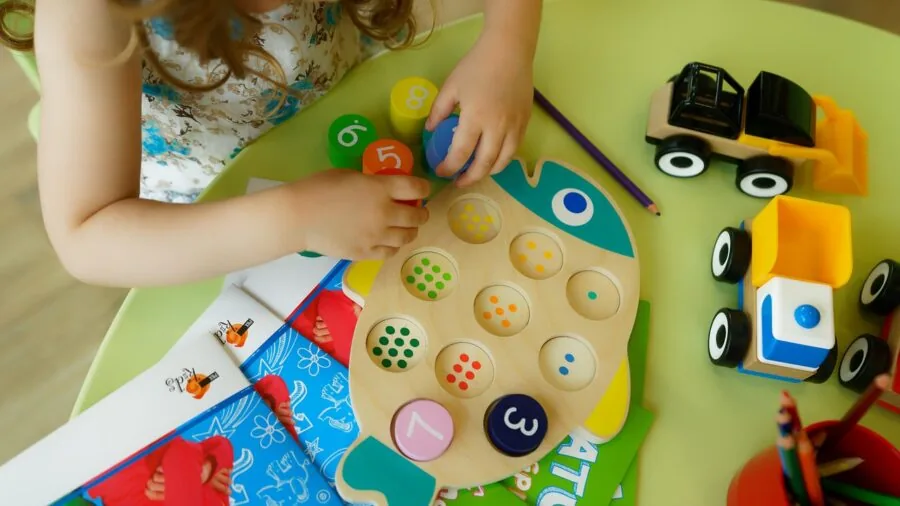
Theme acts as the primary motivator for young children. A child fascinated by dinosaurs will return to a dinosaur puzzle far more often than a generic geometric shape puzzle, even if the latter is technically more challenging.
Themes also support vocabulary building: completing an animal puzzle while naming each piece is a documented early literacy technique used in Montessori and play-based learning environments.
The breadth of theme coverage within a set matters for sustained interest.
Four-in-one puzzle sets that cover different subject areas, such as the SYNARRY dinosaur 4-in-1 or the NASHRIO set covering dinosaurs, space, and transportation, extend the usable life of a single purchase by several months.
Single-theme puzzles are better suited as targeted gifts when you already know a child’s specific interest.
Bright, high-contrast illustration styles improve piece differentiation for younger children who have not yet developed strong color vocabulary. Subdued or monochromatic illustrations increase difficulty in a natural way for older kids without changing the piece count.
If you are looking to build a broader educational play environment, pairing puzzles with coding toys for kids and science kits creates a layered STEM-friendly activity corner at home.
Educational Value and Montessori Alignment
Many wooden puzzles in this category are marketed as Montessori-inspired, a term that broadly signals self-directed, hands-on, materials-based learning.
In practical terms, this means pieces that are sized and weighted for independent manipulation, activities with a clear self-correcting feedback mechanism (pieces only fit in the right orientation or location), and themes drawn from the real world rather than purely fantasy characters.
Genuine Montessori alignment goes beyond marketing language. Look for puzzles where the child can verify correctness without adult input, where the difficulty scales progressively within a set, and where the materials encourage repeated, focused engagement rather than one-time novelty.
The LiKee shape puzzle with sixty challenge cards is a particularly strong example of a product that builds in progressive difficulty through card-based prompts.
Parents interested in expanding Montessori-style play beyond puzzles will find that many of the same criteria apply when evaluating other hands-on educational formats.
A child who thrives with wooden puzzles often responds well to open-ended hands-on STEM activities that extend spatial and logical reasoning into new domains.
Value, Durability, and Long-Term Use

Wooden puzzles generally outlast cardboard equivalents by years under normal use conditions. A well-constructed wooden set can pass from one sibling to the next without degrading, which substantially improves the cost-per-hour-of-play metric even for moderately priced options.
Budget-range sets in this category can be excellent value when construction quality is solid; the price difference between the most affordable and most premium picks in this roundup reflects differences in piece count, packaging, and thematic breadth rather than fundamental quality gaps.
Multi-pack sets and bundled formats provide the strongest value for families buying a first puzzle or refreshing a collection.
Single-puzzle picks at a lower unit price make more sense as add-ons once you know which format and difficulty level best suits your child.
Always factor in whether a replacement piece policy exists; reputable brands often sell or supply replacements for lost pieces, which is a meaningful quality indicator for a product intended to last several years.
Why You Should Trust Us
ProductFind is an independent editorial review site. We evaluate every product using a consistent, multi-factor research framework that draws on published specifications, expert review consensus from parenting experts and child development specialists, and verified buyer feedback sourced from confirmed purchasers.
Each product receives a PF Score on a 0-to-10 scale that reflects our assessment across criteria including material quality, age appropriateness, educational value, design, and owner satisfaction signals.
We do not conduct our own product trials; our evaluations are grounded in research, published data, expert review consensus, and verified buyer feedback.
This methodology allows us to assess a broad range of products consistently and transparently, without the conflicts of interest that can arise from manufacturer-supplied samples or sponsored placement.
ProductFind may earn a commission when you purchase through links in this article. That affiliate relationship has no influence on rankings, PF Scores, or product selection. Every pick in this list was chosen on editorial merit.
We do not accept payment for placement, and products are ranked solely on the quality of our research assessment.
Final Thoughts
The wooden puzzles for kids in this roundup span a wide range of formats, age targets, and budgets, and each earns its place on this list for distinct reasons. Here are our editorial awards based on PF Score and product strengths:
- Best Overall: SYNARRY Wooden Puzzles for Toddlers 1-3, 6-Set with Rack earns the top spot with the highest PF Score in this roundup, combining a generous six-puzzle set, a built-in display rack for storage and showcase, and verified strong reception from parents of one-to-three-year-olds seeking Montessori-aligned toddler play.
- Best for Growing Preschoolers: SYNARRY Large Dinosaur Wooden Puzzles 4-in-1 stands out for its four-board dinosaur format sized generously for little hands, with broad appeal across the three-to-six age window and consistently positive verified buyer feedback on piece quality and theme engagement.
- Best for Shape and Logic Learning: LiKee Wooden Shape Puzzle with 36 Blocks and 60 Cards delivers the best blend of physical manipulation and card-based challenge progression in this group, making it a standout choice for parents seeking a Montessori-style activity that scales in difficulty over time.
- Best Budget Pick: NASHRIO Wooden Educational Jigsaw Puzzles 4-Pack offers four themed twenty-piece boards covering dinosaurs, space, and transportation at an accessible price point, with solid construction quality relative to its cost confirmed by verified buyer reviews.
- Best Classic Toddler Pick: Melissa & Doug Safari Wooden Chunky Puzzle remains a trusted staple for ages two and up, backed by FSC certification, a well-established brand track record, and decades of positive reception in early childhood education settings.
Whichever format you choose, wooden puzzles for kids reward repeated play and grow in value as children revisit them at different developmental stages.
Pairing puzzles with other open-ended educational formats, such as age-appropriate coding toys or hands-on science kits for kids, builds a well-rounded learning environment that extends well beyond any single activity.
Frequently Asked Questions
What age should kids start doing wooden puzzles?
Most child development specialists suggest introducing simple pegged wooden puzzles as early as twelve to eighteen months, once a child demonstrates consistent interest in picking up and placing objects.
At this stage, large chunky pieces with knob handles are ideal because they support pincer grip development without requiring fine coordination. By age two, most toddlers can manage four-to-eight-piece pegged puzzles independently with some initial guidance.
Classic jigsaw-style puzzles with interlocking pieces generally become appropriate around age three, starting with twelve to twenty-four pieces. Complexity can increase gradually as the child demonstrates consistent success and growing frustration tolerance. Logic-based formats like tangrams are typically introduced from age four onward.
Are wooden puzzles better than cardboard puzzles for toddlers?
For toddlers specifically, wooden puzzles offer several practical advantages over cardboard. Wood pieces are significantly more durable and resist the bending, tearing, and moisture damage that cardboard pieces suffer under the rough handling typical of one-to-three-year-olds.
Wooden pieces also tend to be thicker and heavier, which makes them easier for small hands to pick up and orient correctly.
The main advantage of cardboard puzzles is cost and variety at higher piece counts for older children. For kids aged five and above working on fifty-piece or larger puzzles, high-quality cardboard jigsaws are a practical and widely accepted format.
For the toddler and early preschool years, however, wood consistently outperforms cardboard on durability and sensory feedback.
How many puzzle pieces are right for a four-year-old?
Most four-year-olds are ready for puzzles in the twenty-to-sixty-piece range, depending on prior puzzle experience and individual development.
A child with regular puzzle exposure from age two or three can often handle forty-to-sixty-piece sets comfortably at age four, while a child newer to puzzles may benefit from starting at the lower end of that range.
The SYNARRY 4-in-1 dinosaur set and the NASHRIO four-pack in this roundup both fall within this appropriate window.
Watch for signs of appropriate challenge: mild problem-solving effort and occasional requests for a hint are healthy, while extended frustration and piece-throwing signal the puzzle is too difficult.
Adjust up or down by five to ten pieces at a time rather than jumping to a dramatically different count.
What should I look for in a puzzle set for multiple siblings of different ages?
Multi-board sets with varying difficulty levels within a single package are the most practical choice for mixed-age households. Look for sets that include both simple pegged boards suitable for toddlers and more complex interlocking boards for preschoolers.
SYNARRY’s toddler six-set with rack is designed specifically to accommodate this kind of progressive use, while the SYNARRY Match & Find 4-in-60 format suits older children exploring reading and category recognition alongside puzzle completion.
Card-based formats like the LiKee shape puzzle also work well across ages because younger children can use fewer cards and simpler configurations while older siblings tackle more complex arrangements with the same physical set.
This shared-use potential significantly improves the per-child value of a single purchase. For broader gifting ideas that work across age ranges, our coverage of STEM toys for kids and family-friendly board games offers complementary recommendations that scale similarly.
Do wooden puzzles help with school readiness?
Yes, a substantial body of early childhood education research links regular puzzle play to improvements in spatial reasoning, visual discrimination, shape recognition, and fine motor control, all of which are directly relevant to early literacy and numeracy.
Completing a puzzle also builds task persistence and the ability to tolerate temporary uncertainty while searching for a solution, skills that transfer directly to classroom learning behaviors.
Thematic puzzles that incorporate animals, letters, numbers, or real-world scenes add a vocabulary-building layer when adults narrate and name pieces during shared play.
Child development specialists widely recommend wooden puzzles as one of the highest-value screen-free activities for children between eighteen months and six years, precisely because they address multiple developmental domains simultaneously in a single, self-contained activity.
About the author
Chester is a reviewer and writer for ProductFind who specializes in Educational & STEM Toys. Chester evaluates products through independent research: specifications, expert review consensus, and verified buyer feedback, and rates each one on the PF Score. Chester focuses on helping readers pick the right educational & stem toy for their needs and budget.