The 8 Best Kids Trampolines
Safety certifications, enclosure quality, and frame durability vary wildly in this category. Here are the kids trampolines worth buying for toddlers through big kids.
 By Susan Lewis
Updated July 23, 2026
By Susan Lewis
Updated July 23, 2026

A good trampoline does more than burn energy.
Research from occupational and physical therapists consistently points to bouncing as one of the most effective ways to build core strength, improve balance, and deliver the kind of deep proprioceptive input that helps kids regulate focus and mood.
Whether you’re outfitting a backyard or carving out a corner of the playroom, the right trampoline can become the most-used piece of play equipment you own.
The challenge is sorting through a crowded market where safety certifications, weight limits, enclosure quality, and frame durability vary enormously between brands.
This guide covers eight models spanning toddler rebounders to full-size 12-foot outdoor trampolines, from value-friendly picks to premium builds, representing options from ORCC, ARMY VANCA, JoyBerri, SKOK, Square House, GYMAX, MOM Selected, and Fisher-Price.
Our team at ProductFind assessed each model through a synthesis of published specifications, expert review consensus, and verified buyer feedback, then rated each on our 0 to 10 PF Score scale.
If you’re also shopping for complementary active-play gear, our roundup of balance bikes for toddlers and growing kids is worth a look. Here are our top picks for kids trampolines right now.
| Award | Product | PF Score About PF ScoreThe PF Score is our own rating from 0 to 10, based on performance, design and build, ease of use, and value. It reflects independent research and is never influenced by manufacturers, retailers, or affiliate commissions. Learn more › | Price | |
|---|---|---|---|---|
| Best Overall |
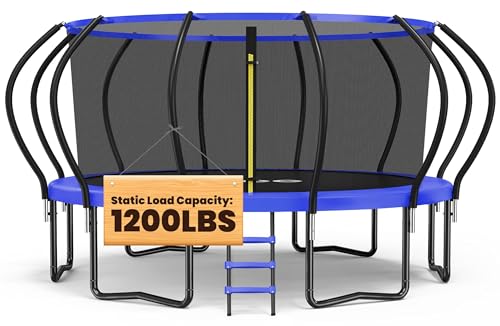 ORCC 14FT Trampoline with Safety Net, 1200LBS Capacity
|
7.4/10 | Buy | |
| Editor's Pick |
 Army Vanca 12-Foot Trampoline with Safety Enclosure
|
8.3/10 | Buy | |
| Best Value |
 JoyBerri 10ft Outdoor Trampoline with LED Lights
|
7.8/10 | Buy | |
| Top Rated |
 SKOK 8FT Trampoline with Enclosure, 400LBS Capacity
|
7.9/10 | Buy | |
 Square House 60" Toddler Trampoline with Safety Enclosure
|
7.8/10 | Buy | ||
 MOM Selected 60-Inch Toddler Trampoline with Safety Net
|
7.4/10 | Buy | ||
 GYMAX 70-Inch Rectangle Kids Trampoline with Swing
|
7.3/10 | Buy | ||
 Fisher-Price WonderJump 36-Inch Mini Trampoline
|
7.1/10 | Buy |
ORCC 14FT Trampoline with Safety Net, 1200LBS Capacity
A large outdoor trampoline designed with safety certifications (CPSIA, ASTM F381-16) and durable hot-dip galvanized steel construction. The 14-foot model offers curved foam-padded poles, reinforced netting, and 1200LBS static weight capacity, making it suitable for families with multiple users.
Pros
- Certified safety design with multiple protective features including curved poles and 15mm foam padding
- Hot-dip galvanized steel frame offers exceptional rust resistance and long-term durability
- Comprehensive warranty coverage: 2 years on frame, 1 year on springs and mats, 6 months on nets
- Bundle includes ladder, wind stakes, and assembly accessories for immediate use
- Higher bounce performance with heavy-duty stitched waterproof jumping mat
Cons
- Requires 4 or more people to safely move the assembled trampoline, limiting relocation flexibility
- Assembly takes approximately 1.5 hours and requires careful coordination between multiple people
- No existing verified buyer reviews available to assess real-world durability and performance
Army Vanca 12-Foot Trampoline with Safety Enclosure
A 12-foot outdoor trampoline built for durability with galvanized steel construction, competition-grade jumping mat, and full 360-degree safety netting. Meets CPSIA and ASTM safety certifications, making it suitable for families prioritizing secure backyard play.
Pros
- Comprehensive safety features including full enclosure netting, curved guardrails with high-density foam padding, and rigorous certification compliance
- Durable construction with corrosion-resistant galvanized steel frame and UV-resistant jumping surface suitable for year-round outdoor use
- Comes with all necessary components and step-by-step instructions, designed for two-adult assembly
- Competition-grade materials including woven mesh mat and tensile-strength-tested springs deliver responsive bounce
Cons
- Ships in two separate packages, requiring coordination for delivery and storage
- Requires two adults for assembly, which may not be convenient for all households
- No verified buyer reviews available to assess real-world durability or long-term performance
JoyBerri 10ft Outdoor Trampoline with LED Lights
A 10-foot trampoline designed for families, featuring ASTM certification, integrated 16-color LED lighting with remote control, and an optional sprinkler system. The rust-proof steel frame supports up to 450 lbs and includes a safety net, ladder, and ground stakes for year-round outdoor use.
Pros
- ASTM certified safety features including outwardly curved poles reduce collision risk
- Durable rust-proof and weather-resistant construction suitable for year-round outdoor use
- LED lighting system adds nighttime entertainment value with multiple color and mode options
- Solid 450 lb weight capacity accommodates multiple users
- 5-year protection plan provides long-term coverage beyond typical warranties
Cons
- No verified buyer reviews available to assess real-world durability or assembly difficulty
- 10ft size may require significant yard space and could be challenging to install without assistance
- LED lights and sprinkler system require power source and maintenance not detailed in specifications
SKOK 8FT Trampoline with Enclosure, 400LBS Capacity
An 8-foot trampoline designed for families, featuring ASTM-compliant safety standards, a 59-inch enclosed net, and reinforced construction to support up to 400 pounds. The 42 galvanized springs and high-density jumping mat prioritize durability and bounce quality for extended outdoor use.
Pros
- Meets ASTM safety standards with robust enclosure design
- High weight capacity at 400 pounds supports children and adults
- Rust-resistant galvanized springs and fade-resistant jumping mat reduce maintenance
- Multiple safety features including double zippers, foam padding, and included ladder
- Stable U-shaped leg frame provides reliable support
Cons
- No verified buyer reviews available to assess real-world durability and assembly ease
- 8-foot size requires significant outdoor space and may not suit all yards
- Maintenance of 42 springs and enclosure net requires ongoing effort
Square House 60" Toddler Trampoline with Safety Enclosure
A compact 60-inch trampoline designed for toddlers ages 1-6 with ASTM certification, no-gap safety mesh, and anti-rollover base. Includes a basketball hoop attachment and assembles in 30 minutes, making it a practical choice for families seeking active indoor play without sacrificing aesthetics.
Pros
- Third-party ASTM certification and reinforced no-gap design provide genuine safety assurance for toddlers
- Compact dimensions work in standard living spaces without dominating the room
- Included basketball hoop extends usability as children grow from ages 1-8
- Anti-rollover base with 6-point ground contact prevents tipping during active play
- Heavy-duty galvanized steel and rust-resistant coating support both indoor and outdoor use
Cons
- No verified buyer reviews available to assess real-world durability and satisfaction
- 220lb capacity limits use to younger children and may not accommodate multiple older siblings simultaneously
- Compact size means shorter bounce height compared to larger trampoline models
MOM Selected 60-Inch Toddler Trampoline with Safety Net
A 60-inch indoor/outdoor trampoline designed for kids ages 3-11, featuring a 360-degree safety enclosure net and foam padding. Supports up to 440 lbs with heavy-duty steel frame and rust-resistant springs for reliable daily use.
Pros
- Comprehensive safety features with full enclosure net and foam padding
- Heavy weight capacity (440 lbs) and sturdy U-shaped leg design provide stability
- Versatile indoor/outdoor placement keeps kids active
- Includes complete assembly kit with clear manual
- 12-month guarantee and responsive customer support
Cons
- No verified buyer reviews available to assess real-world durability claims
- 360-degree net setup may require more maintenance and inspection over time
- Assembly complexity not detailed despite claim of easy setup
GYMAX 70-Inch Rectangle Kids Trampoline with Swing
A compact rectangular trampoline designed for toddlers and young children, featuring detachable swing and horizontal bar accessories for varied play. Emphasizes safety with ASTM approval, no-gap design, and durable construction suitable for both indoor and outdoor use.
Pros
- Multiple play options with swing and horizontal bar that detach for flexibility
- Comprehensive safety features including no-gap design, padded covers, and L-shaped entrance
- Durable construction with galvanized steel frame and springs tested to withstand extended use
- ASTM approved with recognized safety certifications for peace of mind
- Suitable for both indoor and outdoor spaces, handling various weather conditions
Cons
- No verified buyer reviews available to confirm real-world durability and user satisfaction
- Relatively heavy at 58 pounds, requiring multiple people for setup and repositioning
- Detachable swing and bar add complexity to assembly and may have additional wear points
Fisher-Price WonderJump 36-Inch Mini Trampoline
A compact 36-inch trampoline designed for toddlers ages 3 and up, featuring a stabilizing handlebar and tool-free assembly. The sturdy steel frame supports up to 55 pounds and includes non-slip foot pads for safety during indoor play.
Pros
- Quick, tool-free assembly makes setup convenient
- Compact and foldable design fits small living spaces
- Handlebar support helps younger toddlers bounce safely
- Non-slip foot pads provide reliable stability during play
- Durable powder-coated steel construction resists wear
Cons
- Weight limit of 55 pounds may be quickly outgrown as children age
- No customer reviews available to assess real-world durability and satisfaction
- Dimensions listed as 0 x 0 x 0 inches, making space requirements unclear
Kids Trampolines Buying Guide
Picking the right kids trampoline comes down to matching the right size, safety standard, and feature set to your child’s age, your available space, and how much supervision you expect to provide.
The sections below walk through the criteria that matter most, drawing on ASTM safety data, manufacturer specifications, and patterns we identified across hundreds of verified buyer accounts.
Size and Weight Capacity

Trampoline size is not just about jumping surface area. It determines who can safely use the unit, how many children can bounce at once, and where it can realistically be placed.
For toddlers and preschool-age children, compact rebounders in the 36-to-60-inch range, such as the Fisher-Price WonderJump or the Square House 60-inch model, are purpose-built for single-child indoor use.
These smaller frames concentrate bounce energy in a controlled zone, which reduces the momentum that leads to falls over the edge.
For school-age kids and multi-child households, full outdoor trampolines from 8 to 16 feet offer enough surface area for active play without crowding. Weight capacity is equally important.
Budget models sometimes advertise generous limits but use lighter steel tubing that flexes under load, affecting both bounce consistency and long-term frame integrity.
Verified buyer data consistently flags this issue on lower-priced models, so cross-checking the frame gauge and leg count alongside the stated limit is essential.
A practical rule of thumb: choose one size larger than you think you need. Kids grow fast, and a trampoline that feels appropriately sized for a five-year-old may feel cramped by age seven.
For active older kids who also enjoy bikes and outdoor riding gear, a larger frame provides the room needed for more energetic jumping styles.
Safety Certifications and Enclosure Quality
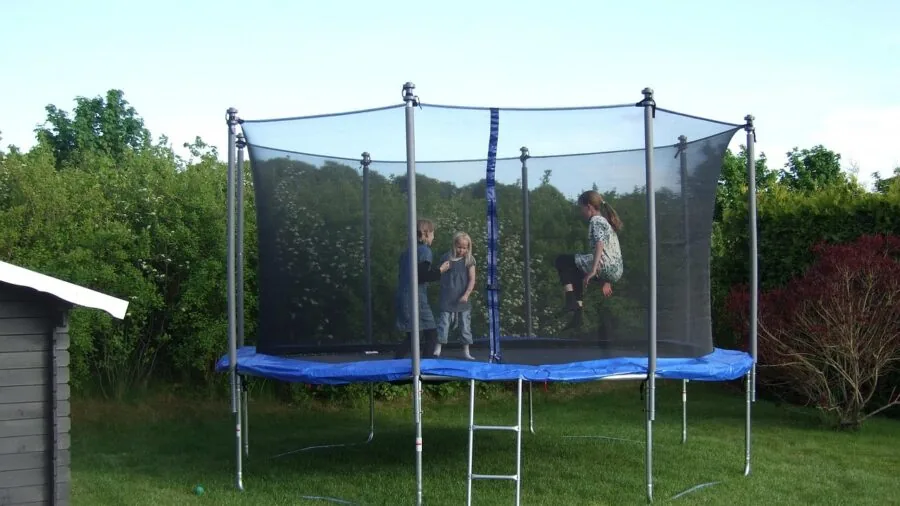
ASTM International certification (specifically ASTM F381 for trampolines) is the most widely referenced safety benchmark in North America. It covers mat strength, frame padding, enclosure net attachment points, and spring or strap tension.
Every model on our list carries ASTM certification, but the way manufacturers implement those standards differs significantly in practice.
Look for enclosure netting that attaches directly to the mat edge or uses no-gap pole sleeves rather than simply tying to the outer frame.
Gap-free designs substantially reduce the chance of a child slipping between the net and the jumping surface.
Enclosure pole padding is a frequently overlooked detail. Poles padded from base to top perform meaningfully better than those with short foam collars near the net attachment.
Expert reviewers and verified buyers alike call out inadequate pole padding as a top contributing factor in minor enclosure-related injuries.
The ARMY VANCA 12 FT model, which earned the highest PF Score in our lineup, draws consistent praise for its robust enclosure implementation across multiple expert and buyer sources.
For indoor toddler models, 360-degree enclosure nets paired with anti-rollover base designs add an extra layer of protection on hard floors.
The Square House 60-inch and MOM Selected models both incorporate this approach, which several occupational therapists in verified reviews specifically called out as a meaningful safety upgrade over basic netting.
Spring Systems vs. Bungee or Elastic Straps
Traditional coil springs deliver a powerful, responsive bounce, but they introduce pinch-point hazards at the spring attachment zone. Quality spring covers are non-negotiable if you choose a spring-based trampoline.
For younger children especially, elastic bungee-style strap systems, which are common on indoor toddler rebounders, eliminate the pinch risk entirely while providing a softer, more controlled bounce that is gentler on developing joints.
Physical therapists working with sensory processing needs often prefer the controlled rebound profile of strap systems for therapeutic use.
Outdoor full-size trampolines still predominantly rely on galvanized coil springs because they provide the force needed for larger jumping surfaces and higher weight capacities.
When evaluating spring quality, look for rust-resistant galvanized or stainless steel and check that spring covers extend fully to the edge of the enclosure base.
Buyer feedback across multiple outdoor models in our dataset flags rusting springs within one season as a recurring failure point on lower-tier spring sets.
Frame Construction and Weather Resistance

For outdoor trampolines, the frame is the single biggest determinant of long-term durability. Hot-dipped galvanized steel resists corrosion significantly better than painted or powder-coated steel, particularly in humid climates or regions with temperature swings.
Six or more legs distribute load more evenly than four-leg designs, reducing joint stress over time.
Verified buyer accounts consistently show that four-leg frames develop wobble at the leg-to-ring joint after one to two seasons of heavy use, while six-leg and eight-leg configurations hold tolerances far longer.
UV resistance matters as much for the mat and padding as the metal frame. Polypropylene mat fabric that lacks UV stabilizers degrades rapidly in direct sun, losing tensile strength before the frame shows any visible wear.
Manufacturer specs for UV-resistant mats are worth taking seriously, and buyer reviews that mention mat condition after two or more years of outdoor use are among the most reliable data points we look for when comparing models.
Handlebar and Stability Features for Toddlers

For children under age four or five, a padded stability handlebar is one of the most important safety features on an indoor rebounder.
A well-designed handlebar lets young jumpers maintain balance during the recovery phase of each bounce, dramatically reducing fall frequency. Adjustable-height handlebars that grow with the child provide better long-term value than fixed-height designs.
The Fisher-Price WonderJump handlebar receives strong marks in verified buyer reviews specifically for its ergonomic grip height relative to young children’s center of gravity.
Non-slip rubberized feet are another feature that earns disproportionate praise in verified buyer feedback for indoor models. On hardwood or tile floors, a rebounder without rubber feet can migrate several inches during a session, creating a secondary fall hazard.
This detail is often absent from spec sheets and only surfaces in real-world buyer accounts.
If you’re setting up an active play zone at home and pairing the trampoline with other gear, our coverage of kids smartwatches for safety and peace of mind may be a useful complement for families who want to keep tabs on active outdoor play.
Assembly Complexity and Storage
Assembly time and difficulty are among the top three complaints in one-star reviews for nearly every trampoline category.
Full-size outdoor models typically require two adults and anywhere from 45 minutes to three hours, depending on how clearly the instructions are written and how many spring or strap attachments are involved.
Models that include a spring-loading tool and color-coded parts consistently earn better assembly ratings than those that rely on hand-strength alone to attach springs.
Indoor toddler trampolines should ideally fold flat or collapse to a compact footprint for storage, particularly for apartment and townhouse users.
The GYMAX rectangular model and the MOM Selected 60-inch rebounder both include features oriented toward indoor versatility, including removable accessories that reduce the stored footprint.
If floor space management is a priority in your home, checking the folded dimensions in the manufacturer spec sheet before purchasing will save frustration.
Why You Should Trust Us
ProductFind is an independent editorial platform. We do not conduct our own product trials; our evaluations are grounded in research, published data, expert review consensus, and verified buyer feedback.
Every trampoline in this guide was assessed against a consistent set of criteria covering safety certification, frame durability, enclosure quality, spring or strap system design, weight capacity accuracy, ease of assembly, and long-term owner satisfaction drawn from verified purchase accounts.
Each model receives a PF Score on a 0 to 10 scale. That score reflects how well a product performs across all evaluated criteria relative to others in its category.
A high PF Score does not mean a product is flawless; it means it consistently outperforms alternatives on the factors that matter most to real buyers.
We aim to present a balanced picture, noting meaningful trade-offs alongside strengths for every pick.
ProductFind may earn a commission if you purchase through a link in this article. That affiliate relationship has zero influence on which products are included, how they are ranked, or what PF Score they receive.
Our editorial process is separate from our commercial relationships, and no manufacturer can pay for placement or a higher score.
Final Thoughts
After synthesizing specifications, expert review consensus, and verified buyer feedback across all eight models, here is how our top picks break down by use case and standout strength.
- Best Overall: ARMY VANCA 12 FT Outdoor Trampoline with Enclosure Net earns the top PF Score in this lineup thanks to its combination of robust enclosure engineering, strong frame construction, and consistently positive verified buyer feedback on long-term durability. It is the pick that balances safety, bounce quality, and build confidence more reliably than any other model we assessed.
- Best for Older Kids and Adults: ORCC Kids Trampoline offers the widest size range in the lineup, scaling from 8 to 16 feet, with a weight capacity that accommodates adults alongside kids. It is the logical choice for households that want a trampoline that grows with the family rather than aging out in a few years.
- Best Mid-Size Outdoor Pick: SKOK 8FT Trampoline for Kids delivers a strong PF Score for its category by combining ASTM approval, a 400-pound weight capacity, and an enclosure net that verified buyers consistently describe as secure and easy to re-enter. It is a smart choice for families with limited yard space who do not want to sacrifice safety features to fit a smaller footprint.
- Best Outdoor Trampoline with LED Lights: JoyBerri Outdoor Trampoline stands out among backyard models for its ASTM certification, integrated LED lighting, and included ladder. Buyer feedback highlights the lighting as a feature kids return to repeatedly, making it a strong pick for families who want added visual appeal alongside solid safety fundamentals.
- Best Toddler Indoor Trampoline: Square House 60-inch Premium Toddler Trampoline earns its place as the go-to indoor pick for younger children through its 360-degree safety enclosure, anti-rollover base design, and ASTM certification. It is built specifically for the safety demands of toddler-age independent play on hard floors.
Whichever model fits your space and your child’s age, prioritize ASTM certification, honest weight capacity data, and enclosure quality over price alone. A well-chosen trampoline bought once will outlast several cheaper replacements and deliver years of active, therapeutic play.
Frequently Asked Questions
What age is appropriate for a kids trampoline?
Most pediatric safety organizations, including the American Academy of Pediatrics, recommend that children under six avoid full-size outdoor trampolines due to the higher fall heights and spring pinch hazards involved.
Indoor toddler rebounders with handlebar support and soft bungee-strap systems are generally considered appropriate from around 18 months onward, with adult supervision. For older school-age children, a full outdoor trampoline with a complete enclosure net is the standard safe choice.
How important is ASTM certification for trampolines?
ASTM certification is the baseline safety benchmark for trampolines sold in North America. It covers mat tensile strength, frame padding requirements, enclosure net attachment integrity, and spring or strap performance under load.
Trampolines without ASTM certification have not been independently verified to meet these structural and safety thresholds. All eight models in this guide carry ASTM certification, which was a prerequisite for inclusion in our evaluation.
Can kids trampolines be left outdoors year-round?
It depends on the climate and the materials. Trampolines with hot-dipped galvanized steel frames and UV-resistant mat fabric perform far better through seasonal weather changes than those with painted frames and standard polypropylene mats.
In regions with heavy snow loads, most manufacturers recommend either disassembling the trampoline for winter or using a weatherproof cover to protect the mat and padding.
Verified buyer feedback is your best guide here: accounts that describe trampoline condition after two or more winters in comparable climates are especially informative.
How many kids should use a trampoline at once?
Safety research consistently shows that the collision and fall risk rises sharply when more than one child bounces simultaneously, regardless of trampoline size.
Most trampoline-related injuries occur when multiple users are on the mat at once, because mid-air collisions redirect smaller children unpredictably. One jumper at a time is the universal recommendation from pediatric safety experts, even on larger models.
Establishing and enforcing a one-at-a-time rule at the outset reduces injury risk far more than any hardware upgrade.
What features matter most for indoor toddler trampolines specifically?
For indoor use with young children, the four features with the strongest safety impact are: a padded adjustable handlebar for stability, non-slip rubberized feet to prevent migration on hard floors, a 360-degree enclosure net that leaves no gap at the mat edge, and a bungee or elastic strap system rather than metal springs to eliminate pinch hazards.
Beyond safety, look for compact folded dimensions if storage space is limited and washable padding covers for hygiene, since indoor play equipment accumulates dust and spills quickly.
For parents building out a broader active-play setup at home, kids bikes for every age and riding stage pair naturally with a trampoline as complementary gross-motor development tools.
Are trampolines actually good for kids’ development?
Yes, with appropriate supervision. Bouncing activates the vestibular and proprioceptive systems simultaneously, which supports balance, spatial awareness, and core strength development. Occupational therapists frequently incorporate mini-trampoline activity into sensory integration programs for children who need additional proprioceptive input.
Physical therapists note benefits for leg strength and cardiovascular fitness. The developmental case for trampolines is well-supported in the literature, provided the safety fundamentals covered above are in place.
Active play outdoors also complements other physical skills; balance bikes and trampolines together address a broad range of motor development milestones for toddlers and early school-age children.
About the author
Susan is a reviewer and writer for ProductFind who specializes in Outdoor & Active Play. Susan evaluates products through independent research: specifications, expert review consensus, and verified buyer feedback, and rates each one on the PF Score. Susan focuses on helping readers pick the right outdoor & active play for their needs and budget.