The 8 Best Balance Bikes
Balance bikes build real riding skills faster than training wheels ever could. Our picks cover every age, inseam, and budget, from lightweight first bikes to versatile convertibles.
 By Susan Lewis
Updated July 23, 2026
By Susan Lewis
Updated July 23, 2026
A balance bike is one of the single most effective tools for teaching a toddler to ride.
Instead of relying on training wheels that create a false sense of stability, balance bikes let children develop core coordination, steering instinct, and genuine confidence at their own pace.
Research from child development specialists and the cycling community consistently shows that children who learn on balance bikes transition to pedal bikes faster and with less frustration than those who use training wheels.
With dozens of options spanning budget builds to premium lightweight frames, however, choosing the right one takes more than a quick Amazon scroll.
This guide covers the best balance bikes available right now, drawing on specifications, expert review consensus across the cycling and parenting press, and verified buyer feedback from thousands of confirmed purchasers.
Our picks span a wide range from entry-level models to high-quality builds for riders ages 18 months through 6 years, covering brands like Strider, Retrospec, KRIDDO, Ridego, Bobike, JMMD, and LOL-FUN.
Whether you need a first birthday gift or a stepping stone to a full pedal bike, the ranked picks below will help you match the right bike to your child’s size, age, and budget.
| Award | Product | PF Score About PF ScoreThe PF Score is our own rating from 0 to 10, based on performance, design and build, ease of use, and value. It reflects independent research and is never influenced by manufacturers, retailers, or affiliate commissions. Learn more › | Price | |
|---|---|---|---|---|
| Best Overall |
 Strider 12 Sport Balance Bike
|
8.8/10 | Buy | |
| Editor's Pick |
 Retrospec Cub Plus Balance Bike for Toddlers 18M-4Y
|
8.3/10 | Buy | |
| Best Value |
 Ridego 14-Inch Balance Bike for Ages 3-6
|
7.1/10 | Buy | |
| Top Rated |
 JMMD 6-in-1 Toddler Bike, 12 inch, Ages 18-60 Months
|
6.4/10 | Buy | |
 KRIDDO Mini Cruiser Balance Bike for Ages 1-2
|
6.3/10 | Buy | ||
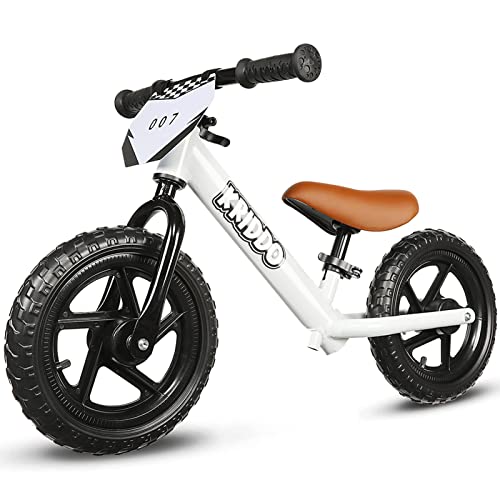 KRIDDO 12-Inch Balance Bike for Toddlers 2-5 Years
|
6.2/10 | Buy | ||
 Bobike Balance Bike for Toddlers, Adjustable Seat
|
6.1/10 | Buy | ||
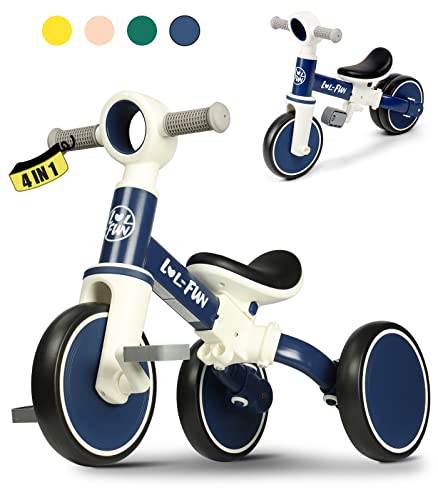 LOL-FUN 4-in-1 Balance Bike for Toddlers 1-4 Years
|
5.8/10 | Buy |
Strider 12 Sport Balance Bike
A lightweight balance bike designed for toddlers ages 1 to 4, featuring adjustable seat and handlebars to grow with your child. The foam rubber tires never go flat, making it a low-maintenance option for teaching balance before pedaling.
Pros
- No-maintenance foam tires eliminate puncture worries and ongoing upkeep
- Height adjustments accommodate growing toddlers across the 1-4 age range
- Lightweight and simple assembly make it accessible for parents
- Proven pedagogical approach to teaching balance and coordination
Cons
- No customer reviews available yet, limiting real-world performance insights
- Foam tires may not perform as smoothly as air-filled alternatives on rough terrain
- Limited to ages 1-4 with 60 lb weight cap, shorter useful lifespan than larger balance bikes
Retrospec Cub Plus Balance Bike for Toddlers 18M-4Y
A lightweight balance bike designed for toddlers ages 18 months to 4 years, with adjustable components that grow with your child. Features air-filled tires, a safety V-brake system, and an ultra-low frame for easy mounting.
Pros
- Grows with your child thanks to adjustable seat and handlebars, extending usable lifespan
- Lightweight at 9 pounds makes it easy for toddlers to control and maneuver independently
- Adjustable V-brake system teaches proper braking habits early with appropriately sized levers
- Air-filled tires provide cushioning and traction across different surfaces, not just pavement
- Low frame clearance eliminates mounting barriers for young riders building confidence
Cons
- No verified buyer reviews available to assess real-world durability and long-term performance
- Air-filled tires require regular maintenance and potential repairs, unlike solid alternatives
- Limited to one size, so fit may not be optimal for all children within the 18-month to 4-year range
Ridego 14-Inch Balance Bike for Ages 3-6
A lightweight balance bike with air rubber tires and adjustable seat designed to help young riders develop cycling confidence without pedals or training wheels. The glass-reinforced nylon frame keeps weight down to 8.16 lbs while supporting up to 110 lbs, making it easy for kids to control and parents to carry.
Pros
- Very light and durable construction allows kids to maneuver easily and parents to transport without strain
- Air rubber tires with deep tread provide stable traction across grass, gravel, and pavement
- Adjustable seat grows with child, extending usable age range
- Soft padded saddle and footrest enhance comfort during rides
- Pedal-free design focuses on balance and steering fundamentals
Cons
- No verified buyer reviews available to confirm real-world performance and durability claims
- Air tires require periodic maintenance and may be prone to punctures on rough terrain
- Limited to ages 3-6, so shorter usable lifespan before outgrowing
JMMD 6-in-1 Toddler Bike, 12 inch, Ages 18-60 Months
A convertible tricycle-to-balance-bike system designed to adapt as your child grows from toddler to early rider. Built with safety features like puncture-proof wheels, hand brakes, and a steering limiter, plus quick-fold portability for travel.
Pros
- Multi-mode design eliminates need for multiple bikes across different growth stages
- Strong focus on safety with steering limiter, hand brake, and stable aluminum frame
- Folds compactly for family travel and storage convenience
- Requires minimal assembly with most components pre-installed
- Adjustable components accommodate a wide age range without poor fit
Cons
- No verified buyer reviews available to assess real-world durability or parent satisfaction
- Transitioning between all six modes may require parental guidance and part adjustments
- Foldable design durability over extended use and repeated folding not confirmed in data
KRIDDO Mini Cruiser Balance Bike for Ages 1-2
A lightweight balance bike designed for toddlers starting at age 1, featuring a wide 3.6-inch PU wheel for stability and eco-friendly TPR handles. Best suited as a first riding toy for children transitioning from stationary play to outdoor exploration.
Pros
- Wide wheel base provides solid stability for young riders learning balance
- Soft, easy-to-grip handle design sized for small hands
- Materials certified safe and BPA-free with compliance to U.S. toy standards
- Lightweight construction suits 1-2 year old strength and coordination
Cons
- No customer reviews available to verify real-world durability or assembly experience
- Limited to ages 1-2, narrow age range before outgrowing
- Seat width and handlebar height may not accommodate taller toddlers at upper age range
KRIDDO 12-Inch Balance Bike for Toddlers 2-5 Years
A lightweight balance bike designed to help toddlers develop riding skills through walking and pushing rather than pedaling. Adjustable seat and handlebars grow with your child, backed by a carbon-steel frame rated for up to 110 lbs.
Pros
- Adjustable components allow the bike to grow with your child, extending usability across the recommended age range
- Extra-thick puncture-resistant tires provide stability on multiple surfaces without regular maintenance
- Customizable plate with included stickers adds a personalization element that may increase engagement
- Soft grip handlebars and PU seat reduce discomfort during learning
- Sturdy carbon-steel frame supports children up to 110 lbs with confidence
Cons
- No verified buyer reviews available to assess real-world durability and user satisfaction
- Quick release mechanism ease of use cannot be independently verified without hands-on evaluation
- Customizable plate feature may wear or degrade with outdoor use over time
Bobike Balance Bike for Toddlers, Adjustable Seat
A carbon steel balance bike designed to teach toddlers ages 1-6 the fundamentals of balance and coordination without pedals. Features adjustable seat and handlebar, enclosed wheels, and quick assembly, suitable for both indoor and outdoor use.
Pros
- Adjustable seat and handlebar accommodate growing toddlers up to age 6
- Carbon steel frame is durable and built to withstand regular use
- 135-degree steering limit and enclosed wheels reduce tipping and foot injuries
- Assembles in minutes without specialized tools
- ASTM F963-11 and EN71 certified for safety standards
Cons
- No verified buyer reviews available to assess real-world durability and performance
- Limited to middle size only, no size options for different age ranges within the 1-6 year bracket
- Requires adult supervision for indoor use, limiting independent play
LOL-FUN 4-in-1 Balance Bike for Toddlers 1-4 Years
This 4-in-1 tricycle converts between modes to grow with your child from 10 months through age 4, featuring a sturdy carbon steel frame and removable pedals for flexible riding styles. Assembly takes about a minute with no tools required, though it has no verified buyer reviews yet to validate real-world durability.
Pros
- Shock-absorbing sawtooth handles designed for toddler grip
- Extra-large wheels for indoor and outdoor use
- Removable pedals and mode switching means extended usability across age ranges
- No small parts or tools required for assembly
- Head limited to 50-degree angle for safer steering
Cons
- No verified buyer reviews available to confirm durability and real-world performance claims
- Limited color option (Midnight Blue only in available data)
- Weight of 6.6 pounds may feel heavy for smaller toddlers under 12 months
Balance Bikes Buying Guide
Buying a balance bike is not complicated once you know what actually matters.
Many parents default to age recommendations on the box, but inseam length, bike weight, and frame adjustability are far more predictive of a good fit and a successful learning experience.
The sections below walk through each key criterion so you can evaluate any model with confidence.
Correct Sizing: Inseam Fit Comes First
Age ranges printed on balance bikes are guidelines, not guarantees. The single most important measurement is your child’s inseam, which should be compared to the bike’s minimum seat height.
When seated on the saddle at its lowest setting, your child should be able to place both feet flat on the ground with a slight bend at the knee.
Tiptoeing causes loss of control; full flat-footing at minimum height means the bike will grow with the child as the seat is raised.
Most toddler balance bikes target an inseam range of roughly 12 to 17 inches, while bikes aimed at older kids (ages 3 to 6) often start at a higher minimum seat height.
Always check the published minimum and maximum seat height against your child’s actual inseam before buying. A bike that fits correctly from day one will be used; one that doesn’t will collect dust.
Bike Weight and Frame Material
Weight is arguably the most overlooked spec in this category, yet it matters enormously. A bike that is too heavy relative to the child’s body weight becomes difficult to maneuver, pick up after a fall, and carry when tired.
Expert reviewers and verified buyers consistently rate lightweight builds significantly higher for real-world usability. As a practical benchmark, the bike should weigh no more than roughly 30 percent of the child’s body weight, and lighter is always better at this age.
Steel frames tend to be heavier but more durable under rough use. Aluminum frames shave meaningful weight and resist rust, making them popular in mid-range and premium picks.
Avoid bikes with plastic frames if you want longevity; they flex, crack, and offer poor stability.
Strider’s long-standing category dominance is partly built on a frame that balances light weight with genuine structural integrity, which is why it remains the reference point for expert reviewers assessing this category.
Tire Type: Air-Filled vs. Foam vs. Rubber
The tire is the child’s only contact point with the ground surface, so it has an outsized effect on ride feel and traction. Air-filled (pneumatic) tires absorb bumps and provide natural grip on varied surfaces including grass, gravel, and pavement.
They require occasional inflation but deliver a noticeably smoother, more confidence-inspiring ride. Bikes like the Retrospec Cub Plus use air-filled tires specifically because reviewers and buyers alike flag the improved outdoor traction as a meaningful upgrade.
Foam-filled or EVA solid tires are puncture-proof and genuinely maintenance-free, which is why they appear on many popular models including the Strider 12 Sport. They work well on smooth surfaces and indoor environments.
Hard rubber tires offer the least traction and compliance and are typically found only on the lowest-cost options.
Choosing between air and foam largely comes down to where the bike will be ridden most and how much maintenance you are willing to do.
Seat and Handlebar Adjustability

Children grow fast, and a balance bike that fits at 18 months may feel cramped by age 3. Wide seat and handlebar adjustment ranges extend the usable life of the bike significantly, which directly affects value for money.
Look for bikes where the seat height spans at least 4 to 5 inches of range. Tool-free seat adjustments are a practical convenience, especially for families with multiple children at different stages.
Strider’s design is frequently cited as a benchmark here for its quick-release lever and wide adjustment window.
Handlebar height and reach also matter for posture. A child hunched forward over too-low bars or straining upward toward too-high ones will tire quickly and may develop a reluctance to ride.
Ideally, the handlebars sit just at or slightly above hip height when the child is seated. Check that the handlebar stem is adjustable and that the grips are sized for small hands, with a soft, non-slip texture.
Brakes: Necessary or Optional at This Age?
For children under 2.5 years old, hand brakes are rarely useful because toddlers at this stage lack the hand strength and coordination to apply a lever reliably.
Most expert reviewers agree that foot dragging is the natural and effective stopping method for very young riders, and many entry-level bikes omit brakes intentionally.
However, as children approach age 3 and begin scooting faster and on steeper terrain, a rear brake becomes genuinely useful and starts teaching the habit they will need on a pedal bike.
If your child is on the older end of the balance bike age range, prioritize a model with a working hand brake. The Retrospec Cub Plus includes a V-brake specifically to serve this older toddler demographic.
For younger starters, the absence of a brake is not a flaw; it keeps the bike lighter and simpler, which is appropriate for the developmental stage.
Convertible Designs and Long-Term Value
Several models in this category are marketed as convertible or multi-stage bikes: they add pedals, training wheels, and sometimes even a parent push handle to serve multiple developmental stages.
The appeal is obvious since you buy one product instead of several. In practice, however, the best convertibles execute each stage well rather than compromising all of them.
The JMMD 6-in-1 is the most ambitious example in this roundup, offering a folding frame, training wheels, pedals, a kickstand, and a push handle within a single product.
The trade-off is usually weight. A bike engineered to carry all that hardware is rarely as light as a dedicated balance bike, which matters most during the earliest learning phase.
Families who want maximum longevity from a single purchase should weigh the added weight against the convenience of not needing to buy a separate pedal bike later.
Families who simply want the best possible first balance bike experience often do better with a lighter, purpose-built model.
Why You Should Trust Us
ProductFind is an independent review publication.
Every product in this roundup was evaluated using our structured research methodology: we analyze published specifications, assess consensus across expert reviews in the cycling, parenting, and outdoor recreation press, and incorporate verified buyer feedback from confirmed purchasers.
Each model receives a PF Score on a 0 to 10 scale based on consistent, category-specific criteria applied uniformly across all picks.
We do not conduct our own product trials; our evaluations are grounded in research, published data, expert review consensus, and verified buyer feedback.
For balance bikes specifically, our scoring framework weights inseam fit range, frame weight, tire quality, adjustability, safety features, and long-term durability as reported by verified purchasers.
A model earning a PF Score in the 8-plus range must perform strongly across all these dimensions, not just one.
Models that score well on price but weakly on fit range or build quality are ranked accordingly and noted in context.
ProductFind may earn a commission if you purchase through a link in this article. That affiliate relationship has no influence on which products are included, how they are ranked, or what PF Score they receive.
Our editorial decisions are made independently of commercial considerations. We do not sell products, process orders, or handle warranty or return inquiries; for any of those matters, please contact the retailer or manufacturer directly.
If you are also researching other gear for your home or family, you might find our guides to air purifiers and wireless security cameras useful alongside this one.
Final Thoughts
The balance bike market ranges from simple, durable workhorses to feature-rich convertibles, and the right choice depends on your child’s age, inseam, the terrain they will ride on, and how long you want the bike to last.
After evaluating all eight models in this roundup against consistent criteria, here are the standout picks:
- Best Overall: Strider 12 Sport Bike earns the top position with the highest PF Score in this roundup. Its lightweight frame, tool-free adjustments, padded seat, and flat-free foam tires have made it the category-defining balance bike trusted by millions of families worldwide. It is the benchmark every other pick is measured against.
- Best for Older Toddlers Who Want Air Tires: Retrospec Cub Plus earns the second-highest PF Score and stands out for its pneumatic air-filled tires, working V-brake, and lightweight frame, making it the top pick for children approaching age 3 and above who ride on varied outdoor surfaces.
- Best for Bigger Kids Ages 3 to 6: Ridego 14 Inch Balance Bike addresses a genuine gap in this category. Its larger wheel size and higher seat range serve children who have outgrown 12-inch bikes but are not yet ready for a full pedal setup, backed by a solid mid-range PF Score.
- Best Convertible Multi-Stage Pick: JMMD 6-in-1 Toddler Bike is the most versatile option in the roundup, offering training wheels, pedals, a push handle, a kickstand, and a foldable frame for families who want one bike to cover multiple developmental stages.
- Best Budget Balance Bike: KRIDDO 12 Inch Balance Bike delivers a functional, customizable balance bike experience at a budget-friendly price, making it an accessible entry point for families who want to try the format without a large upfront investment.
No matter which model you choose, starting your child on a balance bike rather than a trike or training wheels is a well-supported decision.
The skill transfer to a pedal bike is faster, the confidence gain is real, and most children simply have more fun on a bike that responds naturally to how they move.
Pair the right bike with a properly fitted helmet and let the child set the pace. Most kids are scooting confidently within days and gliding within weeks.
Frequently Asked Questions
What Age Should a Child Start on a Balance Bike?
Most children can begin on a balance bike between 18 months and 2.5 years old, though the more reliable indicator is inseam length rather than age.
A child who can sit on the saddle at its lowest setting and place both feet flat on the ground is ready to start, regardless of whether they are 18 months or 3 years old.
Some dedicated mini models like the KRIDDO Mini Cruiser are designed specifically for children closer to 12 months who can walk confidently.
Are Balance Bikes Better Than Tricycles or Training Wheels?
For teaching a child to ride a pedal bike, expert consensus strongly favors balance bikes over tricycles and training wheels.
Tricycles and training wheels allow children to pedal without ever learning to balance, which means that skill must be learned from scratch later.
Balance bikes develop balance, steering coordination, and spatial awareness simultaneously, skills that transfer directly to a two-wheeled pedal bike.
Most children who learn on a balance bike can transition to a pedal bike without training wheels and often do so before age 4.
That said, the LOL-FUN 4-in-1 model in this roundup is technically closer to a tricycle-convertible and may suit families who want a gentler, more structured first step for children under 2 who are not yet comfortable with two-wheeled balance.
How Do I Know If the Bike Is the Right Size?
Measure your child’s inseam by having them stand barefoot against a wall, then measuring from the floor to the highest point of their inner leg. Compare that measurement to the bike’s published minimum seat height.
The seat should be set so the child can sit with both feet flat on the ground and a very slight bend at the knee. If the child can only tiptoe, the bike is too tall.
If the knees are bent sharply or the seat cannot go low enough, the bike is too small.
When in doubt, size down rather than up; children can manage a slightly short bike far more safely than one that is too tall.
What Safety Gear Does a Child Need With a Balance Bike?
A properly fitted helmet is the essential and non-negotiable piece of equipment. Look for a helmet certified to CPSC standards that sits level on the head, covers the forehead, and does not rock side to side.
Knee pads and elbow pads are optional but worthwhile for younger or more adventurous riders, particularly on harder surfaces.
Because balance bikes move at low speeds and children instinctively put their feet down to stop, serious falls are relatively rare compared to pedal bikes, but the helmet should always be worn regardless.
Can a Balance Bike Be Used Indoors?
Yes, and many families use balance bikes indoors during colder months or in apartments with hallways and open living areas.
Models with foam or EVA solid tires are particularly well suited to indoor use because they leave no marks and require no inflation.
Air-tired models can also be used indoors but may leave faint marks on hardwood or tile if the tires are dirty. Indoor use is a great way for very young children to build initial confidence before moving outside.
Just clear the space of sharp furniture corners and use a helmet even indoors while the child is still learning.
When Should a Child Move From a Balance Bike to a Pedal Bike?
The clearest sign that a child is ready to transition is when they consistently glide with both feet off the ground for several seconds at a time on their balance bike.
At that point, they have mastered the core balancing and steering skills and typically need only a few sessions to learn pedaling. Most children reach this milestone between ages 3 and 5, though some confident riders transition as early as 2.5.
When they make the switch, removing the pedals from a small pedal bike and using it as a balance bike briefly can ease the transition, or you can move directly to a pedal bike sized for their current inseam.
For more gear ideas that make outdoor family time easier and more enjoyable, our roundup of Bluetooth speakers covers portable options that are great for backyard and park sessions, and our guide to floor lamps can help brighten the indoor spaces where little riders practice on rainy days.
About the author
Susan is a reviewer and writer for ProductFind who specializes in Outdoor & Active Play. Susan evaluates products through independent research: specifications, expert review consensus, and verified buyer feedback, and rates each one on the PF Score. Susan focuses on helping readers pick the right outdoor & active play for their needs and budget.