The 11 Best Automatic Litter Boxes
Tired of daily scooping? These automatic litter boxes handle waste removal, odor control, and app monitoring so you don't have to. Here are the top picks for every home.
 By Leta Henry
Updated July 23, 2026
By Leta Henry
Updated July 23, 2026
Scooping litter is one of those chores that never ends, and for multi-cat households it can feel like a full-time job.
Automatic litter boxes have matured significantly over the past few years: today’s models integrate weight sensors, infrared scanning, app connectivity, and triple-layer odor control into a package that does the dirty work for you while keeping your cat safe.
If you’re also thinking about upgrading your cat’s feeding routine, pairing a self-cleaning box with automatic cat feeders can turn daily pet care into a largely hands-off system.
To help you cut through the noise, the ProductFind editorial team analyzed published specifications, expert review consensus, and verified buyer feedback across dozens of models before narrowing the field to the eleven standouts you see below.
Our research covers self-cleaning mechanisms, safety system reliability, odor management, app usability, and long-term ownership costs so you can match the right box to your household. Read on for our top picks.
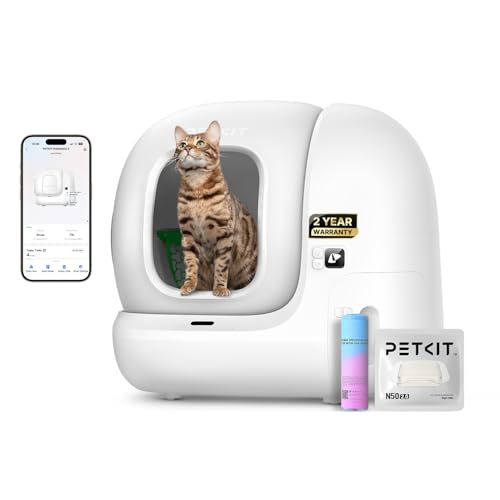
PETKIT PuraMax 2 Automatic Self-Cleaning Litter Box
An app-controlled automatic litter box designed for multi-cat households, featuring infrared and weight sensors for safety, dual odor control, and health tracking via smartphone. The 76L capacity and low 7.87-inch entry make it accessible for older or mobility-limited cats.
Pros
- Comprehensive health monitoring through app tracks each cat's weight, frequency, and duration to identify health changes
- Safety-first design with multiple sensors that pause operation when cats approach, preventing injuries
- Anti-leakage waterproof pad with elastic edges handles urine around edges without spills
- Dual odor control system with sealed bin and N50 2.0 cartridge effectively reduces smell
- Basic bundle includes all essentials: litter sifter, magnetic remover, 20 trash bags, and accessories
Cons
- Cannot be placed on carpets or soft surfaces as sensors may malfunction, limiting placement flexibility
- No reviews available yet to verify real-world performance and longevity claims
- Not compatible with non-clumping litters, and K3 Smart Spray add-on is incompatible with this model

UBPET XX-Large Automatic Cat Litter Box with App Control
This 106-liter self-cleaning litter box accommodates multiple cats and larger breeds with a low-entry design that reduces stress for senior or anxious cats. Four weight sensors and a patented anti-pinch structure prioritize safety, while app connectivity tracks up to 30 cats' health metrics remotely.
Pros
- Extra-large capacity and low entrance reduce accessibility barriers for older or anxious cats
- Safety features, four weight sensors, and anti-pinch design provide genuine injury protection
- App monitoring tracks bathroom frequency and weight changes for health insights across multiple cats
- Sealed waste compartment and deodorizer blocks effectively contain odors
- Quiet operation and detachable drum make maintenance straightforward
Cons
- No verified buyer reviews available yet to confirm real-world reliability and performance claims
- Requires 2.4GHz Wi-Fi connectivity for app features, limiting use without stable internet
- Premium pricing typical for automatic litter boxes may not suit budget-conscious buyers
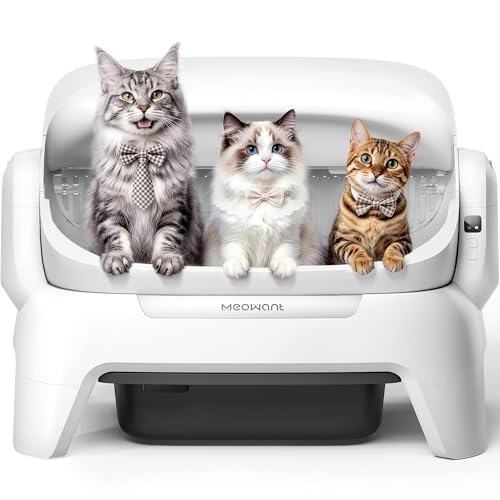
Meowant Extra Large Automatic Litter Box with App Control
This top-entry self-cleaning litter box offers 40% more space than competitors, making it practical for multi-cat households and larger breeds. Infrared sensors and a 12-liter waste bin enable up to 10 days of hands-free operation, though it requires cats over 5.91 inches tall and the lack of verified reviews limits confidence in long-term durability.
Pros
- Spacious 21.65 x 15.75 inch opening accommodates larger cats and enables natural digging behavior
- Holds 6L of litter with 12L waste capacity, reducing weekly maintenance for multi-cat homes
- Infrared monitoring stops cleaning if cat is inside, prioritizing safety over convenience
- App integration provides real-time visit frequency and behavioral insights
- Multi-layer odor system with silicone sealing and waterproof mat prevents leaks and smell
Cons
- No verified buyer reviews available to confirm real-world performance or reliability after extended use
- Minimum cat weight requirement of 3 lbs and height over 5.91 inches excludes kittens and small breeds
- Premium pricing reflects the feature set, making it inaccessible for budget-conscious buyers

PetCove PurrTek Automatic Self-Cleaning Litter Box
An automatic litter box that seals waste into bags after each use, eliminating daily scooping for multi-cat households. Features app control, odor neutralization via sealed bin and negative-ion system, and multi-sensor safety design.
Pros
- Eliminates daily scooping and reduces odor with sealed waste containment and negative-ion technology
- Smart app integration allows remote monitoring, weight tracking, and full-bin alerts from anywhere
- Multi-layer safety system with five sensors prevents injury and includes child-lock protection
- Large 12L waste bin extends intervals between bag changes, practical for busy households
- Quiet operation and spacious drum design accommodate natural cat behavior
Cons
- Requires specific clumping litter within manufacturer guidelines; incompatible with crystal, pine, or non-clumping varieties
- No customer reviews available to verify real-world reliability and durability claims
- Sealed bag system creates ongoing consumable costs for waste bags beyond initial investment

Vivirata Automatic Litter Box with App Control
A large-capacity self-cleaning litter box designed for multi-cat households, featuring dual safety sensors, app-based monitoring, and customizable cleaning modes. Best suited for owners seeking automated waste management with remote health tracking capabilities.
Pros
- Safety sensors automatically pause operation when cat is present, eliminating injury risk
- App integration provides real-time litter level alerts and health monitoring through usage statistics
- Kitten Mode and Sleep Mode allow customization for different household routines
- Large capacity suitable for multiple cats with sealed design to minimize odors
- Includes maintenance supplies and fully washable parts for easy upkeep
Cons
- No verified user reviews available to assess real-world reliability or common failure points
- Requires app connectivity and smartphone for full feature access, limiting convenience for non-tech users
- Large footprint (22.8 x 22.6 x 13.2 inches) may not fit compact spaces

Neakasa M1 Plus Open-Top Self-Cleaning Litter Box
An automatic litter box designed for multi-cat households with an open-top design that mimics traditional boxes. Features upgraded safety sensors, odor sealing, and app connectivity to track your cat's bathroom habits over 7-14 days between cleanings.
Pros
- Open-top design offers better visibility and comfort for cats transitioning from traditional boxes
- Enhanced safety detection with multi-angle sensor scanning improves accuracy
- Extended 7-14 day operation reduces maintenance frequency for busy households
- App integration lets you monitor litter habits and spot health changes
- Includes accessories (mat, refill bags) at purchase
Cons
- Requires 2.4GHz Wi-Fi only, incompatible with 5GHz networks
- No verified customer reviews available yet to assess real-world reliability
- Relatively heavy at 22 pounds, requiring deliberate placement consideration
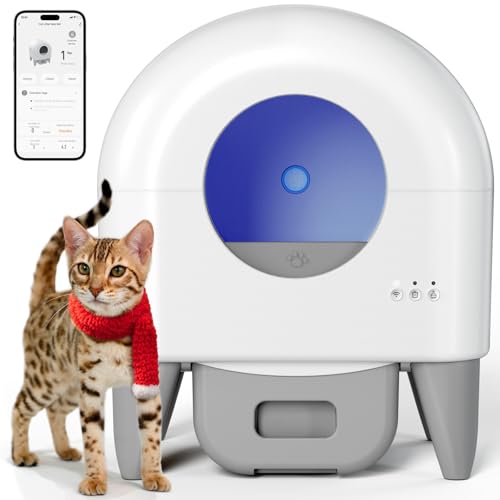
Fumoi 95L Automatic Self-Cleaning Litter Box
Large-capacity self-cleaning box designed for multi-cat households with app control, infrared safety sensors, and quiet operation. The 95L drum and sealed waste compartment minimize maintenance frequency, though WiFi connectivity is limited to 2.4GHz.
Pros
- Infrared safety sensors provide automatic hazard protection during cleaning cycles
- App-enabled remote management and waste bin alerts suit busy or traveling owners
- 95L capacity with sealed waste compartment reduces daily maintenance demands
- Ultra-quiet operation suitable for light sleepers and nighttime-active households
- Washable liner lowers consumable costs compared to disposable-only models
Cons
- WiFi connectivity limited to 2.4GHz only, excluding 5GHz networks
- No verified customer reviews available to assess real-world reliability or durability
- Large footprint at 21.6 x 19.6 x 25.8 inches requires significant floor space
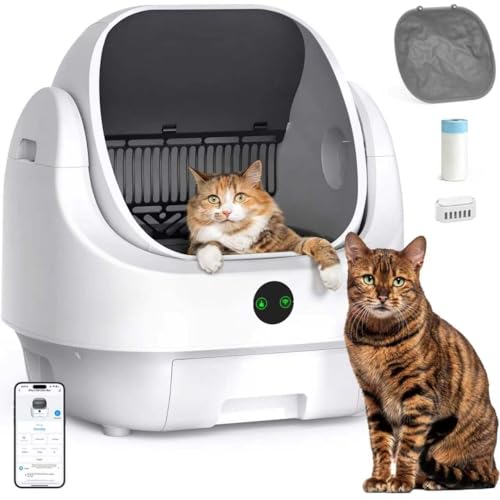
Ellenpent Open-Top Self-Cleaning Litter Box, 9L
An automated litter box with open-top design for cat comfort and dual-layer odor control via sealed construction and deodorizer gel. Features Wi-Fi app monitoring, safety sensors, and arrives fully assembled with a 9L waste capacity rated for 10 days per cat.
Pros
- Fully assembled and plug-and-play setup requires no installation
- Large 9L waste capacity reduces frequent emptying
- Open-top layout accommodates large cats and eases transition from traditional boxes
- Safety sensors with automatic pause protect cats during cleaning cycles
- App-based health monitoring provides insights into litter box usage patterns
Cons
- No verified buyer reviews available to assess real-world reliability or user experience
- Open-top design may allow some odor to escape compared to fully enclosed models
- Requires Wi-Fi connectivity and smartphone for full smart features; app functionality depends on stable connection
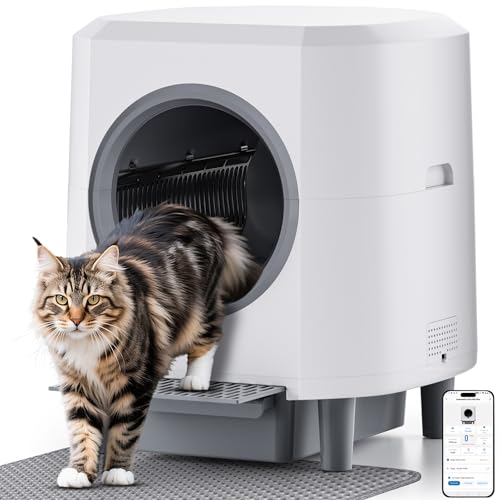
Ellenpent 90L Automatic Litter Box with APP Control
A self-cleaning litter box designed for multiple cats with a 90L capacity trash bin and Wi-Fi app monitoring. Features infrared and weight sensors for safety, odor control through sealed design and scent gel, plus pre-assembled setup with no tools required.
Pros
- Large 90L capacity reduces frequent emptying, ideal for multi-cat households
- Dual safety sensors pause cleaning if cat approaches, preventing accidents
- App integration tracks real-time health metrics and bathroom patterns
- Sealed construction with scent gel minimizes odor without daily manual cleaning
- Pre-assembled design requires no tools or complex installation
Cons
- No verified buyer reviews available to assess long-term reliability or real-world performance
- App-dependent features require stable Wi-Fi connection and may not appeal to users preferring manual control
- Initial investment is premium-tier compared to standard litter boxes
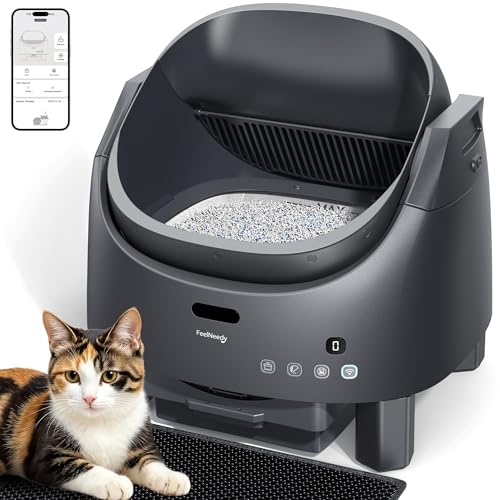
FeelNeedy Automatic Self-Cleaning Litter Box with App Control
A fully automatic, open-top litter box that cleans itself after each use and connects via WiFi app for remote monitoring and full-house odor control. Designed for 1-3 cats with safety sensors to prevent accidental activation during use.
Pros
- App connectivity lets you monitor usage and get waste-full notifications remotely
- Safety sensors stop cleaning cycle instantly if cat returns, preventing injury
- Open-top design appeals to cats hesitant about enclosed boxes
- Spacious interior handles multiple cats without cramping
- Sleep Mode and scatter guard reduce nighttime noise and mess
Cons
- No verified buyer reviews available yet to confirm real-world reliability
- Requires WiFi setup and app connection for full smart features
- 10-liter capacity may need emptying more frequently with 2-3 cats despite claims

PARUUNTYS Open-Top Automatic Litter Box 16.5"
An open-top self-cleaning litter box with dual safety sensors, app control, and a 15L sealed waste bin designed for multiple cats. The spacious entrance and odor-locking compartment reduce daily maintenance, though it requires 2.4G WiFi connectivity for smart features.
Pros
- Spacious open-top design reduces claustrophobia compared to enclosed boxes
- Comprehensive 7-sensor safety system prevents accidental operation during cat proximity
- Large 15L waste capacity minimizes emptying frequency for multi-cat households
- App-based remote management and usage tracking adds convenience
- Leak-proof construction and included washable liners keep cleanup simple
Cons
- Requires 2.4G WiFi only, limiting compatibility with newer 5G networks
- No verified buyer reviews available to confirm real-world reliability and performance
- Heavy at 24 pounds, making repositioning or cleaning challenging
Automatic Litter Boxes Buying Guide
Shopping for automatic litter boxes involves more trade-offs than most pet gear.
Size, cleaning mechanism, sensor type, and odor strategy all interact in ways that matter a great deal depending on how many cats you have and how much space you can dedicate.
The sections below walk through the criteria that matter most so you can make a confident choice rather than guessing at spec sheets.
Interior Space and Capacity

The single most common complaint about automatic litter boxes is that cats outgrow them or simply refuse to enter an enclosure that feels cramped.
As a general rule, the interior should be at least 1.5 times the length of your largest cat from nose to tail base.
For large breeds such as Maine Coons or Ragdolls, or for homes with three or more cats, look for XXXL-designated units that explicitly list interior dimensions in their product specs rather than relying on marketing terms alone.
Waste drawer or waste bin capacity is equally important. A small bin fills quickly in a multi-cat home, forcing you to empty it every day and negating much of the convenience you paid for.
Models with capacious waste compartments paired with liner bag systems simplify the disposal process and reduce odor exposure during emptying.
Open-top designs offer easier entry for cats of all sizes and tend to produce fewer litter-tracking complaints, though they require more thoughtful placement away from high-traffic areas.
Cleaning Mechanism and Cycle Reliability

Most units on the market use a rotating drum, a raking arm, or a sifting conveyor to separate clumps from clean litter and deposit waste into a sealed compartment.
Rotating drum designs generally produce the cleanest separation and leave less residual waste in the litter bed, but they require more vertical clearance and can be noisier during the cycle.
Raking systems are more compact but may leave small clumps behind if the rake tines are too widely spaced for the litter brand you use.
Cycle timing flexibility matters more than most buyers expect.
Fixed-interval cleaning can disturb a cat that likes to revisit the box shortly after use; models that let you set a post-use delay via app give cats a window to return before the mechanism activates.
Quiet-mode settings are worth prioritizing if your box lives in a bedroom or if you have a noise-sensitive cat, since a startling cleaning cycle can permanently discourage use.
Long-term reliability data from verified buyer feedback consistently highlights motor quality and the robustness of the rake or drum coupling as the primary failure points after the first year of use.
Checking whether replacement parts are readily available before you buy can save significant frustration down the line.
Safety Sensors and Cat Detection
A cleaning mechanism that activates while a cat is still inside is dangerous, so sensor quality is non-negotiable. The most reliable systems combine weight sensors in the base with infrared or radar motion detection to create redundant detection layers.
Weight-only systems can miss a very light kitten or fail to detect a cat that jumps onto the rim without fully entering the litter area. Infrared scanning adds a spatial layer that catches more edge cases.
Anti-pinch protection is specifically relevant to rotating drum models, which generate more torque than raking systems. Look for manufacturer claims of anti-jam torque limiting, not just entry-point detection.
Consumer feedback on units from PETKIT, Meowant, UBPET, and Neakasa frequently calls out sensor responsiveness as a meaningful differentiator between models at similar price points.
If you’re building out a connected pet-care setup, a reliable pet water fountain paired with a safe litter box rounds out the essentials nicely.
Odor Control Strategy
Odor control in automatic litter boxes works through three levers: speed of waste removal, physical sealing of the waste compartment, and supplemental filtration.
The fastest cleaning cycle does the most to prevent ammonia from volatilizing into the room, which is why post-use delay settings should be short enough to actually remove waste promptly.
A sealed waste drawer with a tight-fitting lid and a carbon or ion filter inside the compartment adds a meaningful second layer.
Some models integrate UV sterilization or deodorizing ion generators inside the globe or drum. Expert review consensus on these features is cautiously positive for UV but more skeptical about ion generators, whose real-world odor impact is difficult to verify independently.
Regardless of the built-in system, the litter you choose interacts heavily with odor performance: high-quality clumping bentonite generally seals odors more effectively than crystal or plant-based alternatives in rotating-drum units.
Always check manufacturer compatibility notes before switching litter types in an automatic box.
App Control and Connectivity

App connectivity has become nearly universal in this category, but the quality of implementation varies widely.
A well-designed app should let you adjust cleaning delay, monitor litter level, track per-cat usage frequency, and receive fault alerts without requiring more than a few taps.
Verified buyer feedback consistently flags apps that require frequent re-pairing, crash on iOS/Android updates, or bury essential controls behind subscription paywalls as significant frustration sources.
Wi-Fi band compatibility is a practical consideration: most smart home setups still run on 2.4 GHz, and units that require 5 GHz connections may be difficult to set up in homes where the router bands are merged.
The Petcove PurrTek explicitly supports 5 GHz, which offers faster response times but requires a router that can broadcast the bands separately. PETKIT and several others use 2.4 GHz exclusively, which is the more universally compatible choice.
If you enjoy building connected pet ecosystems, the same app-management principles apply to automatic pet feeders where scheduling and monitoring work best when the setup is friction-free.
Ease of Cleaning and Ongoing Maintenance
Automatic litter boxes still require periodic deep cleaning, and how easy that process is can determine whether you actually maintain the unit on schedule.
Removable, washable liners are a genuine convenience feature: they protect the main basin from moisture and waste residue and can be rinsed rather than scrubbed.
Models that require disassembling the motor housing or electronics to access the litter chamber add significant friction to a task that should take ten minutes.
Leak-proof engineering around the base seal and waste drawer is worth scrutinizing in reviews. Urine pooling under a plastic shell is not only unpleasant but can corrode motor components and create bacterial buildup that no cleaning cycle reaches.
Included accessories such as litter mats and starter bags of liners reduce out-of-pocket costs in the first few months and indicate that the manufacturer has thought about the full ownership experience rather than just the initial unboxing.
Why You Should Trust Us
ProductFind is an independent editorial platform modeled on rigorous, research-driven product journalism.
Every product in this roundup was assessed by our editorial team using a consistent set of criteria drawn from published product specifications, expert review consensus across multiple independent sources, and verified buyer feedback aggregated from confirmed purchasers.
We do not conduct our own product trials; our evaluations are grounded in research, published data, expert review consensus, and verified buyer feedback.
Each product receives a PF Score on a scale of 0 to 10, calculated by weighting performance attributes relevant to the category.
For automatic litter boxes, those attributes include cleaning mechanism effectiveness, sensor safety reliability, odor control, app usability, ease of maintenance, and value relative to build quality.
The eleven models in this guide scored between 5.8 and 8.3, reflecting a meaningful spread across capability tiers. Scores are updated when significant new owner feedback or product revisions become available.
ProductFind may earn a commission when you purchase through links on this page. That affiliate relationship has no bearing on which products are included, how they are ranked, or what scores they receive.
Our recommendations are determined entirely by research quality and editorial judgment, not by commission rates or brand relationships. We do not sell products, process orders, or handle returns; for any purchase support, contact the retailer or manufacturer directly.
Final Thoughts
After evaluating all eleven models against consistent criteria, the picks below represent the clearest winners by use case. Whether you’re looking for the most capable overall unit or a budget-friendly entry point, there’s a well-matched option in this roundup.
- Best Overall: PETKIT PuraMax 2 Automatic Self-Cleaning Cat Litter Box earns the top PF Score in this group through its strong balance of safety sensor design, effective odor management, leak-prevention engineering, and polished app experience. It is the most complete package for buyers who want a reliable daily-use unit without making compromises on safety or connectivity.
- Best for Large Multi-Cat Homes: UBPET Self Cleaning Cat Litter Box stands out for its XXXL interior and weight-sensor safety system, making it one of the most practical choices for households with three or more cats or large-breed animals that need genuine room to move.
- Best Mid-Range Pick: Meowant Extra Large Automatic Litter Box delivers open-top convenience, infrared scanning, and a generous waste bin in a price tier that sits well below the premium segment. It earns a strong PF Score for buyers who want most of the top-tier features without the top-tier cost.
- Best Budget Option: Petcove PurrTek Automatic Self Cleaning Litter Box offers triple odor control, app connectivity, and quiet operation at a more accessible price point, making it a compelling entry for first-time automatic litter box buyers who don’t want to sacrifice core functionality.
- Best Open-Top Design: Neakasa M1 Plus Open-Top Self-Cleaning Cat Litter Box prioritizes accessibility with its 360-degree safety sensor array and open entry format, a configuration that works especially well for cats that resist enclosed globes or hooded designs.
Whichever model you choose, pairing your litter box upgrade with a quality pet water fountain supports overall feline health by encouraging consistent hydration, and together these two upgrades cover the most time-consuming aspects of daily cat care.
Frequently Asked Questions
How often does an automatic litter box actually need to be emptied?
It depends on the size of the waste drawer and the number of cats using the box. For a single cat, most mid-capacity models need the waste bin emptied roughly once a week.
In a three-cat household, that interval shrinks to every two or three days. Models with larger waste compartments and liner bag systems are worth the price premium for multi-cat homes precisely because they extend the time between manual interventions.
What type of litter works best in self-cleaning models?
Clumping bentonite litter is the most widely compatible option and performs best in rotating-drum and raking mechanisms because it forms firm, discrete clumps that separate cleanly.
Non-clumping, crystal, or lightweight plant-based litters often fail to clump tightly enough for the mechanism to remove efficiently and can scatter more during the cleaning cycle.
Always check the manufacturer’s litter compatibility list before switching types, as using an incompatible litter can void the warranty on some models.
Are automatic litter boxes safe for kittens?
Most manufacturers recommend waiting until a kitten is at least six months old or weighs above a minimum threshold before using an automatic model.
Younger or very light kittens may not trigger weight sensors reliably, which creates a safety risk during the cleaning cycle.
If you have a young kitten, look specifically for units with dual-layer detection combining weight and infrared motion sensors, and keep the cleaning delay set to a longer interval until the kitten is well above the minimum detection weight.
Do these boxes work with a 2.4 GHz Wi-Fi network?
Most of the models in this guide, including those from PETKIT, Neakasa, Fumoi, and Meowant, use 2.4 GHz Wi-Fi exclusively, which is compatible with the majority of home routers.
The Petcove PurrTek offers 5 GHz support as an option, which can provide faster app response in environments with crowded 2.4 GHz bands, but requires your router to broadcast the two bands separately rather than as a merged network.
If you’re unsure, 2.4 GHz models are the safer default choice for most households.
Can one automatic litter box serve multiple cats?
Yes, but the general guideline from feline behaviorists is one litter box per cat plus one additional box, regardless of whether the boxes are automatic or manual.
In practice, many households with two to three cats manage successfully with a single large-capacity automatic unit, particularly models with XXXL interiors and generous waste bins.
For four or more cats, using two units in separate locations is advisable both for hygiene and to reduce territorial stress among cats that prefer not to share.
How do I get a hesitant cat to use a new automatic litter box?
The most effective approach is a gradual transition. Place the new box next to the existing manual box and put a small amount of used litter from the old box into the new one so the scent is familiar.
Keep the automatic cleaning function disabled for the first few days so your cat can explore without the noise or movement of a cleaning cycle.
Once your cat uses it consistently, enable the longest available delay setting before shortening it incrementally. Open-top designs from brands like Neakasa and PARUUNTYS tend to see faster adoption from cats that are sensitive to enclosed spaces.
About the author
Leta is a reviewer and writer for ProductFind who specializes in Pet Tech. Leta evaluates products through independent research: specifications, expert review consensus, and verified buyer feedback, and rates each one on the PF Score. Leta focuses on helping readers pick the right pet tech for their needs and budget.