The 8 Best Pet Microchip Feeders
Microchip and RFID feeders stop food stealing and protect special diets in multi-pet homes. Here are the options that actually deliver on that promise.
 By Leta Henry
Updated July 23, 2026
By Leta Henry
Updated July 23, 2026
Feeding multiple pets sounds simple until one food-aggressive cat clears every bowl before a timid housemate gets a single bite, or a dog with allergies sneaks into the prescription kibble.
Microchip-activated and RFID pet feeders solve this problem at the hardware level: the lid or door opens only for the animal wearing the registered tag or implanted chip, and stays firmly shut for everyone else.
That kind of selective feeding was once the exclusive domain of expensive veterinary setups, but a new wave of connected feeders from brands like SureFlap, PETLIBRO, Vancpet, and Adolug has brought the technology into everyday homes at a wide range of price points.
For this guide, the ProductFind editorial team analyzed published specifications, drew on expert review consensus from veterinary nutrition and pet-tech sources, and cross-referenced hundreds of verified buyer reports to score each feeder on our 0-to-10 PF Score scale.
Whether you manage a two-pet household on a tight budget or run a six-animal rescue and need Wi-Fi scheduling and diet tracking, the picks below cover every realistic scenario.
Scroll down for our ranked top picks, then read the buying guide to understand which features actually matter before you spend a cent.
| Award | Product | PF Score About PF ScoreThe PF Score is our own rating from 0 to 10, based on performance, design and build, ease of use, and value. It reflects independent research and is never influenced by manufacturers, retailers, or affiliate commissions. Learn more › | Price | |
|---|---|---|---|---|
| Best Overall |
 SureFlap Microchip Pet Feeder MPF001
|
8.2/10 | Buy | |
| Editor's Pick |
 Petlibro RFID Automatic Cat Feeder 3L
|
7.8/10 | Buy | |
| Best Value |
 Vancpet RFID Multi-Cat Feeder for Wet & Dry Food
|
7.5/10 | Buy | |
| Top Rated |
 PETLIBRO RFID Automatic Cat Feeder 3L with App Control
|
7.2/10 | Buy | |
 PawsPik 16-Cup Automatic Microchip Cat Feeder
|
6.8/10 | Buy | ||
 Adolug RFID Automatic Cat Feeder with Microchip Recognition
|
6.4/10 | Buy | ||
 HEAPETS RFID Automatic Cat Feeder with Collar Sensor
|
5.9/10 | Buy | ||
 Baofum Microchip Cat Feeder Bowls, SUS 304 Stainless Steel 2-Pack
|
3.1/10 | Buy |
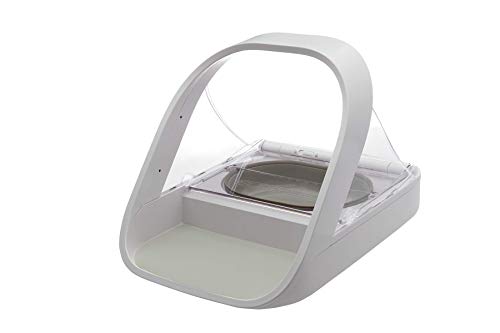
SureFlap Microchip Pet Feeder MPF001
A selective feeder that opens only for your pet's microchip or RFID collar tag, designed to prevent food stealing in multi-pet households. Works with wet or dry food and holds 13.5 fl. oz, making it useful for pets on prescription diets.
Pros
- Solves multi-pet feeding conflicts without manual intervention
- Flexible microchip compatibility covers most standard formats
- Sealed lid design suitable for wet food storage
- Allows prescription diet management for individual pets
- RFID collar tag option available for pets without microchips
Cons
- Requires one feeder per pet for ideal operation, which adds cost in large households
- No customer reviews available to verify real-world performance
- 13.5 fl. oz capacity is relatively small for larger pets or multiple daily feedings
Petlibro RFID Automatic Cat Feeder 3L
An RFID-activated feeder designed for multi-cat households where diet control matters. The collar-tag recognition system locks the bowl between meals, paired with app-based scheduling and diet tracking through Pawsense integration.
Pros
- Solves the problem of dominant cats eating other cats' food or medications in shared households
- Comprehensive eating history in app shows which cat ate when and how much
- 5-layer seal system with desiccant bag and airtight rotor maintains food freshness effectively
- Simple in-app scheduling eliminates manual feeding for busy owners
- Adjustable lid speed accommodates cats with different comfort levels
Cons
- Only works with the included RFID collar tag; no alternative recognition methods supported
- No verified user reviews available to assess real-world reliability or durability
- Requires stable Wi-Fi connectivity (both 2.4G and 5G options) which may not be reliable in all homes
Vancpet RFID Multi-Cat Feeder for Wet & Dry Food
This RFID-enabled feeder uses collar tags to let each cat access only their own food, making it ideal for multi-cat households with different diets or feeding schedules. It handles both wet and dry food, includes cooling packs, and works offline after initial Bluetooth setup.
Pros
- Solves real multi-cat feeding conflicts by restricting access to assigned pets only
- Flexible for households with different dietary needs (prescription, weight-management, or varied meals)
- Works independently after setup; no need for constant phone connection or WiFi
- Dual ice packs extend wet food freshness without requiring a refrigerator
- Safety-focused design with anti-pinch lid and transparent viewing window
Cons
- No user reviews yet available to verify real-world RFID recognition reliability
- Requires separate purchase of raised stand for optimal RFID performance
- Ice packs provide passive cooling only, not active refrigeration, so wet food longevity is limited
PETLIBRO RFID Automatic Cat Feeder 3L with App Control
Dual-feeder bundle with RFID collar tags that dispense meals to individual cats while blocking others, includes app-based portion tracking and 3L storage. Built for multi-cat households managing different diets or weight concerns.
Pros
- RFID personalization solves real multi-cat feeding conflicts and medication schedules without manual supervision
- App-based portion and eating habit tracking helps monitor weight management and dietary compliance
- Sealed desiccant system with included replacement bags keeps kibble fresh throughout two-week storage window
- Dual-band Wi-Fi and battery backup provide reliable operation during connectivity lapses
- Two-feeder bundle supports household with multiple cats needing separate meal plans
Cons
- No buyer reviews available yet, making real-world reliability and durability unclear
- RFID system only works with provided collar tags, limiting flexibility or replacement options if tags are lost
- Desiccant bags require manual replacement every two weeks, adding ongoing maintenance tasks and consumable costs
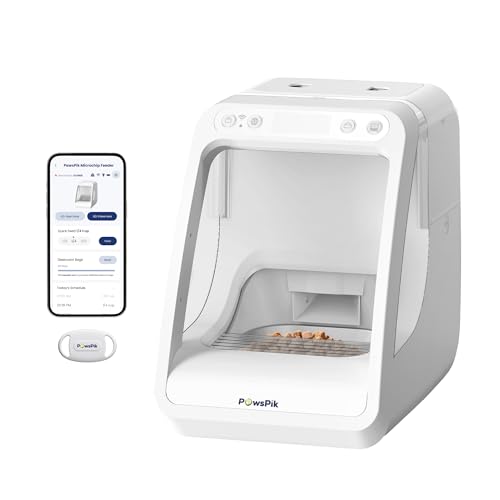
PawsPik 16-Cup Automatic Microchip Cat Feeder
Smart feeder that uses RFID and ISO microchip recognition to prevent food stealing between multiple pets, with app-controlled scheduling for up to 10 meals daily. Best suited for households with competing pets that need dietary separation.
Pros
- RFID and microchip technology effectively prevents food stealing between pets
- Large 16-cup capacity reduces frequent refilling needs
- Battery backup ensures feeding continues during power outages
- App scheduling allows up to 10 customizable meals per day with precise portions
Cons
- Each feeder pairs with only one pet, requiring multiple units for households with multiple pets needing separate feeding
- Requires ISO-compliant microchips or the included PawsPik RFID tag, limiting compatibility
- No verified buyer reviews available to assess real-world reliability and user experience
Adolug RFID Automatic Cat Feeder with Microchip Recognition
This selective feeder uses RFID collar tag detection to dispense food for one registered cat while blocking access to other pets, making it ideal for multi-pet households managing special diets or food theft. The quiet rotating mechanism and dual power options (battery or plug-in) provide flexible placement without disrupting sensitive eaters.
Pros
- Effective solution for protecting prescription or special diet meals in multi-pet homes
- Quiet operation reduces stress for sensitive or senior cats
- Flexible power options allow placement anywhere in your home
- Wide recognition range (2-4 inches) eliminates need for direct tag contact
- Three removable, dishwasher-compatible stainless steel bowls accommodate different feeding scenarios
Cons
- Requires RFID collar tag registration, adding setup complexity and ongoing collar dependency
- No verified customer reviews available to confirm real-world reliability and performance
- Limited bowl capacity (5 oz each) may require frequent refilling for larger cats or multiple daily feedings
HEAPETS RFID Automatic Cat Feeder with Collar Sensor
This RFID-enabled feeder automatically opens only for the paired cat or small dog, making it ideal for multi-pet households where food stealing is a problem. The sealed lid keeps dry food fresh and wet food from spoiling, while the pinch-free design ensures safe, quiet operation.
Pros
- Advanced RFID identity recognition prevents food stealing in multi-pet homes
- Sealed, airtight lid design keeps kibble crunchy and wet food fresh
- Smooth, quiet motorized door with safety-first pinch-free design
- Ready to use out of box with pre-paired tags and intuitive controls
- Removable food-grade bowl simplifies cleanup after wet or dry meals
Cons
- Only one collar can be paired per feeder, limiting flexibility in multi-pet setups
- Wet food should not be left inside for extended periods, reducing convenience for some users
- No verified buyer reviews available to assess real-world durability and long-term performance
Baofum Microchip Cat Feeder Bowls, SUS 304 Stainless Steel 2-Pack
Replacement stainless steel bowls designed specifically for microchip cat feeders, featuring a sealing ring to reduce odors and keep food fresher. Includes two bowls and a catch mat for a complete feeding setup.
Pros
- Food-grade SUS 304 material is safe for pets and durable against scratches and staining
- Sealing ring design keeps pet food fresher and minimizes odor buildup
- Included mat reduces mess and keeps feeding area tidy
- Simple hand-wash cleaning with no special care required
Cons
- Hand wash only, not dishwasher safe, and requires gentle cleaning of rubber sealing parts
- Limited heat resistance at 70°C maximum temperature
- Feeder unit not included, compatibility limited to specific microchip feeder models
- No verified buyer reviews available to assess real-world durability
Pet Microchip Feeders Buying Guide
Choosing the right microchip or RFID feeder is more nuanced than picking any other automatic cat feeder. The identification mechanism, bowl capacity, connectivity, and power resilience all intersect in ways that can make or break daily routines. Here is what to weigh before you buy.
Identification Method: Microchip vs. RFID Collar Tag
True microchip feeders read the ISO 11784/11785 15-digit chip implanted by your vet, which means no collar required and no risk of a collar being removed or lost.
The SureFlap SureFeed is the category benchmark for chip-only compatibility, making it the go-to for cats that live collar-free.
RFID collar-tag feeders like those from PETLIBRO and HEAPETS work equally well in practice, but they depend on the pet consistently wearing the tag. For dogs or collar-tolerant cats, the difference is negligible.
Some models, including the Adolug and Vancpet units, support both modes simultaneously, letting you mix microchipped cats with collar-tagged dogs in the same household.
If your pet roster is likely to grow, dual-mode compatibility is worth prioritizing even if you only need one method today.
Check the manufacturer’s stated chip-standard compatibility before purchasing, since older 10-digit chips (common in some regions) are not universally supported.
Lid and Seal Design: Keeping Food Fresh and Thieves Out
The anti-theft mechanism varies considerably across the category. Hinged-lid designs like the SureFeed’s curved cover physically shield the bowl from an approaching unauthorized pet, which is highly effective but limits bowl access angle.
Sliding or rising-panel designs used by HEAPETS and PawsPik can open faster, reducing the hesitation some anxious eaters show near motorized lids.
Look for feeders that specify a closing delay of one to three seconds after the registered pet walks away, since too-fast closure startles small kittens.
For wet food, an airtight or near-airtight seal is critical. Odor and moisture loss degrade palatability within an hour at room temperature.
Stainless steel bowl inserts with silicone sealing rings, such as those sold separately by Baofum, noticeably extend freshness and are dishwasher-safe.
If the feeder you choose ships with a plastic bowl only, budgeting for a stainless replacement insert is a practical upgrade worth considering alongside any automatic pet feeder purchase.
Capacity and Meal Scheduling
Basic microchip feeders offer a single shared portion per opening event with no scheduling. That is fine for free-feeding households where you simply want to stop food theft, but it falls short for portion-controlled diets.
Wi-Fi-enabled models from PETLIBRO let you program multiple timed meals per day, set portion sizes in grams, and receive push notifications when a pet has or has not eaten, which is genuinely useful for monitoring a cat on a post-surgery or weight-loss diet.
Capacity matters most in single-feeder homes. The PawsPik holds a generous 16-cup reservoir, making it practical for multi-day trips without a sitter.
Smaller lidded-bowl designs like the SureFeed or HEAPETS hold only a single meal portion by design, which is actually an advantage if your vet has prescribed strict meal-by-meal rationing.
Match capacity to your management style rather than defaulting to the largest option. Pairing a scheduled feeder with a quality pet water fountain nearby helps encourage hydration alongside controlled meals.
Wi-Fi Connectivity and App Experience

Wi-Fi connectivity adds scheduling, diet tracking, and eating-behavior reports, but it also introduces dependencies: the feeder needs a working home network, and the app needs to remain functional through software updates.
PETLIBRO’s dual-band 5 GHz and 2.4 GHz support is noteworthy because most smart pet devices are 2.4 GHz only, meaning congested networks in apartments can cause connection drops. Verify your router’s band before assuming a 5 GHz model will connect reliably.
Feeders without Wi-Fi, such as the SureFeed and Adolug, operate entirely offline and are therefore immune to server outages or discontinued apps.
For owners who simply want reliable selective access and do not need remote control, a non-connected feeder is often more robust long-term. Consider how much you genuinely value smartphone data before paying a connectivity premium.
Power Supply and Backup Options
Motorized lids require continuous power, and a pet stranded in front of a dead feeder during a power cut is a real concern. Look for feeders with dual-power capability, meaning they accept both a wall adapter and battery backup simultaneously.
The Adolug explicitly markets three stainless bowls and dual-power operation, which is a meaningful safety feature for households in areas with frequent outages. Battery-only models are portable but require more frequent battery changes, which some owners find inconvenient.
USB-C charging inputs are beginning to appear in newer models and are worth favoring over proprietary barrel connectors, since cables are universally available.
Check the manufacturer’s stated battery life under normal use conditions, and factor in that cold environments drain alkaline batteries faster, which matters if the feeder is placed in a garage or utility room.
Multi-Pet Household Dynamics and Bowl Configurations

Some feeders address multi-pet homes by offering a shared public bowl alongside hidden individual bowls.
The Adolug’s three-bowl layout, with one public bowl and two concealed compartments, is an inventive solution for households where most pets eat freely but one or two animals require a prescription diet.
This layout reduces the number of separate feeder units needed and lowers the overall footprint on your floor or countertop.
For households with more than three pets, a two-feeder setup using the PETLIBRO two-pack bundle may be more practical than a single large unit.
Diet tracking aggregated across multiple linked feeders in the same app also helps owners spot early changes in appetite that can signal health issues.
If bowl geometry matters because of flat-faced breeds like Persians or Bulldogs, look for wide, shallow bowls rather than deep standard dishes, similar to the ergonomic rationale behind elevated dog bowls for larger breeds.
Why You Should Trust Us
ProductFind is an independent review publication.
Every product in this guide was scored using our PF Score system, a consistent 0-to-10 scale applied across the same criteria for every unit in the category: identification reliability, build and materials quality, seal effectiveness, scheduling and connectivity features, ease of setup and cleaning, power resilience, and value relative to the competition.
We do not conduct our own product trials; our evaluations are grounded in research, published data, expert review consensus, and verified buyer feedback.
Our research process draws on publicly available technical specifications, manufacturer documentation, veterinary nutrition commentary where published, and aggregated sentiment from verified purchasers on major retail platforms.
Where expert reviewers in the pet-tech space have reached a consistent consensus about a product’s real-world behavior, we weight that consensus heavily in the final score.
Outlier reviews, whether unusually positive or negative, are noted but do not disproportionately skew results.
ProductFind may earn an affiliate commission if you purchase through a link in this guide. That commercial relationship does not influence our rankings, scores, or product selection in any way.
Products are chosen and ordered solely on the merit of our research findings. We are not affiliated with any of the brands featured, and we do not accept payment for placement.
Final Thoughts
After evaluating every model in this roundup against our consistent criteria, these are the standout picks by use case:
- Best Overall: Sure Petcare SureFeed Microchip Pet Feeder earns the top PF Score in this group for its genuine implanted-microchip compatibility, reliable lid mechanism, and years of proven real-world performance across veterinary and consumer contexts.
- Best Smart Feeder: PETLIBRO RFID Automatic Cat Feeder is the strongest choice for owners who want Wi-Fi scheduling, dual-band connectivity, and per-pet diet tracking in a single connected unit.
- Best for Multi-Pet Homes: Vancpet RFID Cat Feeder balances selective feeding with practical multi-cat household features at a mid-range price that competes well against more expensive options.
- Best Value Two-Pack: PETLIBRO RFID Two-Pack Bundle offers the best cost-per-feeder ratio for households that need selective access at more than one feeding station, with desiccant bags included for wet food freshness.
- Best Budget Pick: HEAPETS RFID Automatic Cat Feeder delivers core anti-food-stealing functionality at the most accessible price in the roundup, making it a reasonable starting point for owners new to selective feeders.
If you are still deciding between a microchip feeder and a standard timed dispenser, our overview of automatic pet feeders covers the broader category with similar depth.
Whichever direction you go, a microchip or RFID feeder is one of the most effective tools available for managing multi-pet diets without daily supervision.
Frequently Asked Questions
Do microchip feeders work with all pet microchips?
Most modern microchip feeders, including the SureFeed, support ISO 11784 and ISO 11785 standard 15-digit chips, which cover the vast majority of chips implanted by vets in North America, Europe, and Australia.
However, some older 9-digit or 10-digit chips used in certain countries may not be recognized. Check your pet’s chip standard with your vet and cross-reference it against the feeder’s documented compatibility list before purchasing.
Can one feeder manage more than one registered pet?
Yes, most models allow you to register multiple chips or RFID tags to a single feeder, though the feeder will then open for any registered animal rather than serving individual portions.
If you need each pet to receive a different diet from the same physical station, look specifically for models with multiple hidden compartments, like the Adolug three-bowl layout, or deploy one feeder per pet and link them through a shared app.
Are these feeders suitable for wet food?
Most microchip feeders in this roundup support both wet and dry food, but build quality matters more for wet food.
A feeder with a properly sealing lid, such as the SureFeed’s curved cover, protects moisture-rich food from drying out between meal openings.
Stainless steel bowls, whether supplied with the unit or purchased separately, are easier to sanitize thoroughly than plastic after wet food contact.
If wet food is your primary use case, prioritize models that specify a tight lid seal and ship with or are compatible with stainless inserts.
What happens if the power goes out?
Feeders without a battery backup will default to either staying open or staying closed depending on the model, and the default behavior varies by brand. A feeder locked shut during an outage could leave a pet unfed for hours.
Always verify the fail-safe behavior in the product specifications, and choose a dual-power model if outages are a concern in your area. Battery-only models sidestep this issue entirely but require regular cell replacement.
How do I train my pet to use a microchip feeder?
Most manufacturers recommend a gradual introduction: place the feeder open and unpowered for a day or two so the pet eats from it without encountering the lid movement.
Next, power it on with the lid programmed to move slowly, and reward calm behavior near the feeder. Anxious or senior pets may take a week or more to acclimate.
Placing the feeder in the pet’s usual eating spot rather than a new location shortens the adjustment period considerably. Pairing mealtime with a nearby circulating water source can also help establish a positive feeding routine.
Is a Wi-Fi feeder worth the extra cost?
For households managing a pet on a prescription diet, a weight-loss program, or post-surgical recovery, the eating-behavior data and remote scheduling that Wi-Fi connectivity provides can be genuinely valuable and may reduce vet visits by catching appetite changes early.
For owners who simply want to stop a dominant pet from stealing food, a non-connected microchip feeder accomplishes that goal reliably at a lower price point. Honest answer: buy the connectivity only if you will actively use the app data.
About the author
Leta is a reviewer and writer for ProductFind who specializes in Pet Tech. Leta evaluates products through independent research: specifications, expert review consensus, and verified buyer feedback, and rates each one on the PF Score. Leta focuses on helping readers pick the right pet tech for their needs and budget.