The 8 Best Epoxy Adhesives
Epoxy adhesives can bond metal, ceramic, plastic, and more with structural strength that outlasts ordinary glues. Here are the top picks worth buying, chosen by bond strength, cure time, and real-world reliability.
 By Rita Chavez
Updated July 23, 2026
By Rita Chavez
Updated July 23, 2026
Epoxy adhesives are among the most versatile and reliable bonding solutions available, capable of joining metals, ceramics, plastics, wood, glass, and concrete with a strength that ordinary glues simply cannot match.
Whether you are repairing a cracked engine bracket, rebuilding a ceramic hose, filling a stripped screw hole, or tackling a weekend woodworking project, the right epoxy can mean the difference between a repair that lasts decades and one that fails within months.
With dozens of formulations on the market spanning quick-set syringe systems, steel-reinforced putties, and crystal-clear structural adhesives, narrowing down the field is genuinely challenging.
At ProductFind, we cut through the noise by researching manufacturer specifications, synthesizing expert review consensus from across the adhesive industry, and analyzing verified buyer feedback from thousands of real-world repair scenarios.
The result is a focused, opinionated shortlist of the best epoxy adhesives worth buying in 2026, drawn from brands including J-B Weld, Loctite, Gorilla, AOJEL, Limino, and Cerca de. Scroll down to see our top picks.
| Award | Product | PF Score About PF ScoreThe PF Score is our own rating from 0 to 10, based on performance, design and build, ease of use, and value. It reflects independent research and is never influenced by manufacturers, retailers, or affiliate commissions. Learn more › | Price | |
|---|---|---|---|---|
| Best Overall |
 J-B Weld KwikWeld 2 oz Quick-Setting Epoxy
|
8.8/10 | Buy | |
| Editor's Pick |
 J-B Weld KwikWeld 6-Minute Epoxy 2-Pack
|
8.5/10 | Buy | |
| Best Value |
 Loctite Epoxy Instant Mix 5-Minute 2-Pack
|
8.2/10 | Buy | |
| Top Rated |
 Gorilla Epoxy Ultimate 0.85oz, 10-Minute Set
|
7.9/10 | Buy | |
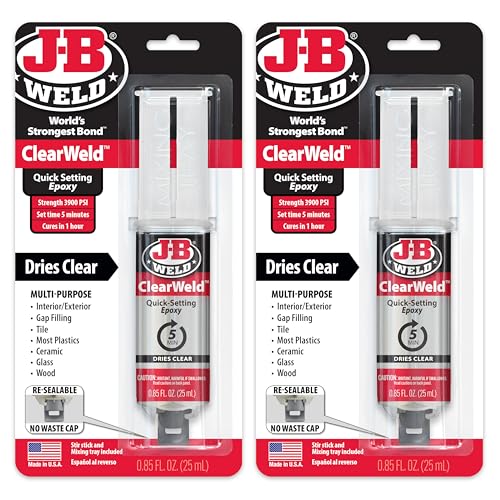 J-B Weld ClearWeld 5-Minute Epoxy Syringe 2-Pack
|
7.6/10 | Buy | ||
 AOJEL S300 Metal Epoxy, 30-Min Working Time
|
7.2/10 | Buy | ||
 Limino Epoxy Putty 280g Two-Part Repair Clay
|
6.8/10 | Buy | ||
 Cerca de Metal Glue 1.6oz Epoxy Adhesive
|
6.5/10 | Buy |
J-B Weld KwikWeld 2 oz Quick-Setting Epoxy
Fast-setting two-part epoxy that cures in 4-6 hours and handles multiple surfaces from metal to tile. Steel-reinforced formula reaches 3127 PSI tensile strength and resists heat up to 230°F, making it suitable for DIY repairs across automotive, marine, and household projects.
Pros
- Fast initial set time (6 minutes) compared to standard two-part epoxies
- Versatile across multiple material types including ceramics and fiberglass
- High strength rating and chemical/petroleum resistance for durable repairs
- Workable after curing, allowing finishing options like sanding and drilling
Cons
- No verified customer reviews available to validate real-world performance claims
- 2 oz size limits quantity for larger repair projects
- Requires mixing at precise 1:1 ratio to achieve rated specifications
J-B Weld KwikWeld 6-Minute Epoxy 2-Pack
Fast-setting two-part epoxy that bonds metal, plastic, wood, concrete and fiberglass with 3127 PSI tensile strength. The syringe delivery with 1:1 mix ratio and resealable cap makes it convenient for DIY repairs, though you'll need to work quickly given the 6-minute set time.
Pros
- Quick 6-minute set time ideal for time-sensitive repairs
- Syringe format with resealable cap prevents waste and allows multiple uses
- High tensile strength of 3127 PSI for durable bonds
- Bonds multiple surfaces including metal, plastic, wood, concrete, ceramic and fiberglass
- Dark grey color blends well on many materials
Cons
- Rapid set time requires fast mixing and application, leaving little room for error or repositioning
- No customer reviews available to verify real-world performance claims
- 4-6 hour full cure time means repairs aren't immediately ready for heavy use
Loctite Epoxy Instant Mix 5-Minute 2-Pack
Two-part epoxy adhesive with self-mixing applicator that sets in 5 minutes and handles most common materials. Quick, mess-free repairs for DIY projects requiring a permanent bond without clamping.
Pros
- Self-mixing double syringe eliminates manual measuring and reduces mixing errors
- Fast 5-minute set time with 1-hour handling strength for rapid turnaround
- Water and humidity resistant with high impact resistance, can be sanded, drilled, and painted after cure
- Works on diverse materials: metal, wood, ceramic, glass, tile, most plastics
- No shrinkage, delivers rigid high-strength bond in single application
Cons
- No verified buyer reviews available to assess real-world reliability or longevity
- 5-minute working window is tight for large or complex repairs requiring careful positioning
- Two-pack format may exceed needs for occasional DIY users with limited shelf life after opening
Gorilla Epoxy Ultimate 0.85oz, 10-Minute Set
A strong two-part epoxy rated at 4250 PSI with a quick 10-minute set time and waterproof curing formula. Ideal for bonding metal, plastic, concrete, ceramic, and fiberglass in situations where speed and permanent adhesion matter.
Pros
- 4250 PSI strength rating, Gorilla's strongest epoxy formula
- 10-minute set time allows for faster project completion
- Waterproof and forms permanent bond
- Easy syringe dispenser design
- Bonds multiple materials including metal, concrete, ceramic, fiberglass, and PVC
Cons
- No verified buyer reviews available to assess real-world durability or application experience
- Syringe format may have limited shelf life once opened
- Cures black, which may be visible on lighter-colored surfaces
J-B Weld ClearWeld 5-Minute Epoxy Syringe 2-Pack
Clear two-part epoxy in convenient syringe format with 1:1 mix ratio, setting in 5 minutes and curing in 1 hour. Bonds metal, plastic, ceramic, glass, wood, and tile with 3900 PSI tensile strength, ideal for small repairs and DIY projects.
Pros
- Clear color ideal for glass, crystal, and transparent material repairs
- Resealable syringe cap allows multiple uses without hardening
- Works across diverse surfaces (metal, plastic, ceramic, wood, glass, tile, concrete, fiberglass)
- Quick 5-minute set time reduces project downtime
- Strong 3900 PSI tensile strength rating
Cons
- No customer reviews available to verify real-world performance
- 5-minute set time leaves minimal working window for adjustments
- Small 25ml per syringe may require multiple packs for large projects
AOJEL S300 Metal Epoxy, 30-Min Working Time
A two-part cold-weld epoxy designed for load-bearing repairs on rigid metals like aluminum, steel, and cast iron. Offers 30 minutes of working time before set and cures to a hard, drillable finish that resists moisture and heat up to 392°F, making it practical for workshop repairs where welding isn't feasible.
Pros
- Extended 30-minute working window allows proper alignment and gap-filling before initial set
- Heat and moisture resistant after full cure, suitable for exposed metal components
- Cures hard enough to drill, sand, and paint without requiring additional tools or processes
- Cold-weld approach eliminates need for welding equipment, sparks, or flame
- Requires only 1:1 mixing ratio for consistent, straightforward application
Cons
- Limited to rigid, non-flexing metal repairs only; incompatible with flexible materials, moving parts, or torsion-loaded surfaces
- Requires thorough surface preparation including oil removal, rust cleaning, and roughening for proper adhesion
- No verified buyer reviews available to assess real-world durability claims or long-term performance feedback
Limino Epoxy Putty 280g Two-Part Repair Clay
Hand-mixable epoxy putty designed for versatile repairs across metal, plastic, ceramic, and tile. Sets quickly in 30 minutes with full cure in 24 hours, withstands temperatures from -50°C to 130°C, and allows drilling and painting once hardened.
Pros
- Extremely versatile across diverse materials and repair types including leaks, cracks, and bonding
- Durable and machinable once cured, allowing drilling, grinding, and painting for seamless repairs
- Quick working timeline enables same-day completion of most repair jobs
- Safe formulation with no toxins or odor suitable for residential use
- Includes mixing scraper, reducing need for additional tools
Cons
- No verified buyer reviews available to assess real-world performance and durability claims
- 8-minute working window may feel rushed for complex or detailed repair work
- Requires precise 1:1 ratio mixing by hand, which can be imprecise without a scale
Cerca de Metal Glue 1.6oz Epoxy Adhesive
A metal-filled epoxy designed for bonding metals, ceramics, and plastics with fast setup and temperature resistance. The 1:1 ratio formula sets in 10 minutes and reaches full strength in 12 hours, making it practical for automotive and household repairs.
Pros
- Versatile compatibility across metals, ceramics, plastics, and other materials
- Durable bond with added metal powder provides good hardness and toughness
- Quick initial set allows for handling within 10 minutes
- Temperature and moisture resistant for demanding applications
- Post-cure workability allows sanding, painting, and drilling
Cons
- No verified buyer reviews available to confirm real-world performance
- Small 1.6oz size limits use for larger repair projects
- Requires full 12 hours for complete strength, which is standard but not fastest in category
Epoxy Adhesives Buying Guide
Choosing the right epoxy comes down to more than just reading the label.
Bond type, cure time, substrate compatibility, gap-filling ability, and environmental resistance all interact in ways that affect whether your repair holds up for years or peels apart in a season.
The sections below walk through the criteria that matter most, based on the same framework we use when evaluating every product in this roundup.
Bond Strength and Substrate Compatibility
Not all epoxies bond equally to every material. Metal-filled formulations, like the steel-reinforced options from J-B Weld, are engineered specifically for metal-to-metal joints and can achieve tensile strengths that rival welding for low-stress applications.
Clear epoxies, on the other hand, are tuned for non-porous substrates like glass, smooth plastics, and ceramics where cosmetic transparency matters as much as strength.
Always cross-reference the manufacturer’s substrate list before committing to a product.
A high-strength metal epoxy may have poor adhesion to polyethylene or polypropylene plastics, while a general-purpose syringe epoxy will bond wood, ceramic, and rigid plastics reliably but may not hold up on oily or heavily corroded steel without surface preparation.
Sanding or scuffing smooth surfaces and wiping with isopropyl alcohol dramatically improves adhesion on nearly every formulation.
For multi-material repairs, a versatile two-part syringe system that bonds at least five or six substrate types is almost always a better choice than a highly specialized product.
If your project involves automotive surfaces or painted panels, look for epoxies explicitly rated for coated or primed substrates.
Cure Time and Working Time

Epoxy cure time splits into two distinct phases: working time (also called open time), during which you can position and adjust parts, and full cure time, after which the bond reaches maximum strength.
Five-minute and six-minute set epoxies are ideal for quick repairs where you cannot hold parts in place for long, but their short working time means you have to mix and apply fast.
Thirty-minute formulations give you much more latitude for complex assemblies.
Full cure typically takes 15 to 24 hours for most consumer-grade epoxies regardless of how quickly they set, so plan to avoid stressing the joint until the following day.
Quick-set products often reach handling strength in minutes but may not achieve full tensile strength for several hours.
If you are making a structural repair on anything load-bearing, the full cure window matters far more than the initial set speed advertised on the package.
Temperature and Moisture Resistance
Standard epoxies handle moderate heat well, but applications near engines, exhaust systems, ovens, or outdoor environments exposed to freeze-thaw cycles demand formulations with elevated temperature ratings.
Steel-reinforced and metal-filled epoxies typically offer the highest heat resistance in the consumer segment, with some rated up to 392°F continuous service. Clear general-purpose epoxies are usually rated considerably lower and should not be used near high-heat sources.
Moisture resistance is equally important for anything used outdoors, in bathrooms, or in marine environments. A waterproof rating means the cured bond resists water ingress; it does not necessarily mean the epoxy can be applied to wet or oily surfaces.
For genuinely wet conditions, seek out products that specifically claim underwater application capability or oil-surface adhesion, as these use modified resin systems that displace moisture during cure.
If you are working on projects that spend time outdoors alongside gear like family camping tents or metal brackets on a patio, prioritize epoxies with explicit all-weather and UV-stable claims to prevent yellowing and embrittlement over time.
Gap-Filling Ability and Consistency

Epoxy is one of the few adhesive families that can fill gaps effectively, which is why it outperforms cyanoacrylate super glues in situations where mating surfaces are not perfectly flush.
Putty-style or clay-style epoxies, such as moldable two-part stick formats, excel at filling voids, rebuilding stripped threads, and sculpting material back onto damaged surfaces.
Liquid syringe formats are better suited to tight-fitting joints where gap filling is minimal but penetration into fine cracks is needed.
Viscosity also affects application control. A thin, watery mixed epoxy tends to run on vertical surfaces and is best suited to horizontal bonds.
A thicker gel or paste consistency stays where you put it and is far more practical for overhead or vertical repairs. Most syringe systems dispense a self-metering 1:1 or 2:1 ratio mix, eliminating the guesswork of measuring resin and hardener by hand.
Machinability and Finish Compatibility

For repairs that need to look invisible or receive a secondary finish, machinability matters.
Drillable, sandable, and paintable epoxies can be worked once cured to blend seamlessly with surrounding material, an important attribute for automotive body filler applications, furniture restoration, and plumbing repairs.
Metal-filled epoxies marketed as cold-weld products are specifically engineered to be drilled and tapped, meaning you can effectively rebuild a mounting boss or stripped thread block with them.
Clear-cure epoxies are a better choice when the repair must remain transparent, such as bonding glass or crystal. Be aware that most clear epoxies can yellow slightly with prolonged UV exposure unless they contain UV stabilizers.
If the finished bond will be painted, nearly any color epoxy works, but grey or dark-cured options may show through thin paint layers, so consider a primer coat over the cured joint.
Value and Package Format
Epoxy adhesives range from budget-accessible single-use packets to multi-pack syringe bundles designed for professional tradespeople. The cost-per-repair calculation depends heavily on how much material you actually need.
For small hobby repairs, a compact syringe or two-pack set offers the best value because you use only what you need and seal the rest.
For large structural voids or industrial fills, a larger putty stick or cartridge system works out far cheaper per gram of applied adhesive.
Shelf life after opening is another practical consideration. Mixed two-part syringe systems waste whatever you dispense and cannot be re-capped indefinitely, so buying more than you will use in a few months is rarely cost-efficient.
Unmixed putty formats tend to stay workable longer in storage. Think about whether you are buying for a single project or stocking a household repair kit, and choose the package size accordingly.
Why You Should Trust Us
ProductFind is an independent editorial site. We do not sell products, and we have no relationship with manufacturers that influences our editorial decisions.
Every product in this roundup was evaluated using a consistent, multi-factor research framework that examines manufacturer-published specifications, expert review consensus drawn from across the adhesive and hardware industry, verified buyer feedback from thousands of confirmed purchases, and publicly available performance data.
We do not conduct our own product trials; our evaluations are grounded in research, published data, expert review consensus, and verified buyer feedback.
Each product receives a PF Score on a scale of 0 to 10, calculated by weighting the criteria that matter most in the category: bond strength and substrate range, cure speed and working time, temperature and moisture resistance, application ease, and overall value.
Higher scores reflect stronger consensus across multiple quality signals, not just a single standout spec. Products in this roundup span a PF Score range from 6.5 to 8.8, meaning even the lowest-ranked pick clears a meaningful quality threshold.
ProductFind may earn a commission if you purchase through a link on this page. That affiliate relationship has zero influence on which products are included, how they are ranked, or what PF Score they receive. Our rankings reflect research quality, not commission rates.
Final Thoughts
The epoxy adhesive market is crowded, but the standout performers separate themselves quickly when you focus on real-world criteria: bond strength across substrates, cure reliability, temperature tolerance, and ease of application.
Whether you need a fast weekend fix or a long-term structural repair, there is a pick in this roundup that fits the job. Here are our editorial awards based on research findings and PF Scores:
- Best Overall: J-B Weld 8276 KwikWeld Quick Setting Steel Reinforced Epoxy earns the top spot thanks to its steel-reinforced formula, proven durability across metal-to-metal and void-filling applications, and the highest PF Score in this roundup. It remains a go-to pick among mechanics, fabricators, and home repairers alike.
- Best for Metal Repairs: J-B Weld 6 Minute Set Epoxy KwikWeld (2 Pack) combines the brand’s trusted metal-filled chemistry with a slightly longer working window and waterproof cure, making it the stronger choice for waterproofed metal joints that need reliable performance in demanding environments.
- Best Quick-Set General Purpose: Loctite Epoxy Instant Mix 5 Minute delivers fast, dependable bonds across a broad range of substrates in a convenient syringe format, and the two-pack value makes it an excellent kit staple for households that face varied repair needs.
- Best Waterproof Syringe Epoxy: Gorilla Epoxy Ultimate stands out for its explicitly waterproof, permanent bond chemistry and trusted brand reliability, making it a sensible pick for outdoor fixtures, plumbing surrounds, and wet-area repairs.
- Best Budget Metal Repair: Limino Epoxy Putty offers an accessible entry point into clay-style two-part epoxy repair at a budget-friendly price, and its multipurpose formulation covers metal, tile, ceramics, and plastic well enough for non-critical patch jobs.
If you are outfitting a broader home workshop or garage, it is worth thinking about complementary tools alongside your adhesive kit. A reliable tire inflator and solid protective gloves round out a practical hands-on repair setup.
For anyone who spends time maintaining vehicles or outdoor equipment, pairing a quality epoxy kit with other durable gear pays dividends over time.
Frequently Asked Questions
What is the difference between a two-part epoxy and super glue?
Two-part epoxies consist of a resin and a hardener that chemically react when mixed, producing a rigid, structural bond that can fill gaps and withstand significant mechanical stress.
Super glues (cyanoacrylates) cure through moisture and work best on tight-fitting, non-porous joints. Epoxy generally offers higher shear strength, better gap-filling, and broader temperature resistance, while super glue sets faster and works well for small precision bonds on smooth surfaces.
For most heavy-duty repairs involving metals, ceramics, or void-filling, epoxy is the right choice. Super glue excels on thin, flush bonds where speed matters more than structural depth.
How long should I wait before stressing an epoxy bond?
Most epoxies achieve handling strength within five to thirty minutes depending on the formulation, but full cure strength typically takes 15 to 24 hours at room temperature.
For load-bearing or high-stress applications, wait the full cure period before putting the joint under any mechanical load.
Cold temperatures slow the curing reaction significantly, so working in a warm environment or applying gentle heat can help achieve full cure faster.
Can epoxy be used on plastic?
Most two-part epoxies bond well to rigid plastics such as ABS, PVC, polycarbonate, and acrylic, but they typically have poor adhesion to flexible or low-surface-energy plastics like polyethylene (PE) and polypropylene (PP). Always check the manufacturer’s substrate compatibility list.
Lightly sanding the plastic surface and wiping with isopropyl alcohol improves adhesion considerably on most compatible plastics. If the plastic flexes in use, consider whether a more flexible adhesive or mechanical fastener would be more appropriate alongside the epoxy bond.
Is epoxy truly waterproof once cured?
Most consumer-grade epoxies are water-resistant once fully cured, meaning the bond resists casual water exposure and humidity reasonably well.
Products specifically labeled waterproof, such as the Gorilla Epoxy Ultimate and J-B Weld’s KwikWeld line, are engineered to resist sustained water contact.
However, no consumer epoxy should be treated as a permanent solution for constant hydrostatic pressure or long-term submersion unless the product data sheet explicitly supports that use case.
Surface preparation is especially critical in wet applications: bonding to damp or oily surfaces significantly undermines adhesion on even the best waterproof formulations.
How do I remove cured epoxy if the repair goes wrong?
Cured epoxy is intentionally difficult to remove, which is part of what makes it effective. Mechanical removal by cutting, grinding, or sanding is the most reliable method for hard substrates.
Heat can soften some epoxy formulations enough to peel or scrape off, though the temperatures required can damage surrounding materials.
Chemical solvents such as acetone or denatured alcohol may soften partially cured epoxy but have limited effect on fully cured bonds.
For precision rework on delicate surfaces, a heat gun applied carefully at a low setting combined with a stiff plastic scraper is usually the safest approach.
What safety precautions should I take when using epoxy?
Epoxy resins and hardeners are chemical compounds that can cause skin sensitization and eye irritation, especially with repeated exposure. Always wear nitrile gloves and safety glasses when mixing and applying epoxy.
Work in a well-ventilated area because the vapors from uncured epoxy can be irritating to the respiratory tract. Avoid touching your face or eyes during application, and wash any skin contact areas promptly with soap and water.
Dispose of mixed epoxy waste according to local regulations, and never pour liquid resin or hardener down a drain. Once fully cured, epoxy is generally considered inert and safe to handle without special precautions.
About the author
Rita is a reviewer and writer for ProductFind who specializes in Adhesives, Sealants & Lubricants. Rita evaluates products through independent research: specifications, expert review consensus, and verified buyer feedback, and rates each one on the PF Score. Rita focuses on helping readers pick the right adhesives, sealants & lubricant for their needs and budget.