The 12 Best Function Generators
From hobbyist DDS modules to professional dual-channel AWGs, choosing the right function generator depends on bandwidth, resolution, and what you are actually measuring. Here are the top picks.
 By Noelle Gray
Updated July 23, 2026
By Noelle Gray
Updated July 23, 2026

Function generators sit at the heart of any serious electronics workbench.
Whether you are debugging an audio amplifier, characterizing a bandpass filter, validating an ADC reference design, or teaching a classroom about AC signals, having a reliable waveform source changes the entire workflow.
A good instrument lets you produce sine, square, triangle, sawtooth, and arbitrary waveforms across a wide frequency range with precise amplitude and DC offset control, so you are always working with known, repeatable signals rather than guessing.
The gap in real-world usefulness between a budget DDS module and a properly engineered bench instrument is enormous, and that gap is not always obvious from a spec sheet alone.
ProductFind assembled this guide through comprehensive research: we cross-referenced published specifications, synthesized expert review consensus from the electronics community, analyzed verified buyer feedback across hundreds of purchases, and examined manufacturer data to assess how each model performs where it matters most.
Options in this roundup come from Rigol, Siglent, UNI-T, OWON, Abestop, and Koolertron, spanning entry-level hobbyist kits to capable dual-channel arbitrary waveform generators suited for professional environments.
Our picks below are ranked by PF Score to help you find the right instrument for your needs and budget.

Rigol DG1022Z 25MHz Dual-Channel Function Generator
A versatile dual-channel signal generator with 25MHz frequency range, 200MSa/s sampling rate, and 160 built-in waveforms plus arbitrary output capability. Designed for education, R&D, and electronics repair, it offers modulation, sweep, and harmonic functions with USB and LAN connectivity for lab integration.
Pros
- Dual-channel simultaneous output enables complex signal testing without multiple devices
- Extensive modulation and sweep options meet diverse signal simulation requirements
- Multiple connectivity options (USB, LAN) support automated test environments and remote operation
- 160 built-in waveforms plus arbitrary capability provides flexibility for custom applications
- 14-bit resolution and high sample rate deliver clean, accurate signals
Cons
- No user reviews available to verify real-world performance and reliability
- 25MHz frequency range may be limited for advanced RF or high-frequency applications
- Specifications listed lack detailed technical depth (input impedance, output amplitude range, etc.)
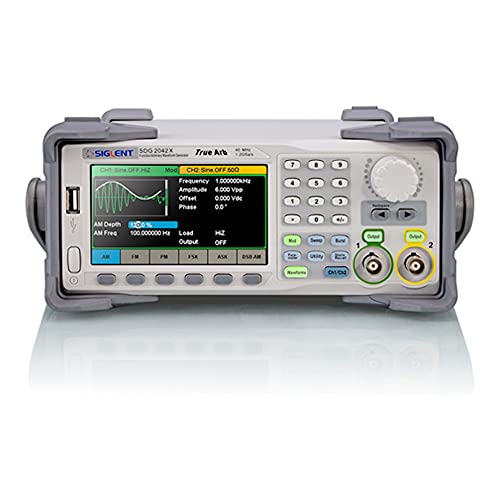
Siglent SDG2042X 40 MHz Dual-Channel Function Generator
A dual-channel arbitrary waveform generator designed for engineers and technicians needing precise signal generation up to 40 MHz. Combines modulation, sweep, and burst capabilities with a 16-bit resolution and built-in frequency counter for lab and bench applications.
Pros
- Dual independent channels at 40 MHz sine wave frequency
- 16-bit vertical resolution for signal accuracy
- TrueArb Technology and Easy Pulse Technology for flexible waveform creation
- Built-in high-precision frequency counter eliminates need for separate equipment
- USB and LAN connectivity with optional GPIB adapter support
Cons
- No verified buyer reviews available to assess real-world reliability and user experience
- Touch screen interface and modulation features require learning curve for new users
- Mid-range frequency limit at 40 MHz may not suit applications requiring higher frequency generation

Rigol DG1032Z 30MHz 2-Channel Function Generator
A dual-channel arbitrary waveform generator designed for engineers and technicians needing reliable signal generation up to 30MHz. The DG1032Z offers 14-bit vertical resolution and 8 million point arbitrary waveform memory for precision work across labs and development environments.
Pros
- Dual independent channels enable complex signal testing and comparison
- 8Mpts arbitrary wave memory supports detailed custom waveform design
- 14-bit resolution provides fine control over signal generation
- 30MHz frequency range covers most standard industrial and research applications
- Established Rigol brand with standard industry support
Cons
- No user reviews available to assess real-world reliability or ease of use
- Relatively heavy at 7 pounds limits portability despite compact dimensions
- Limited feature visibility in product data, so detailed capability comparisons require additional research
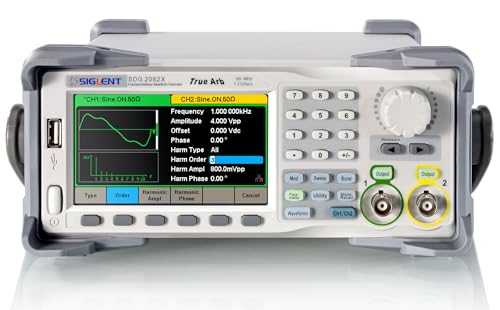
Siglent SDG2082X 80MHz Dual-Channel Function Generator
A dual-channel waveform generator with 80MHz bandwidth and 1.2 GSa/s sampling rate, designed for engineers and technicians needing arbitrary waveform capabilities. TrueArb technology allows custom waveforms up to 8 million points with user-defined sample rates.
Pros
- Dual independent channels enable simultaneous signal generation
- 80MHz bandwidth covers audio through RF testing applications
- 16-bit vertical resolution provides signal fidelity for precise measurements
- TrueArb supports extensive waveform customization from 8 to 8 million points
- User-defined sample rates from 1 microsecond to 75 million samples per second
Cons
- No customer reviews available to assess real-world reliability and ease of use
- Specifications categorized under Home Improvement suggests potential database classification issues
- Weight and dimensions indicate benchtop form factor, not portable

Abestop DGE2070 70MHz Dual-Channel Function Generator
A compact dual-channel arbitrary waveform generator built for engineers, students, and lab work, offering 70MHz frequency range, 300MSa/s sampling, and 14-bit resolution. Connects via USB with SCPI and LabVIEW support for automated testing, plus 160 built-in waveforms and modulation modes including AM, FM, PM, and FSK.
Pros
- Wide feature set including five basic waveforms plus 160 built-in options covers most signal generation needs
- USB and SCPI integration enables software-driven automation and custom waveform uploads
- Dual independent channels allow simultaneous signal generation for multi-point evaluation
- Lightweight and compact footprint makes it portable for field work or shared lab environments
Cons
- No user reviews available, so real-world reliability and performance feedback is absent
- 14-bit resolution and 70MHz maximum frequency are entry-level specifications compared to professional-grade generators
- LCD display size and interface design details not fully documented, which may affect usability in complex workflows

UNI-T UTG932E 30MHz Dual-Channel Function Generator
The UTG932E is a dual-channel function generator designed for hobbyists, students, and small labs working on electronics projects and audio measurements. It delivers sine, square, pulse, ramp, and arbitrary waveforms up to 30MHz with a 200MSa/s sampling rate and includes a built-in frequency counter spanning 1μHz-30MHz.
Pros
- Comprehensive waveform library with arbitrary waveform storage for custom signals
- High sampling rate and bit resolution provide accurate signal generation across frequency range
- Full accessory kit included: power adapter, USB cable, BNC cables with alligator clips, and manuals
- Integrated frequency counter eliminates need for separate measurement tool
- Suitable for diverse applications from circuit testing to audio equipment alignment
Cons
- No verified buyer reviews available to confirm real-world performance and reliability
- Limited to 30MHz frequency ceiling, which excludes higher-frequency RF applications
- Specifications lack detail on output impedance, DC offset range, and amplitude accuracy specifications
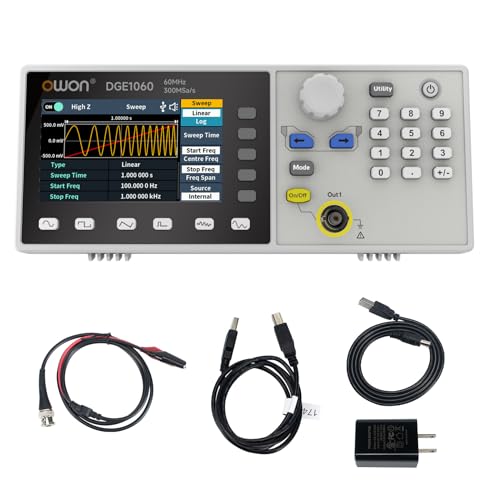
OWON DGE1060 60MHz Waveform Generator
A versatile function generator built for engineers and hobbyists needing broad waveform capability. The DGE1060 pairs a 60MHz bandwidth with 160 built-in arbitrary waveforms, modulation modes, and a 3.6-inch LCD display for straightforward operation.
Pros
- Extensive waveform library covers standard and specialized signal shapes without custom programming for many applications
- Multiple modulation modes and burst capability support complex signal testing scenarios
- 3.6-inch display and shortcut keys designed for efficient bench use
- Stores up to 16 user-defined arbitrary waveforms for quick recall
Cons
- No verified user reviews available to assess real-world reliability or ease of use
- Compact size may limit button accessibility compared to larger benchtop generators
- PC software and remote control compatibility not detailed in specifications

OWON DGE1060 60MHz Arbitrary Waveform Generator
A compact single-channel function generator delivering 60MHz frequency capability with 300MSa/s sampling and 14-bit resolution, suitable for electronics prototyping, educational use, and bench diagnostics. Includes 160 built-in waveforms, modulation functions, and PC control via USB for custom waveform creation and remote operation.
Pros
- Versatile signal generation with modulation modes covers most educational and prototyping needs
- PC software integration allows efficient custom waveform creation and repeatable test routines
- Compact footprint and straightforward controls make it accessible for bench work and learning environments
- SCPI support enables integration into automated test setups
Cons
- Single channel limits simultaneous multi-signal applications requiring independent waveforms
- No user reviews available to verify real-world reliability and feature usability
- Limited information on software stability and learning curve for custom waveform editing

Koolertron 60MHz DDS Signal Generator with Frequency Meter
A dual-channel arbitrary waveform generator built for labs and production lines, offering up to 60MHz sine wave output and 200MSa/s sampling rate. Covers essential functions like frequency sweep, pulse measurement, and 99 preset storage, though it lacks user reviews to validate real-world reliability.
Pros
- Comprehensive feature set including arbitrary waveform generation and built-in frequency counter in one device
- FPGA-based architecture with active crystal reference provides claimed signal stability
- Flexible memory: 99 parameter presets and 60 custom waveform slots with 2048-point, 14-bit resolution
- Independent dual-channel control allows simultaneous different waveform generation
- Suitable for education, R&D, and production testing across multiple disciplines
Cons
- No verified buyer reviews available to assess durability, user experience, or long-term reliability
- Learning curve likely steep given the extensive feature set and manual-dependent operation
- Sampling rate advertised as 200MSa/s but actual output bandwidth limitations not specified
Koolertron 15MHz DDS Signal Generator with Dual-Channel Output
A dual-channel function generator designed for electronics labs and production testing, offering 15MHz sine wave output and multiple waveform types with frequency measurement capabilities. Built-in FPGA architecture and 200MSa/s sampling rate provide stable signal generation for engineering and educational applications.
Pros
- Comprehensive waveform library including sine, square, triangle, sawtooth, pulse, and white noise
- Dual-channel design allows independent parameter configuration per channel
- Built-in measurement functions for frequency, period, and pulse width analysis
- Stores up to 99 instrument configurations for quick recall and reproduction
- FPGA-based architecture with active crystal oscillator ensures signal stability
Cons
- No user reviews available to verify real-world performance or reliability claims
- Limited to 15MHz maximum frequency, which may constrain advanced RF applications
- Custom waveform storage capped at 60 patterns with fixed 2048-point length

Cywhrvzsf FG-200 DDS Function Generator 0.01Hz-500kHz
A compact DDS function generator offering sine, square, and sawtooth waveforms across a wide frequency range, designed for circuit testing and oscilloscope calibration. Powered by 4-9V adapter or 3.7V lithium battery, it includes adjustable DC offset, switchable filters, and amplitude control.
Pros
- Wide frequency range with good accuracy and stability suitable for oscilloscope calibration
- Switchable filter reduces waveform distortion and jitter above 300kHz
- Flexible power supply options (4-9V adapter or 3.7V battery) with low 180mA current draw
- DC offset and amplitude adjustment enable precise signal shaping for circuit testing
- Settings memory preserves configurations between uses
Cons
- Output amplitude decreases at higher frequencies, limiting practical use above stated range
- No verified buyer reviews available to assess real-world reliability and ease of use
- Limited to preset waveforms; lacks arbitrary waveform or modulation capabilities
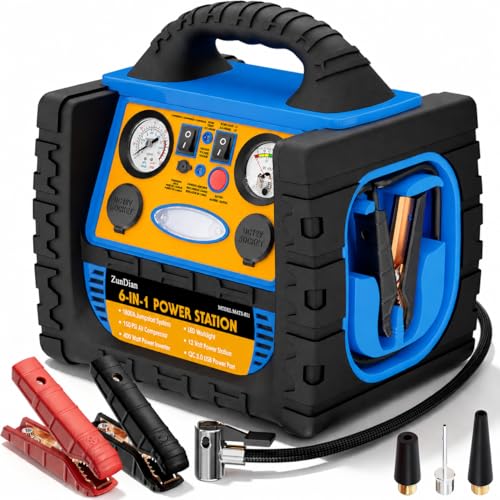
ZunDian 1800A Jump Starter with Air Compressor
A 6-in-1 roadside emergency kit combining jump starting, tire inflation, and portable power in one device. Best suited for drivers who want multiple functions without carrying separate tools.
Pros
- Multifunctional design combines jump starting, air compressor, and power inverter in one unit
- Adequate amperage (1800A) for standard passenger vehicles and larger trucks
- Multiple output options (AC, USB, 12V DC) increase versatility for camping and travel
- Built-in safety features protect against common misuse scenarios
- Compact enough to fit in vehicle trunks despite multiple functions
Cons
- No verified buyer reviews available to validate real-world performance and durability claims
- 400W AC power output is limited for high-demand appliances; may not charge laptops efficiently
- 11-pound weight is heavier than single-function jump starters, adding bulk to emergency kit
Function Generators Buying Guide
Choosing the right function generator means understanding which specifications translate to real-world capability and which are marketing numbers that rarely matter in practice.
The sections below walk through the criteria that genuinely affect how useful an instrument will be on your bench, day after day.
If you are also building out your measurement toolkit, pairing a function generator with a quality oscilloscope is one of the most productive investments you can make.
Frequency Range and Bandwidth
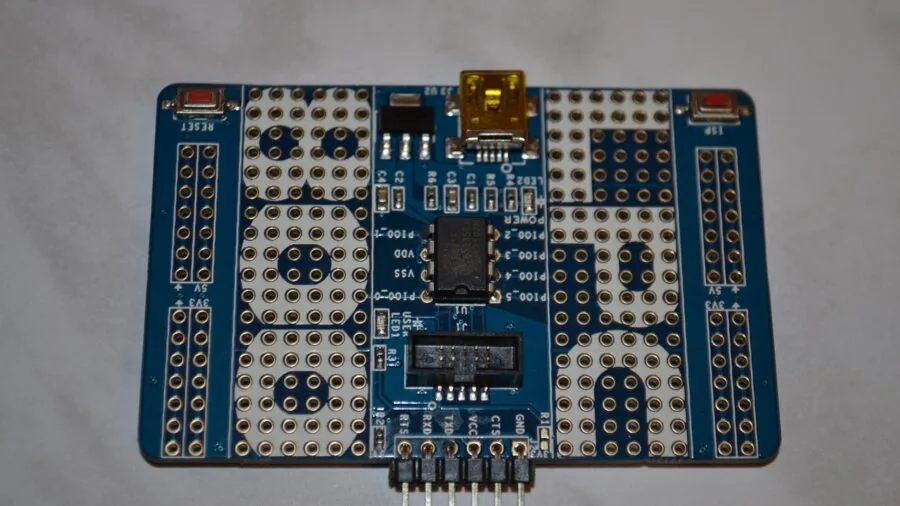
The maximum frequency a generator can produce cleanly is the single most important specification for most buyers. For hobbyist audio work, filter characterization, and basic circuit debugging, a 25 MHz or 30 MHz instrument covers the overwhelming majority of real-world tasks.
RF work, high-speed digital signal simulation, and advanced mixed-signal applications push requirements toward 60 MHz, 70 MHz, or beyond.
Pay attention to whether the stated bandwidth applies to sine waves specifically.
Many generators advertise their maximum frequency for square or arbitrary waveforms, where rise time limitations mean the signal looks nothing like a clean square at the top of the range.
A well-engineered 40 MHz instrument that maintains signal integrity all the way to its rated frequency is more useful than a nominally wider unit with degraded fidelity in its upper octaves.
For most engineers and serious hobbyists, 25 MHz to 40 MHz is the practical sweet spot. If you routinely work with RF stages, switching power supply control loops, or high-speed serial signals, budgeting for a 60 MHz or 70 MHz model is worthwhile.
Koolertron’s 60 MHz and 15 MHz DDS options serve entry-level users, while Rigol and Siglent dominate the mid-range with substantially better signal fidelity at their rated bandwidths.
Channel Count and Independence
Single-channel generators force you to use external splitters or multiple instruments the moment you need to evaluation differential pairs, stimulus-and-response setups, or I/Q signal generation.
Dual-channel instruments remove this constraint and open up a wide range of more advanced measurements. The key question is whether the two channels are truly independent or share a common timebase with limited phase flexibility.
Truly independent dual channels let you set different frequencies, amplitudes, waveforms, and DC offsets on each output simultaneously.
This is essential for evaluation balanced audio circuits, comparing the response of two filter paths, or generating complementary drive signals for H-bridge circuits.
Phase coupling between channels, where you can lock the phase relationship between two signals at the same frequency, adds further flexibility for evaluation phase-sensitive designs.
Every instrument on our list offers dual-channel output. However, the quality of channel isolation and independence varies considerably.
Rigol’s and Siglent’s implementations, supported by their SiFi and TrueArb architectures respectively, are widely regarded by expert reviewers as among the most capable in their price tiers.
Budget models from Koolertron and the FG-200 module handle basic dual-channel operation but show more crosstalk at higher frequencies.
Vertical Resolution and DAC Quality
Vertical resolution, specified in bits, determines the fineness of amplitude steps in the digital-to-analog conversion process.
An 8-bit DAC produces 256 discrete amplitude levels; a 14-bit DAC produces 16,384. This difference is audible in audio applications and measurable in sensitive analog circuits. Low vertical resolution introduces quantization noise that can mask the behavior you are trying to study.
For serious bench work, 14 bits is now a practical baseline. Most of the better instruments in this roundup, including models from Rigol, Siglent, UNI-T, OWON, and Abestop, offer 14-bit resolution.
The Siglent SDG2042X goes further with 16-bit resolution through its TrueArb mode, which is meaningful for fine-grained arbitrary waveform playback and precise level setting.
Budget DDS modules like the FG-200 use simpler DAC implementations that are adequate for square and triangle wave applications but limit sine wave quality.
When evaluating vertical resolution claims, look for the distinction between the hardware DAC bit depth and the effective number of bits (ENOB) in practice.
Manufacturer-published ENOB figures and third-party measurements from the engineering review community often reveal meaningful differences that raw bit-depth claims do not capture. This is one area where expert review consensus across electronics forums and professional publications carries significant weight.
Arbitrary Waveform Capability and Memory Depth

An arbitrary waveform generator (AWG) allows you to define custom waveform shapes, upload them from software, and play them back through the DAC.
This capability is indispensable for simulating sensor outputs, replicating real-world captured signals, generating non-standard modulation patterns, or evaluation specific edge cases in a design.
The depth of the waveform memory determines how complex and how long those custom patterns can be.
Rigol’s DG1022Z ships with up to 16 million points of waveform memory per channel, which is genuinely deep for a generator in its price range and allows for detailed, long-duration arbitrary patterns without aliasing or truncation artifacts.
Siglent’s SDG2042X uses TrueArb architecture to reconstruct arbitrary waveforms point-by-point rather than through simple interpolation, which preserves waveform shape more faithfully at the output.
The Abestop DGE2070 and OWON units include large libraries of built-in arbitrary waveforms as a starting point.
PC connectivity matters here. Instruments that include robust software for waveform creation and upload, along with reliable USB and LAN interfaces, make arbitrary waveform work far less painful.
Rigol’s Ultra Sigma software and Siglent’s EasyWave are both well-regarded by the engineering community. Evaluate whether the vendor maintains software compatibility with current operating systems, as older utilities from budget brands sometimes create friction on modern machines.
Connectivity and Remote Control

Modern bench instruments increasingly need to talk to computers and automated evaluation systems. USB device ports for PC control are now standard on virtually every generator above hobbyist entry level.
LAN (Ethernet) connectivity is where mid-range instruments start to differentiate: it allows integration into automated evaluation environments, remote operation across a network, and SCPI (Standard Commands for Programmable Instruments) control from scripts or LabVIEW.
This matters enormously if the generator will be part of a semi-automated evaluation station or used in a research environment.
The Rigol DG1022Z includes both USB and LAN interfaces along with full SCPI support, which is notable at its price point and a meaningful advantage for anyone who automates measurements.
The Siglent SDG2042X adds USB host functionality, allowing direct waveform data storage to a USB drive without needing a laptop.
OWON’s DGE1060 and Abestop’s DGE2070 also include SCPI and PC control, while Koolertron’s DDS generators are standalone instruments with no remote control capability.
Pairing a function generator with capable digital multimeters and oscilloscopes over a shared bench setup becomes far more efficient when each instrument supports programmatic control.
Display, Interface, and Frequency Counter

A clear, readable display reduces the chance of setup errors and speeds up parameter entry.
Color TFT displays that show waveform preview, frequency, amplitude, offset, and modulation settings simultaneously are now common on mid-range instruments and represent a genuine usability improvement over single-line character displays.
Touchscreen interfaces, as found on the Siglent SDG2042X, further streamline parameter entry. Koolertron’s numeric keypad-and-knob approach is functional but slower for complex setups.
Many generators in this category include a built-in frequency counter, which allows the instrument to measure an external signal’s frequency without needing a separate counter.
This is particularly handy when validating oscillator circuits or checking the output of a circuit under evaluation in relation to your stimulus. The Rigol DG1022Z, Siglent models, UNI-T UTG932E, and Koolertron units all include frequency counter functionality.
Budget-tier DDS modules like the FG-200 include basic counter capability but at limited accuracy.
Button layout and menu depth affect how quickly you can reconfigure the instrument mid-measurement. Instruments with dedicated front-panel buttons for waveform type, modulation, and channel switching are meaningfully faster in practice than those that bury these options in nested menus.
Buyer feedback across verified purchases consistently highlights interface responsiveness as a deciding factor in daily satisfaction, particularly for users who frequently switch between different waveform types and parameter sets.
Why You Should Trust Us
ProductFind is an independent review publication. We do not sell the products we recommend, and we have no affiliation with any manufacturer or retailer listed in this guide.
Every instrument in this roundup is evaluated using the same consistent framework and scored on our 0 to 10 PF Score scale.
Our evaluation methodology is built on comprehensive research synthesis: we analyze manufacturer-published specifications, cross-reference engineering community and expert reviewer consensus, examine verified buyer feedback from confirmed purchasers, and incorporate published measurement data from credible sources.
We do not conduct our own product trials; our evaluations are grounded in research, published data, expert review consensus, and verified buyer feedback.
This approach lets us cover a broader range of instruments with depth and consistency that single-reviewer hands-on guides cannot scale to match.
ProductFind may earn a commission when you purchase through links in this article. That affiliate relationship has zero influence on PF Scores, product rankings, or which instruments we choose to include or exclude.
Our editorial decisions are made independently of commercial considerations, and we disclose this relationship so you can weigh our recommendations accordingly.
Final Thoughts
The function generator market in 2026 covers an unusually wide range of capability and price.
A simple DDS module can handle basic waveform generation for casual hobby projects, while a properly engineered dual-channel arbitrary waveform generator with deep memory, 14-bit or higher resolution, and full connectivity opens the door to professional-grade measurement work.
The instruments in this roundup span that spectrum, and the right choice depends on what you are actually building and measuring. Below are our editorial picks by category, each linked to the full product card above.
- Best Overall: Rigol DG1022Z 25MHz Dual Channel Function Arbitrary Waveform Generator earns the top PF Score in this roundup through its combination of dual independent channels, deep 16-million-point waveform memory, SiFi signal fidelity technology, LAN and USB connectivity, and strong expert and buyer consensus at a mid-range price point.
- Best for High-Bandwidth Work: Siglent Technologies SDG2042X delivers 40 MHz bandwidth with 16-bit TrueArb resolution, a touchscreen interface, and LAN connectivity, making it the go-to pick for users who need cleaner arbitrary waveform reconstruction and a more refined front-panel experience.
- Best Mid-Range Value: Rigol DG1032Z 30MHz offers 14-bit resolution, 8-million-point arbitrary waveform depth, and dual-channel output at a lower price than the DG1022Z while retaining the core Rigol firmware quality that the engineering community consistently praises.
- Best for Budget-Conscious Professionals: Abestop DGE2070 70MHz Dual-Channel punches well above its price with 70 MHz bandwidth, 14-bit resolution, SCPI and PC control, and a library of 150 built-in arbitrary waveforms, making it an outstanding choice for users who need higher bandwidth without paying flagship prices.
- Best Entry-Level Bench Instrument: UNI-T UTG932E 30MHz provides a genuine bench-grade experience with dual channels, 14-bit resolution, a built-in frequency meter, and a clear display at a price that makes it accessible to students and hobbyists stepping up from basic DDS modules.
Whichever generator you choose, make sure your bench setup supports it properly. A function generator is most productive when paired with a capable oscilloscope so you can verify the output waveform and observe the circuit’s response simultaneously.
Building out a complete measurement station piece by piece is a practical approach that keeps costs manageable while steadily increasing what you can characterize and debug.
Frequently Asked Questions
What is the difference between a function generator and an arbitrary waveform generator?
A function generator produces standard, predefined waveform shapes: typically sine, square, triangle, sawtooth, and pulse.
An arbitrary waveform generator (AWG) adds the ability to define any custom waveform shape, upload it from PC software, and play it back through a high-resolution DAC.
Most modern bench instruments combine both capabilities, letting you use standard waveforms for routine tasks and switch to arbitrary mode when you need to simulate a specific signal.
All of the mid-range and higher instruments in this roundup function as AWGs in addition to standard function generators.
How much bandwidth do I actually need for general electronics work?
For the vast majority of hobbyist and general-purpose engineering tasks, including audio circuit design, analog filter characterization, power supply evaluation, and microcontroller debugging, a 25 MHz to 30 MHz generator covers everything you will encounter.
Most real-world signals in those applications fall well below 10 MHz, and the additional headroom ensures clean waveforms without running the instrument at its frequency ceiling.
Step up to 60 MHz or 70 MHz only if you regularly work with RF stages, high-speed serial interfaces, or switching converter control loops that operate in the tens of megahertz range.
Is a dual-channel generator worth the extra cost over a single-channel unit?
In almost every case, yes.
Dual-channel instruments allow you to generate a stimulus signal on one channel and a reference or response signal on the other, which is useful for evaluation differential circuits, comparing two signal paths, or generating complementary drive waveforms.
The practical cost difference between single and dual-channel instruments at comparable specs has narrowed considerably in recent years. Every generator in this roundup offers dual-channel output, which reflects how standard the feature has become at current price points.
Do I need SCPI or PC control for home lab use?
Not for routine bench work, but SCPI and PC control become genuinely valuable the moment you want to automate a sweep, log multiple measurements, or integrate the generator into a script-driven characterization routine.
If you are taking the same measurements repeatedly across component variations or temperature ranges, automated control saves significant time. Rigol’s DG1022Z and DG1032Z, OWON’s DGE1060, and the Abestop DGE2070 all include SCPI support.
For fully manual bench work, a clean front-panel interface matters more than remote control capability.
What waveform resolution should I look for, and does the bit depth actually matter?
Bit depth matters most for arbitrary waveform accuracy and for applications involving precise amplitude control.
A 14-bit DAC produces far smoother sine waveforms than an 8-bit equivalent, and that smoothness translates into lower harmonic distortion in audio and analog signal integrity work.
For standard square wave generation or basic signal injection, lower bit depth is workable. For filter design, ADC/DAC linearity checks, or any application where waveform purity directly affects the measurement, 14 bits should be your minimum.
The Siglent SDG2042X’s 16-bit TrueArb mode is meaningful for users who need maximum waveform precision.
Can a budget DDS module replace a proper bench function generator?
For very simple tasks such as generating a rough square wave to clock a circuit or producing a low-frequency triangle wave for a basic sweep, a budget DDS module can technically get the job done.
However, the tradeoffs are significant: limited frequency accuracy, poor waveform fidelity at higher frequencies, no arbitrary waveform capability, no calibrated amplitude control, and no remote interfacing.
Verified buyer feedback on lower-cost DDS products consistently notes frustration when users try to use them for anything beyond the most basic applications.
If you are serious about electronics work, even a modestly priced bench instrument from Rigol, UNI-T, or OWON will save you far more time and frustration than the price difference suggests.
About the author
Noelle is a reviewer and writer for ProductFind who specializes in Test & Measurement. Noelle evaluates products through independent research: specifications, expert review consensus, and verified buyer feedback, and rates each one on the PF Score. Noelle focuses on helping readers pick the right test & measurement for their needs and budget.