The 10 Best Infrared Thermometers
Infrared thermometers range from rugged industrial guns to compact home models. Here are the picks that deliver accurate, reliable readings across every skill level and budget.
 By Noelle Gray
Updated July 23, 2026
By Noelle Gray
Updated July 23, 2026
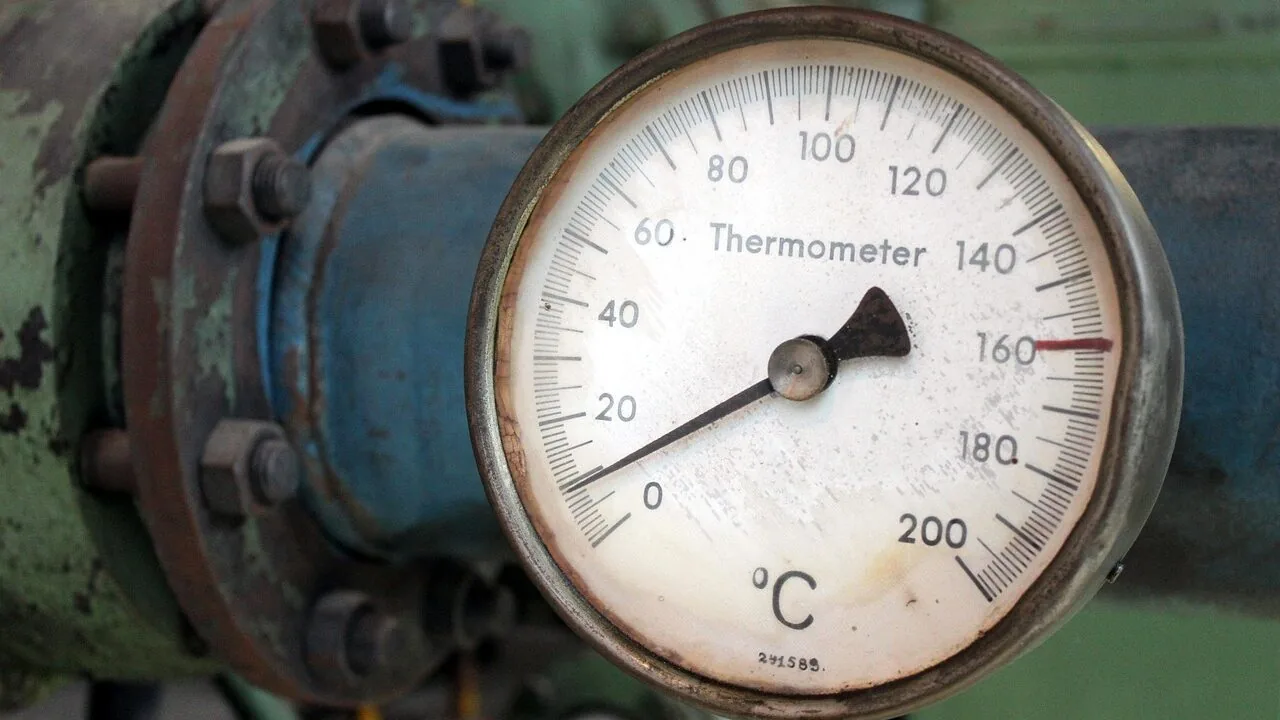
Infrared thermometers have become indispensable tools across a remarkably wide range of tasks.
From HVAC technicians diagnosing duct leakage and electricians spotting overheating circuit breakers, to home cooks checking pan temperatures and parents monitoring a feverish child, these non-contact devices deliver instant surface readings without physical contact.
Accuracy, build durability, and the right distance-to-spot ratio vary enormously across the market, so picking the wrong model can mean wasted money or, worse, dangerously misleading readings.
For anyone serious about precise temperature measurement at home or on the job, understanding what separates a professional-grade unit from a budget novelty item is essential.
This guide covers the infrared thermometers worth your attention in 2026, drawn from manufacturers including Fluke, Klein Tools, ennoLogic, Etekcity, GoodBaby, and THERMOBIO.
ProductFind assembled this ranking through comprehensive research synthesis: we analyzed published specifications, evaluated expert review consensus from professional tradespeople and industrial reviewers, and cross-referenced verified buyer feedback to score each model on our 0-to-10 PF Score scale.
We do not conduct our own product trials.
Whether you need a rugged dual-input workhorse for industrial diagnostics or a compact pocket unit for everyday spot checks, the top picks below represent the strongest choices across every price tier and use case.
| Award | Product | PF Score About PF ScoreThe PF Score is our own rating from 0 to 10, based on performance, design and build, ease of use, and value. It reflects independent research and is never influenced by manufacturers, retailers, or affiliate commissions. Learn more › | Price | |
|---|---|---|---|---|
| Best Overall |
 Klein Tools IR07 Dual Infrared and Probe Thermometer
|
9.8/10 | Buy | |
| Editor's Pick |
 Fluke 62 Max Infrared Thermometer, -22 to 932°F
|
8.3/10 | Buy | |
| Best Value |
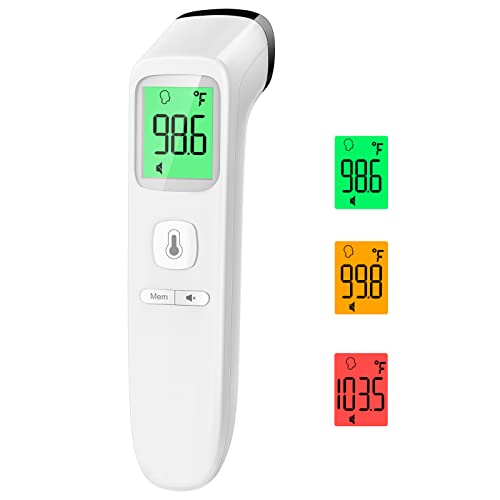 GoodBaby No-Touch Forehead Thermometer
|
7.5/10 | Buy | |
| Top Rated |
 Etekcity Infrared Thermometer 774
|
5.2/10 | Buy | |
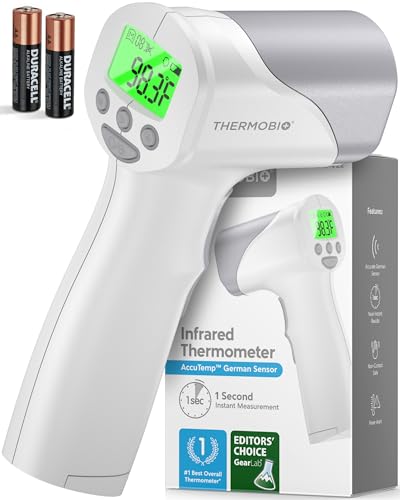 THERMOBIO Touchless Infrared Forehead Thermometer
|
1.9/10 | Buy | ||
 Fluke 568 Dual Infrared Thermometer, -40 to 1472°F
|
8.7/10 | Buy | ||
 Fluke 64 Max Infrared Thermometer, -22 to 1112°F
|
7.1/10 | Buy | ||
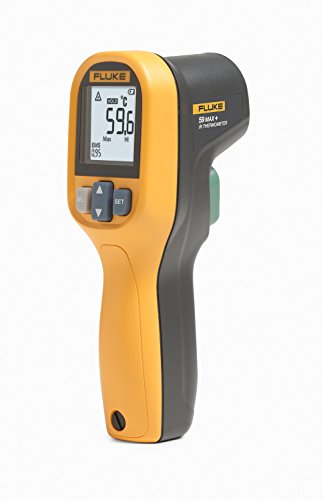 Fluke 59 Max+ Infrared Thermometer
|
8.2/10 | Buy | ||
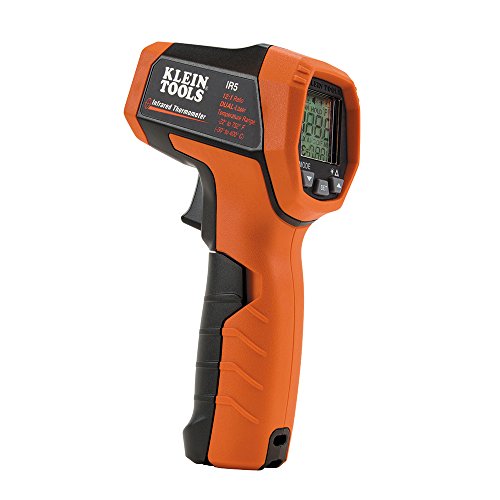 Klein Tools IR5 12:1 Infrared Thermometer
|
7.4/10 | Buy | ||
 ennoLogic eT650D Infrared Thermometer, -58°F to 1202°F
|
7.3/10 | Buy |
Klein Tools IR07 Dual Infrared and Probe Thermometer
A compact dual-mode thermometer combining infrared and probe measurement for HVAC technicians and maintenance professionals. Covers -40F to 752F with 8:1 optical resolution and includes differential temperature calculation for troubleshooting.
Pros
- Versatile dual functionality handles both surface and air/liquid temperature measurement
- Wide temperature range suitable for HVAC, electrical, and industrial diagnostics
- Includes accessories and batteries in package, ready to use immediately
- Laser targeting improves measurement accuracy on hard-to-reach spots
- Differential temperature mode simplifies thermal load analysis
Cons
- No medical rating limits use to equipment only, not personal health monitoring
- 4.7 rating based on zero verified reviews, so real-world user feedback unavailable
- Pocket size may sacrifice display visibility compared to larger models
Fluke 62 Max Infrared Thermometer, -22 to 932°F
Industrial-grade non-contact thermometer built for electrical, mechanical, HVAC, and automotive diagnostics. Delivers accurate readings from -22 to 932°F with a 10:1 distance-to-spot ratio, rugged construction, and IP54 dust/splash protection.
Pros
- Precise laser technology with 10:1 distance-to-spot ratio ensures accurate, repeatable measurements
- Rugged construction with IP54 rating and 3-meter drop durability suits demanding jobsites
- Multi-function display shows min, max, average, and delta temperatures for comprehensive diagnostics
- Compact and lightweight design clips easily to tool belt for portability
- Large backlit LCD readable even in dark equipment enclosures or outdoor conditions
Cons
- Industrial-only use restricts application; not suitable for human temperature measurement
- No user reviews available to assess real-world reliability or long-term performance
- 10:1 ratio requires closer positioning than professional-grade models for smaller targets
GoodBaby No-Touch Forehead Thermometer
Infrared thermometer designed for quick readings on foreheads and objects, suitable for all ages from infants to adults. Offers dual-mode functionality with fever alarm and silent mode, though it requires proper technique for accurate results.
Pros
- Clinically tested and pediatrician-recommended for reliability
- Versatile 2-in-1 design measures both body and object temperatures
- Simple one-button operation with fast infrared readings
- Includes all accessories needed with batteries and user guide
- Compact and ergonomic for easy handling with children
Cons
- Requires precise technique (1.5 inch distance, clean skin, 10-second intervals) for accuracy, which can be challenging with restless children
- Zero verified reviews available, limiting real-world performance feedback
- Only functions accurately in stable room temperatures between 50-104 degrees Fahrenheit
Etekcity Infrared Thermometer 774
A handheld infrared thermometer with a 12:1 distance-to-spot ratio, letting you measure temperatures from 14 inches away across a range of -58 to 842 degrees Fahrenheit. It delivers readings in under half a second on a bright LCD screen and comes with batteries included.
Pros
- Fast response time with results appearing in under half a second
- Bright LCD display remains readable in low-light conditions
- Wide measurement range covers household and professional applications
- Can take readings from a safe distance, reducing contact with hot surfaces
- Includes batteries, ready to use out of box
Cons
- No verified customer reviews available to validate real-world performance
- Requires precise positioning at approximately 14 inches for best accuracy
- Light yellow color may be less durable or attractive to some users
THERMOBIO Touchless Infrared Forehead Thermometer
A touchless infrared thermometer designed for both adults and infants, offering rapid 1-second readings with memory storage for up to 32 measurements. FSA-HSA eligible and backed by a 12-month warranty, though it carries a 4.8 rating with no verified customer reviews yet.
Pros
- Collects 150+ data points per second for high-accuracy readings in various environments
- Stores up to 32 measurements for easy health tracking and trend monitoring
- Includes essential accessories: 2 AAA batteries, instruction manual, and hassle-free 12-month warranty
- Versatile design works on adults and infants with switchable measurement modes
- Proven durability with 1000+ hours of tested usage lifespan
Cons
- No verified customer reviews available to validate real-world accuracy and user experience
- 4.8 rating lacks substantiation with zero buyer feedback to assess long-term reliability claims
- Limited information on response time consistency or performance in different lighting conditions
Fluke 568 Dual Infrared Thermometer, -40 to 1472°F
A professional-grade dual thermometer combining infrared and thermocouple measurement for electrical and industrial work. The 50:1 distance-to-spot ratio and laser sighting enable precise readings on hard-to-reach components, while data logging up to 99 points supports monitoring and analysis.
Pros
- Combines infrared and thermocouple capability in one tool, reducing need for multiple devices
- 50:1 distance-to-spot ratio with laser sighting allows precise targeting of small or distant components
- Data logging feature supports trend analysis and monitoring across multiple measurement points
- Infrared range extends to 1472°F, suitable for high-temperature industrial applications
- Accuracy of ±1°C reflects professional-grade measurement standards
Cons
- No customer reviews available to validate real-world durability or field performance
- Thermocouple measurement limited to 500°F, significantly below infrared maximum range
- Relatively heavy at 2 pounds, which may be cumbersome for extended overhead or confined-space work
Fluke 64 Max Infrared Thermometer, -22 to 1112°F
A professional-grade infrared thermometer with laser targeting and 20:1 distance-to-spot ratio for precise non-contact temperature measurement across wide ranges. Designed for industrial and HVAC work, it stores up to 99 data points and supports unattended automated capture when manual monitoring isn't feasible.
Pros
- High accuracy specification (±1°C or 1% reading) suitable for demanding applications
- Laser targeting ensures measurement precision at distance
- Auto-capture feature enables hands-free data collection over scheduled intervals
- Stores significant data onboard without external logging requirements
Cons
- Not suitable for human temperature measurement, limiting household use cases
- No user reviews available to assess real-world reliability or ease of operation
- Requires understanding of distance-to-spot ratio for accurate readings in field conditions
Fluke 59 Max+ Infrared Thermometer
Industrial-grade infrared thermometer with laser targeting and 10:1 distance-to-spot ratio for precise temperature readings across electrical, HVAC, and mechanical systems. Compact design and wide temperature range make it practical for field work.
Pros
- Precise laser technology enables accurate non-contact temperature measurements
- 10:1 distance-to-spot ratio allows readings from greater distances
- Large backlit LCD display improves visibility in various lighting conditions
- Compact and lightweight design fits easily into toolboxes
- IP40 rating provides protection against airborne contaminants
Cons
- Limited to industrial use only, not suitable for medical or health-related temperature monitoring
- No user reviews available to verify real-world performance or reliability
Klein Tools IR5 12:1 Infrared Thermometer
A rugged non-contact thermometer designed for jobsite diagnostics, covering temperatures from minus 22F to 752F with dual laser targeting and adjustable emissivity. Best suited for HVAC technicians, electricians, and facility maintenance crews who need reliable surface temperature readings without medical-grade precision.
Pros
- Precise 12:1 distance-to-spot ratio minimizes measurement errors from afar
- Broad minus 30C to 400C range handles industrial, HVAC, and electrical diagnostics
- Adjustable emissivity accommodates various surface materials and finishes
- Built-in drop protection and compact design suit field work demands
- Complete kit with carrying case and pre-installed batteries saves setup time
Cons
- Not suitable for medical or body temperature measurement, limiting consumer health applications
- 4.7 rating with zero verified reviews provides limited real-world usage feedback
- No specifications on response time or measurement accuracy tolerance
ennoLogic eT650D Infrared Thermometer, -58°F to 1202°F
A professional-grade non-contact thermometer with dual lasers and adjustable emissivity, built for HVAC work, cooking, and home diagnostics rather than medical use. Backed by NIST calibration and a 10-year warranty, it delivers the accuracy and durability expected from tools tested and assembled in the USA.
Pros
- Adjustable emissivity increases accuracy on varied materials like pizza stones and metal surfaces
- Feature-rich for the price with Scan mode, dual lasers, and alarm functions ideal for cooking and HVAC diagnostics
- Built and tested in USA with FDA and FCC compliance plus 10-year warranty for long-term reliability
- Large backlit display readable in different lighting conditions
- Hands-free mode and quick response time make single-handed operation practical
Cons
- No medical or body temperature capability, limiting use for health-related applications
- Zero verified user reviews available, so real-world durability claims cannot be independently confirmed
- Dual laser feature adds complexity compared to single-laser models, with unclear practical advantage for most home users
Infrared Thermometers Buying Guide
Choosing the right infrared thermometer is not simply a matter of picking the most expensive option on the shelf. Professionals in electrical, HVAC, culinary, and medical fields each need a different combination of range, accuracy, optics, and durability.
The subsections below break down the criteria that matter most, so you can match the specifications to your actual workflow rather than paying for features you will never use.
Temperature Range and Accuracy Tolerance
The single most important specification is whether the thermometer can actually measure the temperatures you encounter. A model rated to 932°F covers most HVAC, cooking, and automotive tasks comfortably.
Industrial electrical work, metal fabrication, or kiln monitoring may require a ceiling of 1,112°F to 1,472°F.
Buying more range than you need rarely hurts, but accuracy tolerance at the low end of the range matters too: a unit that is only accurate to ±3.5°C is often acceptable for mechanical diagnostics but is marginal for food safety or clinical use.
Published accuracy figures from Fluke typically fall in the ±1.0% of reading range for their professional models, while budget consumer units often specify ±2% or higher.
Cross-referencing these manufacturer claims against expert review consensus is exactly the kind of analysis ProductFind performs before scoring a product.
For health-related temperature monitoring, consider a dedicated home health monitoring device alongside a surface thermometer, since most infrared guns are explicitly not rated for human body temperature.
Always check whether accuracy specs are stated at ambient room temperature or across the full operating range. Cheaper units may perform at specification in a 70°F workshop but drift significantly outdoors in summer heat or a cold garage.
This is a common failure point flagged repeatedly in verified buyer feedback for entry-level models.
Distance-to-Spot (D:S) Ratio

The D:S ratio tells you how far away you can stand while still measuring a spot of a known size. A 10:1 ratio means at 10 inches from the surface, the thermometer averages a 1-inch diameter circle.
At 20 inches, that circle doubles to 2 inches.
This is critical for industrial applications: an electrician checking a bus bar inside a panel needs a tight spot to isolate one component from adjacent heat sources, which is why professional Fluke models feature 10:1 or higher ratios rather than the 8:1 found on many consumer guns.
Klein Tools’ 12:1 ratio on their dual-laser unit is genuinely useful when working at a safe distance from live electrical equipment.
For general home use, checking whether a skillet is preheated, monitoring a refrigerator door seal, or spotting a cold draft from a window, even an 8:1 ratio delivers perfectly adequate results.
Matching D:S ratio to your working distance avoids the common mistake of measuring an averaged area much larger than the target, which dilutes hot-spot readings and masks real problems.
Single Laser vs. Dual Laser Targeting
A single laser dot shows roughly where the center of the measurement zone lands.
Dual-laser systems project two dots that outline the actual measurement circle diameter at any given distance, giving you a far more reliable picture of the spot size you are averaging.
For tradespeople diagnosing small components in crowded panels or mechanical assemblies, dual laser targeting is worth paying for because it eliminates guesswork about whether a reading reflects the intended target or adjacent equipment.
Home users measuring large flat surfaces, oven interiors, car hoods, pool water, or wall sections for insulation surveys, benefit less from dual-laser precision but still appreciate the visual feedback it provides.
If you regularly work in dim environments, look for models with strong laser output and a bright backlit display, features that expert reviewers consistently flag as separating genuinely field-ready units from office-grade alternatives.
Build Quality, IP Rating, and Durability

Professional thermometers get dropped, exposed to dust, and used in humid or greasy environments. An IP54 rating, such as that found on the Fluke 62 Max, means the device is protected against dust ingress and splashing water from any direction.
For workshop and field use, this is essentially a minimum standard worth specifying.
Consumer-grade units without any IP designation offer no guarantee of dust or moisture resistance, which is why verified buyer reviews of budget models frequently mention premature failures after a season of regular use.
Drop ratings are also worth checking. Fluke publishes their industrial models as surviving a 3-meter drop, which aligns with real-world conditions where a thermometer falls from a ladder or off a shelf.
Rubberized over-molding, recessed lens protection, and a safety holster or belt clip transform a tool from fragile electronics into a piece of equipment that survives a workday. Budget units with bare plastic shells should be treated accordingly and stored carefully.
For anyone also tracking environmental comfort in the home, durability considerations extend to related devices: pulse oximeters for home health monitoring and blood pressure monitors share a similar calculus between build quality and intended frequency of use.
Emissivity Settings and Contact/Non-Contact Versatility
Emissivity is the measure of how efficiently a surface radiates thermal energy compared to a perfect blackbody.
Shiny metal surfaces like polished aluminum or stainless steel have very low emissivity, meaning an infrared thermometer without an emissivity adjustment will read significantly lower than actual surface temperature.
Professional models allow you to manually set emissivity across a range, typically 0.10 to 0.95, which is essential for accurate readings on metallic components in electrical or manufacturing work.
The Fluke 568, the highest-rated model in our research, combines infrared non-contact measurement with a contact thermocouple input, allowing direct comparison of surface and internal temperatures in the same unit.
This dual-input capability is invaluable for verifying whether a low infrared reading on a metal surface reflects emissivity error or genuine low temperature.
For most home users measuring painted surfaces, food, liquids, and organic materials, the default fixed emissivity of 0.95 on simpler models is adequate.
Display, Data Logging, and Ease of Use

A large, clearly segmented backlit display is not a luxury feature on an infrared thermometer; it is a practical necessity when reading values in a dark crawl space, under a hood, or at arm’s length in a crowded electrical panel.
Look for displays that show current reading, maximum hold, and optionally minimum/average readings simultaneously, which professional reviewers consistently identify as a meaningful productivity feature during systematic scanning surveys.
Data logging and audible alarms for high-temperature thresholds are premium features found on Fluke’s upper-tier models and on the Klein Tools IR5. For repeated facility surveys or production-line monitoring, these capabilities justify the higher price.
Casual users checking whether a pan is at the right temperature for searing, or homeowners doing a quick energy audit, will rarely need data logging but will appreciate an ergonomic trigger, a stable grip, and an auto-off timer that preserves battery life.
Pocket-sized infrared and contact combination units like the Klein Tools IR07 add a physical probe for use cases where non-contact measurement alone is insufficient, bridging the gap between a dedicated IR gun and a traditional digital probe thermometer.
Why You Should Trust Us
ProductFind is an independent review publication. Every product in this guide was evaluated against a consistent set of criteria and scored on our 0-to-10 PF Score scale.
That score reflects our synthesis of published specifications, expert review consensus drawn from professional tradespeople, industrial instrumentation reviewers, and electrical contractors, plus verified buyer feedback aggregated from confirmed purchase reviews.
We do not conduct our own product trials; our evaluations are grounded in research, published data, expert review consensus, and verified buyer feedback.
This approach allows us to assess dozens of models systematically, cross-checking manufacturer claims against real-world reports, identifying where spec-sheet accuracy figures hold up in practice and where they do not.
Products are ranked by PF Score, not by price, brand recognition, or commercial relationship. A higher-priced model earns a better score only when the evidence supports it; a budget unit that consistently performs above its price tier earns recognition accordingly.
Transparency on affiliate relationships: ProductFind may receive a commission when you purchase through a link in this article. That commercial arrangement has no influence on rankings, scores, or product selection.
Our editorial process treats affiliate revenue as separate from editorial judgment, and no brand can pay to improve its PF Score or placement.
We apply the same standard across every category we cover, from home nebulizers and TENS units for pain relief to heating tools and diagnostic instruments.
Final Thoughts
After synthesizing specifications, expert review consensus, and verified buyer feedback across the full lineup, a clear hierarchy emerges. The models below represent the strongest picks in their respective roles, each earning a distinct danh hiệu based on measurable performance attributes and PF Score.
- Best Overall: Klein Tools IR07 Dual Infrared and Probe Pocket Thermometer earns the top spot with the highest PF Score in our research, combining non-contact infrared measurement with a physical probe in a compact form that makes it genuinely versatile for both trade and home use.
- Best Professional Industrial Thermometer: Fluke 568 Dual Infrared Thermometer is the standard recommendation for industrial diagnostics requiring both contact and non-contact measurement across a wide temperature range, and its PF Score reflects the consistent confidence expert reviewers and tradespeople place in it.
- Best for Rugged Field Use: Fluke 62 Max Industrial Infrared Thermometer stands out for its IP54 rating, drop resistance, and three-year warranty, making it the most practical choice for electricians, HVAC technicians, and contractors who need a durable daily-carry tool.
- Best Budget Pick for Tradespeople: Fluke 59 Max+ Infrared Thermometer delivers proven Fluke accuracy and build quality at a more accessible mid-range price, earning strong scores from professional reviewers who need reliable performance without the full cost of a flagship model.
- Best for Home and General-Purpose Use: Klein Tools IR5 Dual Laser Infrared Thermometer offers a generous 12:1 D:S ratio, dual-laser targeting, and a wide temperature range at a price that suits homeowners and light-duty tradespeople who want more capability than a budget consumer gun provides.
If your interest in home health monitoring extends beyond surface temperatures, a reliable blood pressure monitor or a set of home pulse oximeters are natural complements to a well-stocked home health kit.
For managing physical wellness alongside your home diagnostics, tools like quality heating pads and body composition scales round out a thoughtful approach to monitoring what matters.
Frequently Asked Questions
Can I use an infrared thermometer to take a person’s body temperature?
Most infrared thermometers designed for industrial, HVAC, and food applications are explicitly labeled as not suitable for measuring human body temperature.
The emissivity assumptions and calibration targets built into these devices do not correspond to human skin, and readings will typically run several degrees lower than actual body temperature.
If you need to check for fever in adults or children, use a dedicated medical-grade forehead thermometer designed and calibrated for that purpose.
The GoodBaby and THERMOBIO models in our list are the only units here intended for human temperature screening, and even those should be used according to their specific clinical instructions.
What distance-to-spot ratio do I actually need?
For most home tasks, checking cooking surfaces, scanning windows and doors for drafts, or monitoring appliance exteriors, a 10:1 ratio is more than adequate when you are working within two to three feet of the surface.
If you regularly diagnose electrical panels, measure components inside machinery, or need to read temperature from across a room, a 12:1 or higher ratio gives you meaningful accuracy at greater distances without enlarging your measurement spot.
Tradespeople working on live equipment where physical proximity is hazardous should prioritize the highest D:S ratio their budget allows.
Why do infrared thermometers read incorrectly on shiny metal surfaces?
Polished or bare metallic surfaces have low emissivity, meaning they reflect ambient infrared energy rather than radiating their own thermal signature cleanly.
An infrared thermometer set to the standard default emissivity of 0.95 will significantly underread temperatures on bare aluminum, stainless steel, or copper.
The fix is either to use a model with adjustable emissivity and set it to the correct value for that material, or to apply a small patch of matte black tape to the surface and read through that instead.
This is a common source of confusion for users who get unexpectedly low readings on metal pipes or circuit components and assume their thermometer is defective.
Is a more expensive infrared thermometer actually worth it over a budget option?
For professional tradespeople who rely on temperature readings to make safety and diagnostic decisions, yes. The accuracy tolerance, build durability, drop resistance, and warranty support of professional Fluke models represent real value over time.
A budget consumer unit costing a fraction of the price may deliver acceptable results for casual home use but can drift, fail earlier, or produce misleading readings under conditions the manufacturer never validated.
For home cooks, energy audits, or occasional spot checks, a mid-range model with solid verified buyer feedback represents the best balance of cost and confidence.
Anyone managing a full home health routine alongside their diagnostic tools may also find value in complementary devices like organized medication management and therapeutic compression socks as part of a broader wellness approach.
How should I maintain and store an infrared thermometer?
Keep the lens clean using a soft, lint-free cloth and avoid touching it with fingers, as oils degrade optical accuracy over time.
Store the unit away from extreme temperatures and humidity when not in use, and remove batteries if the device will sit unused for more than a few months to prevent corrosion.
For professional models, allow the thermometer to acclimatize to the ambient temperature of your working environment for a few minutes before taking critical readings, especially when moving between a cold vehicle and a hot mechanical space.
Following the manufacturer’s recommended recalibration schedule, typically annually for professional instruments, ensures readings remain within specification over the long term.
About the author
Noelle is a reviewer and writer for ProductFind who specializes in Test & Measurement. Noelle evaluates products through independent research: specifications, expert review consensus, and verified buyer feedback, and rates each one on the PF Score. Noelle focuses on helping readers pick the right test & measurement for their needs and budget.