The 8 Best Light Meters
Getting light right starts with measuring it. This guide covers illuminance meters and professional incident meters for photographers, plant growers, and facility managers across every budget.
 By Noelle Gray
Updated July 23, 2026
By Noelle Gray
Updated July 23, 2026
Whether you’re a photographer dialing in exposure on location, a plant enthusiast chasing the right PAR window, or a facility manager verifying workspace illuminance compliance, a reliable light meter removes the guesswork that your eyes simply cannot handle.
Human vision adapts constantly to changing light conditions, making it impossible to judge lux levels or footcandles with any precision.
A dedicated meter gives you objective, repeatable readings so you can make confident decisions, whether you’re setting flash power, positioning a grow light, or troubleshooting dim office fixtures.
This guide covers a carefully curated range of options, from professional-grade incident meters favored by cinematographers to affordable illuminance meters ideal for hobbyists and indoor gardeners.
ProductFind assembled this list through comprehensive research: we analyzed published specifications, synthesized expert review consensus, and weighed verified buyer feedback to surface the picks most likely to serve each type of user well.
Options from Sekonic, Extech, BTMETER, UNI-T, URCERI, TopTes, and Soonkoda are all represented, spanning a wide range of budgets and use cases. Scroll down to see our top picks ranked and compared.
| Award | Product | PF Score About PF ScoreThe PF Score is our own rating from 0 to 10, based on performance, design and build, ease of use, and value. It reflects independent research and is never influenced by manufacturers, retailers, or affiliate commissions. Learn more › | Price | |
|---|---|---|---|---|
| Best Overall |
 Soonkoda S8608 Digital Light Meter, 200,000 Lux
|
5.2/10 | Buy | |
| Editor's Pick |
 URCERI MT-92H Light Meter, 0-200,000 Lux
|
6.3/10 | Buy | |
| Best Value |
 URCERI Digital Light Meter, 200,000 Lux Range
|
5.8/10 | Buy | |
| Top Rated |
 UNI-T UT383 Light Meter, 0-199,900 Lux
|
6.0/10 | Buy | |
 TopTes TS-710 Light Meter, 0.1-200,000 Lux
|
6.2/10 | Buy | ||
 Sekonic L-858D-U Speedmaster Light Meter
|
9.1/10 | Buy | ||
 BTMETER BT-881D Digital Light Meter, 0.01-400,000 Lux
|
6.1/10 | Buy | ||
 Extech LT40 LED Light Meter
|
7.5/10 | Buy |
Soonkoda S8608 Digital Light Meter, 200,000 Lux
The Soonkoda S8608 is a digital illuminance meter designed to measure visible light intensity up to 200,000 lux across indoor and outdoor environments. It offers practical features like auto-range switching, data hold, and backlight display, making it useful for photography, horticulture, and facility lighting assessments.
Pros
- Covers extensive lux range suitable for diverse lighting conditions from indoor offices to outdoor grow operations
- Auto-range switching simplifies operation without manual adjustment
- Backlight and data hold features improve usability in varied settings
- Low battery indicator prevents unexpected shutdowns mid-measurement
- Lightweight and portable for on-site assessments
Cons
- No verified buyer reviews available to confirm real-world reliability and accuracy
- Specifications lack detail on measurement accuracy tolerance and sensor type
- Weight listed in unusual precision format suggests potential data entry error in product specifications
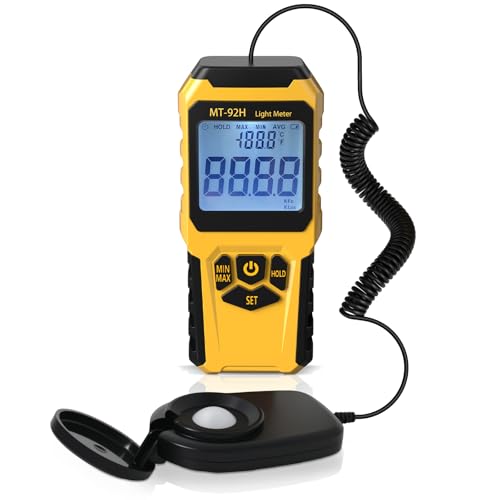
URCERI MT-92H Light Meter, 0-200,000 Lux
A professional-grade illuminance meter with split-sensor design and dual measurement units for both light intensity and temperature. Delivers high-precision readings up to 200,000 Lux with 0.5-second refresh rates, making it suitable for photographers, lighting technicians, and environmental auditors.
Pros
- High measurement ceiling (200,000 Lux) covers everything from dim indoor spaces to direct sunlight
- Split-sensor design eliminates probe shadow on measurement area, improving accuracy in tight spaces
- Dual unit switching accommodates both metric and imperial standards without separate devices
- Fast response time (0.5 seconds) ideal for monitoring light changes in video/photography workflows
- Backlit display with glare resistance works across extreme lighting conditions
Cons
- No verified buyer reviews available to validate real-world performance claims
- Relatively basic feature set compared to smart meters with wireless connectivity or data logging
- Sensor accuracy specifications don't indicate performance at extreme ranges (near 0 Lux or 200,000 Lux)
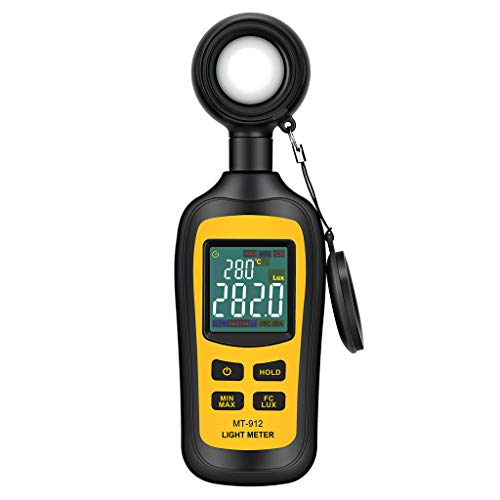
URCERI Digital Light Meter, 200,000 Lux Range
A compact digital luxmeter that measures illumination up to 200,000 lux with ambient temperature sensing, suitable for photography, film production, industrial settings, and home use. The 4-digit LCD display shows min/max readings and includes standard conveniences like data hold and auto power-off.
Pros
- High measurement range of 0-200,000 lux covers both low and bright light environments
- Includes temperature measurement alongside illuminance in one device
- Useful features like min/max recording, data hold, and automatic power-off extend usability
- Compact size makes it portable for on-location or field work
- 2-year warranty provides reasonable coverage for a specialized meter
Cons
- No verified customer reviews available, making real-world performance assessment difficult
- Accuracy tolerance widens to ±4% at higher lux levels (above 10,000 lux)
- Small size and handheld design may require careful handling to avoid drops or damage
UNI-T UT383 Light Meter, 0-199,900 Lux
The UNI-T UT383 is a compact digital illuminance meter that measures light intensity in both lux and foot candles, making it suitable for photography, film production, and agricultural applications. Its 4-digit LCD display, 0.5-second sampling time, and accuracy of +/-(4% + 8) provide reliable readings across a wide range from 0 to 199,900 lux.
Pros
- Portable and user-friendly with large 4-digit display and backlight for visibility
- Accurate readings with +/-(4% + 8) tolerance suitable for professional photography and lighting work
- Versatile applications across photography, film studios, agriculture, laboratories, and industrial settings
- Fast 0.5-second sampling time for responsive measurements
- Data hold and max/min recording functions help capture specific lighting conditions
Cons
- No verified customer reviews available to assess real-world reliability and durability
- Limited information on battery type, runtime, and replacement costs
- Manual provided only in paper and downloadable formats with no in-app guidance
TopTes TS-710 Light Meter, 0.1-200,000 Lux
A versatile digital light meter with a 180-degree rotating sensor and backlit display, designed for measuring illumination across plants, automotive, and indoor environments. Captures lux and foot-candle readings with 3% accuracy plus bonus temperature and humidity monitoring.
Pros
- Broad lux range suitable for grow lights, LEDs, fluorescent, and sodium lamps
- Fast 0.5-second sampling provides continuous real-time readings
- Dual-unit display in lux and foot-candles for flexibility
- Rotating sensor eliminates need to reposition the meter body
- Multi-function design adds temperature and humidity tracking
Cons
- No verified buyer reviews available to assess real-world reliability or long-term durability
- Temperature sensor requires adaptation time in new environments, potentially affecting initial accuracy
- Limited to 10-minute auto shut-off, which may or may not suit prolonged monitoring needs
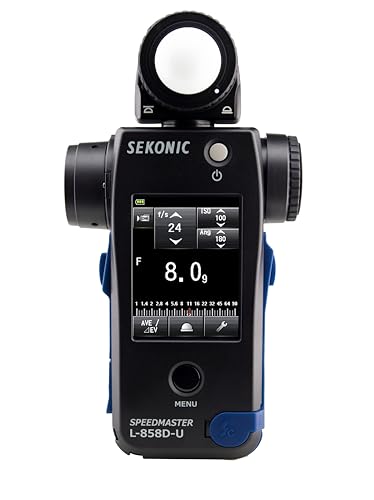
Sekonic L-858D-U Speedmaster Light Meter
A professional-grade incident and spot light meter designed for photographers who need precise flash metering, including HSS duration analysis and wireless triggering compatibility. The built-in 1∞ spot viewfinder and broad EV range make it suitable for complex studio and on-location lighting scenarios.
Pros
- Measures flash duration and HSS output for precise motion control and high-speed sync accuracy
- Integrated spot viewfinder eliminates need for separate spot metering tool in complex multi-light setups
- Expandable via optional radio modules for integrated flash control from the meter itself
- Wide EV range handles both low-light ambient and high-intensity flash environments
- Professional build with proven Sekonic reputation in metering technology
Cons
- No verified user reviews available to assess real-world reliability or learning curve
- Radio triggering modules sold separately, adding to total system cost
- Spot metering requires familiarity with its viewfinder interface for effective use
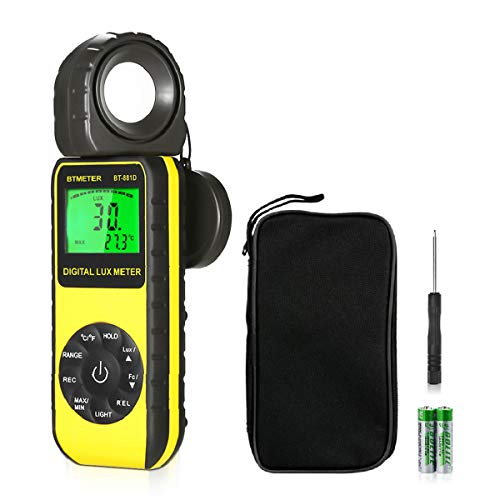
BTMETER BT-881D Digital Light Meter, 0.01-400,000 Lux
A wide-range illuminance meter designed for measuring LED grow lights, indoor spaces, and outdoor environments with a 270-degree rotatable sensor. Offers high accuracy ratings and fast response time, making it suitable for plant growers, educators, and lighting professionals who need reliable light intensity readings.
Pros
- Exceptionally wide measurement range compared to standard lux meters
- 270-degree rotatable sensor eliminates need to reposition the entire device
- Data logging capability allows recording and comparison of 33 readings
- Fast response time provides near-instant illuminance readings
Cons
- No verified buyer reviews available to assess real-world reliability
- Relatively compact design may make small display difficult to read in bright conditions
- Limited information on battery life and durability specifications
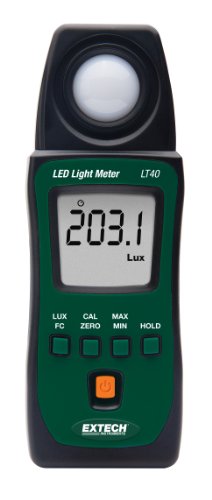
Extech LT40 LED Light Meter
A compact light meter designed for professionals needing quick illumination readings with a backlit display for low-light environments. The 4000 count LCD and data hold function make it practical for field work, though limited user feedback is available to assess long-term reliability.
Pros
- Backlit LCD display enables readings in low-light environments
- Data hold and auto power off features add convenience and battery efficiency
- Relative mode adjustment capability for calibration flexibility
- Portable form factor suits mobile professionals and job sites
Cons
- No verified buyer reviews available to validate real-world performance or durability
- Limited documentation on measurement accuracy range or calibration schedule
- Specifications lack detail on battery type, runtime, or light measurement range
Light Meters Buying Guide
Choosing the right light meter depends heavily on what you plan to measure and how precise you need your readings to be.
A professional photographer shooting with strobes has very different requirements than a gardener checking photon levels above a seedling tray.
The sections below break down the criteria that matter most, so you can match a meter’s strengths to your specific workflow.
If you already use studio lighting kits, pairing them with an accurate meter is one of the most impactful upgrades you can make to your setup.
Meter Type: Incident vs. Reflected vs. Illuminance

Light meters fall into two broad functional families. Incident meters measure the light actually falling on your subject, using a translucent dome (lumisphere) that captures light from a wide hemisphere.
This is the gold standard for photographic and cinematic exposure work because it is unaffected by subject reflectance.
Reflected or spot meters read the light bouncing back from a specific surface or zone, useful for evaluating contrast ratios or confirming highlight detail without walking up to a subject.
Illuminance meters, sometimes called lux meters or luxmeters, are a separate category optimized for measuring ambient light intensity in lux or footcandles.
They are the right tool for plant lighting assessments, office compliance checks, automotive headlight verification, and general electrical troubleshooting.
Most of the meters in this roundup are illuminance meters, with the Sekonic L-858D-U standing apart as a full-featured incident and spot meter designed specifically for photography and cinematography.
If you are shopping purely for photography exposure work, an incident meter is almost certainly what you want.
If you need to verify light intensity for plants, workspaces, or LED fixtures, an illuminance meter will serve you better and cost far less. Knowing which category you need narrows your shortlist immediately.
Measurement Range and Resolution

Maximum lux range matters if you intend to measure bright outdoor scenes or high-intensity grow lights. Most consumer illuminance meters top out around 200,000 lux, which covers direct sunlight near the horizon.
If you are working indoors with LED panels or fluorescent fixtures, even a meter rated to 100,000 lux will rarely be limiting.
Resolution, expressed as the smallest increment displayed (often 0.01 lux at the low end), matters more for low-light plant environments or dimly lit interior photography.
Footcandle readout (FC) is worth checking if you work in industries or regions that use imperial units for lighting standards. Most meters in this roundup display both lux and footcandles, switchable via a single button.
For scientific plant research, some growers prefer a meter that reads in PPFD (micromoles per square meter per second) rather than lux, since lux is photopically weighted and not a direct proxy for photosynthetically active radiation.
Standard illuminance meters can approximate plant light needs but are not a substitute for a dedicated quantum meter in precision horticulture.
Sensor Design and Cosine Correction
The physical design of the sensor head has a direct impact on accuracy. A flat, forward-facing sensor reads light coming straight at it accurately but underestimates light arriving at oblique angles.
A cosine-corrected sensor compensates mathematically or optically for angled light, producing readings that better represent the total illuminance on a horizontal plane. This matters most when measuring diffuse ambient light or overhead grow lights from a fixed mounting position.
Rotating or articulating sensors, like the 270-degree swivel on the BTMETER BT-881D or the 180-degree pivot on the TopTes TS-710, let you aim the sensor at a light source without contorting your wrist or repositioning the entire meter.
This is especially practical when checking mounted grow lights or overhead office fixtures. A fixed sensor is fine for benchtop work but becomes awkward in real-world field conditions.
Flash and High-Speed Sync Capability
Standard illuminance meters are designed for continuous light sources and will not accurately capture the brief pulse of a photographic strobe or speedlight.
If flash measurement is part of your workflow, you need a meter with a dedicated flash mode that can latch the peak of a transient pulse.
The Sekonic L-858D-U goes further, offering flash duration analysis and high-speed sync (HSS) measurement, capabilities that are essentially unavailable at any lower price point in this category.
For photographers who rely on camera flashes and external strobes, this distinction is non-negotiable. A lux meter that lacks flash mode will display a meaningless averaged reading or simply fail to register a short strobe pulse.
The Sekonic’s wireless radio triggering compatibility also means you can fire and meter a strobe simultaneously without an assistant, a significant workflow advantage on solo shoots.
Display, Ergonomics, and Ease of Use
A large, high-contrast display matters in bright outdoor conditions where you might be squinting into direct sun. Backlit LCDs help in dim interiors and nighttime shoots.
Some meters like the URCERI MT-92H offer a switchable backlight, which is a small but genuinely useful feature when you find yourself in a dark venue trying to log readings.
Refresh rate also matters: faster refresh (the URCERI MT-92H quotes 500 ms) makes it easier to wave the sensor across a grow canopy and catch variation in real time rather than waiting for a sluggish display to settle.
Button layout and menu depth are worth considering if you plan to switch between measurement modes frequently. Budget illuminance meters generally keep things simple, with one or two buttons for unit switching and range hold.
The Sekonic L-858D-U has a more complex interface that reflects its professional feature set, and there is a genuine learning curve for first-time users.
If simplicity is your priority, the budget-friendly options from Soonkoda, UNI-T, and TopTes are deliberately minimal. Paired with a solid travel tripod, a swivel-head meter can take repeatable position-locked readings without an extra pair of hands.
Build Quality, Accuracy, and Value at Each Price Tier

At the budget tier (under roughly $30), expect plastic housings, basic cosine correction, and accuracy ratings typically cited at plus or minus 3 to 5 percent of reading.
These meters are more than adequate for hobbyist plant growers, DIY home lighting projects, and photography students learning exposure fundamentals.
The Soonkoda meter sits at the very bottom of this range and reflects the trade-offs: adequate range, minimal features, and build quality that matches its entry-level price.
Mid-range illuminance meters from established evaluation-equipment brands like Extech step up in accuracy certification, build durability, and in some cases add temperature measurement as a bonus channel.
The Extech LT40 is priced at a meaningful premium over the budget cluster and is aimed at professionals who need a meter they can trust in a compliance or inspection context.
At the top of the professional photography segment, the Sekonic L-858D-U commands a premium price that reflects its incident metering dome, 1-degree spot metering angle, flash duration analysis, and wireless triggering.
It is an investment for working cinematographers and photographers, not a casual purchase.
For anyone building out a photography kit, it pairs naturally with a complete set of softbox lighting and ring lights to give you full quantitative control over your lighting setup.
Why You Should Trust Us
ProductFind is an independent review publication. We do not sell any of the products we cover, and we have no affiliation with retailers or manufacturers.
Every product in this roundup was evaluated using our structured research methodology: we analyzed published technical specifications, synthesized consensus from expert reviewers across multiple credible sources, and carefully weighed verified buyer feedback to identify consistent patterns of real-world performance, reliability concerns, and standout strengths.
Each product receives a PF Score on a 0 to 10 scale, generated by assessing it against a consistent set of criteria relevant to the category.
For light meters, those criteria include measurement range and resolution, sensor design and cosine correction quality, display usability, build quality relative to price, and any specialized capabilities such as flash metering or rotating sensor heads.
We do not conduct our own product trials; our evaluations are grounded in research, published data, expert review consensus, and verified buyer feedback.
ProductFind may earn a commission if you purchase through a link in this article. That affiliate relationship has no bearing on which products are included, how they are ranked, or what PF Score they receive.
Our recommendations reflect the merits of the products themselves, not commercial arrangements. We aim to give you the kind of straightforward, balanced analysis you would get from a knowledgeable friend who has done the research for you.
Final Thoughts
The right light meter depends entirely on what you are measuring and how much precision you need. After comprehensive research across specifications, expert assessments, and buyer experience, here are our standout picks from this roundup:
- Best Overall: Sekonic L-858D-U Speedmaster earns the top PF Score in this group by a significant margin. Its combination of incident metering, 1-degree spot capability, flash duration analysis, HSS measurement, and wireless radio triggering makes it the most capable and versatile light meter here. It is a professional investment that serious photographers and cinematographers will find difficult to outgrow.
- Best Mid-Range Pick: Extech LT40 LED Light Meter occupies a confident middle ground. It is built to a higher standard than the budget cluster and is suited for professional compliance checks, facility management, and photographers who need a trustworthy illuminance reference without committing to a full incident meter.
- Best for Plants and Indoor Grow Lights: BTMETER BT-881D earns this nod for its wide measurement range, 270-degree rotating sensor, and the practical flexibility that makes it well-suited for checking grow light distribution across a canopy from multiple angles.
- Best Budget Pick: TopTes TS-710 offers the best balance of features at an entry-level price point, including a 180-degree rotating sensor, large backlit display, and a 200,000 lux ceiling. It is a sensible first meter for hobbyist plant growers and home lighting enthusiasts who want more than a bare-bones tool without spending more than they need to.
- Best Ultra-Budget Option: Soonkoda Digital Illuminance Meter is the most affordable option in the group and fits a narrow but real niche: anyone who just needs a rough lux reference for a one-off project and has no interest in spending more. Expectations should be set accordingly.
If you are building out a complete photography and lighting workflow, it is worth exploring related gear including camera straps built for long shooting days, lens cleaning kits to keep your glass in top condition, and camera batteries that keep you shooting through long sessions.
A good light meter is one piece of a larger system that rewards careful, well-equipped work.
Frequently Asked Questions
What Is the Difference Between a Light Meter and a Lux Meter?
“Light meter” is a broad term that encompasses several different instruments. In photography, it usually refers to an incident or reflected meter that outputs exposure values (EV), f-stops, and shutter speeds.
A lux meter, also called an illuminance meter, measures the intensity of light on a surface in lux or footcandles and is used for environmental lighting assessment rather than photographic exposure.
Both measure light, but they are optimized for different outputs and different users.
Can I Use a Lux Meter to Measure Light for My Plants?
Yes, with some caveats. Lux is a photopic measurement calibrated to human visual sensitivity, which peaks in the green-yellow range. Plants absorb light primarily in the red and blue spectra, so lux readings do not perfectly represent photosynthetically useful light.
For casual hobbyist growing, lux meters provide a useful relative reference and help you compare positions and fixture distances.
For precision horticulture, scientific plant research, or commercial cultivation, a dedicated quantum meter measuring PPFD in micromoles per square meter per second is more appropriate.
Do I Need a Separate Flash Meter for Studio Photography?
If you shoot with external strobes or monolight systems, yes. Standard illuminance meters cannot capture the brief pulse of a flash accurately and will give you meaningless readings.
A dedicated incident meter with a flash mode, like the Sekonic L-858D-U, is designed to latch the peak value of a strobe pulse and give you an accurate EV reading you can translate directly into camera settings.
Many professional photographers who invest in a full studio lighting setup treat a flash-capable incident meter as an essential companion rather than an optional accessory.
How Accurate Are Budget Lux Meters?
Most budget illuminance meters specify accuracy at plus or minus 3 to 5 percent of reading under ideal conditions (calibrated white light source, correct measurement angle, stable temperature).
In practice, readings can vary more if you are measuring LEDs with unusual spectral profiles, since many budget sensors are calibrated for incandescent or standard fluorescent light.
For relative comparisons (is this corner brighter than that corner?) budget meters are perfectly reliable. For absolute compliance measurements or scientific data, a calibrated mid-range or professional meter is worth the additional investment.
What Lux Level Is Right for Different Lighting Situations?
Generally accepted benchmarks vary by application. Office workplaces typically target 300 to 500 lux at desk level for comfortable, productive work. High-detail tasks like drafting or jewelry inspection may call for 750 to 1,000 lux or more.
Plant light requirements range from as little as 1,000 lux for low-light houseplants to 40,000 lux or higher for high-light succulents and fruiting vegetables under artificial light. Direct midday sunlight can exceed 100,000 lux.
Having a meter lets you verify whether your setup is actually hitting these targets rather than guessing based on perceived brightness.
For photographers, the low-light end of the spectrum is equally important to understand, especially when planning shoots in challenging ambient conditions.
Is a Light Meter Useful for Video and Vlogging?
Absolutely. Consistent, well-measured lighting is one of the biggest factors separating polished video from amateur-looking footage.
An incident meter helps you set exposure precisely, balance key and fill lights to a specific ratio, and maintain consistency across multiple shooting locations or sessions.
Creators who shoot with vlogging cameras or mirrorless systems benefit from knowing their light levels quantitatively rather than relying solely on the in-camera histogram.
For anyone serious about visual storytelling, a light meter is a small investment with an outsized impact on production quality.
About the author
Noelle is a reviewer and writer for ProductFind who specializes in Test & Measurement. Noelle evaluates products through independent research: specifications, expert review consensus, and verified buyer feedback, and rates each one on the PF Score. Noelle focuses on helping readers pick the right test & measurement for their needs and budget.