The 9 Best Spotting Scopes
From backyard birding to long-range target shooting, the right spotting scope changes what you can see. Here are the top picks across every budget, researched and ranked for real-world performance.
 By Jerry Gutierrez
Updated July 23, 2026
By Jerry Gutierrez
Updated July 23, 2026
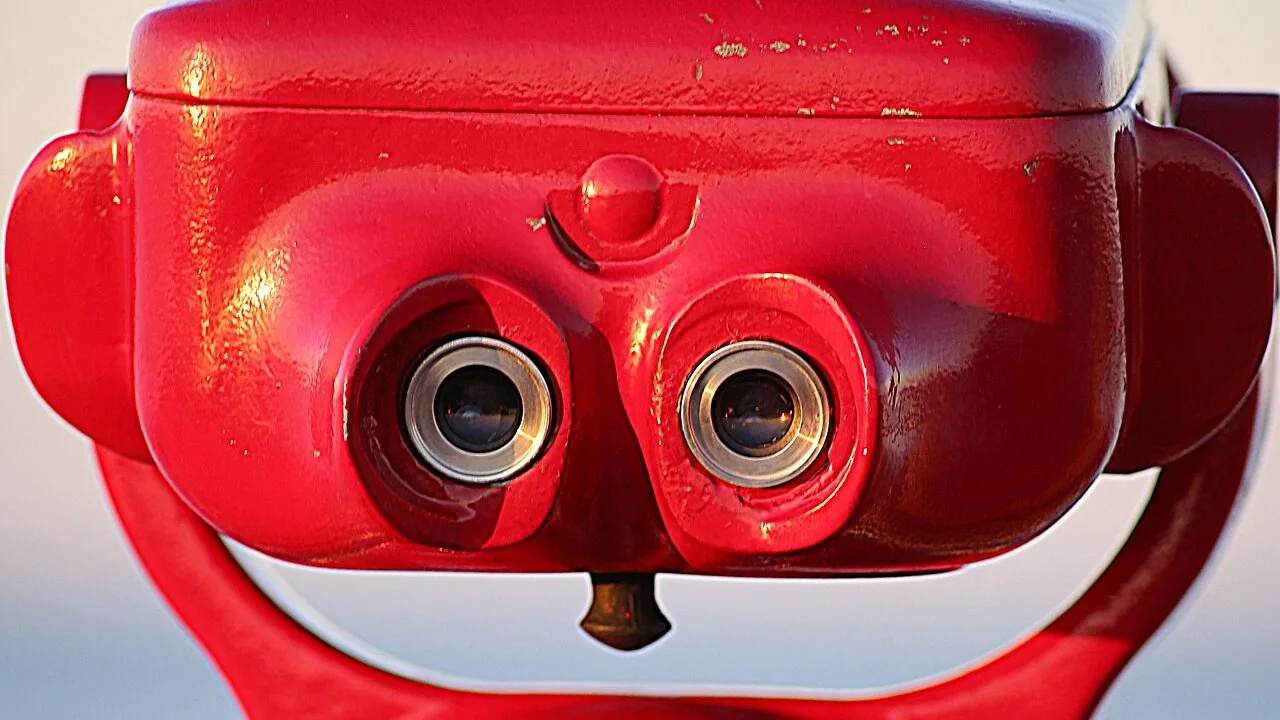
A spotting scope sits in a unique sweet spot between binoculars and a full telescope, delivering the sustained, high-magnification viewing that serious birders, hunters, and long-range shooters need without the bulk of an astronomical setup.
Whether you’re calling the impact of a shot at 500 yards, scanning a mountain ridge for elk at last light, or tracking shorebirds across a tidal flat, the quality of your optic determines how much you actually see.
The market spans a remarkable range, from budget-friendly entry points that cost less than a good pair of binoculars to precision instruments with premium glass that rivals much pricier alternatives, and navigating those choices without a reliable guide is genuinely difficult.
This guide cuts through the noise by focusing on what genuinely matters for real-world performance.
Our team at ProductFind researched each model through a rigorous synthesis of published optical specifications, expert review consensus from the shooting, hunting, and birding communities, and verified buyer feedback across thousands of documented purchases.
Models from Athlon Optics, Gosky, SVBONY, Celestron, and Emarth were assessed against consistent criteria spanning optical clarity, build quality, weather resistance, tripod integration, and value.
Scroll down to see our top picks, then use the buying guide below to match the right scope to your specific needs.
| Award | Product | PF Score About PF ScoreThe PF Score is our own rating from 0 to 10, based on performance, design and build, ease of use, and value. It reflects independent research and is never influenced by manufacturers, retailers, or affiliate commissions. Learn more › | Price | |
|---|---|---|---|---|
| Best Overall |
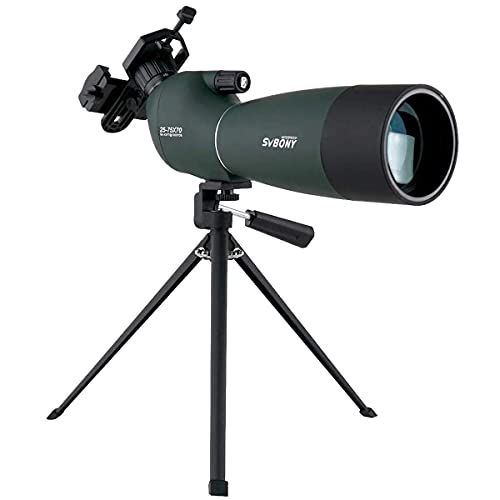 SVBONY SV28 25-75x70mm Spotting Scope with Tripod
|
5.1/10 | Buy | |
| Editor's Pick |
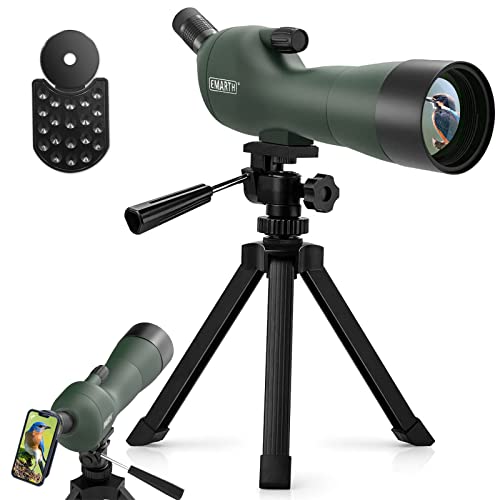 Emarth 20-60x60 Spotting Scope with Tripod
|
5.2/10 | Buy | |
| Best Value |
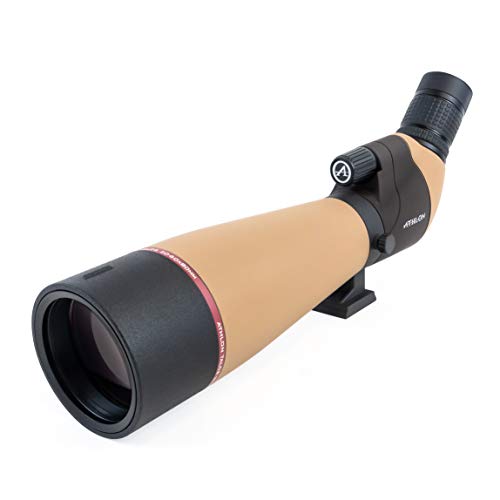 Athlon Optics Talos 20-60x80 Spotting Scope
|
7.1/10 | Buy | |
| Top Rated |
 Gosky 25-75x80 Spotting Scope with Tripod
|
7.2/10 | Buy | |
 Gosky 25-75x85 Spotting Scope with Tripod
|
7.3/10 | Buy | ||
 Athlon Optics Argos HD 20-60x85 Spotting Scope
|
8.1/10 | Buy | ||
 Celestron C5 5-inch Schmidt-Cassegrain Spotting Scope
|
6.5/10 | Buy | ||
 Sogries 20-60x80 Spotting Scope with Phone Adapter
|
6.9/10 | Buy | ||
 GUANIEE 25-75x80 Spotting Scope with Tripod
|
6.8/10 | Buy |
SVBONY SV28 25-75x70mm Spotting Scope with Tripod
The SV28 offers a 25-75x zoom range and 70mm objective lens designed for bird watching, wildlife viewing, and target shooting. It includes a phone adapter and portable tripod, making it accessible for beginners and field observers who need a lightweight, waterproof spotting solution.
Pros
- Wide zoom range accommodates both close and distant viewing without switching equipment
- Large 70mm lens provides good light transmission for bright, clear images
- Waterproof design handles outdoor conditions without damage risk
- Phone adapter enables easy photo and video sharing from the field
- Included tripod and lightweight build make it suitable for travel and camping
Cons
- No verified buyer reviews available to assess real-world performance and durability claims
- Desktop tripod design may have limited stability for extended use or high-power magnification
- Limited information on optical quality specifics, such as glass coatings or distortion at maximum zoom
Emarth 20-60x60 Spotting Scope with Tripod
A lightweight spotting scope designed for hunters and birdwatchers, offering 20-60x magnification with a 60mm objective lens and included 14-inch tabletop tripod. The compact 1.31lb kit includes a carrying case, making it portable for field use, though it lacks verified buyer feedback to assess real-world performance.
Pros
- Lightweight design with soft carrying case makes it easy to transport on hikes and camping trips
- Wide field of view at 20x magnification for locating targets, with 60x zoom for detail inspection
- Waterproof and fogproof performance suitable for light rain and temperature changes
- Standard tripod mount enables use with full-size tripods, car window mounts, and other supports
- Stable 14-inch tripod with wider leg base reduces tipping risk on uneven terrain
Cons
- No verified buyer reviews available to validate optical quality or durability claims
- Tabletop tripod limits stability for extended use compared to full-size tripod setups
- Relatively high weight specification in specs (3.45 lbs) conflicts with advertised 1.31 lb scope claim
Athlon Optics Talos 20-60x80 Spotting Scope
A mid-range spotting scope built for durability in tough conditions, featuring nitrogen purging for moisture resistance and fully multi-coated optics for bright image quality. Best suited for hunters, birders, and outdoor enthusiasts who prioritize waterproof reliability over premium optics.
Pros
- Nitrogen purging system improves waterproofing and thermal stability
- Fully multi-coated lenses deliver bright, clear images with good light transmission
- Waterproof construction handles harsh weather and accidental submersion
- Compact and portable at 2.375 pounds and 16.5 inches length
- Variable 20-60x magnification covers wide range of spotting distances
Cons
- No verified buyer reviews available to assess real-world performance and durability
- Entry-level price positioning suggests optical quality may not match premium spotting scopes
- 80mm objective lens is standard rather than oversized, limiting light gathering in low-light conditions
Gosky 25-75x80 Spotting Scope with Tripod
A mid-range spotting scope with 25-75x magnification and 80mm objective lens, designed for bird watching, hunting, and target shooting. Features BAK4 prisms, nitrogen-filled construction, and comes bundled with tripod and carrying case for immediate outdoor use.
Pros
- Complete accessory bundle (tripod, carrying case, lens covers, cleaning cloth) ready to use out of box
- Large 80mm objective lens and 23mm eyepiece deliver bright images with wide field of view
- Reliable waterproof and fogproof construction suitable for all-weather outdoor conditions
- Versatile 25-75x magnification range covers bird watching, hunting, and target shooting needs
Cons
- No verified buyer reviews available to assess real-world performance and durability over time
- Tabletop tripod included may lack stability for extended use compared to full-sized tripods
- Heavier at 4.5 pounds may require sturdy support for extended viewing sessions
Gosky 25-75x85 Spotting Scope with Tripod
A professional-grade spotting scope delivering 25-75x magnification through an 85mm objective lens, designed for bird watching, wildlife observation, and long-range target assessment. Includes heavy-duty tripod, phone adapter, and carrying bag at an accessible price point.
Pros
- Professional magnification range (25-75x) at mid-range pricing
- Large 85mm lens with BAK4 prism delivers bright, sharp images in low light
- Sturdy full-size tripod included, rated for high magnification stability
- Dual-speed focus system reduces focus time for beginners
- Complete kit includes phone adapter and carrying bag, no additional purchases needed
Cons
- No user reviews available yet to validate real-world durability claims
- Angled scope design may feel less intuitive than straight models for some users
- Heavy-duty tripod adds weight and bulk to the overall package
Athlon Optics Argos HD 20-60x85 Spotting Scope
A mid-range spotting scope designed for hunting, birding, and target shooting with 20-60x magnification and an 85mm objective lens. The angled eyepiece and fully multi-coated optics deliver bright, sharp images across varied lighting conditions, while sealed construction handles weather exposure.
Pros
- Advanced multi-coated optics provide true color accuracy and sharp detail
- Sealed and gas-purged design handles wet conditions without fogging
- 45-degree angle is ergonomic for extended glassing sessions
- Rotating tripod ring allows flexible positioning for different viewing angles
Cons
- No verified user reviews available to assess real-world performance and reliability
- Relatively lightweight construction may feel less durable than premium alternatives
Celestron C5 5-inch Schmidt-Cassegrain Spotting Scope
NASA-heritage Schmidt-Cassegrain design delivers sharp long-range views with 1250mm focal length and compact 6-pound build. Ideal for birding, target shooting, and astrophotography with camera adapter compatibility.
Pros
- Proven Schmidt-Cassegrain optical design selected by NASA for Space Shuttle missions
- Lightweight and portable compared to other 5-inch aperture scopes, weighing only 6 pounds
- Fully compatible with camera T-Adapters for professional astrophotography applications
- Includes essential accessories: erect image finderscope and protective carrying case
- Backed by Celestron Limited Lifetime Warranty and US-based customer support since 1960
Cons
- No verified buyer reviews available to assess real-world performance and reliability
- Requires optional T-Adapter and T-Ring purchases for camera use, adding to total cost
- 50x magnification with single included eyepiece limits viewing flexibility without additional eyepieces
Sogries 20-60x80 Spotting Scope with Phone Adapter
A versatile spotting scope built for bird watchers and outdoor observers needing reliable optics across varying light conditions. The dual focus system, BAK4 glass, and waterproof design handle early morning and dusk viewing, though zero verified buyer feedback limits real-world confidence.
Pros
- High magnification range covers both distant wide views and detailed close observation
- Waterproof and fogproof technology reliable for damp or harsh weather conditions
- Thoughtful details for comfort like twist-extendable eyecups and ergonomic angle reduce neck strain during long sessions
- Includes smartphone adapter and tripod for practical field use and photo sharing
- Detachable eyepiece offers flexibility for different viewing preferences
Cons
- No verified customer reviews available to validate real-world optical performance or durability claims
- Relatively unknown brand may lack established reputation or reliable customer support track record
- Field of view specifications not clearly stated, making it difficult to assess clarity at maximum zoom
GUANIEE 25-75x80 Spotting Scope with Tripod
A variable magnification spotting scope designed for target shooting, bird watching, and wildlife observation. Comes with a full-size adjustable tripod, phone adapter, and protective accessories for field use.
Pros
- Wide magnification range accommodates both close and distant targets
- 80mm objective lens provides field of view at 123-63 feet per 1000 yards
- Durable rubber armor offers shock protection and non-slip grip
- Complete accessory package with tripod and phone mounting adapter
- Multi-coated optics deliver clear imagery even in challenging light conditions
Cons
- No verified buyer reviews available yet to confirm real-world performance
- Phone adapter quality and compatibility with various phone models not detailed
- Tripod stability at maximum 59.3-inch extension not independently verified
Spotting Scopes Buying Guide
Choosing the right spotting scope is more nuanced than simply picking the highest magnification or the largest objective lens.
The best scope for a competitive shooter who uses a covered bench is very different from the best scope for a backcountry hunter who carries everything on their back.
The criteria below walk you through every decision point so you can spend your money on the attributes that actually serve your use case.
Objective Lens Diameter and Light Gathering

The objective lens diameter, measured in millimeters, is the single biggest driver of image brightness and resolution.
Larger objectives gather more light, which translates directly into sharper, more detailed images at high magnification and meaningfully better performance in the low-light conditions that hunters and wildlife watchers encounter most often, such as dawn and dusk.
Scopes in the 60mm range are lighter and more portable but give up real-world performance when pushed beyond 40x.
The 80mm and 85mm scopes in this roundup hit the sweet spot that most experts recommend for general use, providing enough light transmission to support 60x magnification without the image washing out.
Keep in mind that a larger objective also means a heavier, bulkier scope and a tripod that must support more weight.
If you plan to use a travel-capable tripod and carry your setup on foot, the size and weight of a 80mm or 85mm scope is worth factoring into your decision early.
For strictly stationary use such as a shooting bench or a fixed observation post, objective size is almost always worth maximizing.
Magnification Range and Zoom Versatility

Most modern spotting scopes use a variable zoom eyepiece rather than fixed magnification, and the range printed on the body matters more than the top number alone.
A scope marketed as 25-75x sounds more impressive than a 20-60x, but cranking any scope to its maximum power reveals the limits of its optical system.
Atmospheric shimmer, heat mirage, and the inherent aberrations of budget glass all become dramatically more apparent at high magnification.
The practical ceiling for most scopes in this price bracket is somewhere between 50x and 60x, where image quality and brightness remain usable.
Expert reviewers across the hunting and shooting community consistently note that owners of scopes with high maximum magnification end up spending most of their time at the lower two-thirds of the zoom range.
The low end of the zoom range matters for situational awareness and for locating your target before zooming in.
A wider field of view at the bottom of the range, say 20x or 25x, makes it far easier to pick up a moving bird or find your spotting location on a target.
Scopes with a minimum power of 30x or higher can feel claustrophobically narrow when you first try to find a subject. This is particularly relevant for birding and wildlife watching, where subjects move unpredictably.
Optical Glass Quality and Coatings
The glass formulation and the coatings applied to each lens element separate genuinely good scopes from those that merely look similar on a spec sheet.
ED (extra-low dispersion) glass, which Athlon Optics specifies in the Argos HD, significantly reduces chromatic aberration, the color fringing around high-contrast edges that becomes noticeable when you look at a bird against a bright sky or trace a rifle target at long range.
Phase-correction coatings on the prism, typically BAK4 glass prisms in quality scopes, also play a major role in contrast and color fidelity.
Gosky specifies BAK4 prisms in both their Flagship and their newer 85mm model, a meaningful upgrade over BK7 prisms found in many budget offerings.
Multi-coated optics, where multiple layers of anti-reflective coating are applied to all air-to-glass surfaces, produce noticeably better light transmission than single-coated or partially coated lenses.
When comparing two scopes with similar objective diameters, the one with fully multi-coated optics will reliably deliver a brighter, higher-contrast image.
This is one of the clearest differentiators between the budget end of the market and the mid-range models that this roundup focuses on. If you care about low-light optical performance, prioritize coatings over raw magnification numbers.
Angled vs. Straight Body Design

Angled scopes, where the eyepiece sits at a 45-degree angle relative to the main tube, are the overwhelming preference among experienced users and represent the majority of scopes in this roundup.
The ergonomic benefits are significant: you can mount the scope lower on the tripod for a more stable setup, accommodate multiple observers of different heights without repositioning the tripod head, and observe subjects above the horizon without awkwardly craning your neck.
For extended sessions at a spotting bench or birding from a vehicle window mount, the angled design reduces fatigue considerably.
Straight-body scopes are easier to acquire a target with quickly, which makes them popular with hunters who need to scan and identify fast-moving game. They also integrate more intuitively with a rifle on a parallel setup for confirming bullet impact.
If your primary use is shooting sports where you track a specific known location downrange, the straight design has genuine utility.
For everyone else, the angled configuration is the more versatile choice, which is reflected in why the vast majority of expert-recommended scopes skew angled.
Weatherproofing and Build Durability

A spotting scope that fogs internally or leaks moisture is useless in the field. Nitrogen purging or argon filling prevents internal fogging caused by temperature swings, and O-ring seals block moisture and dust.
Most scopes in this roundup specify waterproof and fogproof construction, but the quality of implementation varies.
Verified buyer feedback across multiple scopes in the budget tier reveals that waterproofing claims do not always hold up to sustained rain exposure, whereas mid-range models from established brands tend to hold their seals more reliably over time.
The outer armoring material matters for everyday handling. Rubber armoring protects the optical body from impact and provides grip in wet conditions, and it also reduces the noise of incidental contact with hard surfaces such as rocks or vehicle interiors.
The Celestron C5 uses rubber armoring that expert reviewers describe as particularly robust.
For hunters and outdoor users who push their gear hard, a scope that can take a knock without losing collimation is worth a meaningful premium over one that requires careful handling.
Phone Adapter Compatibility and Digiscoping

Digiscoping, the practice of shooting photos or video through a spotting scope using a smartphone, has become standard practice for birders and wildlife photographers who want documentation without carrying a dedicated long telephoto lens.
Several scopes in this roundup include a phone adapter in the box, which is a legitimate value-add for buyers who plan to use the feature. The quality of the adapter itself varies considerably.
Look for adapters with a universal clamp design that accommodates a range of phone sizes and a secure locking mechanism that keeps the phone centered on the eyepiece without slipping.
For users who take digiscoping seriously, the optical quality of the scope becomes even more critical, because a smartphone camera sensor amplifies aberrations that the naked eye might overlook.
The mid-range scopes in this roundup with better glass quality will produce noticeably better digiscoping results than budget models at equivalent magnification settings.
If you pair your scope with a stable tripod platform, even modest scopes can produce usable wildlife documentation images.
Why You Should Trust Us
ProductFind is an independent review platform with no brand affiliations and no obligation to any manufacturer or advertiser.
Every product in this roundup was evaluated and assigned a PF Score on a consistent 0 to 10 scale, grounded in four primary inputs: published optical specifications and manufacturer data, consensus from expert reviewers across the shooting sports, birding, and hunting communities, verified buyer feedback drawn from documented purchase records, and publicly available performance comparisons.
We do not conduct our own product trials; our evaluations are grounded in research, published data, expert review consensus, and verified buyer feedback.
This approach allows us to assess a broader range of products than any single field evaluation could cover, and to weight real-world user experience alongside technical specifications rather than relying on either alone.
When expert reviewers and verified buyers consistently converge on the same strengths and weaknesses, that consensus carries genuine predictive value for what a new buyer will experience.
PF Scores reflect that synthesis rather than a single reviewer’s impression on a single day.
ProductFind may earn a commission when you purchase through links on this page. That affiliate relationship does not influence our rankings, scores, or recommendations in any way.
Products are selected and ranked based on the quality of available evidence, not on commission rates or advertiser relationships. Our editorial independence is the foundation of the trust readers place in our assessments.
Final Thoughts
The spotting scopes in this roundup span a wide range of budgets and use cases, and the right choice depends heavily on how and where you plan to use it.
Here is how we would categorize the standout performers based on our research and PF Score rankings.
- Best Overall: Athlon Optics Argos HD 20-60×85 Spotting Scope. The Argos HD earns the top overall position with the highest PF Score in this roundup, a reflection of its HD optical system, 45-degree angled body, and consistent praise from both expert reviewers and verified buyers for image clarity and build quality that punches well above its mid-range price.
- Best Value Pick: Athlon Optics Talos 20-60×80. A sibling to the Argos HD but positioned at a more accessible price point, the Talos delivers Athlon’s optical engineering in a slightly more compact package, making it the strongest value in the mid-range bracket for buyers who want a trusted brand without stepping up to the full HD system.
- Best for Birding and Wildlife: Gosky 25-75×85 High Powered Spotting Scope. Gosky’s upgraded 85mm model with BAK4 prisms and a bundled phone adapter earns its place as the top recommendation for birders and wildlife watchers who want high magnification, digiscoping capability, and a wide field of view at the low end of the zoom range in a single package.
- Best Budget Entry: Gosky Flagship 25-75×80 Spotting Scope. For buyers stepping into spotting scopes for the first time without committing to a premium budget, the Gosky Flagship offers a full accessory kit with tripod, carrying bag, and phone holder, and receives consistently positive verified buyer feedback for image clarity relative to its price tier.
- Best Compact Alternative: Celestron C5 Angled Spotting Scope. The Schmidt-Cassegrain optical design makes the C5 uniquely compact for its aperture class. Celestron’s multi-coated optics and rubber-armored body have earned it a dedicated following among observers who prioritize portability and build quality, and it remains a genuinely distinct option in a field dominated by refractor-style spotters.
Whichever scope you choose, pairing it with a stable, weight-appropriate tripod head is as important as the scope itself. A premium optic mounted on a wobbly platform will never perform to its potential, particularly at high magnification where even small vibrations render the image unusable.
Frequently Asked Questions
What Is the Difference Between a Spotting Scope and a Rifle Scope?
A spotting scope is a portable terrestrial telescope designed for handheld or tripod-mounted observation at variable magnification, typically without being mounted to a firearm.
A rifle scope is designed to be affixed to a rifle, has fixed or limited zoom, and is built to withstand the recoil forces generated by firing.
Spotting scopes are used alongside rifles in shooting sports to observe bullet impact on a target downrange, but they serve the observer rather than the shooter. The optical and structural requirements of the two types are fundamentally different.
How Much Magnification Do I Actually Need?
For target shooting at ranges up to 300 yards, 20x to 40x is generally sufficient to read shot placement clearly. For ranges from 300 to 600 yards, 40x to 60x becomes useful.
Beyond 600 yards, heat mirage and atmospheric distortion often limit the practical benefit of magnification beyond 60x regardless of the optical quality of the scope.
For birding, 20x to 40x covers the vast majority of field situations, with higher magnification mainly useful for stationary subjects at great distance such as raptors on a distant cliff face.
Do I Need a Scope with ED Glass?
Extra-low dispersion glass reduces chromatic aberration, the colored fringing around high-contrast edges that becomes most noticeable when viewing bright subjects against light backgrounds.
If you plan to use your scope primarily for birding where you frequently observe birds against a bright sky, or for wildlife photography where color accuracy matters, ED glass is a worthwhile upgrade.
For target shooting where you are reading a black bullet hole against a white target, chromatic aberration is less of a practical concern.
The Athlon Optics Argos HD is the only scope in this roundup that specifies HD glass, and it is reflected in its PF Score advantage over similarly priced competitors.
Can I Use a Spotting Scope for Astronomy?
Spotting scopes can be used for casual astronomical observation, particularly for viewing the moon and bright planets.
The Schmidt-Cassegrain design of the Celestron C5, for example, traces its lineage directly to astronomical telescope design and is capable of impressive lunar and planetary views.
However, most straight-body and angled refractor-style spotters are optimized for terrestrial use, with prism configurations that produce an upright, correctly-oriented image for field observation but are not designed around the needs of deep-sky astronomy.
For serious astronomical work, a dedicated telescope is a better investment, but a quality spotting scope makes a capable secondary instrument for daytime-to-dusk transitions.
What Tripod Should I Use with a Spotting Scope?
The tripod is arguably as important as the scope itself. At 40x or higher magnification, any vibration in the mounting system is amplified and makes the image difficult to use.
For scopes in the 80mm to 85mm objective class, a fluid-head tripod rated for at least twice the weight of the scope is a practical starting point.
Many of the scopes in this roundup include a tabletop or lightweight tripod in the bundle, which is adequate for casual use but will limit performance at higher magnification.
For hunters who need to move quickly in the field, a lightweight but rigid carbon-fiber tripod is worth the investment. For stationary setups like a shooting bench, a heavier, more stable pan-head design will serve you better.
Are Bundled Accessories Like Tripods and Phone Adapters Worth It?
Bundled accessories add convenience but rarely represent the same quality level as purpose-bought alternatives.
The tripods included with budget and mid-range scopes are typically adequate for occasional use on flat, stable surfaces, but they tend to lack the rigidity and smooth pan-tilt movement of a dedicated optics tripod.
The phone adapters included with scopes from Gosky, SVBONY, and GUANIEE are functional for casual digiscoping but may not hold a heavier smartphone securely at the full range of eyepiece positions.
If digiscoping is a primary goal rather than a bonus feature, budget separately for a quality adapter.
The bundles are genuinely useful as a starter kit, especially for buyers new to the category who want everything in one purchase before they decide whether to upgrade individual components.
About the author
Jerry is a reviewer and writer for ProductFind who specializes in Hunting & Shooting Sports. Jerry evaluates products through independent research: specifications, expert review consensus, and verified buyer feedback, and rates each one on the PF Score. Jerry focuses on helping readers pick the right hunting & shooting sport for their needs and budget.