The 8 Best Toy Kitchen Sets
From solid wooden sets to interactive plastic kitchens, picking the right toy kitchen involves more than looks. Here are the top picks for every age and space.
 By Marcia Vasquez
Updated July 23, 2026
By Marcia Vasquez
Updated July 23, 2026
A toy kitchen is one of those rare gifts that earns its floor space.
Children who cook, serve, and tidy up in pretend play are quietly building fine motor skills, social vocabulary, and early lessons in cause and effect, all without screens or batteries (in most cases).
The market has exploded in recent years, stretching from compact plastic tabletop units to large wooden sets that would look at home in a Scandinavian design catalog, and the price range spans from budget-friendly to solidly premium.
Parents who want to buy wisely need more than a pretty photo to go on.
This guide cuts through the clutter. Our team at ProductFind researched dozens of toy kitchen sets by analyzing manufacturer specifications, synthesizing expert review consensus, and combing through verified buyer feedback across thousands of real-world purchases.
The result is a focused shortlist of eight standout options, covering a range of ages, spaces, and budgets, so you can match the right set to your child’s play style. Scroll down to see our ranked picks.
| Award | Product | PF Score About PF ScoreThe PF Score is our own rating from 0 to 10, based on performance, design and build, ease of use, and value. It reflects independent research and is never influenced by manufacturers, retailers, or affiliate commissions. Learn more › | Price | |
|---|---|---|---|---|
| Best Overall |
 Tiny Land Wooden Play Kitchen, 31.89 x 31.5 inches
|
8.5/10 | Buy | |
| Editor's Pick |
 Step2 Fun with Friends Kids Kitchen Playset, Indoor/Outdoor Kitchenette, Interactive Play with Lights and Sounds, Durable Plastic, Includes 25 Piece Toy Accessories, Toddlers 2+ Years Old, Pink
|
8.2/10 | Buy | |
| Best Value |
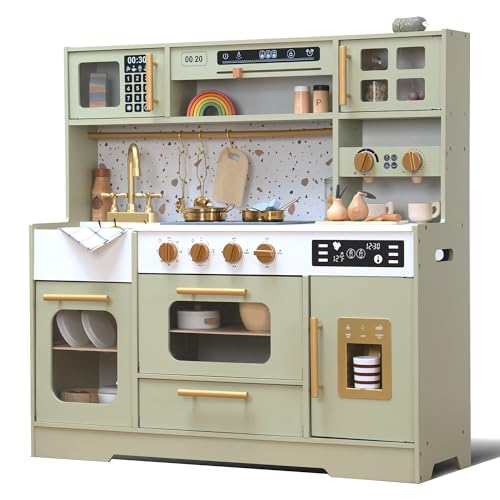 bpmfkid Wooden Play Kitchen Set, 35 inches
|
7.4/10 | Buy | |
| Top Rated |
 Kinder King Wooden Play Kitchen, 39 inches
|
7.3/10 | Buy | |
 ROBUD Wooden Play Kitchen, Bean Green, 31.3 x 11.6 x 34.7 in
|
7.1/10 | Buy | ||
 bpmfkid Wooden Play Kitchen, 91cm with 15 Accessories
|
7.0/10 | Buy | ||
 LACCHOUFEE Wooden Play Kitchen, 38"L x 35"H with 41 Accessories
|
6.9/10 | Buy | ||
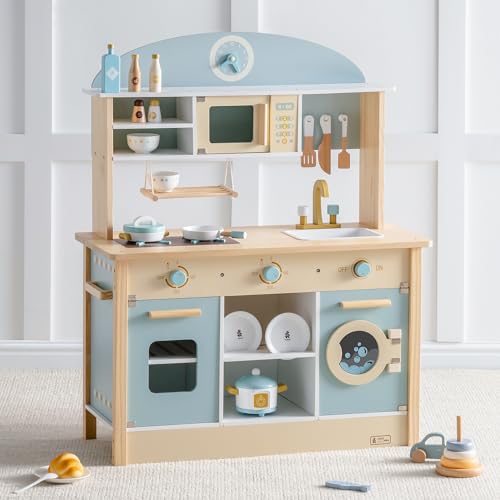 ROBUD Wooden Play Kitchen Set, 31 x 14 x 38 inches
|
6.8/10 | Buy |
Tiny Land Wooden Play Kitchen, 31.89 x 31.5 inches
A natural wood play kitchen with multiple functional stations including stovetop, sink, microwave, and coffee bar to encourage imaginative role play and basic life skills learning. Built from durable, non-toxic materials with interactive features like clicking knobs and a turning faucet.
Pros
- Well-designed layout mirrors a real kitchen, supporting realistic role play and learning
- Comprehensive feature set in one unit reduces need for separate accessories
- Sturdy construction with smooth, rounded edges for safety
- Built-in storage helps keep play area organized
- Non-toxic materials and safety certifications provide parent peace of mind
Cons
- No verified buyer reviews available yet to confirm durability and assembly ease claims
- Compact footprint (9.5 inches deep) may limit play space in smaller rooms
- Accessories and play food not included, requiring additional purchase
Step2 Fun with Friends Kids Kitchen Playset, Indoor/Outdoor Kitchenette, Interactive Play with Lights and Sounds, Durable Plastic, Includes 25 Piece Toy Accessories, Toddlers 2+ Years Old, Pink
bpmfkid Wooden Play Kitchen Set, 35 inches
A green wooden kitchen playset sized for toddlers ages 3 and up, featuring a stove, sink, coffee maker, ice maker, and 15 accessories to encourage imaginative cooking play. Constructed from durable wood with child-safe paint and designed with storage shelves to develop organizational habits alongside fine motor skills.
Pros
- Realistic interactive details like working faucet and glowing stove enhance immersive play experience
- Integrated storage teaches children organization and responsibility through tidy habits
- Durable wood construction with safety certifications provides long-term durability
- Open-ended design supports creative storytelling and hands-on learning
Cons
- No verified buyer reviews available to confirm assembly difficulty or durability claims in practice
- 35.4-inch height and overall footprint requires significant dedicated floor space
- Relatively small play surface depth of 11.8 inches may limit simultaneous multi-child play
Kinder King Wooden Play Kitchen, 39 inches
A multifunctional wooden play kitchen with realistic appliances including microwave, oven, fridge, and washing machine. Features a paintable acrylic backboard, stainless steel cookware accessories, and removable sink, designed for creative pretend play in homes and educational settings.
Pros
- Comprehensive feature set with realistic appliance details and working mechanisms
- Durable MDF construction rated as safe for extended play
- Paintable surface encourages creativity while remaining easy to clean with damp cloth
- Removable sink component simplifies maintenance and setup
- Ample storage for organizing toys and accessories
Cons
- Substantial at 44 pounds and 39 x 35.2 inches, requiring significant floor space
- No verified buyer reviews available to assess real-world durability or build quality
- 4.8 rating appears based on zero submitted customer reviews, limiting confidence in assessment
ROBUD Wooden Play Kitchen, Bean Green, 31.3 x 11.6 x 34.7 in
A feature-rich wooden play kitchen with eight interactive functions including refrigerator, ice maker, coffee machine, and dishwasher. The bean green design with gold accents appeals to preschoolers and early elementary kids seeking imaginative kitchen play.
Pros
- Comprehensive feature set encourages extended creative play and role-playing scenarios
- Premium materials and careful craftsmanship throughout, reflecting ROBUD's quality standards
- Portable design with side handles makes moving and repositioning practical
- Smooth construction eliminates sharp edges and safety hazards for young children
- Attractive green and gold color scheme fits modern play spaces and decor
Cons
- No verified buyer reviews available yet to assess real-world durability and user experience
- Substantial weight of 37.5 pounds may require adult assistance for frequent relocation despite handles
- Eight different functions could overwhelm younger children or create maintenance complexity for parents
bpmfkid Wooden Play Kitchen, 91cm with 15 Accessories
A spacious wooden play kitchen designed for collaborative pretend play among multiple children, featuring interactive elements like light-up stove and clicking oven, plus 15 included accessories. Built from certified non-toxic wood and sized to accommodate group playdates while developing motor skills and social confidence.
Pros
- Spacious footprint encourages group play and social interaction
- Certified non-toxic wood with smooth, rounded edges meets strict safety standards
- Interactive features (light-up stove, clicking oven) add sensory engagement
- Comprehensive accessory set reduces need for separate purchases
- Includes assembly tools and video instructions for straightforward setup
Cons
- No verified buyer reviews available to assess real-world durability and assembly difficulty
- Large size requires significant floor space and may not suit compact play areas
- White finish may show dirt and stains during active play
LACCHOUFEE Wooden Play Kitchen, 38"L x 35"H with 41 Accessories
A spacious wooden play kitchen designed for multiple children with realistic appliances like a working faucet, ice maker, and microwave. Comes with 41 food and cookware pieces to encourage imaginative role-play and motor skill development for ages 3-8.
Pros
- Spacious countertop and realistic feature set spark extended imaginative play
- Complete accessory bundle eliminates need for separate purchases
- Meets rigorous U.S. and EU safety standards with smooth edges and child-safe finishes
- Large size benefits multiple children or group settings like daycares
Cons
- No verified buyer reviews available to confirm assembly difficulty or durability in real-world conditions
- Size may require significant playroom space and could be challenging to relocate
- Dimension discrepancies noted in product specs (38L x 35H vs. 43L x 40H vs. 12 x 38 x 35 inches)
ROBUD Wooden Play Kitchen Set, 31 x 14 x 38 inches
A solid wood play kitchen designed for toddlers and preschoolers with realistic features like turning knobs and clicking sounds. Built for imaginative role-play and fine motor skill development, though it comes with no verified buyer feedback to validate durability claims.
Pros
- Solid wood build promises longevity for active play
- Interactive knob mechanism adds sensory engagement to pretend cooking
- Compact footprint compared to full-size play kitchens
- Encourages creative role-play and fine motor development
Cons
- No verified customer reviews available to confirm construction quality or assembly difficulty
- 4.8 rating appears to lack substantiation without review data
- Heavy at 38.6 pounds, making relocation or cleaning underneath challenging
Toy Kitchen Sets Buying Guide
Choosing among the best toy kitchen sets comes down to more than looks. Build material, realistic play features, size, and what accessories are included all shape how much a child actually uses the set over time.
The subsections below walk through each key criterion so you can prioritize what matters most for your household.
Wood vs. Plastic Construction

Material choice affects durability, aesthetics, and weight. Solid or MDF-core wooden sets tend to feel more substantial, hold up better to years of daily use, and blend more naturally into living room or bedroom decor.
Brands like Tiny Land, ROBUD, and Kinder King have invested heavily in wood-based construction with child-safe finishes, which is why several of our picks come from those lines.
Plastic sets, on the other hand, are often lighter and easier to wipe clean, which makes them practical for outdoor or garage play.
Step2’s Fun with Friends Kitchen is a good example: its durable molded plastic survives weather exposure and rough handling that would chip a painted wood panel.
The trade-off is that plastic sets can feel hollow or tip more easily if a toddler leans on them, so check that the base is wide and stable regardless of material.
Whichever material you choose, look for non-toxic finishes certified under ASTM F963 or EN71 standards. Reputable brands publish this information in their product listings.
Verified buyers frequently call out paint chipping as a negative in lower-quality wooden sets, so it is worth checking recent reviews before committing.
Size and Footprint

Toy kitchens come in a wide range of heights and widths. A set that looks compact in a product photo can dominate a small bedroom once assembled.
Before ordering, measure the intended wall space and compare it against the assembled dimensions listed in the specification table, keeping a few inches clear on each side so the child can move around comfortably.
Height matters especially for toddlers. Sets that sit at counter height for a two-year-old will feel low for a five-year-old, so adjustable-leg designs are a meaningful feature for families who want the kitchen to grow with their child.
Some Tiny Land models, for example, include multiple height settings that extend the usable life of the set by a year or two.
If space is genuinely tight, consider a corner-format kitchen or a two-in-one unit that pairs a stove with storage on a narrower base.
Compact sets also tend to be lighter, which matters if you plan to move it between rooms or pack it away during holidays.
Pair the kitchen with smart utensil holders nearby so accessories stay organized without cluttering the floor around the set.
Realistic Play Features
The features that most consistently extend play sessions are those that mimic a real kitchen: clickable knobs, open-and-close oven or refrigerator doors, a working faucet or running-water sink simulation, and at least some form of sound or light feedback.
Research into child development consistently shows that realistic detail invites more sustained imaginative play than abstract shapes, particularly for children between three and six.
Light-and-sound stovetops, like the interactive panel on the Step2 Fun with Friends Kitchen, encourage role play by giving an audible cue when a burner is activated.
Ice makers, coffee machines, and dishwashers, featured on some of the ROBUD sets in our lineup, add variety so the play kitchen does not feel repetitive after the first week.
That said, sound features depend on batteries; check whether the set ships with them or requires a separate purchase.
Verified buyers often note that the most used features are the simplest ones: rotating knobs, a door that opens with a satisfying click, and a pot or pan that sits level on the burner.
Flashy electronic add-ons are a bonus, but basic mechanical interactivity is the foundation of lasting play value.
Accessories and Play Food Included

Accessory count is not the same as accessory quality.
A set advertised with 50 pieces that includes dozens of identical plastic fruit slices delivers less play variety than a thoughtfully curated 15-piece set with a pot, pan, spatula, plates, cups, and a few realistic food items.
Assess the accessory list by type diversity, not raw count.
Among our picks, the LACCHOUFEE wooden kitchen ships with 41 pieces of food and cookware, while bpmfkid’s Montessori-inspired models include a more curated 15-piece kit.
Parents in verified reviews who bought sets with large accessory bundles occasionally report that smaller pieces become choking hazards or go missing quickly. If the child is under three, prioritize larger accessories and check minimum age guidance carefully.
Complement the kitchen with age-appropriate building block sets to round out open-ended creative play in the same space.
Storage is also part of the accessory equation. Sets with integrated shelving, hooks, or pull-out drawers make it easier for children to tidy up independently, which early-childhood educators consistently flag as a developmental benefit of toy kitchen play.
Look for at least one dedicated shelf or drawer in whatever set you choose.
Age Appropriateness and Safety
Most full-size toy kitchens carry a minimum age recommendation of three years, largely because of small accessory parts. Toddler-targeted sets (ages one to two) are typically simpler, have chunky accessories, and sit lower to the ground.
Buying above the age recommendation is usually fine since kids grow into features, but buying below it can mean unused or unsafe accessories.
Structural stability is the primary safety concern with larger sets. Check that the assembled unit does not rock when a child pushes against it from the front. Anti-tip hardware or a wide base footprint addresses this.
Verified buyers for several wooden sets in our list note that proper assembly, following the included instructions carefully, is critical to achieving full stability. Loose screws or skipped steps are cited repeatedly in low-rated reviews as the cause of wobbling.
Paint and finish safety certification is non-negotiable. Reputable brands submit their products for independent third-party certification. If a product listing does not mention any safety certification, treat that as a red flag.
A baby monitor in the play area is also a practical addition for parents of very young toddlers who want to keep an eye on early kitchen play without hovering in the room.
Assembly Complexity and Ongoing Maintenance

Full-size wooden toy kitchens typically require 45 minutes to 2 hours to assemble. Most brands include a hex key and numbered hardware bags, but quality of instruction manuals varies considerably.
Verified buyers across multiple sets in this guide highlight clear diagrams as one of the biggest factors in a smooth assembly experience. If you are ordering as a gift, build in time to assemble before wrapping.
Maintenance is straightforward for both wood and plastic: wipe surfaces with a damp cloth and mild soap, avoid soaking wooden panels, and periodically check that screws and joints remain tight.
Wooden sets with a lacquer or sealed finish resist staining better than those with a raw-wood aesthetic.
Several parents in long-term verified reviews note that sets they purchased three or more years ago still look presentable with minimal upkeep, which supports the durability case for mid-range wooden designs.
Why You Should Trust Us
ProductFind is an independent review publication. We do not sell any of the products we evaluate, and we have no relationship with manufacturers beyond the standard affiliate programs disclosed below.
Every product in this guide was assessed using a consistent research framework: we analyze published specifications, synthesize expert review consensus from credible third-party sources, and evaluate verified buyer feedback drawn from thousands of real-world purchases.
We do not conduct our own product trials; our evaluations are grounded in research, published data, expert review consensus, and verified buyer feedback.
Each product is assigned a PF Score on a scale of 0 to 10. The score reflects a weighted combination of build quality, play value, safety documentation, accessory completeness, assembly experience, and value relative to price.
Products are ranked in descending PF Score order so the strongest overall options appear first. Scores are reviewed periodically as new buyer feedback accumulates or manufacturers update their products.
ProductFind may earn a commission when you purchase through links in this article. That affiliate relationship has no influence on which products are included, how they are ranked, or what scores they receive.
Our editorial recommendations are determined solely by research quality and PF Score, not by commission rates.
Final Thoughts
After evaluating the full field of toy kitchen sets across construction quality, play features, safety documentation, accessory value, and real-world durability feedback, eight sets rose to the top. Each earns a distinct recommendation based on what it does best.
- Best Overall: Tiny Land Wooden Play Kitchen for Toddlers earns the top spot with the highest PF Score in the group, combining solid wood construction, Montessori-aligned design principles, and consistently praised build quality from verified buyers.
- Best Interactive Features: Step2 Fun with Friends Kids Kitchen Playset stands out for its lights-and-sounds stovetop, durable outdoor-ready plastic, and a generous 25-piece accessory bundle that gets children cooking from day one.
- Best Montessori-Inspired Design: bpmfkid Kids Wooden Play Kitchen Set with Stove, Sink, Coffee Maker and Ice Maker brings a curated accessory set and intentional feature layout that aligns well with child-led, open-ended play philosophies.
- Best Budget-Friendly Wooden Pick: Kinder King Wooden Kids Play Kitchen Set delivers a clean white finish and solid cookware accessories at a more accessible price point, making it an excellent entry-level wooden option.
- Best All-Appliance Feature Set: ROBUD Play Kitchen Set with Ice Maker, Fridge, Coffee Machine, Oven, Dishwasher and Microwave packs the widest variety of simulated appliances into a single unit, keeping imaginative scenarios fresh for longer.
Whichever set you choose, a toy kitchen is an investment in years of creative, social, and developmental play.
If your child is also drawn to construction play, pairing the kitchen with age-appropriate toy cars or other open-ended play items keeps the playroom engaging across different moods and play styles.
Frequently Asked Questions
What age is best to introduce a toy kitchen set?
Most full-size toy kitchens are designed for children aged three and up, primarily because the accessory pieces that come with them are sized for older toddlers. Simplified sets with chunky, oversized accessories are available for children from about 18 months.
As a general rule, matching the set’s minimum age recommendation to your child’s current developmental stage is safer than going significantly younger in hopes that they will grow into it quickly.
Are wooden toy kitchens worth the higher price compared to plastic ones?
For most families, yes. Wooden sets tend to last longer, withstand heavier daily play without cracking or fading, and hold resale value better if you choose to pass them on.
The durability advantage is especially pronounced for mid-range wooden sets from established brands. Plastic sets earn their place when the play environment includes outdoor use, high humidity, or very rough handling, where wood finishes would deteriorate faster.
How long does a toy kitchen set typically take to assemble?
Assembly time for full-size wooden toy kitchens ranges from about 45 minutes for simpler two-panel designs to two hours or more for multi-appliance sets with separate refrigerator, microwave, and oven compartments.
Verified buyers consistently report that following the instruction manual step by step, rather than improvising, is the most reliable way to achieve a sturdy, wobble-free result. Most sets include all necessary hardware and a hex key.
What safety certifications should I look for on a toy kitchen set?
In the United States, look for compliance with ASTM F963, the standard Consumer Product Safety Commission specification for toy safety. European-market products should carry EN71 certification. Both standards cover paint and finish toxicity, structural stability, and small-parts hazards.
Reputable brands include certification details in their product listings or packaging. If a listing makes no mention of any safety standard, that is worth treating as a caution signal before purchasing.
How many accessories do children actually need with a toy kitchen?
Quality and variety matter far more than raw count.
A set with 12 to 20 well-chosen pieces, covering at least one pot, one pan, a spatula or ladle, plates, cups, and a few food items, provides more meaningful play than a 50-piece bundle of repetitive fruit slices.
Children tend to gravitate toward accessories that mirror what they see adults using in a real kitchen.
Starting with a curated core set and adding supplementary play food separately as the child’s interests develop is a practical approach many parents recommend.
Can a toy kitchen set be used outdoors?
Plastic toy kitchens, particularly those from Step2, are explicitly designed for indoor and outdoor use and resist moisture and UV exposure well.
Wooden sets are generally not recommended for prolonged outdoor use because moisture causes paint to peel and wood panels to warp over time.
If you want a kitchen for a patio, garage, or yard, choose a model specifically rated for outdoor environments and keep it covered or stored indoors when not in use.
Families who want matching outdoor and indoor play zones often find that remote control cars and other outdoor-friendly toys pair naturally with a weather-resistant kitchen setup in a backyard play area.
About the author
Marcia is a reviewer and writer for ProductFind who specializes in Kids Toys. Marcia evaluates products through independent research: specifications, expert review consensus, and verified buyer feedback, and rates each one on the PF Score. Marcia focuses on helping readers pick the right kids toy for their needs and budget.