The 10 Best Oscilloscopes
Bandwidth, memory depth, channel count, and display quality all shape which oscilloscope actually fits your workflow. Here are the strongest picks across every tier.
 By Noelle Gray
Updated July 23, 2026
By Noelle Gray
Updated July 23, 2026
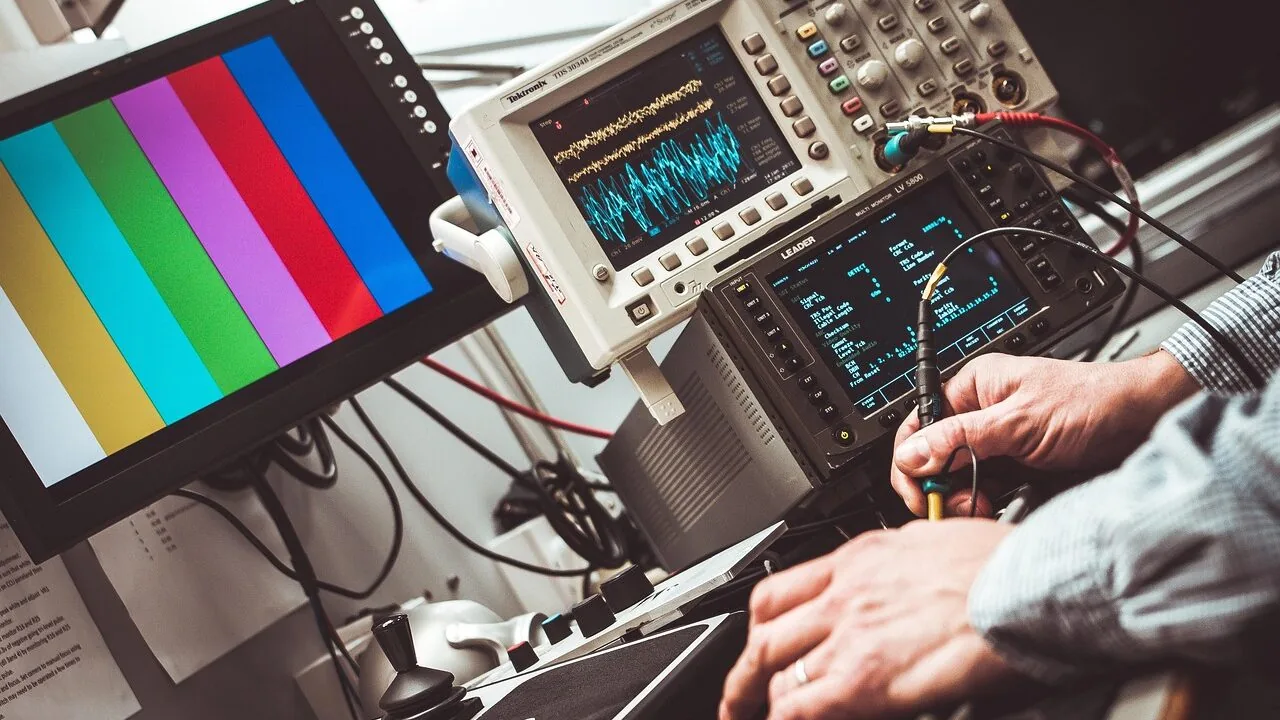
Oscilloscopes are among the most versatile instruments in any electronics toolkit, giving engineers, hobbyists, and technicians a real-time window into the electrical signals that make modern circuits work.
Whether you are debugging a microcontroller, characterizing a power supply, or learning the fundamentals of signal analysis, the right oscilloscope transforms hours of guesswork into minutes of clarity.
The market today spans a wide range: from compact handheld units that double as multimeters and signal generators, to high-bandwidth bench instruments with large touch displays and deep memory that rival professional lab setups.
Navigating those options without clear guidance wastes both time and money.
This guide cuts through the noise by synthesizing manufacturer specifications, expert review consensus from engineering publications, and verified buyer feedback gathered across thousands of real-world purchases.
ProductFind’s researchers compared ten models across bandwidth, sampling rate, memory depth, display quality, trigger capability, and overall value before assigning each a PF Score on our 0 to 10 scale.
The result is a ranked list of the best oscilloscopes available right now, covering every major use case from classroom education to professional field diagnostics. Scroll down to see our top picks.
| Award | Product | PF Score About PF ScoreThe PF Score is our own rating from 0 to 10, based on performance, design and build, ease of use, and value. It reflects independent research and is never influenced by manufacturers, retailers, or affiliate commissions. Learn more › | Price | |
|---|---|---|---|---|
| Best Overall |
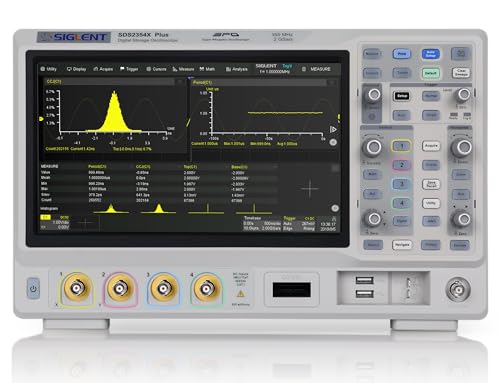 Siglent SDS2204X Plus 200 MHz 4-Channel Oscilloscope
|
8.7/10 | Buy | |
| Editor's Pick |
 Rigol DS1104Z Plus 100 MHz 4-Channel Digital Oscilloscope
|
8.3/10 | Buy | |
| Best Value |
 Rigol DS1054Z 50 MHz 4-Channel Oscilloscope
|
8.1/10 | Buy | |
| Top Rated |
 UNI-T UPO1202CS 200MHz Digital Oscilloscope
|
7.9/10 | Buy | |
 Rigol DS1202Z-E 200 MHz Digital Oscilloscope
|
7.8/10 | Buy | ||
 Hantek DSO2D15 150MHz 2-Channel Oscilloscope
|
7.2/10 | Buy | ||
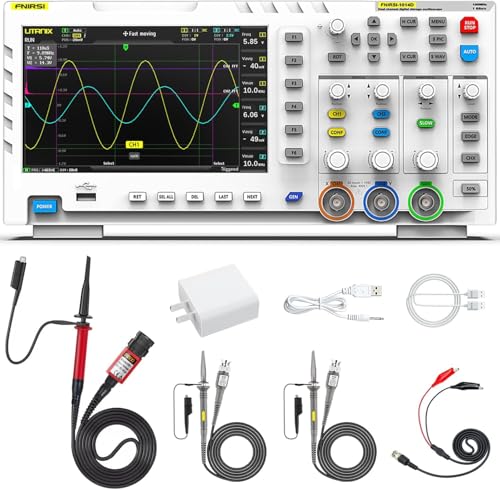 FNIRSI 1014D 100MHz 2-Channel Oscilloscope with DDS Generator
|
6.1/10 | Buy | ||
 FNIRSI 2C53T 50MHz Handheld Oscilloscope with Multimeter
|
5.3/10 | Buy | ||
 FNIRSI DSO-TC3 3-in-1 Handheld Oscilloscope
|
4.2/10 | Buy | ||
 FNIRSI DSO-510 10MHz Handheld Oscilloscope with Signal Generator
|
9.8/10 | Buy |
Siglent SDS2204X Plus 200 MHz 4-Channel Oscilloscope
A mid-range digital oscilloscope built for engineers and technicians who need solid performance without premium pricing. The 200 MHz bandwidth, 2 GSa/s sampling, and built-in serial bus decoding (I2C, SPI, UART, CAN, LIN standard) cover most lab and field troubleshooting tasks effectively.
Pros
- 200 MHz bandwidth with 4 channels and up to 2 GSa/s real-time sampling rate
- 200 Mpts record length enables extended waveform capture and detailed signal analysis
- High waveform capture rate (120,000 wfm/s normal, 500,000 wfm/s sequence mode) for reliable signal monitoring
- Serial bus triggering and decoding standard for I2C, SPI, UART, CAN, LIN with optional protocols
- 10.1 inch display provides adequate workspace for multi-channel analysis
Cons
- No verified user reviews available to assess real-world reliability and long-term performance
- Heavier at 2.2 pounds may limit portability for field service applications
- 200 MHz bandwidth is entry-level for RF and high-frequency signal work
Rigol DS1104Z Plus 100 MHz 4-Channel Digital Oscilloscope
A 4-channel, 100 MHz oscilloscope with 16 digital channels and 24 Mpts memory depth, designed for engineers and technicians needing multi-channel signal analysis. Includes bundled software and supports optional MSO upgrade for mixed-signal measurement.
Pros
- Supports both analog and digital channel measurement with optional MSO upgrade path
- Deep 24 Mpts memory enables detailed signal analysis over longer time windows
- Fast 30,000 waveforms per second capture rate reduces missed transient events
- Bundled software package adds value without extra cost
Cons
- No verified buyer reviews available to validate real-world performance claims
- Digital logic measurement requires separate RPL1116 connector purchase for full MSO capability
- 100 MHz bandwidth may be limiting for higher-frequency circuit analysis
Rigol DS1054Z 50 MHz 4-Channel Oscilloscope
A capable 50 MHz digital oscilloscope with 4 channels, 1 GSa/s sampling, and deep memory (24 Mpts) designed for electronics debugging, education, and embedded systems troubleshooting. Includes serial bus decoding (UART, I2C, SPI), high-speed waveform capture up to 30,000 wfms/s, and LAN connectivity for lab integration.
Pros
- High capture rate (30,000 wfms/s) with intensity grading reveals intermittent faults effectively
- Deep memory up to 24 Mpts in single-channel mode supports extended signal observation
- Built-in serial protocol decoding (RS232, I2C, SPI) streamlines embedded system debugging
- Waveform recording and playback (60,000 frames) enables post-capture anomaly analysis
- Multiple connectivity options (USB, LAN/LXI, AUX output) support remote operation and documentation
Cons
- 7-inch display at 800x480 resolution is modest by current standards, limiting detail visibility during dense waveform analysis
- No verified buyer reviews available to assess real-world reliability and user experience
- 50 MHz bandwidth may be limiting for higher-frequency digital or RF debugging applications
UNI-T UPO1202CS 200MHz Digital Oscilloscope
A dual-channel 200MHz oscilloscope with 1GSa/s sampling and 56Mpts memory depth, designed for engineers needing deep waveform storage and remote web-based control. The Ultra Phosphor display and FFT spectrum analyzer suit frequency domain analysis work.
Pros
- High memory depth (56Mpts) enables capture of long signal sequences without gaps
- Web-based remote control removes dependency on software installation
- 256 gray level display provides clear detail for complex waveform observation
- Bundled with probes and calibration report, ready for immediate use
- FFT capability adds frequency domain analysis without separate equipment
Cons
- No user reviews available to verify real-world performance and reliability claims
- Dual-channel configuration limits simultaneous multi-signal testing compared to 4-channel models
- Requires internet connectivity for remote operation, adding setup complexity
Rigol DS1202Z-E 200 MHz Digital Oscilloscope
A 2-channel, 200 MHz oscilloscope designed for electronics debugging and education labs, featuring deep memory up to 24 Mpts and serial bus decoding for UART, I2C, and SPI. Fast waveform capture at 30,000 frames per second and hardware recording of up to 60,000 frames help identify intermittent glitches and capture long transients.
Pros
- High waveform capture rate reveals intermittent glitches effectively
- Large deep memory enables longer signal captures at full sample rate
- Built-in serial protocol decoding simplifies embedded system troubleshooting
- Intensity graded display provides phosphor-like jitter and noise visualization
- Multiple connectivity options including LAN for remote operation
Cons
- Limited to 2 analog channels, restricting multi-signal simultaneous analysis
- No verified user reviews available to assess real-world reliability
- 7-inch display resolution at 800x480 is modest by modern standards
Hantek DSO2D15 150MHz 2-Channel Oscilloscope
Budget-friendly digital oscilloscope with 150MHz bandwidth and dual channels, designed for engineers and educators working on embedded systems and communications projects. Includes integrated waveform generator and multiple trigger modes for practical troubleshooting.
Pros
- Dual-channel configuration suitable for comparative signal analysis
- Integrated waveform generator eliminates need for separate signal source
- Serial protocol trigger and decode support reduces manual analysis time
- Economy pricing makes it accessible for education and small projects
Cons
- No verified buyer reviews available to assess real-world reliability
- 150MHz bandwidth limits use on higher-frequency applications
- Limited information on software interface and ease of use
FNIRSI 1014D 100MHz 2-Channel Oscilloscope with DDS Generator
A dual-function 100MHz oscilloscope paired with a DDS signal generator, targeting hobbyists and technicians who need basic waveform analysis and signal generation in one device. The 7-inch LCD display, 1GSa/s sampling rate, and built-in storage make it practical for lab work, though the lack of verified buyer feedback leaves performance durability uncertain.
Pros
- Dual functionality reduces need for separate instruments
- Adaptive auto-trigger simplifies initial signal capture
- Cursor measurement provides direct parameter readout without conversion
- FFT and Lissajous analysis useful for signal characterization
- Includes 100X high voltage probe for expanded measurement range
Cons
- No verified buyer reviews available to confirm real-world reliability
- Limited channel count (2 channels) compared to mid-range oscilloscopes
- 100MHz bandwidth sits at entry-level; inadequate for high-frequency work
FNIRSI 2C53T 50MHz Handheld Oscilloscope with Multimeter
A compact 3-in-1 device combining a 50MHz, 2-channel oscilloscope with a 19999-count multimeter and signal generator. Built for technicians, students, and hobbyists who need portable bench capabilities without breaking the bank.
Pros
- Genuine multi-functionality eliminates need for three separate instruments
- Adequate 50MHz bandwidth and 250MS/s sampling for hobby and educational electronics work
- Solid battery life with USB charging convenience
- Waveform save and comparison features enable better troubleshooting workflow
- Support for 13 different signal generator waveforms up to 50kHz
Cons
- No verified buyer reviews available yet, limiting real-world reliability data
- 1Kpts record depth is shallow compared to professional oscilloscopes, restricting detailed waveform analysis
- 2.8-inch display may feel cramped for detailed waveform inspection during extended use
FNIRSI DSO-TC3 3-in-1 Handheld Oscilloscope
A compact multi-function device combining digital oscilloscope, DDS signal generator, and transistor tester in one unit. Built around a 2.4-inch display with 10 MS/s sampling and 500 kHz bandwidth, it suits technicians and hobbyists who need portable component diagnostics alongside basic signal measurement.
Pros
- Consolidates multiple test functions into a single handheld unit, reducing tool clutter
- Automatic pin detection and transistor analysis streamline component identification
- One-key AUTO setup eliminates manual adjustment complexity for periodic signals
- Support for NEC infrared protocol analysis and temperature/humidity sensor measurement extends diagnostic range
- Rechargeable battery enables field use without external power
Cons
- 500 kHz bandwidth and 10 MS/s sampling rate limit capability for higher-frequency signals compared to benchtop oscilloscopes
- No user reviews available to verify real-world reliability or usability claims
- Small 2.4-inch display may reduce visibility for detailed waveform analysis in bright environments
FNIRSI DSO-510 10MHz Handheld Oscilloscope with Signal Generator
A portable 2-in-1 oscilloscope and DDS signal generator designed for automotive and field diagnostics. Combines 10MHz bandwidth with 13 waveform output modes and long battery life, though limited to modest screen resolution and sampling capacity for advanced applications.
Pros
- 2-in-1 design eliminates need for separate oscilloscope and function generator
- Portable form factor and built-in battery enable field use without external power
- Auto-optimization and waveform scaling simplify setup for users of varying skill levels
- Capable of measuring high voltages (400V) suitable for automotive work
- Signal generator with 13 waveform types covers diverse testing scenarios
Cons
- 2.8-inch 320x240 resolution display limits detail visibility during complex signal analysis
- 10MHz bandwidth and 48MS/s sampling rate are modest for high-frequency or fast transient signals
- No verified buyer reviews available to assess real-world reliability or user satisfaction
Oscilloscopes Buying Guide
Choosing an oscilloscope is less about picking the highest headline spec and more about matching the instrument’s capabilities to your actual workflow.
A field technician diagnosing automotive signals has completely different needs from a student learning about waveforms, and both differ from an RF engineer validating a 200 MHz signal chain.
The six criteria below are the factors that matter most when you compare models, and they are the same criteria ProductFind’s researchers used to evaluate and score every pick in this list.
Bandwidth and Sampling Rate
Bandwidth is the single most cited specification in any oscilloscope comparison, and for good reason: it defines the highest-frequency signal the instrument can faithfully capture without significant amplitude roll-off.
As a practical rule, choose a scope whose bandwidth is at least three to five times the highest fundamental frequency you expect to measure, because real-world signals carry harmonics well above their fundamental.
A 50 MHz scope covers most low-speed serial buses and general-purpose analog work, while 200 MHz opens the door to faster digital designs, switching power supplies, and RF circuits.
Real-time sampling rate is directly tied to bandwidth.
The Nyquist theorem requires the sampling rate to be at least twice the bandwidth to avoid aliasing, but quality instruments typically sample at five to ten times bandwidth for more accurate waveform reconstruction.
Models in this guide from Rigol, Siglent, and UNI-T all publish both figures prominently, and their real-world waveform fidelity at rated bandwidth is well-documented in independent engineering reviews.
When evaluating budget options, pay attention to whether the advertised sampling rate applies to all channels simultaneously or only to a single channel, as many entry-level units halve the rate when both channels are active.
Memory Depth

Memory depth determines how many sample points the oscilloscope can store per acquisition, and it has a direct impact on how long a time window you can capture at full sampling rate without decimating the data.
Shallow memory forces the instrument to reduce its effective sampling rate the moment you zoom out the time base, which can cause you to miss fast transients buried inside a slow periodic event.
Deep memory oscilloscopes, such as those featuring Rigol’s UltraVision architecture with 24 Mpts storage, let you capture long time spans without sacrificing resolution.
For debug work involving serial protocols like UART, I2C, or SPI, deep memory is especially valuable because protocol packets can be spaced far apart in time while individual bit transitions are extremely fast.
Scopes with hardware serial decode built in, such as several Rigol models in this roundup, use that memory depth to correlate physical waveforms with decoded data annotations.
If you work regularly with embedded systems or communication buses, prioritize memory depth as highly as bandwidth when comparing specifications.
Number of Channels
Two-channel oscilloscopes cover the majority of analog measurement tasks, and they dominate the budget and mid-range segments of the market.
Four-channel models cost more but add enormous diagnostic power when you need to simultaneously monitor multiple signals, for example comparing input and output on both power rails of a differential circuit, or correlating four lines of a parallel bus.
The Rigol DS1054Z and the DS1104Z Plus are both four-channel instruments, which is a major reason they consistently rank highly in engineering community discussions despite the relatively modest bandwidth of the entry-level model.
Mixed-signal oscilloscopes add a bank of digital logic channels on top of the analog channels, letting you correlate analog waveforms with digital bus activity in a single view.
The Rigol DS1104Z Plus includes 16 digital channels, making it a full mixed-signal instrument at a mid-range price point.
If your work involves firmware debugging or board bring-up where you need to watch both a clock signal and a data bus at the same time, those extra channels pay for themselves almost immediately.
For pure analog work or learning, two channels is usually sufficient.
Display Quality and Waveform Update Rate

Display quality affects how quickly and accurately you can interpret what you are seeing, and it is especially important during long debug sessions.
Look for a minimum 7-inch display with a resolution of at least 800 by 480 pixels; the larger screens on premium instruments like the Siglent SDS2204X Plus feature 10.1-inch panels that make it significantly easier to read multiple channels simultaneously.
Intensity grading, sometimes marketed as phosphor or ultra-phosphor display technology, adds brightness variation to indicate signal frequency of occurrence, making intermittent glitches visually obvious in a way that traditional monochrome traces cannot achieve.
Waveform update rate, measured in waveforms per second (wfms/s), determines how often the display refreshes. A high update rate, typically 30,000 wfms/s or more, reduces the dead time between acquisitions and improves the probability of catching rare events.
The UNI-T UPO1202CS stands out here with a published rate of 500,000 wfms/s, one of the highest figures in its price class.
For general-purpose work the difference between 30,000 and 500,000 wfms/s may be invisible, but for capturing infrequent glitches on power supplies or automotive signals it can be the difference between seeing a fault and missing it entirely.
Built-in Analysis and Protocol Decode

Modern oscilloscopes do far more than display voltage over time. Built-in measurement functions for frequency, period, rise time, fall time, duty cycle, and amplitude statistics are standard on every model above the basic handheld tier.
What separates the more capable instruments is hardware-accelerated serial protocol decode: the ability to interpret UART, I2C, SPI, CAN, and LIN bus traffic directly on the screen, overlaying decoded bytes onto the waveform.
This feature alone can compress a multi-hour debug session into a few minutes when you are chasing a firmware communication bug.
FFT (Fast Fourier Transform) spectrum analysis is another feature worth verifying before you buy. It converts the time-domain waveform into a frequency-domain view, which is invaluable for diagnosing power supply noise, audio interference, or unwanted oscillations.
Most bench scopes in this guide include FFT as a standard function.
If you are also looking for a audio signal reference for acoustic measurements, pairing an oscilloscope’s FFT mode with a quality playback source gives you a surprisingly capable measurement environment for speaker and amplifier diagnostics.
Look for FFT window options (Hanning, Blackman-Harris, Flat Top) as a sign of measurement-grade implementation rather than a cosmetic feature.
Form Factor: Bench vs. Handheld

Bench oscilloscopes sit on a workbench and draw power from the wall outlet. They offer the largest displays, deepest memory, highest bandwidth, and most comprehensive feature sets for the price.
Every Rigol, Siglent, and UNI-T model in this guide is a bench instrument, which is why they score higher on our PF Scale than their handheld counterparts.
If you have a fixed workspace and work primarily at a bench, this is almost certainly the right category.
Handheld oscilloscopes, like several of the FNIRSI models included here, trade raw performance for portability and versatility.
The FNIRSI 1014D, 2C53T, and DSO-510 all combine oscilloscope functionality with a built-in signal generator, and some add a multimeter as well, making them practical all-in-one tools for field service, automotive diagnostics, and on-site troubleshooting.
Their bandwidth and memory depth are more limited than bench instruments in the same price range, so they are best understood as portable diagnostic aids rather than replacements for a full bench setup.
For technicians who spend most of their time away from a fixed workbench, a capable handheld unit often provides better value than a high-spec bench scope that never leaves the shelf.
If you work across multiple site types, pairing a portable scope with a reliable portable power source ensures you are never without measurement capability in the field.
Why You Should Trust Us
ProductFind is an independent editorial review platform. We do not sell any of the products we cover, and we have no involvement in order fulfillment, warranty service, or customer support for any item listed here.
Every recommendation on this page is the output of a structured research and evaluation process, not a sales pitch.
Each oscilloscope in this guide was assessed against a consistent set of criteria: bandwidth, real-time sampling rate, memory depth, channel count, display quality and waveform update rate, built-in analysis features, serial decode capability, build quality, and value relative to the competitive set.
We do not conduct our own product trials; our evaluations are grounded in research, published data, expert review consensus, and verified buyer feedback. Sources include manufacturer-published specifications, engineering and maker-community forum discussions, and aggregate buyer feedback from verified purchasers.
Each product receives a PF Score on a 0 to 10 scale, where scores above 8.0 represent strong all-around performance and scores below 6.0 indicate meaningful limitations relative to the category.
ProductFind may earn an affiliate commission if you purchase through links on this page. That commercial relationship has no influence on our rankings, scores, or editorial selections.
Products are ranked on the merit of our research findings, and the affiliate arrangement is disclosed here in full for transparency.
Final Thoughts
After synthesizing specifications, expert review consensus, and thousands of verified buyer responses, the oscilloscopes in this guide represent the strongest options available across every major use case in 2026. Here is how we would summarize the standout picks:
- Best Overall: SIGLENT SDS2204X Plus earns the top overall position with the highest PF Score in the group. Its 200 MHz bandwidth, 2 GSa/s sampling rate, 200 Mpts memory, and large 10.1-inch super phosphor display set a benchmark that no other model in this roundup matches across all dimensions simultaneously. It is a premium bench instrument suited for professionals and serious hobbyists who need headroom for demanding signal environments.
- Best Mid-Range Pick: Rigol DS1104Z Plus delivers exceptional breadth of capability at a mid-range price. Four analog channels plus 16 digital logic channels make it a genuine mixed-signal oscilloscope, and its strong PF Score reflects well-documented performance in engineering community evaluations. It is the instrument most commonly recommended for students transitioning from coursework to professional-level debugging.
- Best Value Bench Scope: Rigol DS1054Z has been a perennial favourite among electronics enthusiasts for years, and it remains one of the most recommended entry points into four-channel bench oscilloscopy. Deep memory, hardware serial decode, and a proven UltraVision architecture make it punching above its weight class at a budget-friendly price point.
- Best for Field Service and Portability: FNIRSI 1014D combines a 100 MHz oscilloscope with a DDS signal generator in a handheld form factor with built-in 1 GB storage, making it one of the more capable portable options at its accessible price. Technicians who need a grab-and-go instrument for on-site diagnostics will find it a practical choice, with the understanding that its PF Score reflects the trade-offs inherent in the handheld category.
- Best Budget Desktop Option: Hantek DSO2D15 includes a built-in waveform generator alongside its 150 MHz dual-channel oscilloscope, offering a two-in-one bench setup at a price accessible to students and hobbyists who cannot yet justify a higher investment. Its PF Score acknowledges competitive value within the budget tier.
Whatever your application, buying an oscilloscope is one of the highest-leverage investments you can make in your electronics toolkit. A well-chosen scope pays dividends across every project you tackle from the moment it arrives on your bench.
Frequently Asked Questions
What bandwidth oscilloscope do I actually need?
For general hobby electronics, Arduino and Raspberry Pi projects, audio circuits, and low-speed serial buses (UART, I2C, SPI running at common microcontroller speeds), a 50 MHz to 100 MHz scope covers the vast majority of signals you will encounter.
If you work with switching power supplies, high-speed digital buses, or RF circuits in the sub-200 MHz range, step up to a 200 MHz model.
The practical guideline is bandwidth equal to at least three to five times your highest signal frequency of interest, to account for the harmonics that define signal shape.
Is a four-channel oscilloscope worth the extra cost over a two-channel model?
It depends heavily on your workflow. For single-ended analog measurements, audio work, and simple digital debugging, two channels are almost always enough.
The moment you need to correlate signals across multiple points simultaneously, such as monitoring all four lines of an SPI bus, checking both sides of a half-bridge, or comparing input-output phase relationships on a differential amplifier, the limitation of two channels becomes genuinely frustrating.
Four-channel models like the Rigol DS1054Z and DS1104Z Plus command a premium but repay it quickly for anyone doing systematic embedded systems work or multi-channel power electronics debugging.
Can a handheld oscilloscope replace a bench scope for professional use?
For field service, automotive diagnostics, and on-site troubleshooting, a quality handheld oscilloscope like the FNIRSI 1014D is genuinely useful and far more practical than carrying a bench instrument. However, handheld units trade screen size, memory depth, and bandwidth for portability.
For systematic bench debugging, prototype validation, or any measurement that benefits from a large display and deep waveform capture, a dedicated bench scope is meaningfully more capable.
Many professionals maintain both: a bench scope for the lab and a handheld for field work.
Just as a photographer might complement a camera with the right point-and-shoot for casual carry, a handheld scope serves as the portable companion to a more capable bench instrument.
What is serial decode and why does it matter?
Serial decode is hardware-accelerated firmware built into the oscilloscope that interprets raw voltage transitions on a wire as a recognized communication protocol, such as UART, I2C, or SPI, and overlays the decoded bytes directly onto the waveform display.
Without it, you read raw logic transitions and manually decode bytes from a datasheet, which is time-consuming and error-prone.
With it, you can visually confirm in seconds whether a microcontroller sent the correct address, whether an acknowledgment bit fired, or where a packet was corrupted.
For anyone working with embedded firmware or sensor integration, serial decode is not a luxury feature; it is a core productivity tool that substantially reduces debug time.
How important is the waveform update rate for everyday use?
For routine measurements on stable, repetitive signals, waveform update rate rarely matters: even a modest 10,000 wfms/s refresh is indistinguishable from 500,000 wfms/s when you are measuring a clean 1 kHz sine wave.
The update rate becomes critical when you are hunting intermittent faults: a reset glitch that occurs once every ten seconds, a dropout in a power rail, or a sporadic communication error.
A higher update rate reduces the dead time between acquisitions and increases the statistical probability of capturing a rare event on-screen.
If your work involves troubleshooting intermittent issues in production hardware or field-reported failures, prioritizing a high waveform update rate alongside deep memory is well worth the additional investment.
Are Rigol oscilloscopes good enough for professional engineering work?
Rigol instruments have earned a strong reputation in engineering communities over the past decade, and they appear in university labs, startup engineering teams, and independent maker workshops around the world.
Their UltraVision architecture delivers competitive memory depth and a capable measurement suite at price points significantly below comparable instruments from legacy premium brands.
The DS1054Z in particular is one of the most discussed and recommended entry-level professional instruments in online engineering forums.
For the majority of embedded systems, power electronics, and mixed-signal debugging tasks encountered in professional practice, Rigol scopes are more than adequate.
For specialized work at frequencies above 200 MHz or requiring calibration traceability for regulated industries, higher-tier instruments from premium brands may be more appropriate.
About the author
Noelle is a reviewer and writer for ProductFind who specializes in Test & Measurement. Noelle evaluates products through independent research: specifications, expert review consensus, and verified buyer feedback, and rates each one on the PF Score. Noelle focuses on helping readers pick the right test & measurement for their needs and budget.