The 10 Best Analytical Balances
Precision down to 0.1 mg separates a true analytical balance from an ordinary scale. Our research covers readability, calibration tech, and build quality across top picks from Ohaus and Bonvoisin.
 By Daniel Payne
Updated July 23, 2026
By Daniel Payne
Updated July 23, 2026
Precision matters more than almost any other variable in scientific measurement, whether you are formulating pharmaceutical compounds, calibrating reagents in a chemistry lab, or verifying the purity of a jewelry alloy.
Analytical balances occupy a different tier from ordinary digital scales because they resolve weight differences down to 0.1 mg or finer, making them indispensable wherever accuracy is not optional.
Choosing the wrong model can mean wasted reagents, failed audits, or results that simply cannot be reproduced.
This guide cuts through the noise by drawing on manufacturer specifications, expert review consensus across scientific-instrument publications, and verified buyer feedback from laboratory and industrial purchasers.
Our coverage spans precision-grade instruments from Ohaus and Bonvoisin at a range of readability levels and price points, so whether you need sub-milligram accuracy with a full draftshield or a rugged semi-analytical scale for high-capacity work, you will find a clear recommendation below.
| Award | Product | PF Score About PF ScoreThe PF Score is our own rating from 0 to 10, based on performance, design and build, ease of use, and value. It reflects independent research and is never influenced by manufacturers, retailers, or affiliate commissions. Learn more › | Price | |
|---|---|---|---|---|
| Best Overall |
 Ohaus PX84 Pioneer Analytical Balance 84g
|
9.1/10 | Buy | |
| Editor's Pick |
 Ohaus PX323 Pioneer 320g Analytical Balance
|
8.8/10 | Buy | |
| Best Value |
 Ohaus SPX2202 Scout 2200g Analytical Balance
|
8.2/10 | Buy | |
| Top Rated |
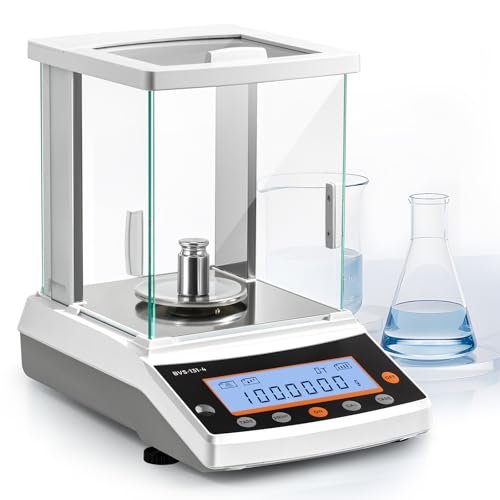 Bonvoisin 0.0001g Analytical Balance 120g Capacity
|
7.8/10 | Buy | |
 Ohaus SPX421 Scout Analytical Balance, 420g Capacity
|
7.5/10 | Buy | ||
 LACHOI 500g Analytical Balance 0.001g Precision
|
7.2/10 | Buy | ||
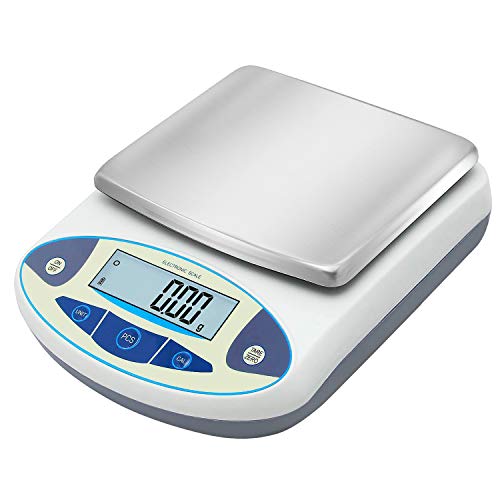 Bonvoisin 5000g Analytical Balance 0.01g Precision
|
7.1/10 | Buy | ||
 Bonvoisin 500g Analytical Balance 0.001g Precision
|
6.9/10 | Buy | ||
 UXILAII SCIENTIFIC 5000g x 0.01g Lab Scale
|
6.8/10 | Buy | ||
 Bonvoisin 600g Digital Lab Scale 0.01g Precision
|
4.8/10 | Buy |
Ohaus PX84 Pioneer Analytical Balance 84g
A precision analytical balance designed for laboratory and professional weighing applications, featuring 0.0001g readability across 17 measurement units. The integrated draftshield and internal calibration make it suitable for sensitive measurements in controlled environments.
Pros
- High precision 0.0001g readability suitable for analytical chemistry and material testing
- Extensive unit selection covers both common and specialized weighing needs
- Internal calibration and security bracket reduce calibration errors and prevent tampering
- Glass draftshield helps isolate measurements from air currents in laboratory settings
- Included AC adapter eliminates battery dependency for consistent power
Cons
- No user reviews available to validate real-world performance and durability
- Requires stable, level surface and controlled environment for optimal accuracy at 0.0001g resolution
- 3.54-inch pan size may limit sample dimensions for larger materials
Ohaus PX323 Pioneer 320g Analytical Balance
A precision analytical balance designed for laboratory and professional settings, offering 0.001g readability with internal calibration and a protective draftshield. The 2-line LCD display and multiple weighing units make it versatile for chemistry, pharmaceuticals, and jewelry applications.
Pros
- 0.001g precision meets analytical lab standards for most applications
- Built-in draftshield and metal base construction reduce measurement errors from air currents and vibration
- 18 unit options accommodate diverse professional industries without recalibration
- Internal calibration saves time versus external calibration procedures
- Stainless steel pan and security bracket enhance durability and prevent theft
Cons
- No verified user reviews available to confirm real-world reliability and longevity
- 320g capacity limits use to small-sample applications; not suitable for larger batches
- Requires AC power connection, reducing portability compared to battery-operated alternatives
Ohaus SPX2202 Scout 2200g Analytical Balance
The Ohaus SPX2202 is a top-loading analytical balance designed for laboratory and educational settings, offering a 2200g capacity with 0.01g readability. Compact and straightforward in design, it suits users who need reliable weighing without advanced connectivity features.
Pros
- High precision readability of 0.01g suitable for analytical work
- Compact and lightweight design for bench-top or portable use
- Established manufacturer with technical support resources
Cons
- No customer reviews available to verify real-world reliability or ease of use
- Limited feature set with no digital connectivity or advanced functions mentioned
- Specifications lack details on calibration method, pan material, or display type
Bonvoisin 0.0001g Analytical Balance 120g Capacity
A precision laboratory scale engineered for pharmacy, jewelry, and scientific applications with 0.0001g readability and multi-unit conversion. Best suited for users requiring consistent accuracy and data logging capabilities rather than casual kitchen weighing.
Pros
- High precision 0.0001g readability suitable for pharmaceutical and jewelry applications
- RS232 interface enables direct data transfer to computers for research documentation
- Percentage weighing and counting functions streamline repetitive lab and commercial tasks
- Multi-unit conversion eliminates need for separate scales or manual conversions
Cons
- 120g capacity is relatively low, limiting use for larger samples or materials
- No verified buyer reviews available to assess real-world durability and user experience
- Requires external setup and computer software for data logging functionality
Ohaus SPX421 Scout Analytical Balance, 420g Capacity
The Ohaus SPX421 is a compact analytical balance designed for laboratory and precision weighing applications up to 420 grams with 0.1 gram readability. Its space-saving footprint and dual voltage capability make it suitable for educational labs and small-scale analytical work.
Pros
- Precise 0.1 gram readability for analytical applications
- Compact dimensions (9.8 x 11.8 x 3.4 inches) fit tight lab spaces
- Dual voltage operation (115/230 VAC) supports multiple regions
- 420 gram capacity handles most routine lab samples
- Established Ohaus brand reputation for analytical instruments
Cons
- No verified customer reviews available to assess real-world reliability
- Limited documentation provided on calibration requirements or maintenance
- Compact size may require careful sample placement for accurate readings
LACHOI 500g Analytical Balance 0.001g Precision
High-precision lab scale designed for analytical work requiring 0.001g accuracy across 500g capacity. Features RS232 interface for data export and multiple unit conversions, making it suitable for laboratories, jewelry assessment, and scientific research.
Pros
- Excellent precision at 0.001g for analytical applications
- Direct data transfer capability via RS232 eliminates manual entry
- Multiple measurement units support diverse professional needs
- Built-in overload protection and fault detection
- Compact footprint suitable for lab benches with space constraints
Cons
- No verified buyer reviews available to confirm real-world performance and reliability
- Requires stable environment away from sunlight, temperature fluctuations, and magnetic interference, limiting placement flexibility
- RS232 interface is outdated technology compared to USB or wireless alternatives on newer models
Bonvoisin 5000g Analytical Balance 0.01g Precision
A laboratory-grade digital scale offering 0.01g accuracy across 8 selectable ranges up to 5000g, featuring a large stainless steel pan and 13 unit conversions. Best suited for labs, schools, and precision work in jewelry or powder measurement, though calibration weights are not included for the 5000g model.
Pros
- High precision 0.01g accuracy suitable for laboratory and professional applications
- Large weighing pan accommodates diverse materials from jewelry to powder
- Comprehensive unit conversion system for international or specialized use
- Built-in sensor and calibration features for reliable measurements
Cons
- 5000g model does not include calibration weights in package, requiring separate purchase
- No verified buyer reviews available to assess real-world durability and consistency
- Heavy unit may require stable, dedicated workspace for optimal accuracy
Bonvoisin 500g Analytical Balance 0.001g Precision
A compact lab scale offering 0.001g readability with dual AC/DC power options, ideal for jewelry, chemistry, and precision weighing tasks. The windshield reduces environmental interference, though the AC adapter is limited to 110V regions.
Pros
- Excellent precision at 0.001g readability, suitable for jewelry and laboratory work
- Flexible power options with both AC and 9V battery capability
- Windshield and stainless steel construction reduce measurement variability
- 13 unit modes provide flexibility across different weighing applications
- Large, clear LCD display readable even in low light
Cons
- AC power cable limited to 110V only, requiring separate 220V cable or battery operation in other regions
- No verified customer reviews available to confirm real-world reliability and durability
- Relatively heavy at 4.9 pounds, limiting portability for mobile lab work
UXILAII SCIENTIFIC 5000g x 0.01g Lab Scale
A mid-range analytical balance designed for laboratory, jewelry, and precision weighing applications. Offers 0.01g accuracy across a 5000g capacity with multiple unit conversions and standard lab features including tare, counting mode, and external calibration support.
Pros
- Consistent 0.01g precision across its range with adjustable calibration included
- Versatile unit conversions and multiple specialized functions (counting, percentage, tare) handle diverse weighing needs
- Durable construction using stainless steel pan, aluminum base, and strain gauge sensor
- Large LCD display provides clear readings in seconds with error indication
- One-year replacement guarantee from manufacturer
Cons
- No existing verified buyer reviews available to assess real-world reliability and consistency
- RS232 connection cable not included, requiring separate purchase for printer integration
- Heavy footprint at 30.4 x 20.4 x 9 inches may occupy significant bench space in smaller labs
Bonvoisin 600g Digital Lab Scale 0.01g Precision
A compact analytical balance designed for jewelry, scientific work, and precision weighing tasks up to 600 grams. It offers multiple unit conversions, a tare function, and dual power options, making it practical for users who need accuracy without premium pricing.
Pros
- 0.01g precision and fast response suitable for jewelry and gemstone weighing
- Multiple unit conversion modes eliminate need for manual calculations
- Flexible power options work with or without AC adapter
- Counting and tare functions streamline repetitive weighing tasks
- Energy-efficient auto-shutoff extends battery life
Cons
- Calibration weights sold separately, requiring additional purchase for proper setup
- AA batteries not included despite battery operation capability
- No verified customer reviews available to confirm real-world performance and durability
Analytical Balances Buying Guide
Selecting an analytical balance involves trade-offs that are very different from choosing a kitchen or shipping scale. The subsections below walk through every criterion that meaningfully separates a reliable instrument from one that will frustrate you within weeks.
Readability and Capacity

Readability, also called the scale division or “d” value, is the smallest increment an instrument can display. True analytical balances typically offer readability of 0.1 mg (0.0001 g) or 1 mg (0.001 g), while semi-analytical or precision balances read to 0.01 g.
Choosing the wrong readability for your application is the single most common purchasing mistake: a pharmaceutical formulation requiring milligram accuracy needs a 0.1 mg instrument, not one that resolves only to 10 mg.
Capacity and readability are inversely linked by design. High-capacity models rated at several kilograms inevitably sacrifice fine resolution, which is why a 5 000 g balance in this category reads to 0.01 g rather than 0.1 mg.
Before committing to a model, map your heaviest typical sample against the rated capacity, leaving at least 10 percent headroom. Overloading even once can permanently damage the weighing cell.
Calibration Technology
Calibration is what keeps a balance traceable to SI mass standards over time and across temperature changes.
External calibration balances require you to place a certified reference weight on the pan and trigger a calibration routine manually, which introduces operator variability and the ongoing cost of maintaining certified weights.
Internal calibration, also called FACT (Fully Automatic Calibration Technology) in Ohaus literature, uses a built-in reference mass and calibrates automatically when the instrument detects a temperature shift, saving time and reducing human error in regulated environments.
For ISO 17025 or GMP compliance, internal auto-calibration is strongly preferred because the calibration event is logged with a time stamp that satisfies audit trails.
Budget balances in the Bonvoisin and UXILAII SCIENTIFIC lines in this roundup use external calibration, which is acceptable for non-regulated work if you commit to a disciplined calibration schedule at the start of each session.
Draftshield Design and Environmental Protection
Air currents are the principal enemy of sub-milligram weighing. A well-engineered draftshield encloses the weighing chamber on all sides and uses sliding or hinged doors that minimise turbulence when you reach in to place a sample.
Glass or acrylic construction allows you to see the display without craning, and anti-static coatings matter especially when you are handling fine powders.
The Ohaus Pioneer PX series ships with a fully enclosed draftshield as standard, while lower-cost options often provide only a partial windshield that is adequate for 0.01 g work but marginal at 0.001 g.
Room environment also matters. Balances placed near HVAC vents, open windows, or high-traffic walkways will show erratic readings regardless of their rated resolution.
If your space is genuinely vibration-prone or poorly climate-controlled, consider a model with built-in vibration filtering, a feature called “environmental mode” or “stability filter” in most menus, and pair it with an anti-vibration table for the most demanding work.
Connectivity and Data Output

Modern laboratory workflows demand that measurement data flow directly into LIMS, spreadsheets, or printers without manual transcription. RS-232 serial output remains the most universal standard among laboratory instruments, and most balances in this roundup include it.
Some higher-end units add USB-A or USB-B ports for plug-and-play connectivity with modern PCs.
If your workflow involves a microscope imaging station or multi-instrument setup, confirming that both the balance and your data-capture software support the same protocol avoids costly surprises.
Beyond data logging, connectivity enables GLP/GMP-compliant printouts, which include the date, time, balance serial number, and result on each record.
Balances lacking any data port force you to transcribe readings by hand, a practice that regulatory bodies increasingly flag during audits. For any regulated lab, treat RS-232 or USB output as a minimum requirement, not a luxury feature.
Build Quality and Pan Material

A balance is long-term laboratory infrastructure, so construction quality affects both longevity and total cost of ownership. Stainless-steel pans resist corrosion from solvents, acids, and biological fluids and can be autoclaved where needed.
The housing should feel solid with no flex in the chassis, since a warping body misaligns the internal load cell.
Ohaus instruments in particular have a well-documented reputation for durable construction and service part availability, which matters if a balance sees daily use for a decade or more.
Budget models from Bonvoisin and UXILAII SCIENTIFIC use lighter polymer housings that are perfectly acceptable for occasional or educational use.
Verified buyers consistently note that these units perform well out of the box but may show drift sooner than Ohaus-class instruments in high-cycle production environments.
Match build quality to your expected daily usage rather than defaulting to the lowest price point.
Display, Usability, and Application Modes

A clear, backlit LCD that remains readable from a seated position reduces fatigue during long weighing sessions. Many analytical balances include onboard application modes such as parts counting, percent weighing, density determination, formulation, and animal weighing.
While these modes may sound peripheral, parts counting in particular can replace a separate dedicated counter in small manufacturing operations, improving value significantly.
Look for a leveling indicator, usually a bubble level with adjustable feet, on any 0.001 g or finer instrument. Even small tilts introduce a systematic offset that compounds across multiple measurements.
Levelness should be verified every time the balance is moved, not just at initial installation.
Some Ohaus Pioneer PX models include a “LevelMatic” feature that compensates for slight floor irregularities, a genuinely useful addition in older buildings where floors shift seasonally.
Why You Should Trust Us
ProductFind is an independent review platform with no manufacturer relationships that influence our rankings.
Every balance in this roundup was evaluated by comparing published specifications, analyzing expert review consensus from scientific-instrument publications and procurement guides, and reviewing verified buyer feedback from confirmed purchasers in laboratory, pharmaceutical, jewelry, and educational settings.
We do not conduct our own product trials; our evaluations are grounded in research, published data, expert review consensus, and verified buyer feedback.
Each product receives a PF Score on a 0 to 10 scale, calculated against a consistent set of criteria: readability and capacity, calibration technology, build quality, connectivity, draftshield effectiveness, display usability, and overall value within its price tier.
The Ohaus PX84 Pioneer earns the top PF Score of 9.1 in this group because it excels across every dimension, while budget entries from Bonvoisin and UXILAII SCIENTIFIC are scored fairly within the expectations of their respective price bands.
ProductFind may earn a commission if you purchase through links in this article. That affiliate relationship has zero bearing on a product’s PF Score, its ranking, or whether it appears in this roundup at all. Our recommendations follow merit, not margin.
Final Thoughts
After evaluating all 10 instruments across calibration technology, resolution, build quality, connectivity, and value, here are our standout picks:
- Best Overall: Ohaus PX84 Pioneer Analytical Balance earns the highest PF Score in this roundup with 0.0001 g readability, internal auto-calibration, a fully enclosed draftshield, and the kind of build quality that justifies long-term laboratory investment.
- Best High-Capacity Precision Pick: Ohaus SPX2202 Scout Analytical Balance covers a demanding 2 200 g capacity while maintaining 0.01 g readability, making it the go-to choice for bulk sample work and formulation tasks that exceed the range of most analytical-class instruments.
- Best for 0.001 g Work on a Mid-Range Budget: Ohaus PX323 Pioneer Analytical Balance delivers 320 g capacity with 1 mg resolution and internal calibration, offering analytical-grade reliability at a more accessible price than the flagship PX84.
- Best Sub-Milligram Budget Option: Bonvoisin Analytical Balance 0.0001 g brings 0.1 mg readability at a fraction of the price of name-brand competitors, a compelling entry point for small labs or independent researchers who need fine resolution without enterprise-level spend.
- Best for High-Volume, Low-Resolution Needs: Bonvoisin Lab Scale 5000 g x 0.01 g handles the largest sample weights in this group and suits receiving, batching, or quality-control roles where throughput matters more than sub-gram precision.
Whatever your application, matching readability, capacity, and calibration method to your actual workflow is more important than brand loyalty. Use the buying guide above to anchor your decision, and revisit your requirements every few years as your laboratory’s demands evolve.
Frequently Asked Questions
What Is the Difference Between an Analytical Balance and a Precision Balance?
The terms overlap in casual usage, but in instrument classification an analytical balance typically resolves to 0.1 mg (0.0001 g) or 1 mg (0.001 g), while a precision or semi-analytical balance reads to 0.01 g or coarser.
Analytical balances require a draftshield because they are sensitive enough to register a breath of air.
If your application demands milligram-level accountability, such as in pharmaceutical compounding or chemical titration, you need a true analytical instrument rather than a precision model.
How Often Should an Analytical Balance Be Calibrated?
Good laboratory practice recommends verifying calibration at the start of each measurement session using a certified reference weight.
Balances with internal auto-calibration handle temperature-triggered recalibration automatically, but a morning span check with an external weight is still advisable in regulated environments.
Full calibration to traceable standards by a qualified metrologist is typically performed annually or whenever the balance is relocated, repaired, or shows suspicious drift. Keep calibration records, as audit bodies will ask for them.
Can I Use an Analytical Balance for Jewelry Weighing?
Yes, and several models in this roundup are marketed explicitly for jewelry applications. A 0.001 g or 0.0001 g balance easily resolves differences in gold or gemstone weight that matter commercially.
Look for a stainless-steel pan large enough to accommodate rings and small pieces, and ensure the capacity covers your largest items.
The LACHOI Analytical Balance with 500 g capacity and 0.001 g readability is a practical choice for most jewelry store workflows, and the included windshield helps in retail environments where air conditioning is unavoidable.
Does Room Temperature Affect Balance Accuracy?
Significantly. Analytical load cells are sensitive to thermal expansion, so a rapid temperature change of even a few degrees can shift readings noticeably.
Balances with internal auto-calibration compensate for this in real time, which is one reason the Ohaus Pioneer PX series commands a premium for regulated applications.
If you use a balance with external calibration only, allow the instrument to warm up for at least 30 minutes after powering on, and avoid placing it near heating vents, windows, or refrigeration equipment.
Are Budget Analytical Balances From Brands Like Bonvoisin Reliable?
For non-regulated educational or research use, budget options from Bonvoisin and UXILAII SCIENTIFIC perform respectably when used correctly and calibrated regularly. Verified buyer feedback across multiple platforms confirms that these instruments provide repeatable results under controlled conditions.
Where they fall short is long-term durability in high-cycle environments, service and replacement-part availability, and the audit-trail features required by GMP or ISO 17025.
If your work is regulated or your balance will be used dozens of times per day, budget toward an Ohaus or comparable instrument.
What Accessories Do I Need With a New Analytical Balance?
At minimum, budget for a set of certified calibration weights in the range your balance covers, a set of anti-static tweezers for handling reference weights without transferring oils, and a dust cover or enclosure to protect the instrument when idle.
An anti-vibration table or foam pad is worthwhile if your bench is near heavy equipment. For data logging, a compatible RS-232 to USB adapter and simple serial-capture software are often all you need to connect to a modern laptop.
Printer connectivity can replicate GLP-compliant labels directly from the balance without a PC.
About the author
Daniel is a reviewer and writer for ProductFind who specializes in Lab & Scientific. Daniel evaluates products through independent research: specifications, expert review consensus, and verified buyer feedback, and rates each one on the PF Score. Daniel focuses on helping readers pick the right lab & scientific for their needs and budget.