The 12 Best Hydrometers
From wireless in-fermenter sensors to precise lab-grade glass instruments, finding the right hydrometer depends on your brewing style, accuracy needs, and budget. Here are the top picks.
 By Daniel Payne
Updated July 23, 2026
By Daniel Payne
Updated July 23, 2026

Whether you are brewing your own beer, making wine at home, or running a laboratory that demands precise liquid density measurements, a reliable hydrometer is an essential tool.
These instruments measure the specific gravity or relative density of liquids, giving brewers, winemakers, and scientists the data they need to monitor fermentation progress, calculate alcohol content, and verify liquid purity.
Without accurate readings, a batch of craft beer can miss its target ABV, a wine ferment can stall unnoticed, or a lab sample can yield unreliable results.
With a wide range of options spanning traditional glass hydrometers, wireless floating sensors, and digital hygrometers that track ambient humidity and temperature, finding the right instrument for your specific use case requires careful research.
The team at ProductFind analyzed specifications, synthesized expert review consensus, and reviewed verified buyer feedback across dozens of models to narrow the field to the top picks below.
Scroll down to see our ranked list, then read on through the buying guide for everything you need to know before making a purchase.

Tilt Pro Wireless Hydrometer RED
A commercial-grade wireless hydrometer engineered for large-scale brewing operations up to 20 BBL, delivering 0.0001 specific gravity accuracy. Designed for professional breweries and advanced homebrewers who prioritize precision fermentation monitoring with Raspberry Pi integration and extended Bluetooth range.
Pros
- Exceptional precision at 0.0001 gravity tolerance, meeting commercial brewery standards
- Robust construction built to withstand intensive daily brewery operations
- Extended Bluetooth connectivity and long battery life enable reliable monitoring across diverse vessel sizes
- Raspberry Pi integration provides enhanced stability during intense fermentations
- Easy recovery design through 2-inch port reduces downtime
Cons
- Premium-tier pricing positions it toward commercial operations rather than casual homebrewers
- No verified user reviews available to validate real-world performance claims
- Requires Raspberry Pi setup for full monitoring capabilities, adding complexity for some users

Tilt Green Wireless Hydrometer for Fermentation
A wireless hydrometer that tracks specific gravity and temperature during fermentation without disrupting your batch. Pre-calibrated and app-controlled, it's designed for brewers managing multiple fermentation vessels simultaneously.
Pros
- Non-invasive monitoring eliminates need to open fermenter repeatedly
- Precise gravity and temperature measurements support consistent fermentation control
- Multi-batch capability with color-coded system reduces tracking confusion
- No calibration required before use
Cons
- No verified buyer reviews available to assess real-world reliability or durability
- Requires smartphone, tablet, or Tilt Pi hardware for full functionality
- Battery life varies significantly (12-24 months) depending on usage frequency
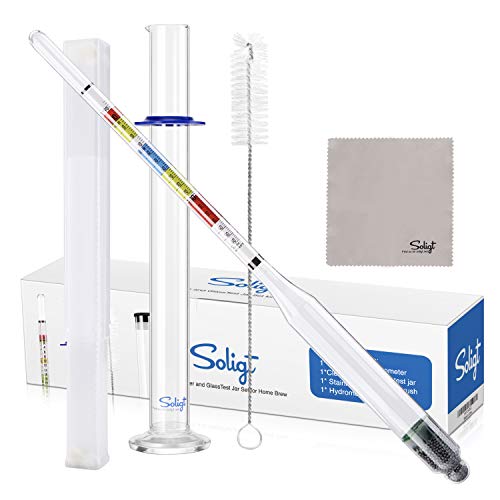
SOLIGT Triple Scale Hydrometer with Test Jar Kit
A complete hydrometer kit for home brewers measuring wine, beer, mead, and cider with ABV, Brix, and gravity scales. Includes glass test jar, brush, storage case, and conversion chart, designed to minimize sample waste at 125ml per test.
Pros
- All essential tools included in one package, suitable for beginners entering home brewing
- Efficient design saves 50% liquid compared to standard testing methods
- High-quality markings across three measurement scales for diverse fermentation tracking
- Protective storage case helps prevent breakage during handling and storage
Cons
- No verified buyer reviews available to confirm real-world accuracy or durability claims
- Limited to 0-20% ABV range, which may not suit high-alcohol spirit production
- Glass jar requires careful handling to avoid breakage despite included protection

CIMALAB Triple Scale Hydrometer Kit for Home Brewing
A three-in-one hydrometer that measures ABV, Brix, and specific gravity in a single reading, designed for homebrewers making beer, wine, mead, and kombucha. Comes with a test jar, brush, and cleaning cloth for complete setup out of the box.
Pros
- Triple scale design eliminates need for multiple instruments by reading ABV (0-20%), Brix (0-35), and specific gravity (0.99-1.17) simultaneously
- Large numerals and graduated color bands improve readability and reduce measurement errors
- Complete kit includes test jar, cleaning brush, microfiber cloth, and instruction sheet with conversion chart
- Mercury-free construction for safe handling
- Includes 12-month warranty and storage tube for protection
Cons
- No verified buyer reviews available to assess real-world accuracy or durability
- Plastic test jar may be prone to scratching or cloudiness over time, affecting visibility
- Requires proper technique and understanding of hydrometer use for consistent results, despite included instructions
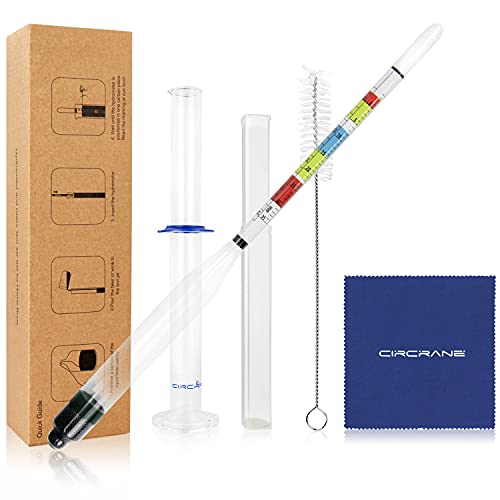
Circrane Triple Scale Hydrometer with 125ml Glass Jar
A complete home brewing measurement kit that combines a triple scale hydrometer with a narrow glass cylinder to reduce sample waste. Designed for beer, wine, mead, and kombucha makers who need accurate gravity, Brix, and ABV readings without mercury or hazardous materials.
Pros
- Reduces liquid waste with narrower cylinder design requiring half the typical sample size
- Mercury-free composition safer for home use
- Full accessory kit with protective storage case and cleaning tools included
- Easy-to-read triple scale handles multiple brewing types in one instrument
- Manufacturer backs product with one-year warranty and replacement guarantee
Cons
- No verified buyer reviews available to assess real-world reliability or durability
- Glass cylinder and hydrometer are fragile and require careful handling despite protective case
- Accuracy dependent on proper technique and liquid temperature, which instruction sheet must adequately explain

EISCO Laboratory Hydrometer 1.000-1.500 Specific Gravity
A dual-scale hydrometer designed for measuring relative density in heavy liquids, with shot loading for accuracy. Best suited for laboratory work, educational settings, or specialized home applications requiring precise specific gravity readings.
Pros
- Shot-loaded construction provides reliable, stable readings
- Includes protective case for safe storage and transport
- Versatile enough for both professional laboratory and home garage applications
- Clearly marked dual scale for easy measurement reading
Cons
- No verified buyer reviews available to assess real-world durability or accuracy claims
- Limited to heavy liquids only, not suitable for standard liquid gravity measurements
- Specific gravity range may be narrow for some applications requiring different density measurements

Govee H5179 WiFi Thermometer Hygrometer
A compact indoor temperature and humidity monitor with WiFi and Bluetooth connectivity via the Govee Home app. Delivers precise readings refreshed every 2 seconds, paired with customizable alerts and up to 2 years of data export capability.
Pros
- High accuracy with temperature precision of ±0.54°F/±0.3°C and humidity ±3% RH
- Dual connectivity (WiFi and Bluetooth) provides flexibility for monitoring from anywhere
- Alert function helps catch sudden environmental changes in specific rooms like basements or nurseries
- Historical data storage and export feature supports long-term tracking and trend analysis
- Lightweight and portable design with included lanyard for easy placement
Cons
- Alerts only configurable via Bluetooth, not WiFi connection
- Does not support 5GHz WiFi networks, limiting compatibility with newer routers
- No verified buyer reviews available to assess real-world reliability and user experience

ANFBYOH 6-Pack Mini Hygrometer Thermometer
A compact 2-in-1 temperature and humidity monitor designed for reptile tanks, greenhouses, and storage spaces. Delivers readings every 10 seconds with stated accuracy of +/-2°F for temperature and +/-5% for humidity across a wide -58°F to 158°F range.
Pros
- 6-pack quantity allows monitoring multiple areas simultaneously
- Wide operating range covers most indoor and specialized environments
- Compact 1.12 x 1.12 inch footprint fits tight spaces easily
- Stated accuracy of +/-2°F and +/-5% RH is reasonable for budget monitoring
- Auto-updating readings every 10 seconds provide timely data
Cons
- No verified buyer reviews available to confirm real-world accuracy and durability claims
- 4.9 rating with zero reviews raises questions about product legitimacy and customer feedback
- Limited documentation on battery type, lifespan, or display specifications in provided data

WWHAKO 4-Pack Mini Hygrometer Thermometer
A compact four-pack digital hygrometer and thermometer set designed for monitoring temperature and humidity across multiple environments. Features dual Fahrenheit/Celsius modes, fast 10-second refresh updates, and versatile mounting options for terrariums, incubators, and storage containers.
Pros
- Four units included for the price of a bundle, covering multiple habitats or monitoring points
- Temperature accuracy of +/-1°F and humidity accuracy of +/-2% RH meets most hobby and household needs
- Flexible mounting options accommodate various enclosure types without permanent modification
- Wide operating range handles extreme environments from refrigerators to greenhouse setups
- Instant temperature/humidity mode switching via dedicated button
Cons
- No verified buyer reviews available to confirm real-world durability or long-term reliability
- Small circular display may be difficult to read from a distance or in low-light conditions
- Embedded opening installation requires specific mounting hole size, limiting retrofit options

DOQAUS Digital Hygrometer Thermometer with 5s Refresh
Compact indoor hygrometer with 2.3-inch LCD display that updates every 5 seconds, offering temperature accuracy to ±1°F and humidity readings to ±5%RH. Includes visual comfort indicators and three mounting options, making it practical for bedrooms, offices, greenhouses, and nurseries.
Pros
- 5-second refresh rate provides near real-time humidity and temperature data
- Multiple mounting solutions: hanging hole, tabletop stand, and magnetic attachment for flexible placement
- Visual air comfort indicator with three icons simplifies environmental monitoring without reading numbers
- Compact and lightweight design fits easily in pockets or small spaces
- Switchable between Celsius and Fahrenheit with simple button control
Cons
- No user reviews available yet to verify real-world accuracy and durability claims
- 2.3-inch display, while readable, is relatively small for viewing from a distance
- Limited to basic temperature and humidity readings without additional smart features or app connectivity

TempPro TP50 Digital Thermometer Hygrometer
A compact indoor thermometer and humidity gauge that tracks air conditions with wellness indicators and updates readings every 10 seconds. Useful for homes, greenhouses, and specialty storage, though it offers basic functionality without smart connectivity.
Pros
- Quick 10-second refresh rate keeps data current without lag
- Dual mounting options (stand and magnetic) offer flexible placement
- Wellness indicator provides intuitive air quality feedback for everyday users
- Accurate readings within +/- 1°F and +/- 2-3% RH across varied environments
- Runs on single AAA battery, minimizing maintenance concerns
Cons
- No digital display or app connectivity for remote monitoring
- Limited to basic high/low record tracking without data logging capabilities
- Brand transition from ThermoPro to TempPro may result in inconsistent packaging

TempPro TP55 4-Inch Digital Hygrometer Thermometer
A wall-mounted or tabletop humidity and temperature monitor with a large 4-inch display and 10-second refresh rate, delivering readings accurate to within 1°F and 2% RH. Best suited for home climate tracking, plant care, or greenhouse monitoring.
Pros
- Fast 10-second refresh rate keeps data current for active climate adjustments
- High accuracy with advanced humidity sensors supports precise environment management
- Flexible placement with tabletop, wall, and magnetic mounting options
- Intuitive comfort indicator icons simplify environmental monitoring
- Front-touch buttons allow operation without removing from wall mount
Cons
- No verified buyer reviews available to confirm real-world performance and durability
- Brand transition from ThermoPro to TempPro may result in inconsistent packaging or product appearance
- Limited to indoor use; no wireless connectivity or app integration for remote monitoring
Hydrometers Buying Guide
Choosing the right hydrometer comes down to understanding your intended use, the accuracy you need, and how much convenience matters to your workflow.
Traditional glass hydrometers cost very little and work without batteries or wireless signals, but they require pulling a sample, using a evaluation jar, and reading a meniscus carefully.
Wireless floating hydrometers like the Tilt devices sit inside your fermenter throughout the entire fermentation process and send live data to your phone. Laboratory-grade instruments prioritize traceable calibration and wide specific gravity ranges.
Humidity monitors (also called hygrometers) are a separate category entirely, useful for tracking the moisture level of a room, a reptile enclosure, or a wine cellar environment, but they do not measure liquid density.
Understanding the difference will help you avoid buying the wrong type of device. Below are the key criteria to weigh before you buy.
Type of Hydrometer and Intended Use
The first question to ask is what liquid you are measuring and how. Home brewers and winemakers most commonly use triple-scale glass hydrometers that display specific gravity, Brix (sugar content), and potential alcohol by volume all on a single instrument.
These come paired with a plastic or glass evaluation cylinder. If you brew frequently and find the process of pulling samples inconvenient or wasteful, a wireless floating hydrometer that monitors your fermenter continuously is a strong upgrade.
For anyone working in analytical chemistry or laboratory settings, a single-scale laboratory hydrometer covering a precise range of specific gravity with finer graduations is the right tool.
Accuracy requirements differ sharply between casual homebrewing and professional or scientific applications, so match the instrument class to the task.
For anyone who needs to track the moisture level of a storage space rather than a liquid, a digital hygrometer is the product to look at, though it belongs to a different product category than liquid hydrometers.
If you also rely on precision digital scales for weighing ingredients or samples, pairing those with a well-calibrated hydrometer gives you a complete measurement workflow for brewing or laboratory tasks.
Measurement Range and Scale Accuracy

For brewing and winemaking, a typical glass hydrometer covers a specific gravity range from roughly 0.990 to 1.170, which handles everything from a dry-finished lager to a high-gravity barleywine or dessert wine.
A triple-scale instrument adds Brix and potential ABV scales alongside specific gravity, which makes calculations faster without needing a conversion table. Finer graduation increments (0.002 vs.
0.005 specific gravity) mean you can detect smaller changes in fermentation, which is valuable when approaching terminal gravity or when troubleshooting a stuck ferment.
For laboratory applications, the EISCO model in this list covers heavy liquids from 1.000 to 1.500 in 0.010 increments, making it suited for solutions that are denser than typical brewing worts.
When assessing accuracy, verified buyer feedback consistently flags reading technique (temperature correction, meniscus reading from eye level) as a bigger source of error than the instrument itself for entry-level glass hydrometers.
If you want to eliminate human reading error, a wireless sensor or a digital instrument is worth the higher investment.
Wireless Connectivity and Smart Features
Wireless hydrometers like the Tilt and Tilt Pro represent a significant convenience upgrade over traditional glass instruments.
They float inside a sealed fermenter and transmit real-time specific gravity and temperature readings via Bluetooth to a smartphone or tablet, logging data over time so you can graph the complete fermentation curve.
This eliminates the need to open the fermenter, reduces the risk of contamination, and gives you a running log without manual notation.
The Tilt is positioned for enthusiast homebrewers, while the Tilt Pro targets semi-professional or high-frequency brewers who want higher accuracy and longer-range Bluetooth.
Keep in mind that wireless devices require a compatible device nearby during fermentation to log data effectively, and battery replacement is an occasional maintenance task.
Expert review consensus notes that wireless hydrometers are particularly valuable for longer fermentations like lagers, Belgian ales, or high-ABV beers where daily manual readings would otherwise be cumbersome.
If you are building a broader home brewing or measurement toolkit, analytical balances pair well with digital and wireless hydrometers to give you complete control over ingredient quantities and gravity targets.
Build Quality and Durability

Traditional glass hydrometers are fragile by nature. A drop onto a hard surface almost always ends in a broken instrument, so verified buyer reviews almost universally recommend ordering a spare.
Better-quality glass hydrometers use borosilicate glass and are weighted with lead shot for stable, upright floating. Budget models sometimes use lower-grade glass with paper scales that can shift or blur if liquid seeps inside the instrument, which permanently compromises accuracy.
For entry-level purchases, look for models that include a protective case or arrive with a robust evaluation cylinder to minimize breakage during storage and transport.
The EISCO laboratory hydrometer ships with a protective case specifically to address this fragility concern in professional settings.
Wireless floating hydrometers are housed in sealed, waterproof plastic capsules, making them far more durable in daily use, though you should verify the O-ring seal condition before each brew.
If precise measurement is part of a broader scientific workflow that also involves laboratory microscopes or other analytical instruments, investing in a sturdier lab-grade hydrometer is justified.
evaluation Jar Size and Included Accessories
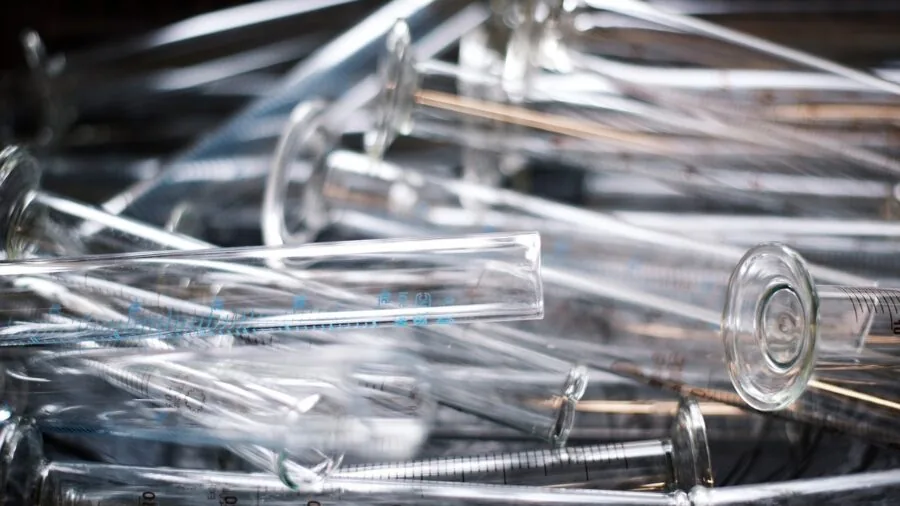
A hydrometer is only as useful as the evaluation cylinder it ships with. A narrow, short cylinder makes it difficult to float the hydrometer freely without it touching the sides, which skews readings.
A cylinder that is too wide wastes a large volume of sample liquid.
The standard recommendation among homebrew experts is a cylinder at least 250 mL in volume, ideally made from borosilicate glass for easy cleaning and chemical resistance, though plastic cylinders are more forgiving if dropped.
Some kits include both the hydrometer and a correctly sized evaluation jar, which saves the trouble of sourcing them separately.
The SOLIGT and Circrane kits in this list are both sold as complete sets with a glass evaluation cylinder, which is a practical advantage for new brewers or winemakers who want a ready-to-use package.
Kits from CIMALAB similarly bundle a evaluation jar with a triple-scale hydrometer at an accessible price point.
If you already have a cylinder, buying just the hydrometer saves money, but confirm the length of your hydrometer fits your existing cylinder before ordering.
Digital vs. Analog Instruments and Room Humidity Monitors

It is worth clarifying the difference between a hydrometer (measures liquid density) and a hygrometer (measures relative humidity in air). Several products in this category listing are hygrometers rather than liquid hydrometers.
Digital hygrometers from brands like Govee, DOQAUS, TempPro, ANFBYOH, and WWHAKO display ambient temperature and relative humidity on an LCD screen, making them useful for wine cellars, reptile enclosures, baby rooms, or greenhouses where environmental moisture control matters.
They are not capable of measuring the specific gravity or alcohol content of a liquid.
If your goal is monitoring a fermentation vessel or evaluation liquid density, you need a true liquid hydrometer or a wireless floating sensor, not a humidity monitor.
If you are setting up a space where both fermentation and environmental tracking matter, such as a dedicated brewing area or a wine storage cellar, you may find value in both types of instrument running alongside each other.
Govee’s WiFi-connected model, for example, offers app-based alerts and remote monitoring, which could be useful for keeping tabs on the ambient conditions of a fermentation room even if it cannot read specific gravity.
For broader home environmental monitoring needs, essential oil diffusers with built-in humidity control and a dedicated digital hygrometer make a complementary pairing for maintaining stable room conditions.
Why You Should Trust Us
ProductFind is an independent review publication. We do not represent any manufacturer, retailer, or brand, and our editorial decisions are made entirely on the basis of research quality and consumer value.
Every product in this list was evaluated against a consistent set of criteria including measurement accuracy, build quality, ease of use, category suitability, and value relative to alternatives in the same price tier.
Each model receives a PF Score on a 0 to 10 scale, calculated from a structured assessment of publicly available specifications, expert review consensus drawn from multiple credible sources, and verified buyer feedback from confirmed purchasers.
We do not conduct our own product trials; our evaluations are grounded in research, published data, expert review consensus, and verified buyer feedback.
This approach allows us to assess a wide range of products consistently and without bias toward any particular supplier.
ProductFind may earn a commission when you purchase through a link on this page. That affiliate relationship has no bearing on which products are included, how they are ranked, or what PF Score they receive.
Our rankings reflect research quality, not commercial arrangements. We are a review resource, not a retailer, and we do not handle orders, returns, or warranty claims for any product featured here.
Final Thoughts
After reviewing the full range of hydrometers and related measurement instruments in this list, a few clear standouts emerge across different use cases and budgets.
Whether you brew regularly, ferment wine or mead at home, need a laboratory-grade instrument, or simply want to track ambient humidity in a storage space, there is a well-suited option here.
- Best Overall: Tilt Pro Wireless Hydrometer and Thermometer RED earns the top position for its combination of professional-grade accuracy, continuous in-vessel monitoring, and Bluetooth connectivity that eliminates the need for manual sample pulls entirely. It is the most capable instrument in this lineup for serious homebrewers or semi-professional fermenters who want a complete data log of every fermentation.
- Best Wireless Pick for Enthusiasts: Tilt Wireless Green Hydrometer and Thermometer delivers the same real-time wireless monitoring concept at a more accessible price point, making it the go-to option for homebrewers who want the convenience of in-fermenter tracking without stepping up to the professional tier.
- Best Kit for Beginners: SOLIGT Triple Scale Hydrometer and Glass evaluation Jar bundles everything a new brewer or winemaker needs in one package: a triple-scale glass hydrometer covering ABV, Brix, and specific gravity alongside a properly sized glass cylinder, at a budget-friendly price.
- Best Budget Complete Set: CIMALAB Hydrometer evaluation Kit offers strong value for first-time brewers or winemakers who want a complete triple-scale kit with a evaluation jar without committing to a higher budget, and verified buyers consistently note its solid performance for the price.
- Best for Laboratory Use: EISCO Laboratory Hydrometer is the right choice for scientific or analytical applications requiring a precise, single-scale instrument covering heavy liquids, particularly because it ships in a protective case that extends the life of a fragile glass instrument.
For most homebrewers starting out, the SOLIGT or Circrane kits represent excellent entry points. For anyone who brews frequently enough that pulling samples becomes a chore, stepping up to the Tilt wireless ecosystem is a worthwhile investment.
Laboratory or professional users should focus on the EISCO model for traceable, precise measurements. Whichever path you choose, matching the instrument type to your actual use case is the single most important decision in this category.
Frequently Asked Questions
What Is the Difference Between a Hydrometer and a Hygrometer?
A hydrometer measures the specific gravity or density of a liquid, which makes it essential for brewing, winemaking, and laboratory work. A hygrometer measures the relative humidity of the air in a room or enclosed space.
The two instruments serve completely different purposes. Several products in this roundup are digital hygrometers rather than liquid hydrometers, so always confirm which type you need before purchasing.
How Do I Read a Traditional Glass Hydrometer Accurately?
Place your liquid sample in the evaluation cylinder and float the hydrometer inside it, making sure it does not touch the sides or bottom of the cylinder.
Read the scale at the bottom of the meniscus (the curved surface of the liquid) while holding the cylinder at eye level.
Most glass hydrometers are calibrated to be accurate at 60°F or 68°F; if your liquid is warmer or cooler, apply a temperature correction factor using a standard correction chart to get a precise reading.
Can a Wireless Hydrometer Replace a Traditional Glass One?
For most homebrewing and winemaking purposes, yes.
Wireless floating hydrometers like the Tilt and Tilt Pro sit inside the fermenter throughout the entire ferment, sending continuous gravity and temperature readings to your phone without any need to open the vessel or pull samples.
They reduce contamination risk and provide a complete fermentation data log. The trade-off is a significantly higher upfront cost and the need for a nearby Bluetooth-capable device to log readings.
A traditional glass hydrometer remains valuable as a backup or for quick spot checks on small batches.
What Specific Gravity Range Do I Need for Homebrewing?
For the vast majority of beers and wines, a hydrometer with a range of 0.990 to 1.160 or 1.170 covers everything from a dry-fermented cider or light lager up to a high-gravity imperial stout, barleywine, or dessert wine.
A triple-scale model that also displays Brix and potential ABV saves time by eliminating the need to perform manual conversions after each reading.
If you are brewing extremely high-gravity beers or fortified wines, verify that your hydrometer’s upper range extends far enough before purchasing.
How Do I Clean and Store a Glass Hydrometer to Prevent Breakage?
Rinse your glass hydrometer with warm water after each use and allow it to air dry completely before storing. Never use abrasive brushes on the inside of the instrument, as they can shift the paper scale.
Store the hydrometer in a protective tube or case, upright or horizontal on a padded surface, away from edges where it might be knocked over.
Many experienced brewers keep a spare hydrometer on hand precisely because glass breakage is common, especially during the cleaning step.
Kits that include a protective case, such as the EISCO laboratory model, are well worth considering if longevity matters to your workflow.
Are Digital Hygrometers Useful for Wine or Beer Cellars?
Yes, but for a different reason than liquid hydrometers. A digital hygrometer monitors the relative humidity and temperature of the air inside a wine cellar, brewing room, or aging space.
Maintaining the right humidity level prevents corks from drying out in wine storage, reduces unwanted evaporation, and helps preserve the quality of aging beverages.
Models with app connectivity and alerts, such as the Govee WiFi Thermometer Hygrometer, allow you to monitor cellar conditions remotely and receive notifications if humidity or temperature drifts out of an acceptable range.
They are a worthwhile addition to any serious home cellar or aging setup alongside your liquid measurement tools.
Proper environmental control in a storage space pairs naturally with well-chosen food storage containers and careful humidity monitoring to preserve ingredients and finished products alike.
About the author
Daniel is a reviewer and writer for ProductFind who specializes in Lab & Scientific. Daniel evaluates products through independent research: specifications, expert review consensus, and verified buyer feedback, and rates each one on the PF Score. Daniel focuses on helping readers pick the right lab & scientific for their needs and budget.