The 12 Best Microscopes
Compound, binocular, trinocular, or stereo, picking the right microscope means matching optics, build quality, and imaging capability to your actual needs. Here are the top picks across every use case.
 By Daniel Payne
Updated July 23, 2026
By Daniel Payne
Updated July 23, 2026

A good microscope opens up a world that’s invisible to the naked eye, whether you’re a student dissecting a leaf cell, a hobbyist examining insect specimens, or a lab professional preparing slides for clinical analysis.
The challenge isn’t finding a microscope for sale, it’s figuring out which one actually delivers crisp optics, reliable illumination, and a build that holds up over time without forcing you to overspend on features you’ll never use.
Brands like SWIFT, OMAX, AmScope, and Woehrsh each take a different approach to magnification, camera integration, and stage design, and those differences matter enormously depending on how and where you plan to use the instrument.
This guide draws on specifications, expert review consensus, and verified buyer feedback to cut through the marketing noise and surface the models worth your money in 2026.
ProductFind assessed each option against consistent criteria covering optics quality, build materials, imaging capability, and overall value.
Whether you need a compact monocular for a classroom, a trinocular compound scope with camera output for documentation, or a stereo zoom setup for detailed surface work, our top picks below represent the strongest choices across every major use case.

Swift SW380T Trinocular Microscope, 40X-2500X
A research-grade compound microscope built for clinicians, students, and serious hobbyists with magnifications up to 2500X and a rotatable Siedentopf head for collaborative use. The trinocular design accepts camera attachments for imaging and livestreaming, though cameras are sold separately.
Pros
- Wide magnification range covers detailed specimen analysis at multiple scales
- Rotating Siedentopf head accommodates multiple users and shared lab environments
- Camera-ready trinocular design enables documentation and digital workflow integration
- High-quality glass optics with wide-field eyepieces reduce image distortion
- Precise focusing mechanism supports both coarse adjustment and fine detail work
Cons
- No reviews available yet to verify real-world performance and durability claims
- Microscope camera attachments sold separately, adding to total cost
- Relatively heavy at 9.5 pounds, which may limit portability for field use

OMAX M83EZ-C50S 40X-2500X Trinocular Microscope with 5MP Camera
A trinocular compound microscope designed for laboratory and educational use, featuring a 5MP digital camera, mechanical stage, and NA1.25 Abbe condenser. Best suited for users who need documentation capabilities alongside traditional eyepiece viewing.
Pros
- Trinocular head allows simultaneous eyepiece viewing and camera documentation
- 5MP camera with Windows compatibility enables image capture and analysis
- Double layer mechanical stage provides stable specimen positioning
- NA1.25 Abbe condenser with iris diaphragm offers flexible illumination control
- Variable intensity LED illumination reduces heat exposure compared to halogen
Cons
- No user reviews available to assess real-world reliability and performance
- 5MP resolution is modest by modern digital camera standards
- Weight and dimensions suggest significant desktop footprint requirement

JECONE 40-2500X Binocular Microscope with Dual LED
A versatile binocular microscope spanning 40x to 2500x magnification with dual LED illumination and a five-color filter wheel, designed for both educational and professional use. The rotating head and inclined viewing angle reduce strain during extended observation sessions.
Pros
- Wide magnification range covers beginner to advanced observation needs
- Dual illumination system offers flexibility for different specimen types
- Built-in color filters reduce preparation time for transparent samples
- Ergonomic design with rotating head minimizes neck and eye strain
- Comes with accessories including mechanical stage and slides set
Cons
- No verified buyer reviews available to assess real-world reliability and durability
- Weighs five pounds, which may limit portability for field use
- Dual focus system requires learning curve to master fine adjustment precision
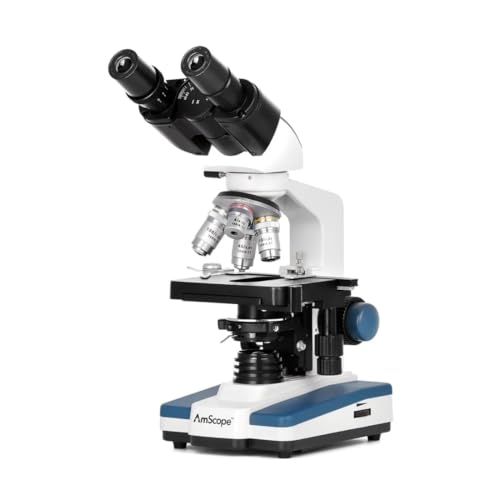
AmScope B120 40X-2500X LED Binocular Microscope with 5MP Camera
A budget-friendly binocular compound microscope designed for students and professionals, offering a wide magnification range from 40X to 2500X with integrated LED illumination and 5MP digital imaging. The included USB camera and software enable capture and analysis of microscopic specimens without additional purchases.
Pros
- Wide magnification range supports both low and high-power specimen analysis
- LED illumination provides consistent, daylight-balanced lighting compared to traditional halogen systems
- 5MP camera with software bundled, eliminating extra costs for digital documentation
- Binocular design reduces eye strain during extended observation sessions
- Suitable for both educational environments and professional laboratory work
Cons
- No verified buyer reviews available to assess real-world reliability and performance consistency
- 9.9-pound weight and dimensions may require dedicated workspace or storage
- Limited detail on software capabilities and compatibility with different operating systems

AmScope M150C 40X-1000X Student Compound Microscope
A budget-friendly compound microscope designed for K-12 science education, featuring five magnification levels and cordless LED illumination powered by batteries or AC adapter. The all-metal construction and optical glass lenses make it suitable for classroom or home school use.
Pros
- Multiple magnification levels accommodate different specimen sizes and detail requirements
- Flexible power options allow use in classrooms without nearby outlets
- Sturdy all-metal construction designed to withstand student use
- Optical glass elements provide clearer imaging than plastic alternatives
- Compact size makes storage and transport practical
Cons
- No customer reviews available to evaluate real-world performance and reliability
- Monocular design limits depth perception compared to binocular microscopes
- Maximum 1000X magnification may be limited for advanced or professional work

Woehrsh Trinocular Microscope 40X-5000X
A laboratory-grade compound microscope designed for adults pursuing serious biological work, education, or professional examination. The 185 achromatic objective lens and dual mechanical stage deliver magnification up to 5000x, supported by a generous accessory kit that covers most beginner and intermediate needs.
Pros
- Comprehensive accessory bundle eliminates need for immediate additional purchases
- Wide magnification range accommodates both basic observation and advanced specimens
- Dual eyepiece and USB camera options provide flexibility for individual or group use
- Adjustable optics accommodate different eye prescriptions and distances
- Professional-grade construction suitable for education, veterinary, and research applications
Cons
- No verified buyer reviews available to confirm real-world performance and durability
- High magnification range does not guarantee proportional image quality at extreme settings
- Learning curve for proper focus and specimen preparation required for best results

Woehrsh Trinocular Microscope 40X-5000X with USB Camera
Laboratory-grade compound microscope designed for adults, researchers, and educators with magnification up to 5000X and dual mechanical stage. Comes as a complete kit with slides, coverslips, and accessories, though it has no verified buyer reviews yet to confirm real-world performance.
Pros
- High magnification capacity (5000X) meets professional laboratory standards
- Complete accessory package eliminates need for separate purchases
- Multiple eyepiece options (WF10x and WF25x) provide viewing flexibility
- Wide-angle design reduces eye strain during extended observation
- LED lighting system and adjustable focus mechanisms for clear imaging
Cons
- No verified customer reviews available to validate claimed specifications or build quality
- Premium price point may be difficult to justify without real user feedback on durability and optical performance
- Steep learning curve typical of laboratory-grade microscopes may challenge casual users
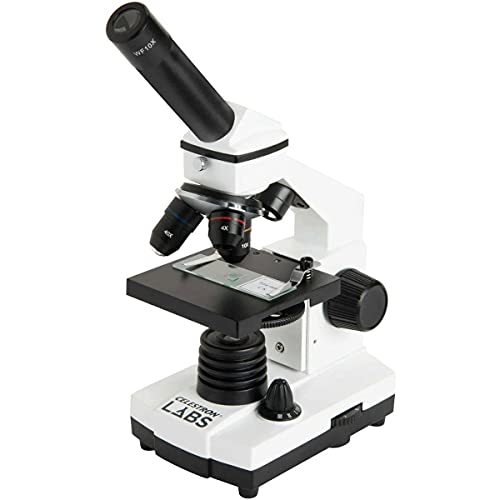
Celestron CM800 Compound Microscope, 40x-800x
A lab-grade compound microscope offering five magnification levels from 40x to 800x, suitable for students and hobbyists who need versatility without premium pricing. Includes dual LED illumination, prepared slides, and a two-year warranty backed by Celestron's established support.
Pros
- Wide magnification range covers basic to advanced specimen observation
- Battery-powered with included AA cells eliminates power cord dependency
- Comes with prepared slides and multiple objective/eyepiece combinations for immediate use
- Adjustable dual LED lighting provides consistent illumination at all magnifications
- Strong manufacturer warranty and accessible technical support from US-based team
Cons
- No user reviews available to validate real-world performance and durability
- Monocular design provides no depth perception, limiting detailed 3D observation compared to binocular models
- 3.15-pound weight and footprint suggest it requires dedicated desk space rather than portability
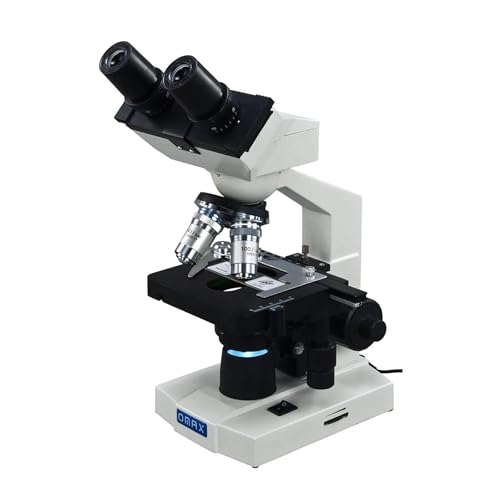
OMAX M82ES 2000X Binocular Compound Microscope
A versatile lab microscope offering eight magnification levels from 40X to 2000X through interchangeable eyepieces and objectives, suited for educational and professional microscopy work. Comes equipped with a mechanical stage, LED illumination, and basic accessories including slides and cleaning supplies.
Pros
- Wide magnification range supports diverse specimen observation from low to high detail
- Mechanical stage with scales enables precise specimen positioning and measurement
- Binocular eyepieces reduce eye strain during extended observation sessions
- Includes essential accessories (slides, cover slips, cleaning paper) to begin use immediately
- Sturdy metal construction suggests durability for institutional or lab environments
Cons
- No verified user reviews available to assess real-world reliability and performance
- High magnifications (800X-2000X) require oil immersion objectives, adding complexity and ongoing maintenance costs
- Relatively compact stage translation range (70mm x 30mm) limits specimen scanning area per positioning

OMAX MD82ES10 40X-2000X Digital Compound Microscope
A budget-friendly binocular compound microscope with LED illumination and built-in 1.3MP digital camera, designed for students and educational labs. The wide magnification range and USB connectivity make it practical for classroom use, though the camera resolution is modest by modern standards.
Pros
- Wide magnification range covers most educational and lab applications
- LED lighting provides consistent, bright illumination without heat generation
- Digital camera integration allows direct image capture and documentation
- Dual-compatibility with Windows and Mac removes OS barriers
Cons
- 1.3MP camera resolution is lower than current microscope camera standards, limiting image detail and print quality
- No user reviews available to assess real-world reliability or ease of use
- Product data shows inconsistent branding between OMAX title and AmScope features, creating uncertainty about actual manufacturer

AmScope SM-1TSZ-144S 3.5X-90X Stereo Microscope with 5MP Camera
A professional-grade stereo microscope designed for detailed inspection work on circuit boards, dental appliances, and similar specimens. The trinocular head, continuous zoom range, and 5MP digital camera with software make it suitable for both visual inspection and documentation tasks.
Pros
- Trinocular design allows two people to view simultaneously, useful for training or collaborative work
- Includes camera and software for digital documentation without additional purchases
- Removable LED ring light with intensity control prevents heat damage to sensitive specimens
- Wide magnification range covers both low-power overview and high-detail inspection
- Reversible stage plate accommodates both light and dark specimens
Cons
- No verified user reviews available to confirm real-world performance or reliability
- Pillar stand design may limit workspace access compared to articulating arm alternatives
- 5MP camera resolution is modest by modern standards for high-detail documentation

PalliPartners Compound Binocular Microscope 40X-2000X
A dual-LED compound microscope designed for students, professionals, and hobbyists seeking magnification range from 40X to 2000X. Features binocular optics with adjustable eyepieces, mechanical stage, and separate incident/transmitted lighting for both opaque and transparent specimens.
Pros
- Wide magnification range and dual eyepiece options accommodate various specimen types and viewing preferences
- Separate incident and transmitted LED systems with independent brightness controls eliminate need for light source switching
- Mechanical stage with scale markings enables precise location tracking across specimens
- Ergonomic binocular design with 45-degree inclination and adjustable interpupillary distance reduces fatigue during extended use
- Mobile phone compatibility allows documentation and sharing of microscopic observations
Cons
- No verified buyer reviews available to assess real-world durability and optical performance consistency
- Compact dimensions suggest potential stability concerns for heavier specimens or extended laboratory use
- Mobile phone camera compatibility depends on user-provided adapter, not included in kit details
Best Microscopes Buying Guide
Choosing the right microscope comes down to matching the instrument’s capabilities to your actual use case.
A scope that excels in a university pathology lab will frustrate a middle schooler doing homework projects, and a basic student model will fall short the moment a hobbyist needs camera output for documentation.
The sections below cover the criteria that separate genuinely useful scopes from ones that look impressive in a product listing but disappoint in practice.
If precision measurement tools interest you alongside optical instruments, our coverage of STEM-focused educational tools may also be worth a look for younger learners getting started with science.
Magnification Range and Optical Quality

Magnification range is the spec most buyers look at first, but it’s one of the most misleading numbers in microscopy marketing.
A scope advertised at 2500X is only useful at that power if the objective lenses and eyepieces are optically matched and the glass quality supports it.
“Empty magnification”, where the image simply gets bigger without resolving more detail, is a real problem in budget models that push high-end numbers.
For most compound microscopy applications, a range of 40X to 400X covers the vast majority of everyday needs, with 1000X being genuinely useful only with oil-immersion objectives and proper technique.
Look for achromatic objectives, which correct for chromatic aberration and deliver cleaner color rendition across the field of view.
Semi-plan and plan objectives go further by keeping the entire field in focus simultaneously, a meaningful upgrade for anyone doing image capture or extended observation sessions.
Wide-field eyepieces (WF10x or WF25x) are preferable to standard eyepieces because they widen the observable area without requiring additional objective magnification.
Siedentopf-style binocular or trinocular heads deserve particular attention: the inter-pupillary distance adjustment is tool-free and the diopter correction is independent per eye, which reduces fatigue significantly during long sessions.
For stereo microscopes, the calculus is different.
The zoom objective (typically expressed as a range like 0.7X to 4.5X) determines how much working distance you retain at high power, and working distance matters when you’re manipulating a specimen with tools underneath the lens.
Low overall magnification with large depth of field is the goal in stereo work, not the extreme values that define compound microscopy.
Head Configuration: Monocular, Binocular, or Trinocular
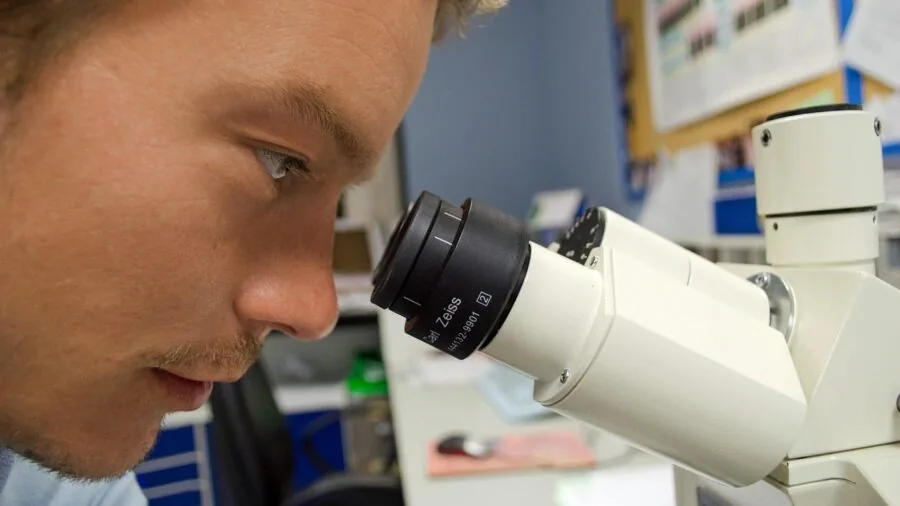
The head configuration determines both the ergonomics of observation and the scope’s compatibility with imaging.
Monocular heads (single eyepiece) are compact, inexpensive, and perfectly adequate for brief, casual observation, but they cause more eye strain during extended sessions and offer no convenient path to camera integration.
They suit younger students or anyone with a tight budget who needs basic capability. A quality monocular like the AmScope M150C sits at the budget end of the market and performs consistently within its intended role.
Binocular heads split the light path between two eyepieces, dramatically reducing fatigue and allowing both eyes to work together. This is the minimum configuration anyone should consider for regular adult use.
The inter-pupillary distance adjustment is a critical comfort feature: cheaper binocular heads sometimes have limited adjustment ranges that don’t accommodate all face geometries, so it’s worth confirming that specification before buying.
For classroom use or home education, a binocular compound scope with LED illumination hits a practical sweet spot of usability and value, and pairing it with a set of art and visual observation tools can round out a creative science learning environment.
Trinocular heads add a third port dedicated to camera attachment, leaving both eyepieces fully functional during imaging. This is the professional standard and the configuration you want if documentation, teaching, or digital sharing is part of your workflow.
The SWIFT SW380T and OMAX M83EZ-C50S are strong examples of trinocular scopes that balance camera compatibility with refined optics at mid-range price points.
Most trinocular ports accept C-mount or T-mount cameras directly; check that the camera included (or the one you plan to add) matches the port standard.
Illumination System
Modern LED illumination has largely replaced halogen and mirror-based systems, and for good reason. LEDs run cooler, draw less power, last far longer, and produce consistent color temperature that doesn’t shift as a bulb ages.
For transmitted-light compound microscopes, look for adjustable brightness with a rheostat or stepped controls rather than a simple on/off switch: the ability to dim the light is essential when working with stained specimens or transparent cells that wash out under full intensity.
For stereo microscopes, incident (top) lighting is equally important because you’re illuminating opaque surface specimens rather than shining light through a slide.
Ring lights are the standard solution, and the number of LEDs in a ring affects how evenly the specimen is lit and how effectively shadows are eliminated.
The AmScope SM-1TSZ-144S-5M uses a 144-bulb LED ring that delivers notably even coverage and supports detailed surface documentation. Some stereo scopes also include a transmitted light base for thin specimens, and this dual-illumination capability adds meaningful versatility.
Cordless operation is worth noting for classroom and field-adjacent use. The AmScope M150C’s rechargeable battery design means it can function without a wall outlet, which matters in settings where power access is limited or where the scope needs to travel between stations.
Mechanical Stage and Focus Mechanisms
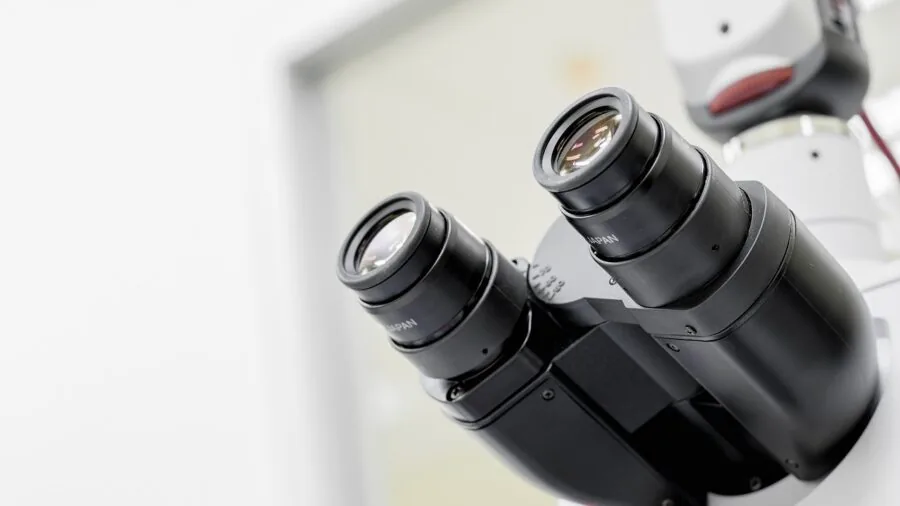
The mechanical stage is where build quality shows up most clearly in day-to-day use.
A double-layer mechanical stage with X/Y control knobs lets you move a slide precisely and repeatably, returning to an exact point on the specimen without hunting.
Stages that lack rack-and-pinion control require you to slide specimens by hand, which is frustrating and imprecise. For any serious work, a double-layer mechanical stage is a non-negotiable feature rather than a premium upgrade.
Coarse and fine focus knobs should have smooth, consistent tension with minimal backlash.
Cheap scopes often develop focus drift, where the stage slowly drops under the weight of the objectives after you release the focus knob, which destroys concentration during high-magnification work.
Tension adjustment rings on the coarse focus are a sign that the manufacturer accounted for this problem.
The SWIFT SW380T is frequently cited in expert consensus for its unusually precise focusing mechanism relative to its price point, a detail that compounds over hours of use.
Dual mechanical stages, as found in some Woehrsh models, add lateral stability and improve positioning repeatability when switching between specimens. For high-volume slide review or any workflow requiring systematic scanning, this feature reduces operator fatigue and improves throughput.
Camera Integration and Digital Output
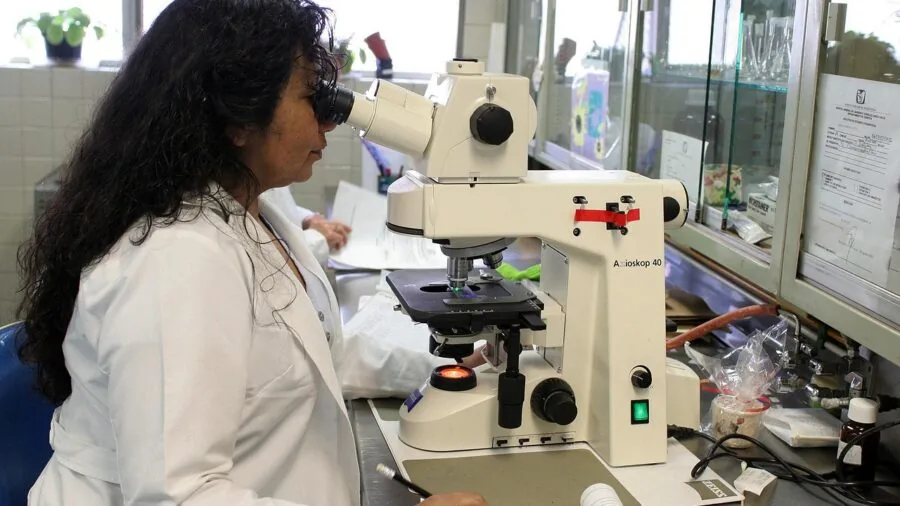
Many scopes in this price range include a bundled USB camera, but camera quality varies enormously.
Megapixel count is only one factor: sensor size, frame rate, software quality, and driver compatibility all affect how usable the digital output is in practice.
A 5MP camera with good color accuracy and a stable frame rate is more useful than a higher-resolution sensor with compression artifacts or Windows-only drivers that don’t work on current operating systems.
Check whether the included software supports measurement tools, image stacking, and time-lapse capture if those capabilities matter to your workflow.
The OMAX MD82ES10 is notable for explicitly supporting both Windows and Mac, which addresses a real compatibility gap that plagues some competing bundles.
If you plan to use the camera primarily for sharing images rather than measurement, basic capture software combined with standard image-editing applications is usually sufficient.
For those who want to connect a smartphone rather than a dedicated camera, some models include phone holders or adapter rings.
The JECONE binocular scope includes a phone holder in its accessory bundle, making casual documentation accessible without additional hardware purchases.
Smartphone adapters vary in alignment quality, so verified buyer feedback on image centering is worth consulting before assuming the included adapter will deliver professional-grade results.
Build Quality and Long-Term Durability

All-metal bodies are the standard in professional and research-grade instruments because metal frames resist flex under the weight of objectives and cameras, maintain alignment over time, and withstand the physical demands of shared or institutional use.
Plastic-bodied scopes are lighter and less expensive, but they’re more susceptible to mechanical play developing at joints and mounting points, which degrades optical alignment and ultimately image quality.
For any scope intended for regular use over multiple years, an all-metal or metal-dominant construction is strongly preferable.
Objective revolvers (the rotating turret that holds multiple objectives) should click positively into each position and hold without wobble. Slip or looseness at the revolver is a sign of quality control issues that will worsen over time.
Similarly, the condenser assembly should lock firmly at the set position rather than drifting with vibration.
These are details that don’t show up in spec sheets but that verified buyer feedback consistently identifies as differentiators between scopes that perform well after six months of use and ones that frustrate users within weeks of purchase.
Paying attention to long-term instrument care, much like choosing the right precision equipment for sensitive environments, makes a significant difference in sustained performance.
Why You Should Trust Us
ProductFind is an independent review publication. We do not accept payment from manufacturers, we do not conduct our own product trials; our evaluations are grounded in research, published data, expert review consensus, and verified buyer feedback.
Each product in this roundup was assessed against a consistent set of criteria covering optical quality, build construction, illumination, camera integration, stage precision, and overall value.
Every product receives a PF Score on a scale of 0 to 10, reflecting its relative strength across those criteria compared to the full competitive field.
Products are ranked by PF Score from highest to lowest, so the top position always reflects the strongest overall performer in our assessment, not a sponsorship arrangement or inventory preference.
We want to be transparent: ProductFind may earn an affiliate commission when you purchase through links on this page. That commercial relationship has no influence whatsoever on our rankings, scores, or product selection.
A product with a high affiliate margin that performs poorly will still score poorly; a product with no affiliate relationship that outperforms its peers will still rank at the top.
Our obligation is to you, the reader, not to any retailer or brand. If you’re investing in precision instruments, the same rigorous, independent thinking applies whether you’re comparing microscopes or evaluating wearable tech for accurate biometric data.
Final Thoughts
The microscope market spans an enormous range of capability and price, and the right pick depends heavily on who’s using it and for what purpose.
After evaluating specifications, expert consensus, and verified buyer feedback across this field, several models stood out clearly in their respective categories.
A reliable scope is an investment in sustained curiosity, whether for a student, a hobbyist, or a working professional, much like choosing a quality home environment tool that performs consistently over time rather than just on day one.
- Best Overall: PalliPartners Compound Binocular Microscope earns the top position with the highest PF Score in this roundup, combining accessible magnification, quality LED illumination, and broad compatibility for lab, school, and home education use at a genuinely budget-friendly price point.
- Best Research-Grade Trinocular: Swift SW380T is the strongest trinocular compound scope in the group, earning consistent praise in expert consensus for its Siedentopf head, ultra-precise focusing, and wide-field eyepieces that make long observation sessions comfortable and productive.
- Best Mid-Range Trinocular with Camera: OMAX M83EZ-C50S delivers a well-matched 5MP camera bundle with a solid mechanical stage and a trinocular head configuration that genuinely supports simultaneous eyepiece and camera use without image quality compromise.
- Best Binocular Upgrade Pick: AmScope B120 Series stands out among binocular compound scopes for its Siedentopf head, included USB camera, and the breadth of its magnification range, making it a strong option for anyone stepping up from a basic student scope.
- Best Budget Entry Point: AmScope M150C is the most compelling monocular option in the group, with an all-metal body, optical glass lenses, and cordless LED operation at a price accessible to students and first-time buyers who need reliable performance without a large investment.
Whatever your starting point, investing in a scope with solid optics and a quality mechanical stage pays dividends in every session. The models above represent the strongest convergence of performance, build quality, and value that our research identified across this field in 2026.
Frequently Asked Questions
What magnification do I actually need for everyday microscopy?
For most general-purpose compound microscopy, including cell observation, slide preparation, and educational biology work, a range of 40X to 400X covers the overwhelming majority of practical applications.
The 1000X setting that many scopes advertise requires oil-immersion technique and is primarily useful in clinical microbiology for identifying bacteria. Beginners and students will rarely need it, and many verified buyers report that they use 40X to 400X almost exclusively.
Choosing a scope with a wide range is fine, but don’t let the upper magnification number drive the purchasing decision at the expense of optical quality at the middle and lower ranges, where you’ll actually spend most of your time.
What’s the difference between a compound microscope and a stereo microscope?
Compound microscopes use transmitted light through a thin, transparent specimen mounted on a glass slide and achieve high magnifications (typically 40X to 2000X or beyond). They’re designed for viewing cells, microorganisms, and tissue sections.
Stereo microscopes, sometimes called dissecting microscopes, use incident (reflected) light to illuminate opaque three-dimensional specimens like insects, circuit boards, coins, or plant material.
They operate at much lower magnifications (typically 7X to 90X) but provide a large working distance and depth of field that makes manipulation and dissection practical.
If you want to look inside a drop of pond water, you need a compound scope. If you want to examine the surface of a seedpod or solder a PCB under magnification, a stereo scope is the right tool.
Are bundled USB cameras worth using, or should I buy a separate camera?
It depends entirely on your intended use. For documentation, sharing images online, or basic classroom demonstration, the bundled cameras included with scopes like the OMAX MD82ES10 or AmScope B120 are genuinely capable and save significant additional cost.
For research documentation requiring calibrated measurement, high frame rates for live specimens, or cross-platform driver support, the bundled camera may fall short and a dedicated C-mount microscopy camera is worth the additional investment.
Check verified buyer reviews specifically about software stability and driver compatibility on your operating system before assuming the bundled solution will work seamlessly out of the box.
How do I maintain a microscope to keep it performing well long-term?
Lens cleaning is the most critical and most frequently neglected maintenance task.
Use only purpose-made lens cleaning paper or lint-free optical wipes with a small amount of lens cleaning solution; never use tissue, clothing, or paper towels, which scratch coated glass.
Always cover the microscope when not in use to prevent dust accumulation on the objectives and eyepieces. Store the scope with the lowest-power objective in the working position to protect higher-magnification objectives from accidental contact.
Keep the mechanical stage free of dried immersion oil by wiping it after each oil-immersion session.
For scopes stored in humid environments, silica gel desiccant packs inside the storage case prevent fungal growth on internal optical elements, which is irreversible and expensive to repair.
Is a trinocular microscope significantly better than a binocular one if I don’t need a camera now?
If you have no immediate imaging needs, a quality binocular scope will serve you very well and typically costs less than a comparable trinocular.
However, trinocular scopes are worth the modest price premium if there’s any realistic chance you’ll want camera output in the future, because retrofitting a binocular scope for camera use is often awkward and optically compromised.
The trinocular port is designed from the ground up to accept a camera without interfering with eyepiece use, and the dedicated port typically delivers better image quality than an eyepiece-mounted adapter.
If your budget allows, buying trinocular upfront is the more future-proof choice, similar logic to investing in a versatile audio setup that grows with your needs rather than having to replace it when requirements change.
What accessories should I budget for alongside the microscope itself?
Blank glass slides and cover slips are essential consumables for preparing your own specimens and cost very little per unit; buying in bulk is economical.
Immersion oil is necessary if you plan to use 100X oil-immersion objectives, and only purpose-made microscopy immersion oil with the correct refractive index should be used.
A stage micrometer slide (a calibrated scale) is useful for calibrating any camera software measurements. Lens cleaning solution and optical wipes should always be on hand.
For stereo microscope users, a fluorescent or fiber-optic ring light upgrade can dramatically improve surface illumination quality beyond what the stock ring light delivers.
Some scopes in this roundup, like the OMAX M82ES bundle, include blank slides and cover slips in the box, which reduces the immediate accessory shopping list for new buyers.
If you’re setting up a dedicated study or workstation, pairing the scope with a comfortable, well-organized workspace matters more than many buyers initially realize, and a sturdy adjustable desk can make extended microscopy sessions significantly more comfortable.
About the author
Daniel is a reviewer and writer for ProductFind who specializes in Lab & Scientific. Daniel evaluates products through independent research: specifications, expert review consensus, and verified buyer feedback, and rates each one on the PF Score. Daniel focuses on helping readers pick the right lab & scientific for their needs and budget.