The 9 Best Ph Meters
pH accuracy matters more than most buyers expect. Our research covers nine meters across water, hydroponics, food, and field use to help you find the right instrument.
 By Noelle Gray
Updated July 23, 2026
By Noelle Gray
Updated July 23, 2026
A reliable pH meter can make the difference between a thriving hydroponic garden, crystal-clear pool water, a safe home brew, and a costly mistake you only discover after the damage is done.
Whether you’re a hobbyist evaluation aquarium water or a serious grower dialling in nutrient solution, the market is full of meters that claim precision but deliver wildly inconsistent results.
Knowing what separates a trustworthy instrument from a cheap gimmick is genuinely useful knowledge, and it’s exactly what this guide is built around.
ProductFind reviewed nine pH meters across a broad price and application spectrum, drawing on published technical specifications, expert review consensus across specialist horticultural, aquatics, and laboratory communities, and verified buyer feedback from thousands of confirmed purchases.
The picks below represent the strongest performers in their respective niches, whether you need a pocket-friendly tester for occasional pool checks or a field-grade instrument for daily professional use. Scroll down for our ranked top picks.
| Award | Product | PF Score About PF ScoreThe PF Score is our own rating from 0 to 10, based on performance, design and build, ease of use, and value. It reflects independent research and is never influenced by manufacturers, retailers, or affiliate commissions. Learn more › | Price | |
|---|---|---|---|---|
| Best Overall |
 Apera Instruments AI209 pH Meter Kit
|
8.7/10 | Buy | |
| Editor's Pick |
 Bluelab pH Pen - Double Junction Probe Meter
|
8.5/10 | Buy | |
| Best Value |
 Extech PH100 Waterproof pH Meter with Adjustable Probe
|
8.2/10 | Buy | |
| Top Rated |
 Milwaukee MW105 MAX pH/ORP/Temp Meter
|
7.8/10 | Buy | |
 AC Infinity pH Meter PRO Kit with ±0.01 Accuracy
|
7.6/10 | Buy | ||
 Milwaukee MW102 Portable pH/Temperature Meter
|
7.3/10 | Buy | ||
 General Tools DPH7011 Digital pH Meter
|
6.8/10 | Buy | ||
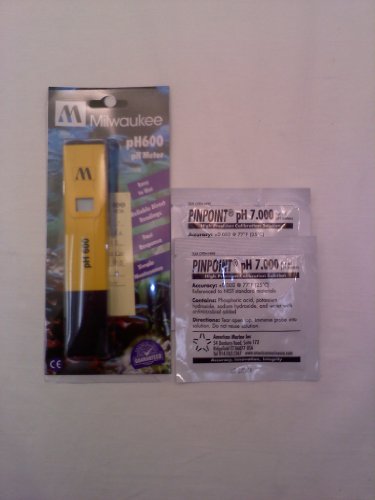 Milwaukee pH 600 Pocket Tester Kit
|
5.9/10 | Buy | ||
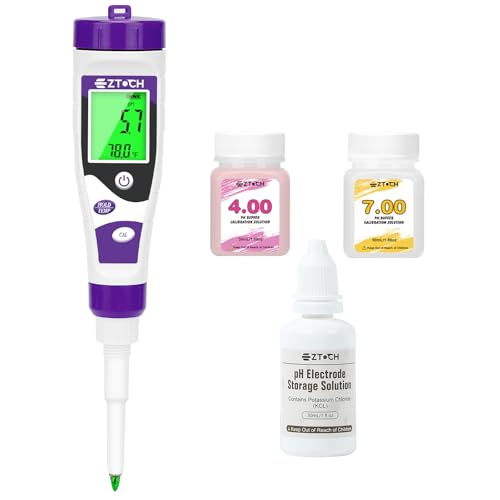 EZTOCH Digital Food pH Meter with Bluetooth
|
5.2/10 | Buy |
Apera Instruments AI209 pH Meter Kit
A portable pH tester with automatic calibration and temperature compensation, designed for field measurements across a wide temperature range. Best suited for users who need reliable readings without manual calibration hassle.
Pros
- Auto-calibration with buffer recognition eliminates guesswork during setup
- Automatic temperature compensation (32-122°F) maintains accuracy across varying conditions
- Extended battery life up to 2000 hours on AAA batteries
- Includes carrying case, pH buffers, and lanyard for portability
- Auto-stable value recognition reduces measurement uncertainty
Cons
- No user reviews available to verify real-world performance claims
- Limited temperature range (32-122°F) may not cover all industrial applications
- Low impedance sensor design benefits response rate but details on maintenance requirements are absent from spec data
Bluelab pH Pen - Double Junction Probe Meter
A rugged, waterproof pH meter built for hydroponics, aquariums, and water quality monitoring. Delivers 0.1 pH accuracy with auto temperature compensation and two-point calibration, plus the durability to float if dropped.
Pros
- Double-junction probe minimizes contamination and lasts longer than glass bulbs
- Waterproof and floats, making it durable for wet environments and accidental drops
- Easy two-point calibration process with included pH7, pH4, and KCl sachets
- Backlit LCD display shows calibration status and temperature in both units
- Includes AAA battery and lanyard for convenient field use
Cons
- Readings can be slow or unstable in low-ion water (tap, RO, or distilled) due to insufficient dissolved salts
- No verified buyer reviews available yet to assess real-world reliability
- Requires regular calibration maintenance to maintain accuracy over time
Extech PH100 Waterproof pH Meter with Adjustable Probe
The Extech PH100 is a waterproof pH meter designed for field measurements with an adjustable stainless steel probe and integrated temperature display. Its flexible probe design and fast response time make it practical for on-site testing, though the lack of verified buyer feedback limits confidence in real-world durability claims.
Pros
- Adjustable probe with fixed detent positions (45, 90, 135, 180 degrees) reduces storage footprint and improves measurement accessibility
- Wide temperature range (-50 to 300°C) covers diverse measurement scenarios
- Waterproof construction supports outdoor and wet-environment use
- Automatic shutdown extends battery longevity during extended field work
Cons
- No verified buyer reviews available, so real-world reliability and durability cannot be independently validated
- Flat surface electrode design may have limited application compared to traditional pointed electrodes for certain sample types
Milwaukee MW105 MAX pH/ORP/Temp Meter
A portable, waterproof pH meter built for lab-grade accuracy in field conditions. The MW105 delivers precision to 0.02 pH with automatic 3-point calibration, making it reliable for water quality testing, aquaculture, and industrial applications.
Pros
- Exceptional precision: 0.02 pH accuracy across wide -2.00 to 20.00 pH range
- IP67 waterproof rating with rugged construction for outdoor durability
- Automatic multi-point calibration (up to 3 points) simplifies routine setup
- Large dual-level LCD display with alphanumeric messages for clear readability
- Long battery life at approximately 200 hours plus auto shut-off power saving
Cons
- No verified buyer reviews available yet, limiting real-world feedback on long-term reliability
- 3-foot probe cable may be limiting for some deep-tank or confined-space applications
- Lab-grade feature set and precision suggest premium positioning, potentially higher initial investment
AC Infinity pH Meter PRO Kit with ±0.01 Accuracy
A lab-grade pH meter designed for hydroponics, aquariums, and gardening with interchangeable probes and calibration solutions included. The IP-67 rating handles moisture and dust well, making it suitable for various water monitoring applications.
Pros
- High precision with ±0.01 pH accuracy for consistent readings
- Complete calibration kit included for long-term accuracy maintenance
- Durable IP-67 rating withstands moisture, dust, and heat exposure
- Interchangeable probe design extends product lifespan
- Instant readings with glass membrane technology
Cons
- No customer reviews available yet to verify real-world performance
- Calibration solutions require periodic replenishment for ongoing use
- Specifications lack detail on battery life and display type
Milwaukee MW102 Portable pH/Temperature Meter
A compact pH meter designed for field and lab use, featuring automatic temperature compensation and two-point calibration for consistent readings across a wide pH range. Best suited for users who need reliable pH measurement without frequent maintenance.
Pros
- High accuracy of ±0.02 pH ensures precise measurements
- Extended pH range from -2.00 to 16.00 covers diverse applications
- Automatic temperature compensation with stainless steel probe eliminates manual adjustments
- Large LCD display provides easy-to-read results in various lighting conditions
- Lab-grade gel-filled double junction electrode reduces maintenance needs
Cons
- No verified customer reviews available to assess real-world durability and long-term performance
- Relatively large dimensions at 5 x 10 x 10 inches may limit portability despite portable classification
- Two-point automatic calibration is standard but may not address drift in specialized applications
General Tools DPH7011 Digital pH Meter
A compact, waterproof pH meter designed for quick field measurements across a wide pH range of 2 to 16. Auto temperature compensation and IP-57 waterproofing make it practical for wet environments, though lack of verified user feedback limits confidence in real-world performance.
Pros
- Wide pH measurement range from 2 to 16 covers most applications
- IP-57 waterproof rating with floating design for wet work environments
- Auto temperature compensation adjusts readings automatically
- Pocket-sized and lightweight for portability
- Digital display for clear reading
Cons
- No verified customer reviews available to assess reliability or accuracy
- RS-232 output requires compatible data logging setup, adding complexity
- Dimensions listed appear incomplete or potentially erroneous, raising specification clarity concerns
Milwaukee pH 600 Pocket Tester Kit
Milwaukee's pH 600 is a straightforward, pocket-sized pH meter with a full 0.0 to 14.0 range and calibration fluid included. It's built for budget-conscious users who need basic pH testing without complexity.
Pros
- Full pH range from 0.0 to 14.0 covers most applications
- Calibration fluid included in kit eliminates extra purchases
- Compact design fits easily in a pocket for portability
- Reasonable accuracy at ±0.2 pH for the price point
Cons
- No verified user reviews available to assess real-world reliability
- Limited accuracy of ±0.2 pH may not suit precision-critical testing
- Pocket-sized form factor suggests simplified controls and durability concerns
EZTOCH Digital Food pH Meter with Bluetooth
A Bluetooth-enabled pH meter designed for home canning, sourdough baking, and fermentation projects. Comes pre-calibrated with calibration solutions and stores up to 1,000 readings via the YINMIK app.
Pros
- Ready to use immediately with included calibration solutions and protective solution
- Bluetooth data logging eliminates manual record-keeping for fermentation monitoring
- Suitable for both high-acid (water bath) and low-acid (pressure) canning applications
- Covers diverse food preparation needs from baking to brewing to cheese making
Cons
- No verified buyer reviews available to assess real-world reliability or accuracy consistency
- Requires smartphone and YINMIK app for full feature utilization; data management limited without it
- Product specifications lack details on measurement range, resolution, or response time
pH Meters Buying Guide
Choosing the right pH meter is less about chasing the lowest price and more about matching the instrument’s design to your actual conditions.
A meter that works brilliantly in a controlled kitchen fermentation environment may perform poorly when dunked into a muddy irrigation tank. The six criteria below cover every dimension that meaningfully affects real-world performance, from probe durability to long-term calibration stability.
Measurement Accuracy and Resolution
pH accuracy is expressed as a plus-or-minus tolerance, and the difference between ±0.1 pH and ±0.01 pH is substantial in practice.
For most home uses including pools, aquariums, drinking water, and casual gardening, ±0.1 pH accuracy is entirely adequate and far easier to maintain with regular calibration.
For hydroponics, food fermentation, and laboratory work where small deviations have cascading consequences, ±0.01 pH resolution is worth the investment.
Just as a quality digital multimeter earns its keep through repeatable precision rather than raw spec numbers, a pH meter’s real-world accuracy under varying conditions matters far more than the headline figure on the packaging.
Resolution describes how finely the meter displays readings, typically 0.1 or 0.01 pH increments. Higher resolution only provides value when the underlying sensor and electronics can support it consistently.
A meter claiming 0.01 pH resolution but using a single-junction probe in mineral-rich water will drift faster than a better-built ±0.1 instrument. Always cross-reference the accuracy spec with the probe type and the manufacturer’s recommended application range.
Probe and Electrode Quality
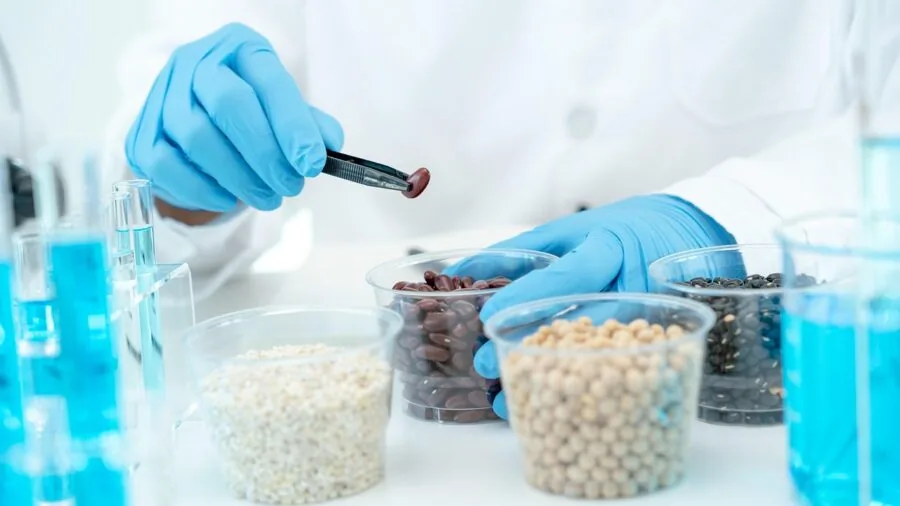
The probe is the heart of any pH meter, and it’s the component most commonly compromised in budget instruments. Single-junction probes are the standard in entry-level meters and perform well in clean water, nutrient solution, and soil slurries.
Double-junction probes, such as those found in the Bluelab pH Pen, isolate the reference electrode from the sample, dramatically extending service life and improving accuracy in samples containing proteins, sulfides, or high ionic concentrations.
If you’re measuring fermentation mash, compost teas, or any solution with biological content, the double-junction design is worth seeking out.
Probe replacement availability is a practical concern that’s easy to overlook at the point of purchase.
Some manufacturers, particularly in the professional and semi-professional segment, sell interchangeable probe systems that allow you to replace only the electrode rather than the entire meter body.
The AC Infinity pH Meter PRO Kit takes this approach, giving growers a path to cost-effective long-term ownership. Confirm whether replacement probes are actually stocked and what they cost before committing to any instrument above the entry tier.
Waterproofing and Build Durability
For any application involving frequent immersion or outdoor fieldwork, IP-rated waterproofing is non-negotiable.
A meter rated IP67 or better can be submerged briefly and rinsed under a tap without damage, which is a practical feature you’ll appreciate more as months pass.
The Apera PH20, Bluelab pH Pen, and Extech PH100 are all explicitly waterproof and float if dropped in water. Floating is a particularly underrated feature when you’re leaning over a reservoir or tank and the meter slips from your grip.
Build quality also determines long-term value. Meters with rubberised housings, reinforced probe caps, and durable clip mechanisms hold up significantly better in working environments than smooth-sided plastic instruments.
For outdoor or agricultural fieldwork, consider whether the meter can be stored with a protective cap or case.
Several of the picks in this roundup include carrying cases with buffer solution vials, which both protect the unit and keep calibration supplies immediately accessible.
Automatic Temperature Compensation (ATC)
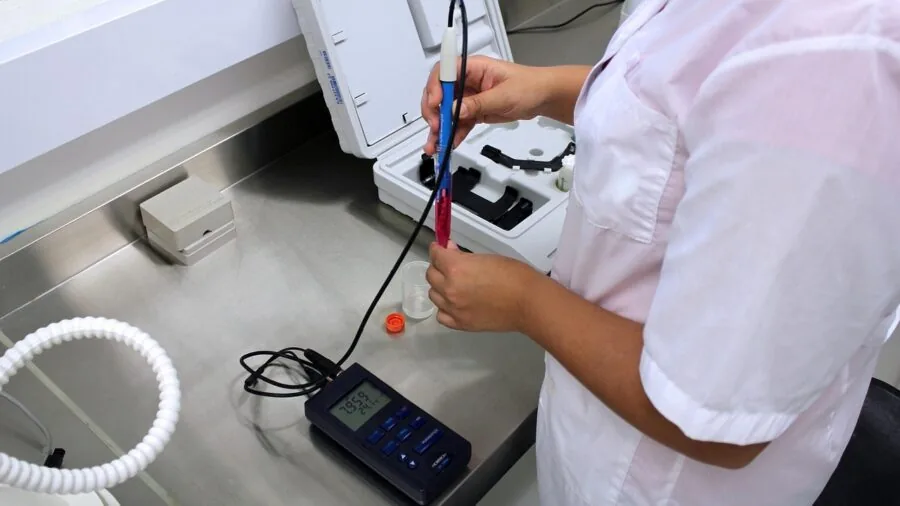
pH readings shift predictably with temperature: the same solution will read differently at 15°C versus 30°C.
Automatic Temperature Compensation (ATC) corrects for this in real time, ensuring that you’re reading the true pH of the solution rather than a temperature-distorted figure.
For any application where sample temperature fluctuates, ATC is an essential feature, not an optional upgrade. Most meters in this roundup include ATC as standard.
Some instruments, like the Milwaukee MW102 and the Milwaukee MW105 MAX, also display temperature as a separate reading alongside pH. This is genuinely useful in hydroponics and aquaculture where temperature monitoring is itself an important variable.
Just as oscilloscopes provide waveform context that a bare voltage reading cannot, seeing pH and temperature simultaneously gives you a more complete picture of your sample environment.
Calibration Process and Buffer Recognition

All pH meters drift over time and require periodic recalibration against reference buffer solutions. How easy and reliable that calibration process is determines how consistently you’ll actually do it.
Single-point calibration using only a pH 7 buffer is the simplest approach and sufficient for general monitoring, but two-point calibration using pH 4 and pH 7 (or pH 7 and pH 10) buffers produces a more accurate slope correction across the full measurement range.
For professional or research applications, three-point calibration is the standard.
Automatic buffer recognition, where the meter detects which calibration solution is being used without manual input, reduces errors and speeds up the process significantly. Look for meters that indicate calibration status on-screen and remind you when recalibration is due.
A meter that is tedious to calibrate tends to be a meter that gets calibrated infrequently, which is the single most common cause of inaccurate pH readings among home users.
Application Fit: Water, Soil, Food, or Professional Use

The best pH meter for pool maintenance is not the same instrument as the best one for food fermentation or field soil analysis. Pocket-style pen testers are ideal for water-based applications where the probe can be fully immersed.
The EZTOCH Food pH Meter uses a flat-tip or spear probe designed to penetrate semi-solid samples like cheese, meat, or dough without the fragility issues of a conventional glass electrode.
For professional growers managing large reservoir systems, a meter with ORP measurement capability alongside pH, like the Milwaukee MW105 MAX, provides a more complete chemical picture of the growing environment.
Budget is a real constraint for many buyers, and the good news is that solid accuracy is available across a wide price range.
Entry-level options like the Milwaukee pH 600 Tester Kit cover basic water evaluation adequately, while mid-range instruments from Apera and Bluelab offer meaningfully better probe longevity and calibration stability.
Before committing to a premium professional instrument, honestly assess how often you’ll use the meter and in what conditions. A well-maintained mid-range meter used consistently will outperform an expensive unit that sits uncalibrated in a drawer.
Why You Should Trust Us
ProductFind is an independent review publication. We do not accept payment from manufacturers to influence rankings, and we have no commercial relationship with any brand featured in this article.
Every product in this roundup was assessed using our structured PF Score methodology, a 0 to 10 rating system that applies consistent criteria across specifications, build quality, application suitability, calibration reliability, and long-term ownership value.
We do not conduct our own product trials; our evaluations are grounded in research, published data, expert review consensus, and verified buyer feedback.
Our analysis draws on the manufacturer’s published technical data, specialist consensus from hydroponic, aquaculture, and laboratory communities, and aggregated verified purchase reviews from thousands of confirmed buyers.
When expert reviewers and verified buyers consistently agree on a product’s strengths or weaknesses, we weight that consensus heavily in the final PF Score.
ProductFind may earn a commission if you purchase through links on this page. That affiliate relationship has zero bearing on which products are recommended, how they are ranked, or what PF Score they receive.
Our editorial independence is the foundation of the site’s value to readers, and we take it seriously. You will not find a product ranked higher here because it earns us a larger commission.
Final Thoughts
The pH meter market in 2026 spans a genuinely wide range of quality and application fit, from simple pocket testers that handle occasional pool season checks to field-grade instruments built for professional growers managing nutrient chemistry daily.
The nine products reviewed here cover that entire spectrum, and each earns its place through a specific combination of accuracy, build quality, calibration reliability, and value in its price tier.
Here are our standout picks with the awards they earned through the evaluation process:
- Best Overall: Apera Instruments AI209 PH20 Waterproof pH Tester Kit earns the top spot with the highest PF Score in the group, combining waterproof construction, automatic temperature compensation, and reliable two-point calibration in an accessible, portable package that covers the widest range of common applications.
- Best for Precision Growers and Serious Hobbyists: Bluelab pH Pen stands out for its double-junction probe design and New Zealand-built durability, delivering consistently stable readings in demanding samples where single-junction competitors drift faster.
- Best Portable Field Meter: Extech PH100 Waterproof ExStik II pH Meter Kit is the go-to for fieldwork and wet environments, pairing a flat surface electrode with an integrated temperature display and a probe that adjusts to multiple angles for convenient positioning.
- Best for Professional and Multi-Parameter Monitoring: Milwaukee MW105 MAX Waterproof pH/ORP/Temp Portable Meter is the instrument of choice when pH alone is not enough, adding ORP measurement and temperature logging in a field-ruggedised housing built for sustained professional use.
- Best for Food Fermentation and Canning: EZTOCH Food pH Meter fills a niche that most pen testers cannot, with a probe geometry designed for semi-solid food samples rather than water immersion, making it purpose-built for cheesemaking, meat curing, and canning applications.
If you’re still narrowing down your choice, focus first on application fit, then on probe type, and finally on how frequently you’re willing to calibrate. The right meter is the one you’ll actually maintain and use consistently.
Frequently Asked Questions
How often should I calibrate my pH meter?
For most home applications like pool monitoring or aquarium checks, calibrating once every one to two weeks is sufficient. For professional hydroponics, food fermentation, or laboratory work where accuracy is critical, calibrating before each measurement session is the standard.
All pH electrodes drift over time, and the drift rate accelerates with heavy use, exposure to extreme temperatures, or contact with high-protein or high-mineral samples. A calibration log is a simple habit that pays off quickly in consistent, trustworthy readings.
What is the difference between a single-point and two-point calibration?
Single-point calibration using a pH 7 buffer sets the meter’s zero offset but does not correct for slope errors across the full measurement range.
Two-point calibration using both pH 4 and pH 7 buffers (or pH 7 and pH 10) corrects both the offset and the slope, producing meaningfully more accurate readings at the extremes of the scale.
For any application where you routinely measure below pH 6 or above pH 8, two-point calibration is strongly recommended. Most mid-range and professional meters in this roundup support two-point or three-point calibration as standard.
Can I use a water pH meter to measure soil pH?
Not directly. Standard pH meters with glass or gel-filled electrodes require full immersion in a liquid sample.
For soil, the correct approach is to prepare a soil slurry by mixing a sample with distilled or deionised water at a standard ratio, typically 1:1 or 1:2 by weight, then measuring the liquid portion.
Some meters designed for aquatic use can perform this adequately, but dedicated soil electrodes or flat-tip probes provide more consistent results, especially in clay-heavy or high-organic soils.
Always check the manufacturer’s stated application range before using a water-optimised meter in soil slurries.
Do more expensive pH meters give significantly more accurate readings?
Not necessarily. Above a certain threshold, the accuracy difference between a well-maintained mid-range meter and a professional instrument becomes very small for most practical applications.
The real advantages of higher-cost meters tend to be probe longevity, build durability, multi-parameter measurement capability, and features like data logging or RS-232 output for record-keeping.
For occasional home use, a reliable mid-range option maintained with regular calibration will outperform an expensive instrument that is rarely calibrated or improperly stored. Calibration discipline matters more than price tag for everyday accuracy.
What buffer solutions do I need for calibration?
The most common calibration buffers are pH 4.0, pH 7.0, and pH 10.0. For two-point calibration covering the acidic to neutral range, pH 4 and pH 7 buffers are the standard pairing.
If you routinely measure alkaline samples such as pool water or certain hydroponic applications, adding a pH 10 buffer for three-point calibration improves accuracy at the high end.
Buffer solutions have a limited shelf life once opened, typically three to six months, and should be discarded if they show cloudiness, colour change, or contamination.
Several of the meters in this roundup include starter buffer sachets or vials in the kit, which is a practical convenience worth noting when comparing total kit value.
Is a pH meter better than pH evaluation strips?
For most applications beyond casual colour-matching, yes. pH evaluation strips are inexpensive and require no calibration, but they rely on subjective colour interpretation and typically offer only 0.5 to 1.0 pH resolution at best.
A digital pH meter provides objective, numeric readings at 0.1 or 0.01 pH resolution, with automatic temperature compensation that strips simply cannot offer. For pool and spa maintenance where a rough range is sufficient, strips remain a useful quick-check tool.
For hydroponics, fermentation, aquariums, or any application where a half-unit error has real consequences, a digital meter is the appropriate instrument.
Just as investing in quality workshop tools pays dividends in consistent results, the upfront cost of a reliable pH meter quickly justifies itself in avoided crop losses, batch failures, or water chemistry problems.
About the author
Noelle is a reviewer and writer for ProductFind who specializes in Test & Measurement. Noelle evaluates products through independent research: specifications, expert review consensus, and verified buyer feedback, and rates each one on the PF Score. Noelle focuses on helping readers pick the right test & measurement for their needs and budget.