The 12 Best Solar Chargers
From foldable panels to solar power banks, finding a charger that actually delivers in the field is harder than the specs suggest. Here are the picks that hold up.
 By Vernon Jackson
Updated July 23, 2026
By Vernon Jackson
Updated July 23, 2026
Staying powered up when you’re miles from the nearest outlet is no longer a matter of luck.
Solar chargers have matured into a genuinely reliable category, spanning lightweight foldable panels that juice up a phone directly from sunlight, solar power banks that store captured energy for overnight use, and 12V trickle maintainers that keep your car or RV battery healthy during long-term storage.
With options ranging from budget-friendly power banks to high-wattage foldable panels, choosing the right one depends heavily on how and where you plan to use it.
At ProductFind, we researched this category by analyzing manufacturer specifications, synthesizing consensus from expert reviewers, and cross-referencing verified buyer feedback across thousands of real-world purchases.
Whether you’re planning a multi-day backpacking trip or just want reliable emergency backup power at home, the picks below represent the strongest performers across every use case.
Read on for our top-ranked recommendations, followed by a detailed buying guide to help you match the right charger to your needs.

BigBlue 28W Solar Panel Charger
A portable solar charger designed for outdoor enthusiasts that folds to backpack-friendly dimensions and charges multiple devices simultaneously via dual USB-C and USB-A ports. Direct sunlight is required for operation, making it practical for camping and hiking but not for indoor use or cloudy conditions.
Pros
- Industry-leading 25.4% sunlight-to-energy conversion efficiency with advanced N-type solar cells
- Extremely portable at 1.5 lbs and compact folded size, ideal for backpacking and emergency kits
- Triple-port setup (2x USB-C, 1x USB-A) enables charging smartphones, power banks, and small electronics simultaneously
- IP44 waterproof durability with polymer surface better suited to outdoor conditions than conventional panels
- No battery management means minimal maintenance and instant availability for emergency use
Cons
- Requires direct sunlight to operate effectively, with significantly reduced output in clouds, indoors, or through windows
- Cannot store electricity internally, so charging stops when sunlight is blocked or device is disconnected
- USB junction box lacks waterproof protection despite IP44 panel rating, limiting durability in wet conditions
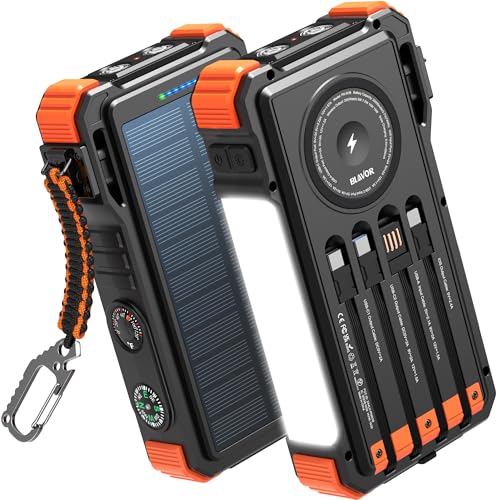
BLAVOR 20000mAh Solar Power Bank with Wireless Charging
A versatile solar power bank designed for outdoor enthusiasts, featuring 20000mAh capacity, wireless charging for phones and Apple Watch, and multi-device charging via 4 built-in cables. Beyond power delivery, it includes useful outdoor accessories like flashlight, camping light, compass, and thermometer for camping and emergency situations.
Pros
- Extensive connectivity with 4 built-in cables (2 USB-C, 1 iOS, 1 USB-A) plus 3 external ports eliminates cable clutter
- Generous 20000mAh capacity with fast 20W charging speed handles multiple devices efficiently
- Bonus outdoor accessories (flashlight modes, camping light, compass, thermometer) add genuine value for camping and hiking
- Rugged ABS+PC shell with waterproof silicone protection suitable for harsh conditions
- Comprehensive safety features protect connected devices from overcharging and electrical faults
Cons
- No verified customer reviews available yet, so real-world performance and reliability feedback cannot be assessed
- Solar charging capability mentioned in title but not detailed in specs, unclear on actual solar panel efficiency or charging speed contribution
- Multi-feature design increases complexity, potentially raising failure points and limiting repairability for individual functions

FlexSolar 40W Foldable Solar Panel Charger
A lightweight, portable solar charger built for backcountry trips and emergency backup, delivering 40W across USB-C, USB-A, and DC outputs with 24% conversion efficiency. Best suited for single-device charging in direct sunlight, though performance drops significantly in shade or partial coverage.
Pros
- Highly portable design ideal for backpacking and emergency preparedness without sacrificing output capacity
- Smart load distribution and device detection simplify multi-device charging scenarios
- IP67 weatherproofing and ETFE laminate offer durability superior to standard PET panels
- Direct 19V DC output powers compatible power stations and small electronics
Cons
- No built-in battery, requires direct sunlight for real-time power generation, making it unsuitable for cloudy conditions or night use
- Junction box lacks full waterproof rating and should be stored indoors during heavy rain
- Performance drops up to 70% under shade or partial coverage, limiting versatility in mixed-light environments

SOLUPUP 30W Foldable Solar Panel Charger
A portable solar charger built around 23% energy conversion efficiency and dual USB outputs for simultaneous device charging. Weighs just 2.4 lbs, folds compact, and includes carabiners and adjustable stand for camping and hiking use.
Pros
- High energy conversion efficiency reduces charging time compared to standard panels
- Dual output ports enable charging two devices at once
- Extremely portable with included carabiners for hands-free outdoor mounting
- Smart chip protection prevents overcurrent, overvoltage, and short circuits
- IPX5 rating provides reliable durability in wet and dusty conditions
Cons
- Output power varies significantly based on season, temperature, angle, and cloud coverage, limiting predictable charging
- No verified buyer reviews to assess real-world performance and reliability
- 15W maximum power per port may slow charging for larger devices or power banks

Ryno Tuff 21W Portable Solar Charger
A lightweight, foldable solar charger weighing about a pound that powers smartphones and tablets via dual USB ports with conversion efficiency rated at 22-25%. Best suited for backpackers and campers who prioritize portability and don't need rapid charging speeds.
Pros
- Compact foldable design (6x12 inches folded) makes it genuinely packable for outdoor trips
- Higher solar conversion efficiency (22-25%) compared to typical panels (16-18%)
- Dual USB ports deliver up to 2.4 amps each with 3 amp maximum output
- Water-resistant canvas exterior with protective pocket for stored devices
- Lifetime warranty backs long-term durability claims
Cons
- Zero verified buyer reviews make real-world performance difficult to assess
- USB output ports cannot be submerged, limiting waterproofing claims in practice
- Solar charging speed inherently slow for devices needing quick power restoration

SolarTred 20000mAh Solar Power Bank with 4 Panels
A high-capacity solar power bank designed for outdoor enthusiasts and extended trips, offering simultaneous multi-device charging via built-in cables and USB ports. The 4-panel solar design and dual lighting system add utility for camping, though solar charging remains slow compared to wired input.
Pros
- Generous 20000mAh capacity handles week-long trips and group use
- Multiple charging ports and 3 built-in cables reduce cable clutter
- IP67 rating makes it genuinely weather-resistant for outdoor abuse
- Dual lighting modes (flashlight with SOS/Strobe, camping light) add practical value
- 36-month warranty signals confidence in durability
Cons
- No verified user reviews yet, so real-world performance and reliability remain unconfirmed
- Solar panels charge slowly in practice; primarily useful as supplement to wired charging
- Flashlight and camping light cannot operate simultaneously, limiting utility in some scenarios
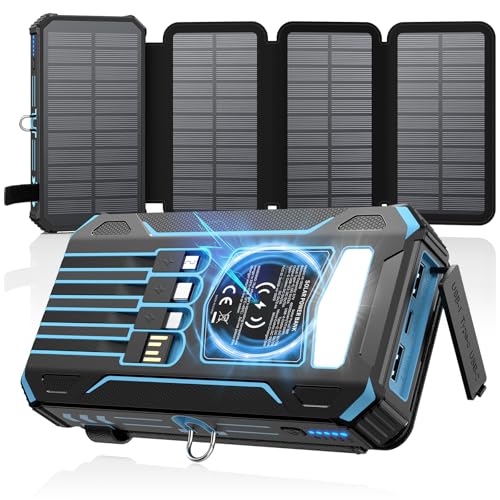
SOARAISE 48000mAh Solar Power Bank with Wireless Charging
A high-capacity solar power bank designed for extended outdoor trips, featuring four solar panels, wireless charging, and support for up to seven devices simultaneously. The 48000mAh battery and multiple built-in cables make it a versatile option for camping and travel scenarios.
Pros
- Large 48000mAh capacity offers substantial charging cycles for extended outdoor use
- Multi-cable setup with four built-in options and three ports provides flexibility for different device types
- Wireless charging pad adds convenience without requiring additional cables
- Four solar panels enable practical solar recharging during outdoor activities
- 5V/3A fast charging reaches significant battery percentages on compatible phones within 30 minutes
Cons
- No verified user reviews available to confirm real-world performance and durability
- Solar charging speed depends on weather and sunlight conditions, may not reliably sustain heavy device usage
- Larger 48000mAh capacity translates to significant weight and bulk compared to smaller power banks

SOARAISE 48000mAh Solar Power Bank with Wireless Charging
A high-capacity solar power bank designed for extended outdoor trips, combining a 48000mAh battery with four solar panels and wireless charging capability. Supports simultaneous charging of up to 7 devices through built-in cables and multiple ports.
Pros
- Large capacity suitable for multi-day camping and travel
- Built-in cable variety eliminates need for separate accessories
- Wireless charging pad adds convenience for compatible phones
- Multiple charging ports (2 USB-A, 1 USB-C) enable simultaneous device charging
- Solar panel array provides charging option without external power source
Cons
- No verified user reviews available to assess real-world performance and reliability
- Solar charging speed dependent on weather and sunlight conditions, making it supplementary rather than primary charging method
- Bulk and weight of 48000mAh capacity may limit portability for ultralight travel
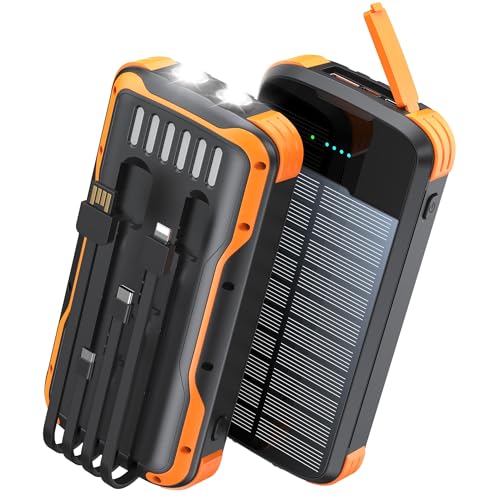
SOXONO 40000mAh Solar Power Bank with PD 20W Fast Charging
A rugged portable charger pairing substantial 40000mAh capacity with built-in cables, dual LED flashlights, and IP67 durability for outdoor use. The 20W PD fast charging and four light modes suit camping and emergency scenarios, though solar recharging remains inherently slow.
Pros
- Built-in multi-cable setup removes need for carrying separate chargers on trips
- Dual flashlights with steady, SOS, strobe modes provide practical outdoor emergency lighting
- Robust IP67 waterproof and shockproof design withstands camping and hiking conditions
- 20W PD Type-C enables fast charging for iPhones, Samsung, and most Android devices
- Large 40000mAh capacity provides multiple charges for extended outdoor use
Cons
- Solar charging is designed as emergency backup only; daytime recharging remains slow and impractical for daily use
- No verified buyer reviews to assess real-world reliability and long-term durability claims
- Heavy at 1.17 pounds, making it less ideal for ultralight backpacking trips

YOLOSKS 49800mAh Solar Power Bank with Wireless Charging
A high-capacity solar power bank designed for outdoor enthusiasts and frequent travelers, offering 6 simultaneous device charging through multiple ports plus wireless capability. The 49800mAh capacity and IP65 durability make it practical for extended trips, though solar charging speed depends heavily on light conditions.
Pros
- Multi-device charging with 6 simultaneous connections eliminates the need for multiple chargers
- Rugged IP65 design handles outdoor conditions including water, dust, and impact
- Fast charging speeds increased 50% via Type-C ports compared to standard models
- Wireless charging adds convenience for compatible phones without cable connection
- Built-in flashlight with multiple modes provides practical emergency utility
Cons
- Solar charging is significantly slower than USB charging and heavily dependent on light intensity, making it unreliable as primary charging method
- No verified user reviews available to confirm real-world performance and reliability claims
- Heavy at 1 pound makes it less portable compared to lighter power banks for daily carry

Voltset 12V 20W Solar Battery Charger with MPPT
A compact solar trickle charger designed for 12V batteries in RVs, boats, and vehicles. Features MPPT technology for faster charging, IP67 waterproofing, and compatibility with multiple battery types including LiFePO4 and AGM.
Pros
- Universal 12V battery compatibility across multiple chemistry types
- Rugged marine-grade construction rated for harsh outdoor conditions
- LED indicators provide real-time charging status feedback
- Built-in overcharge and reverse polarity protection extends battery life
- Compact form factor at 20W suitable for trickle charging applications
Cons
- No verified customer reviews available to assess real-world performance
- 20W output is relatively modest for larger battery banks, limiting charging speed
- Limited information on actual MPPT efficiency gains compared to basic PWM controllers
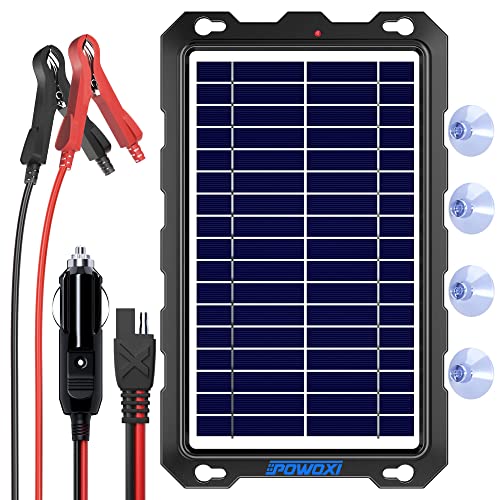
POWOXI 7.5W 12V Solar Battery Charger
A compact solar trickle charger designed for 12V batteries across cars, motorcycles, and recreational vehicles. Built-in smart protection prevents overcharging and short circuits, while the tempered glass panel resists weather damage without requiring maintenance.
Pros
- Solid build quality with impact-resistant glass and ABS/PC frame that won't damage vehicle paint
- Protects batteries from overcharging through smart controller technology
- Versatile compatibility across cars, motorcycles, boats, ATVs, and farm equipment
- No maintenance required once installed
- Clear LED indicators make it easy to verify charging status
Cons
- No verified buyer reviews available to assess real-world performance and longevity
- 7.5W output is relatively modest for larger battery recovery scenarios
- Relies entirely on sunlight availability, limiting use in cloudy climates or nighttime charging
Solar Chargers Buying Guide
Not every device with a solar panel on the label deserves the name. Before you commit to a purchase, it helps to understand the key variables that separate a genuinely capable solar charger from a marketing gimmick.
The sections below break down the criteria that matter most, drawn from expert consensus and real-world buyer experience across all major product types in this category.
Solar Panel Output vs. Battery Capacity
The single most misunderstood spec in this category is the relationship between rated wattage and actual output. A panel rated at 28W will rarely deliver that full figure in real-world conditions.
Expect roughly 60 to 80 percent of the rated wattage under strong, direct sunlight with optimal panel angle. Cloudy days, shade from trees, and suboptimal positioning can cut that figure dramatically.
For foldable solar panels like the BigBlue 28W or the FlexSolar 40W, higher wattage means faster direct charging for phones, tablets, and power banks.
Panels in the 25W to 40W range are the sweet spot for most backpackers and campers who want meaningful output without excessive bulk.
If you’re only maintaining a vehicle battery during storage, a 7.5W to 20W trickle maintainer is adequate and far more affordable.
For solar power banks, pay close attention to the ratio of battery capacity to integrated solar panel wattage. A 40,000mAh power bank with a 2W panel will take weeks to fully recharge via solar alone.
Treat the built-in panels on these devices as a supplemental trickle charge, not a primary energy source. If meaningful solar harvesting is your goal, pair a separate foldable panel with a standalone power bank instead.
Charging Ports and Fast-Charging Protocols
USB-C Power Delivery (PD) is now the standard for fast charging modern smartphones, tablets, and even some laptops. When evaluating any solar charger, check the maximum output wattage of the USB-C port.
A port that outputs only 5W over USB-C is functionally no faster than an old USB-A port.
Look for at least 18W to 20W PD output for meaningful phone charging speeds, and 45W or more if you want to top up a tablet or thin-and-light laptop in a reasonable timeframe.
Qualcomm Quick Charge (QC 3.0 or QC 4.0) on USB-A ports is a useful bonus for Android users whose devices support it.
The SOXONO and SOARAISE power banks in this roundup both include PD 20W outputs alongside QC 3.0, which covers the majority of current smartphones.
Dual-port foldable panels like the BigBlue 28W and the SOLUPUP 30W offer simultaneous USB-A and USB-C output, which is worth prioritizing if you regularly charge two devices at once.
For DC output, which matters if you want to charge a laptop or portable power station directly from a foldable panel, verify that the panel includes an appropriate DC connector and that its voltage output matches your device’s input range.
The FlexSolar 40W stands out in this roundup for offering USB-C, USB-A, and a DC output in a single foldable unit.
Solar Power Banks vs. Foldable Solar Panels

Understanding which product type fits your use case will save you from a frustrating purchase. Foldable solar panels have no internal battery.
They charge your devices directly from sunlight, which means output stops the moment cloud cover arrives or the sun moves.
They are lighter for their wattage, easier to daisy-chain with an external power bank, and generally deliver faster charging when conditions are right.
They’re the preferred tool for serious backpackers who want to keep a power bank topped up throughout the day while on the trail.
Solar power banks combine a battery with small integrated solar panels. You can charge the battery via solar during the day and draw from it at night or during bad weather.
The tradeoff is that their integrated panels are almost always low-wattage, and the solar recharge time for a large-capacity bank can be impractically long.
They shine as emergency backup devices, car-camping companions, or for travelers who want one device rather than a panel-plus-bank system. Pairing a solar power bank with the right backpacking tent gives you a complete off-grid kit for multi-day trips.
If your primary use is vehicle battery maintenance rather than personal device charging, the 12V trickle charger category is its own world.
Devices like the POWOXI 7.5W and the Voltset 20W are designed to be connected semi-permanently to a vehicle, boat, or RV battery to offset self-discharge during storage. They are not suitable for charging smartphones or USB devices.
Waterproofing and Durability Ratings

Outdoor use inevitably means exposure to moisture, dust, and physical stress.
When a solar charger claims to be waterproof, always look for a specific IP rating rather than vague language like “water-resistant” or “splash-proof.” IPX4 means it can handle splashing from any direction.
IPX5 offers protection against low-pressure water jets, which covers most rain scenarios. IPX6 and above adds resistance to powerful water jets and is the level you want for kayaking or heavy rain conditions.
The SOLUPUP 30W foldable panel carries an IPX5 rating, which is notable for a panel in its price range. Most solar power banks have IPX4 to IPX5 ratings.
Foldable panels from brands like BigBlue and FlexSolar use PET laminate or ETFE coatings on their solar cells, which improves both weather resistance and long-term durability compared to cheaper bare-cell designs.
Monocrystalline cells, which are standard across all reputable foldable panels in this roundup, also offer better performance in low-light conditions than older polycrystalline designs.
Build quality of the housing and cable management also matters for long-term reliability. Look for panels with reinforced corner grommets for hanging or mounting, and power banks with rubberized impact-resistant shells if they’ll be carried in a bag alongside heavier gear.
Weight and Packability

Weight is a critical variable for anyone carrying a solar charger on foot. Foldable solar panels are considerably lighter per watt of output than solar power banks, since they carry no battery weight.
A 28W foldable panel typically weighs under 500g, while a 40,000mAh solar power bank can weigh 600g to 900g depending on battery chemistry and casing.
If you’re committed to minimizing pack weight on long hikes, a lightweight foldable panel paired with a slim conventional power bank is usually the more efficient approach.
For car camping or basecamp use where weight is not a constraint, large-capacity solar power banks like the SOARAISE 48000mAh or YOLOSKS 49800mAh offer the convenience of multiple built-in cables, wireless charging, and flashlights in a single device.
These all-in-one designs appeal to campers who want to minimize the number of separate items in their kit. A well-chosen solar charger complements a complete camp setup that also includes quality family camping tents and other outdoor essentials.
12V Battery Maintainers: A Separate Use Case

If your goal is to keep a car, motorcycle, RV, or boat battery healthy during storage, a dedicated 12V solar battery maintainer is a fundamentally different product from a portable solar charger.
These devices connect via ring terminals or alligator clips to your vehicle battery and compensate for the natural self-discharge that causes batteries to fail over weeks or months of disuse.
Key specs to check are the panel’s open-circuit voltage (which must exceed 12V to charge a 12V battery), the presence of a blocking diode or charge controller to prevent reverse discharge at night, and whether the unit includes float-mode functionality for safe long-term connection.
The Voltset 20W stands out in this category for including a smart MPPT controller, which optimizes charging efficiency and prevents overcharging. The POWOXI 7.5W is a simpler, lower-cost option suited to smaller batteries like those found in motorcycles and ATVs.
Why You Should Trust Us
ProductFind is an independent review publication. Every product in this roundup was evaluated using a consistent, structured research methodology.
We assess each product against a defined set of criteria that includes verified technical specifications, published data from manufacturers, consensus from expert reviewers across reputable publications, and aggregated feedback from verified buyers.
Each product receives a PF Score on a scale of 0 to 10, reflecting its overall performance across all evaluated dimensions relative to others in its category.
We do not conduct our own product trials; our evaluations are grounded in research, published data, expert review consensus, and verified buyer feedback.
This approach allows us to assess a broad range of products systematically and without the brand relationships or sample loans that can influence some reviews.
Our editorial team has no direct relationship with BigBlue, BLAVOR, FlexSolar, SOLUPUP, Ryno Tuff, SolarTred, SOARAISE, SOXONO, YOLOSKS, Voltset, or POWOXI.
ProductFind may earn a commission if you purchase through links in this article. That affiliate relationship has no influence on PF Scores, product rankings, or editorial recommendations. Products are ranked by research merit, not by commission rate.
We recommend only products we would genuinely suggest to a friend asking for advice.
Final Thoughts
Solar chargers serve a wide range of use cases, and the strongest pick for a weekend backpacker looks very different from the best choice for a car camper or a boat owner.
After evaluating all twelve products in this roundup against consistent criteria, here are our standout picks by category:
- Best Overall: BigBlue 28W Solar Panel Charger earns the top spot with the highest PF Score in this roundup. Its combination of genuine 28W output, dual USB-C and USB-A ports, proven real-world performance across camping and hiking scenarios, and broad device compatibility makes it the most well-rounded solar charger in the group for active outdoor use.
- Best Solar Power Bank: BLAVOR Solar Power Bank 20000mAh earns the second-highest PF Score in the roundup. Wireless charging, 20W fast charging via USB-C, built-in cables, and a flashlight in a compact, well-built package make it the most capable solar power bank for travelers and campers who want all-in-one convenience.
- Best High-Wattage Panel: FlexSolar 40W Foldable Solar Panel Charger delivers the highest raw wattage among the foldable panels in this guide. Its three output types (USB-C, USB-A, and DC) give it the flexibility to charge laptops, portable power stations, and smartphones from a single panel, making it the most versatile option for base camp or overlanding setups.
- Best Budget Foldable Panel: SOLUPUP 30W Portable Foldable Solar Charger offers a strong combination of output, IPX5 waterproofing, and fast-charging ports at a lower price point than most competitors in its wattage class, making it an excellent entry point for those new to solar charging.
- Best for Vehicle Battery Maintenance: Voltset 20W Solar Battery Charger stands out in the 12V maintainer category for its smart MPPT controller, which provides safer and more efficient charging than basic panel-only maintainers, making it the top choice for RV, boat, and car owners looking to protect their batteries during extended storage.
For most campers and hikers looking for a single device that handles direct panel charging reliably, the BigBlue 28W is the clear starting point.
If you prioritize stored energy and overnight charging capability, the BLAVOR power bank is worth a close look. And if you’re outfitting a basecamp or overlanding rig, the FlexSolar 40W gives you the output headroom to power larger devices.
Whatever your use case, the picks above represent the most defensible choices in a crowded and often overhyped category.
Frequently Asked Questions
How long does it take to charge a phone with a solar charger?
Charging time depends heavily on the panel’s output wattage and available sunlight. A 28W foldable panel in direct sunlight can charge a modern smartphone in roughly one to two hours under good conditions, similar to a standard wall charger.
Output drops significantly under cloud cover or in partial shade, which can extend that time considerably. For reliable charging speeds, prioritize panels with 20W or higher output and ensure the USB-C port supports Power Delivery.
Can a solar power bank fully recharge itself using its built-in solar panels?
In theory, yes. In practice, the integrated solar panels on most power banks are low-wattage trickle chargers that can take days or even weeks to fully replenish a large-capacity battery.
A 40,000mAh to 50,000mAh power bank with a 2W integrated panel could require more than 100 hours of direct sunlight to charge from empty to full via solar alone.
Use the solar feature for supplemental top-ups and always carry a USB-C cable for wall or car charging when accessible.
What is the difference between a solar charger and a solar battery maintainer?
A portable solar charger (panel or power bank) is designed to charge consumer electronics: phones, tablets, cameras, and similar devices.
A solar battery maintainer is designed to connect to a 12V lead-acid battery in a vehicle, boat, or RV to offset self-discharge during storage. The two product types are not interchangeable.
A 12V maintainer like the POWOXI or Voltset will not charge your smartphone, and a foldable USB panel will not maintain a car battery. Choosing the right category is the first decision to make before comparing individual models.
Is an expensive solar charger worth the price over a budget option?
In solar chargers, the gap between advertised and real-world performance is wider than in almost any other electronics category. Budget panels frequently use lower-efficiency solar cells, weaker build quality, and inaccurate wattage claims that result in disappointing real-world output.
The consensus from verified buyers and expert reviewers consistently shows that mid-range and premium panels from established brands deliver output closer to their rated specs and hold up better over time.
For occasional emergency backup, a budget solar power bank may be sufficient. For regular outdoor use, investing in a proven mid-range or premium option typically pays off in reliability and actual charging speed.
Can I use a solar charger to power a camping lantern or other camp accessories?
Yes, provided your solar charger has the right output ports and your accessory is USB-compatible or has a USB charging adapter.
Most camping setups that rely on USB-powered lanterns, fans, or radios can be fed directly from a solar power bank or charged through a foldable panel during daylight.
For higher-draw devices like LED light systems or small appliances, you’ll need a portable power station with a DC or AC output rather than a standard USB solar charger.
Always check the wattage draw of your accessories against your charger’s maximum output before assuming compatibility.
What features should I look for in a solar charger for emergency preparedness?
For emergency use, prioritize a solar power bank over a panel-only device, since stored energy is available immediately regardless of weather or time of day.
Look for a unit with multiple output ports to charge more than one device simultaneously, a built-in LED flashlight (present on the BLAVOR, SolarTred, SOARAISE, and SOXONO models in this roundup), and a durable, water-resistant casing.
A USB-C input for fast recharging from a wall outlet between emergencies is also important, so the battery is full when you actually need it.
Pairing a capable solar power bank with a reliable battery-powered radio or other emergency tools rounds out a solid preparedness kit.
About the author
Vernon is a reviewer and writer for ProductFind who specializes in Camping & Hiking. Vernon evaluates products through independent research: specifications, expert review consensus, and verified buyer feedback, and rates each one on the PF Score. Vernon focuses on helping readers pick the right camping & hiking for their needs and budget.