The 12 Best Thermal Imaging Cameras
From electrical diagnostics to building inspections, thermal imaging cameras surface problems invisible to the naked eye. Here are the top picks across every price range.
 By Noelle Gray
Updated July 23, 2026
By Noelle Gray
Updated July 23, 2026
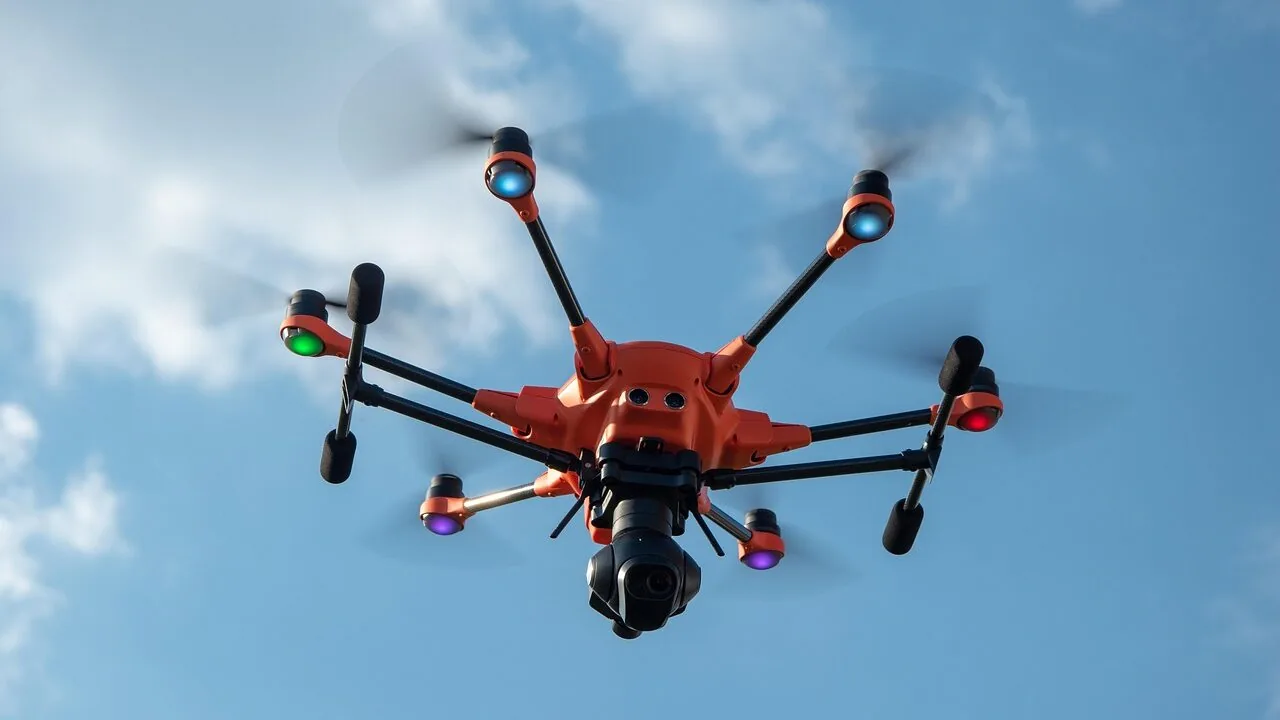
Thermal imaging cameras have quietly moved from expensive professional tools into genuinely practical gear for electricians, HVAC technicians, building inspectors, and serious DIYers.
Whether you are hunting down a hidden air leak before winter, diagnosing an overheating circuit breaker, or surveying moisture damage behind a wall, the right thermal imager gives you information that no ordinary flashlight or multimeter can surface.
The market now spans a wide price spectrum, from compact budget-friendly handheld units to professional-grade systems with high-resolution sensors and cloud connectivity, so matching the right camera to your actual workload matters more than ever.
At ProductFind, we cut through the noise by synthesizing manufacturer specifications, expert review consensus from industry publications, and verified buyer feedback from confirmed purchasers to help you make a confident, well-informed decision.
Every model below has been assessed against a consistent set of criteria and scored on our 0 to 10 PF Score scale. Read on for our top picks across every budget and use case.
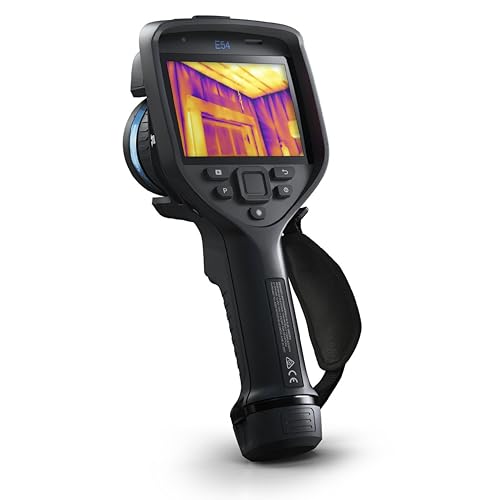
FLIR E54 Thermal Camera 320x240
Professional-grade thermal imager with 320x240 resolution and MSX visual enhancement for detailed heat mapping across -20°C to +650°C range. The 4-inch touchscreen and METERLiNK integration make it practical for electrical and building diagnostics work.
Pros
- Solid infrared resolution with MSX enhancement for sharper thermal detail
- Large touchscreen interface improves on-site usability
- METERLiNK integration streamlines electrical diagnostics workflow
- Wide temperature range suitable for HVAC, electrical, and industrial applications
- Portable at under 2.3 pounds
Cons
- No verified customer reviews available to assess real-world reliability
- Premium price positioning limits accessibility for occasional users
- Class II laser output requires proper safety protocol awareness

TOPDON TC004 Mini Thermal Camera, 128x128 IR
Compact handheld thermal imager with 128x128 native resolution expandable to 240x240 via TISR, suited for electrical inspections, HVAC diagnostics, and leak detection. Delivers 15-hour battery life and auto-capture on temperature alerts, though the 4.3 rating reflects limited verified user feedback.
Pros
- Extended 15-hour runtime minimizes downtime during long inspection days
- Automatic photo capture on temperature alerts saves documentation steps
- Durable construction with IP54 rating and 2-meter drop tolerance suits field work
- Wide 40° x 30° field of view and 25Hz refresh rate provide smooth, detailed thermal mapping
- Temperature accuracy within ±3.6°F/2% and 5-point color palette flexibility
Cons
- No charging head included in package, requires separate purchase or existing USB adapter
- Electronic manual only via QR code scanning; no printed documentation
- 128x128 native resolution is modest compared to higher-end thermal imagers, though TISR enhancement helps

FLIR E6-XT Thermal Camera with WiFi
A handheld thermal imaging camera designed for professionals needing to diagnose equipment failures and building issues. The E6-XT captures temperatures from -20°C to 550°C with 240x180 resolution and MSX technology for sharper thermal images, plus cloud integration for easy image management.
Pros
- MSX technology produces clearer, more interpretable thermal images by embedding visual context
- Cloud connectivity streamlines workflow with automatic image storage and team collaboration through FLIR Ignite App
- Extended temperature measurement range accommodates industrial troubleshooting and HVAC diagnostics
- Lightweight and handheld design suitable for frequent on-site inspections
Cons
- No verified customer reviews available to validate real-world performance and reliability
- 240x180 resolution is entry-level for thermal imaging, limiting detail in larger inspection areas
- Requires separate FLIR Ignite subscription or service for full cloud functionality benefits

TOPDON TC004 3.5" Thermal Camera, 512x384 Resolution
A rugged handheld thermal imager designed for field inspections, the TC004 combines a large 3.5-inch display with enhanced 512x384 infrared resolution for detecting temperature variations. Built-in Wi-Fi, 64GB storage, and IP54 durability make it practical for professionals who need portable, documented thermal analysis.
Pros
- Large display and enhanced resolution provide detailed thermal clarity for spot identification
- Substantial 64GB storage eliminates worry about running out of space during workdays
- Wi-Fi sync with TopInfrared app enables faster reporting and on-site analysis
- IP54 protection and drop resistance built for demanding field environments
- Red laser pointer simplifies matching thermal hotspots to physical locations
Cons
- No verified user reviews available yet, limiting real-world feedback on performance and reliability
- Requires TopInfrared app ecosystem for full functionality, adding dependency on software
- Enhanced 512x384 resolution relies on TISR interpolation rather than native sensor resolution

FLIR C5 Compact Thermal Camera with WiFi
A handheld thermal imager designed for professionals in electrical, mechanical, and HVAC diagnostics. The C5 delivers 160x120 thermal resolution with MSX technology to overlay visual details, plus cloud connectivity for quick report generation and sharing.
Pros
- MSX technology makes thermal images clearer and easier to interpret than standard IR
- Cloud connectivity streamlines workflow, allowing direct image sharing and report generation from the field
- Wide temperature measurement range (-20 to 400°C) suits diverse inspection scenarios
- Extensive warranty protection, especially the 10-year detector coverage, reflects product durability confidence
Cons
- 160x120 pixel resolution is modest by current standards and limits fine detail detection
- No verified customer reviews available to assess real-world reliability and user experience
- Premium positioning may not suit occasional users or hobbyists with tighter budgets

Klein Tools TI290 Thermal Imaging Camera, 76,800 Pixels
A mid-range thermal imager designed for HVAC technicians and electricians who need reliable hot and cold spot detection. Built-in Wi-Fi connectivity and adjustable emissivity make it practical for field work, though the lack of verified reviews limits confidence in real-world durability claims.
Pros
- High pixel count delivers clear thermal detail for troubleshooting
- Wi-Fi connectivity streamlines data sharing and documentation
- Adjustable temperature alarms and emissivity settings cover varied professional needs
- Compact, lightweight design with carrying pouch and carabiner
- Proven drop durability at 6.6 feet reduces replacement concerns
Cons
- No verified customer reviews available, making field reliability unconfirmed
- Limited temperature range compared to premium thermal cameras in industrial settings
- Dependent on Klein Tools app for full functionality, requiring compatible smartphone

Klein Tools TI250 Thermal Imager, 19,200 Pixels
Klein Tools' TI250 offers thermal imaging with 19,200-pixel resolution and adjustable emissivity for accurate temperature readings across various materials. The rechargeable battery, USB-C storage, and included carrying case make it practical for field technicians and maintenance professionals.
Pros
- High pixel resolution enables accurate identification of thermal anomalies
- Adjustable emissivity ensures reliable readings on different surface types
- Rechargeable battery reduces long-term operating costs
- Includes carrying case and all accessories for immediate field deployment
- Temperature alarm functionality helps monitor critical conditions
Cons
- No verified buyer reviews available to assess real-world reliability and durability
- Limited information on battery life per charge or thermal sensitivity specifications
- Color palette selection, while versatile, may require learning curve for optimal image interpretation

RIDGID RT-7X Thermal Imaging Camera with Wi-Fi
The RT-7X is a handheld thermal camera designed for building diagnostics and system troubleshooting, combining infrared imaging with digital snapshots and wireless connectivity. Its automated Scale Assist and emissivity correction features simplify analysis, while the rugged construction suits job-site demands.
Pros
- 240 x 180 pixel infrared resolution, expandable to 480 x 360 via Super Resolution technology for detailed thermal imagery
- Wi-Fi connectivity with iOS/Android app support enables wireless data transfer and remote report sharing
- Automated Scale Assist and emissivity correction reduce user error in thermal measurements
- Integrated digital camera provides context alongside thermal data
- Ruggedized design with industry-leading warranty for durability
Cons
- No verified customer reviews available to confirm real-world performance or reliability claims
- Thermal resolution of 240 x 180 pixels is relatively basic compared to premium industrial thermal cameras
- Super Resolution enhancement is software-based rather than native sensor capability, with variable accuracy

Thermal Master Thor 002 Handheld Thermal Camera, 512×384
A professional-grade handheld thermal imager with 512×384 resolution, 40mK sensitivity, and a 3.5-inch IPS display for electrical, HVAC, and building inspections. Offers wireless connectivity, 10.5-hour battery life, and dual cameras for comprehensive thermal diagnostics.
Pros
- High thermal resolution and sensitivity enable precise defect detection across electrical, mechanical, and building systems
- Extended battery life and fast 18W charging minimize downtime on job sites
- Dual connectivity options (USB, WiFi, mobile) and 32GB storage simplify data management and on-site documentation
- Rugged construction with IP54 protection handles demanding field conditions
- 4.3mm lens with 4X digital zoom covers both close-up and wide-area inspections
Cons
- No verified buyer reviews available to validate real-world performance claims
- 4.3-pound weight and handheld form factor may cause fatigue during extended inspections
- Professional-grade features suggest a premium price point, potentially limiting adoption for casual or DIY users

FOXWELL RT280 Thermal Camera, 320x240 LCD
A handheld thermal imager designed for home inspections, electrical diagnostics, and mechanical troubleshooting. It captures detailed thermal images on a 2.8-inch screen with TISR resolution enhancement, PC analysis software, and 8GB onboard storage for over 20,000 images.
Pros
- TISR resolution enhancement captures fine temperature details for precise inspections
- Comprehensive PC analysis software with point, line, area temperature tools and automatic report generation
- Substantial onboard storage eliminates frequent data transfer during jobs
- High/low temperature alarms with visual and auditory alerts for hazard detection
- Rugged IP54 design and drop resistance suitable for demanding field environments
Cons
- No Mac compatibility for PC analysis software, Windows-only limitation
- No verified user reviews available to assess real-world reliability or long-term durability
- 25Hz frame rate and 240x180 TISR resolution are entry-level specs compared to professional-grade thermal cameras
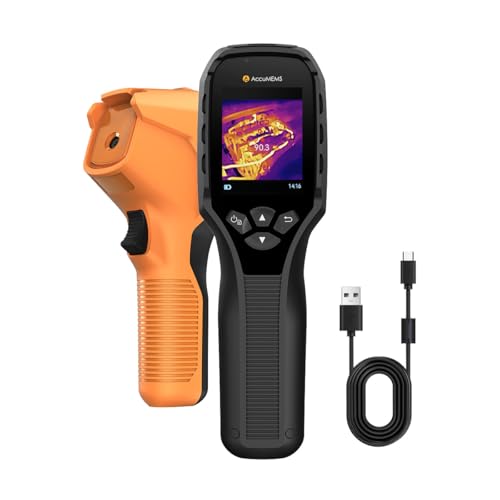
AccuMEMS GT14S Thermal Imaging Camera, -4°F to 1202°F
A compact dual-mode thermal imager combining full-screen thermal imaging with point-and-shoot thermometer readings across a -4°F to 1202°F range. Its 14-hour battery life and lightweight 240g design suit technicians and inspectors needing all-day mobile thermal monitoring without frequent recharging.
Pros
- Combines thermal imaging with thermometer mode in one device, reducing need for multiple tools
- 14-hour battery supports full workday inspection without recharging downtime
- High thermal sensitivity (NETD < 50mK) detects subtle temperature variations for precise diagnostics
- 50-degree wide field of view enables faster coverage of large inspection areas
- Lightweight compact design (240g) with balanced ergonomics for extended handheld use
Cons
- No user reviews available yet, limiting real-world performance and reliability feedback
- Fixed 240g form factor and non-slip grip design may not suit all hand sizes or preferences
- Title specification lists 1022°F max range, but product title claims 1202°F, creating clarity inconsistency

Flagfront YXI96 240x240 Thermal Camera
A handheld thermal imager with 240x240 resolution and 25Hz refresh rate, designed for home inspections, automotive diagnostics, and electrical troubleshooting. Built-in temperature alarm and six color palettes offer practical flexibility, though the lack of verified reviews limits confidence in real-world performance claims.
Pros
- Wide measurement range covers both freezing diagnostics and high-heat industrial applications
- Temperature alarm function speeds up abnormal hotspot identification during inspections
- Rugged design rated for drop impacts and harsh job site conditions
- Multiple color palette options adapt to different visual preferences and lighting conditions
- Handheld portability makes it accessible for residential water leak and electrical circuit inspections
Cons
- No verified buyer reviews available, making real-world durability and accuracy claims unvalidated
- 240x240 resolution is basic compared to thermal cameras in higher price tiers
- Accuracy of 2% requires manual emissivity adjustments, which adds interpretation complexity for casual users
Thermal Imaging Cameras Buying Guide
Choosing among thermal imaging cameras means weighing several technical and practical factors simultaneously. Resolution, temperature range, refresh rate, battery life, and connectivity all affect how useful a unit is in the field.
The sections below break down each criterion so you know exactly what to prioritize for your application.
If your broader diagnostic toolkit is still taking shape, pairing a thermal imager with quality digital multimeters covers the vast majority of electrical and HVAC troubleshooting scenarios.
IR Resolution and Image Quality
Infrared resolution is the single most important spec on a thermal camera. It tells you how many individual temperature data points the sensor captures in one frame.
Entry-level units typically offer 80×60 or 120×90 native pixels, which is enough to detect a hot breaker panel or a cool patch of wall insulation, but will look blocky when you zoom in.
Mid-range cameras in the 160×120 to 256×192 class offer noticeably sharper images that make it easier to pinpoint problems rather than merely identify that a problem exists.
Many manufacturers now advertise a “TISR” or super-resolution figure that is a multiple of the native IR count.
This is a software-interpolated number generated by combining multiple frames, and while it genuinely improves apparent detail in still images, it does not equal native resolution of the same pixel count.
A camera with 128×128 native IR and 240×240 TISR will still outperform an 80×60 native sensor, but it will not match a true 256×192 native imager. When comparing models, always look at native IR resolution first, then consider TISR as a secondary refinement.
Professional models like the FLIR E54 and FLIR E6-XT push native resolution to 320×240 and above, delivering images sharp enough for detailed electrical inspections and building science reports where fine temperature gradients matter.
For general home and light commercial use, a 160×120 or 256×192 native sensor hits an excellent balance of performance and cost.
Temperature Range and Sensitivity
Temperature range determines which applications a camera can cover. Most consumer and light-professional units measure from around minus 20°C up to 300°C or 400°C, which comfortably handles HVAC inspection, electrical panels, building envelopes, and automotive engine bays.
If you regularly work around industrial furnaces, kilns, or high-voltage switchgear, look for units rated to 650°C or beyond, such as the FLIR E54 Advanced, which reaches 650°C.
Thermal sensitivity, also called NETD (Noise Equivalent Temperature Difference), tells you the smallest temperature difference the sensor can detect. A lower NETD means the camera picks up subtler thermal variations.
Professional-grade cameras typically achieve NETD values of 40 mK or better, which is meaningful when you are searching for a hairline moisture intrusion or a barely warm motor bearing.
Budget units often sit at 70 mK to 100 mK, which is still perfectly usable for detecting significant heat sources like missing insulation or a failing circuit breaker.
Refresh Rate and Real-Time Usability
Refresh rate is measured in hertz and describes how many frames per second the thermal sensor updates. The industry standard for smooth, real-time use is 25 Hz.
At this rate, the image feels live and responsive, making it easy to scan a wall or trace a pipe while moving the camera naturally. Some budget models drop to 8 or 9 Hz, which produces a slightly choppy, laggy image.
This is workable for static spot measurements but becomes frustrating when you are sweeping across a large surface looking for a thermal anomaly.
In the United States, many thermal cameras sold by non-FLIR brands are capped at 9 Hz due to export regulations from the ITAR framework; cameras sold as 25 Hz are typically manufactured outside those restrictions or use uncooled sensors not subject to the same controls.
If smooth live scanning is important to your workflow, confirm the stated refresh rate is a genuine sensor rate and not just a video recording frame rate.
Battery Life and Field Endurance

Battery life ranges dramatically across the category. Compact units built around smartphone-style batteries can run from 6 to 8 hours of continuous use, which covers a full inspection day for most professionals.
Some newer designs, including the TOPDON TC004 Mini and Flagfront models, advertise 15 hours or more, making them practical for extended site visits without access to charging.
Rechargeable via USB-C is now the norm at mid-range and above, which means a power bank can keep you running all day.
Larger professional units often use removable Li-ion battery packs that can be swapped in the field, a real advantage when you are working a multi-building inspection route.
Pay attention to whether the battery is user-replaceable, particularly if you plan to use the camera for mission-critical commercial work where downtime is expensive.
Display, Ergonomics, and Build Quality

The built-in screen size and quality directly affects how comfortable it is to work in tight spaces or bright ambient light.
A 3.5-inch IPS display like that on the TOPDON TC004 (full-size) is large enough to evaluate images without squinting; smaller 2-inch screens on budget units are adequate but limiting.
Some cameras also include a built-in visible-light digital camera that overlays or blends with the thermal image, a feature called MSX or picture-in-picture fusion, which dramatically improves your ability to identify exactly where a thermal anomaly sits within a structure.
Build quality and ingress protection (IP) rating matter if you work in dusty environments, outdoors in rain, or on construction sites. An IP54 or IP65 rating provides meaningful protection against dust ingress and water splashes.
The Klein Tools TI250 and TI290 are notable for their rugged, tool-grade build quality aimed at electricians and contractors.
Grip design, button layout, and weight (most units fall between 200 g and 400 g) also affect how fatiguing extended single-handed use becomes during a long day on site.
Good safety glasses round out the personal protective equipment picture when working around live electrical panels where these cameras are most commonly deployed.
Connectivity, Software, and Workflow Integration

Wi-Fi connectivity has become a standard feature at mid-range and above, enabling wireless image transfer to a smartphone or laptop for faster report generation.
FLIR’s ecosystem stands out here: the FLIR E6-XT connects to the FLIR Ignite cloud platform, which stores images and supports collaboration across teams, while FLIR Tools software on PC provides in-depth radiometric analysis of every captured frame.
Klein Tools TI290 similarly offers Wi-Fi data transfer for streamlined job documentation.
PC analysis software matters if you need to produce professional inspection reports. Most mid-range brands now bundle desktop software that lets you re-analyze stored images, adjust color palettes, mark temperature spots, and export annotated reports.
Storage capacity is also worth checking: 8 GB is sufficient for occasional use, while 64 GB of onboard storage on the TOPDON TC004 (full-size) accommodates long-term field archiving.
Professionals who regularly output detailed reports will also find value in complementary oscilloscopes for diagnosing complex electrical waveform issues that thermal imaging alone cannot reveal.
Why You Should Trust Us
ProductFind is an independent review publication with no commercial relationship to any manufacturer in this guide.
Every thermal imaging camera listed here was assessed through our structured research process: we analyze publicly available technical specifications, cross-reference expert review consensus from engineering and trades publications, evaluate verified buyer feedback from confirmed purchasers across major retail platforms, and consult published performance data from industry sources.
Each model receives a PF Score on a consistent 0 to 10 scale that weights IR resolution, temperature accuracy, build quality, workflow features, and value relative to price tier.
We do not conduct our own product trials; our evaluations are grounded in research, published data, expert review consensus, and verified buyer feedback.
ProductFind may earn a commission if you purchase through links on this page. That affiliate relationship has no influence whatsoever on scores, rankings, or which products are included or excluded.
Our recommendations are editorially independent and change only when the evidence warrants it. ProductFind does not sell products, process orders, or handle warranty or return inquiries.
Final Thoughts
The thermal imaging camera market in 2026 spans a genuinely wide range of capability and price, and the right choice depends almost entirely on how you plan to use it.
Occasional homeowners locating drafts and insulation gaps are well served by compact, budget-friendly options. Electricians, HVAC technicians, and building inspectors need higher native resolution, robust build quality, and reliable software ecosystems.
Here are our standout picks by use case based on PF Score and research findings:
- Best Overall: FLIR E54 Advanced Thermal Imaging Camera earns the top overall spot with the highest PF Score in this roundup, combining professional 320×240 native resolution, a broad temperature ceiling, and a field-proven FLIR software ecosystem that serious inspectors depend on.
- Best Value Under Mid-Range: TOPDON TC004 Mini Thermal Imaging Camera punches well above its price tier with a 25 Hz refresh rate, 15-hour battery life, and a compact form factor that makes it easy to carry on any job, earning it the second-highest PF Score in the group.
- Best for HVAC and Light Commercial Work: FLIR E6-XT Commercial Thermal Imaging Camera combines Wi-Fi, FLIR Ignite cloud integration, and a reliable 240×180 sensor in a package trusted by professional building scientists and HVAC contractors globally.
- Best Budget Pick: TOPDON TC004 (3.5-inch) delivers a large display, 64 GB of onboard storage, and 512×384 TISR resolution at a mid-range price that makes it the most capable value option for users who want a capable daily driver without the professional price tag.
- Best for Tradespeople and Contractors: Klein Tools TI290 Rechargeable PRO Thermal Imaging Camera is engineered specifically for electricians and contractors, offering over 76,800 pixels, Wi-Fi data transfer, and the kind of rugged, tool-grade durability that Klein Tools is known for across its entire product line.
Whichever model you choose, pairing your thermal imager with reliable digital multimeters and keeping your workspace well-lit with quality table lamps at your bench makes for a far more effective diagnostic setup overall.
Frequently Asked Questions
What is a thermal imaging camera used for?
Thermal imaging cameras detect and visualize heat emitted by objects, surfaces, and living things.
Common professional applications include finding missing or damaged insulation in walls and ceilings, locating overheating electrical components before they fail, identifying moisture intrusion and water damage behind finished surfaces, and diagnosing HVAC inefficiencies.
Homeowners use them to find drafts around windows and doors, locate radiant heat pipes in floors, and check for pest activity in wall cavities. Industrial users apply them to predictive maintenance on motors, bearings, and industrial equipment.
What IR resolution do I actually need?
For casual home use such as finding drafts or checking a breaker panel, an entry-level unit with 80×60 to 120×90 native IR pixels is workable, though the image will look coarse.
For regular professional use, a minimum of 160×120 native pixels is recommended, and 256×192 or 320×240 delivers a noticeably clearer, more actionable picture.
If you are producing inspection reports for clients or working on complex building science assessments, aim for the highest native resolution your budget allows. Advertising a high TISR number does not replace a higher native sensor count.
How does a thermal camera differ from a regular infrared thermometer?
A standard infrared thermometer gives you a single temperature reading from one spot, which is useful but tells you nothing about the thermal distribution across an entire surface.
A thermal imaging camera captures thousands of temperature data points simultaneously and displays them as a color-coded image, allowing you to see patterns, gradients, and anomalies across a whole wall, panel, or machine at once.
This spatial context is what makes thermal cameras so much more powerful for diagnostic work. Think of it as the difference between knowing one pixel of a photograph versus seeing the entire frame.
Are budget thermal cameras worth buying?
Budget thermal cameras have improved substantially and are genuinely useful for non-critical applications. Models like the TOPDON TC004 Mini and Flagfront units deliver real thermal imaging at accessible price points that would have been unimaginable a few years ago.
Their limitations, such as lower native IR resolution, smaller displays, and fewer software features, matter most when fine spatial detail or precise temperature accuracy is required.
For a homeowner who wants to identify energy-loss hotspots or find a drafty window, a well-chosen budget unit will absolutely get the job done.
For professional inspectors who need defensible data and client-ready reports, investing in a mid-range or premium camera pays back quickly in accuracy and credibility.
Can I use a thermal imaging camera for electrical inspections?
Yes, and electrical inspection is one of the most compelling use cases for thermal cameras.
Overloaded circuits, failing breakers, loose terminal connections, and imbalanced three-phase loads all produce heat that shows up clearly in a thermal image before any visible sign of failure appears.
For this application, a camera with at least 160×120 native resolution and a temperature range reaching 300°C or higher is recommended, along with a fast 25 Hz refresh rate for comfortable panel scanning.
Always follow appropriate lockout/tagout and electrical safety protocols; a thermal camera is a diagnostic aid, not a substitute for safe work practices.
Complementing your thermal work with oscilloscopes helps diagnose harmonic distortion and waveform anomalies that heat signatures alone may not reveal.
Does Wi-Fi connectivity matter on a thermal camera?
Wi-Fi is most valuable for professionals who need to transfer and annotate images quickly between the camera and a laptop or smartphone on-site.
It eliminates the need to carry cables, speeds up report preparation, and enables cloud backup of inspection records. For cloud-based workflows, FLIR’s Ignite platform is the most mature ecosystem available.
Casual users and homeowners who only occasionally review images will find wired USB transfer or a simple SD card slot perfectly adequate.
Wi-Fi connectivity is worth prioritizing if you are building a professional inspection business where documentation speed and organization directly affect your productivity.
About the author
Noelle is a reviewer and writer for ProductFind who specializes in Test & Measurement. Noelle evaluates products through independent research: specifications, expert review consensus, and verified buyer feedback, and rates each one on the PF Score. Noelle focuses on helping readers pick the right test & measurement for their needs and budget.