The 12 Best Voltage Testers
Picking the right voltage tester matters more than most people realize. This guide covers non-contact pens, outlet testers, and full kits from KAIWEETS, Klein Tools, and more.
 By Noelle Gray
Updated July 23, 2026
By Noelle Gray
Updated July 23, 2026

Working safely around electricity starts with one indispensable tool: a reliable voltage tester.
Whether you are a licensed electrician tracing a live circuit, a homeowner replacing an outlet, or a HVAC technician diagnosing a control board, knowing definitively whether voltage is present can mean the difference between a finished job and a serious injury.
The market is crowded with options ranging from simple non-contact pens that cost less than a lunch to comprehensive electrical evaluation kits that cover nearly every diagnostic scenario a professional might face.
Brands like KAIWEETS, Klein Tools, Neoteck, VENLAB, NSI, and AstroAI each take a different approach to detection range, display quality, and feature depth, which makes choosing the right one genuinely confusing without a clear framework.
ProductFind evaluated every model in this list through comprehensive research synthesis, drawing on published product specifications, expert review consensus from the electrical trade and tool communities, and verified buyer feedback from thousands of confirmed purchases.
If you are pairing your voltage work with deeper diagnostics, our guide to digital multimeters covers the full spectrum of bench and field meters worth considering.
Scroll down to see our ranked picks, then use the buying guide below to match the right type of tester to your specific needs.

KAIWEETS HT100s Non-Contact Voltage Tester 12-1000V
A compact non-contact voltage tester designed for electricians and homeowners to safely detect live wires and identify breakpoints across standard and low voltage circuits. Dual-range sensitivity, visual feedback with LED and percentage display, and automatic live/neutral wire detection make it practical for typical household electrical work.
Pros
- Intuitive non-contact operation reduces electrical hazard exposure during wire detection
- Signal percentage bar graph and color-coded screen display (red for live, green for neutral) provide clear voltage intensity feedback
- Adjustable sensitivity setting via S button allows adaptation to different voltage environments including low-voltage systems
- Meets international safety standards (IEC CAT III/IV, CE certified) with high-voltage alert warning above 90V
- Pocket-friendly ergonomic design with integrated flashlight for dimly lit work areas
Cons
- No verified buyer reviews available to assess real-world reliability or durability claims
- Automatic power-off after 5 minutes may interrupt extended diagnostic work requiring manual reactivation
- Specifications lack detail on battery type, runtime, or replacement frequency for maintenance planning

Klein Tools NCVT1P Non-Contact Voltage Tester
A compact non-contact voltage tester for AC detection across 50 to 1000V, designed for electricians and DIY users working with standard outlets and wiring. Features audible and LED alerts, auto power-off, and CAT IV 1000V safety rating for reliable detection without direct contact.
Pros
- Non-contact design eliminates direct electrical contact risk
- Clear dual-alert system with both audible beep and visual LED feedback
- Wide voltage range covers most residential and light commercial applications
- Compact form factor with pocket clip for portability
- Drop protection rated to 6.6 feet indicates durability
Cons
- Not recommended for tamper-resistant outlets; requires different model (NCVT-2P or NCVT-3P) for that use
- No verified buyer reviews available to assess real-world reliability
- Auto power-off function may need frequent re-activation during extended use

Klein Tools MM320KIT Digital Multimeter Electrical Test Kit
This all-in-one electrical testing kit bundles a digital multimeter, non-contact voltage tester, and receptacle tester with carrying case for residential and light commercial work. It covers voltage, current, resistance, continuity, and common wiring faults in one package.
Pros
- Comprehensive testing capabilities with three separate tools designed to work together
- Wide voltage range (12V to 1000V AC) handles both low-voltage and standard residential circuits
- Non-contact voltage tester includes flashlight for improved visibility in dark areas
- Receptacle tester specifically identifies common wiring problems like reverse polarity and open ground
- Includes carrying case for portability and tool organization
Cons
- No verified buyer reviews available to assess real-world durability and reliability
- Digital multimeter current measurement limited to 10A DC, which may restrict testing of higher-load circuits
- Resistance measurement limited to 2 ohms, limiting diagnostics for some applications

KAIWEETS KIT01 3-in-1 Electrical Test Kit
A complete diagnostic package combining digital multimeter, non-contact voltage detector, and GFCI outlet tester in one carrying case. Designed for electricians and DIYers who need multiple tools without separate purchases.
Pros
- Bundles three separate diagnostic tools, eliminating multiple purchases and reducing setup time on jobs
- Non-contact voltage pen includes flashlight and visual/audio alerts with percentage readouts
- All three testers arrive with batteries and carrying case, ready to use out of box
- GFCI tester displays wiring configuration codes and freezes results for easy reading
- Comprehensive safety ratings across all three devices
Cons
- No verified customer reviews available to assess real-world reliability or durability
- GFCI tester limited to CAT II 125V rating, lower than the multimeter and voltage detector
- Battery-powered design requires ongoing AAA battery replacement for continued use

Klein Tools 80077 3-Piece Voltage Test Kit
A practical three-tool kit combining AC/DC voltage detection, non-contact testing, and GFCI outlet diagnosis in one package. Best suited for homeowners and electricians who need reliable voltage identification across standard residential circuits.
Pros
- Multi-function kit eliminates need for separate testers
- LED indicators provide clear voltage type and level identification
- Non-contact detection adds safety when testing live circuits
- GFCI tester confirms protective device operation
- Lightweight at 0.46 pounds for portability
Cons
- No user reviews available to verify real-world reliability claims
- DC voltage range limited to 1.5-24V, may not cover specialized applications
- Product lacks detailed specifications on LED accuracy or response time

KAIWEETS 2-Piece Voltage and GFCI Outlet Tester Kit
This two-tool kit combines a non-contact voltage tester with dual ranges (12-1000V AC) and a dedicated GFCI outlet tester, both featuring LCD displays and LED indicators for clear readings in various lighting conditions. Well-suited for electricians and DIYers who need reliable fault detection without breaking the budget.
Pros
- Comprehensive 2-in-1 kit covers both voltage detection and outlet testing needs
- Clear visual and audible alerts (LED flashing, beeping) work in noisy or dim environments
- Auto shut-off and low-battery indicator on voltage tester extend tool lifespan
- Compact design with Auto Hold function allows testing in tight or hard-to-reach spaces
- Meets strict international safety standards for reliable electrical work
Cons
- No verified buyer reviews available to assess real-world durability or ease of use
- Dual-range voltage tester has separate ranges (12-1000V and 70-1000V AC) rather than single unified scale
- Limited documentation on sensitivity adjustment steps for non-contact mode in various materials

Klein Tools CL120VP Clamp Meter & 3-Tester Kit
A comprehensive electrical testing bundle combining a clamp meter with GFCI receptacle tester and non-contact voltage detector. Designed for electricians and maintenance professionals who need multiple diagnostic tools in one kit, with auto-ranging for consistent accuracy across different measurement tasks.
Pros
- All-in-one kit eliminates need to purchase testers separately
- Auto-ranging removes manual range selection guesswork
- GFCI tester identifies reverse polarity and open ground issues
- Includes carrying pouch and accessories for portability
Cons
- No customer reviews available to verify real-world reliability and durability
- Limited information on measurement accuracy specifications or error rates
- Requires optional magnetic hanger attachment (sold separately) for hands-free use

KAIWEETS KM100 Digital Multimeter with Case
A compact multimeter designed for household, automotive, and basic electrical diagnostics. It covers AC/DC voltage, resistance, continuity, and diode measurement with safety certifications and includes a carrying case plus pre-installed batteries.
Pros
- Comprehensive safety features including anti-burn protection and dual fuses
- Complete accessory package bundled in at no extra cost
- Wide range of measurement functions covers most common electrical diagnostics
- Backlight and data hold features improve usability in dim environments
Cons
- Cannot measure AC current, limiting some advanced electrical troubleshooting
- No user reviews available yet to validate real-world reliability claims
- Requires correct rotary switch positioning for accurate measurements, adding user responsibility
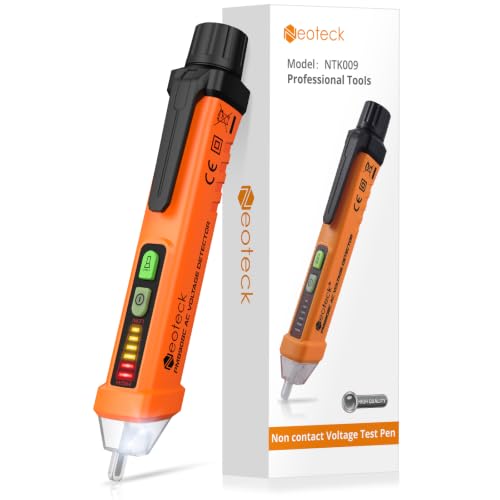
Neoteck Non-Contact Voltage Detector 12-1000V
A compact non-contact voltage tester designed for electricians, technicians, and homeowners to safely detect AC voltage from 12-1000V without physical contact risk. Features audible and LED alerts to distinguish live wires, plus a built-in flashlight for working in dim areas.
Pros
- Safe non-contact voltage detection prevents electrical shock hazard
- LED indicator and audible alarm provide clear live wire identification
- Built-in flashlight adds utility for work in low-light conditions
- Lightweight and pocket-sized for easy portability and storage
- CE and RoHS certified for professional and consumer confidence
Cons
- Not suitable for Christmas light testing per manufacturer specification
- No verified customer reviews available to assess real-world reliability
- Detection range effectiveness depends on proximity to voltage source, not specified in detail
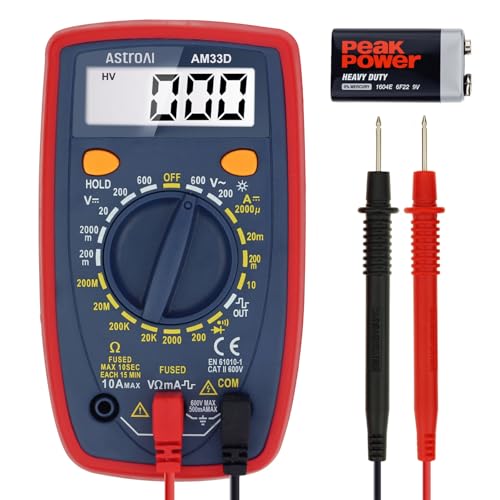
AstroAI 2000 Counts Digital Multimeter
A compact digital multimeter that measures AC/DC voltage, current, resistance, and continuity with a 2000-count LCD display and backlit screen. Well-suited for household electrical troubleshooting, automotive diagnostics, and battery testing, with built-in safety features like dual fuses and a silicone protective cover.
Pros
- Backlit LCD display (3.5 digits, 1999 count) for readability in low-light conditions
- Double fuse protection against overload and electric shock hazards
- Data hold, auto shutoff, and continuity buzzer for user convenience
- Includes test leads, batteries, and user manual in the package
- California-based technical support with 24-hour response commitment
Cons
- Cannot measure AC current or AC voltage below 100mV, limiting some measurement capabilities
- Requires proper test lead insertion and correct dial positioning to function correctly, which can be error-prone for inexperienced users
- No customer reviews available to verify real-world reliability and durability claims

VENLAB Non-Contact Voltage Tester 12V-1000V
A dual-range non-contact voltage detector designed for electricians and DIY users checking live wires safely. Offers adjustable sensitivity modes, audible and visual alarms, plus a built-in flashlight for working in low-light conditions.
Pros
- Non-contact detection eliminates direct contact risk when identifying live circuits
- Dual sensitivity modes cover both low (48V-1000V) and high (12V-1000V) voltage ranges
- Visible and audible feedback with color-coded alerts (red for high voltage, yellow for low)
- Integrated flashlight and red pointer light for convenience in dark workspaces
- 3-year warranty and lifetime technical support included
Cons
- No verified buyer reviews available to assess real-world reliability
- Sensitivity switching between modes adds complexity compared to single-mode testers
- Specifications lack details on detection accuracy range or false-positive rates

NSI TES-2 Dual Voltage Neon Tester
A straightforward neon voltage tester designed to detect the presence of 120 or 240 VAC power. Built with double insulated housing and a pocket clip for portability, it's a no-frills tool for basic electrical troubleshooting.
Pros
- Dual neon indicator clearly shows presence of AC voltage at both 120V and 240V
- Double insulated housing provides safety during use
- Pocket clip enables convenient carrying and hands-free storage
- Made in the United States
- Lightweight at under a quarter pound
Cons
- No customer reviews available to verify real-world reliability and performance
- Neon testers have limited functionality compared to digital multimeters
- No indication of voltage magnitude, only presence detection
Voltage Testers Buying Guide
Choosing the right voltage tester is not simply a matter of grabbing the cheapest pen off the shelf.
The type of work you do, the environments you operate in, and the depth of information you need all point toward very different tools.
The sections below break down the criteria that matter most so you can make a confident, informed decision.
Type of Tester: Non-Contact Pen, Outlet Tester, or Multimeter Kit

The first decision you need to make is which category of voltage tester suits your workflow.
Non-contact voltage testers (NCVTs) are pen-shaped devices that detect AC voltage through insulation without touching a bare wire, making them the fastest and safest option for quickly confirming whether a circuit is live.
They are the go-to choice for most homeowners and a first-check tool for electricians.
Models like the KAIWEETS NCVT (our top-ranked pick) and the Klein Tools NCVT1P represent the gold standard for this format, offering dual-range sensitivity and clear audible plus visual alerts.
Outlet testers are compact plug-in devices designed specifically to verify GFCI protection and common wiring faults in standard receptacles.
They require no interpretation of readings and deliver results via a simple LED or LCD indicator, which makes them ideal for quickly sweeping an entire room or property.
Multimeter kits add the ability to measure DC voltage, resistance, continuity, and current, which is essential if you are doing automotive work, appliance repair, or any diagnostic task beyond simply confirming live versus dead.
If you are also exploring broader measurement tools for workbench use, oscilloscopes complement multimeters well for waveform analysis.
All-in-one kit bundles, such as the Klein Tools MM320KIT and the KAIWEETS KIT01, combine an NCVT, a receptacle tester, and a multimeter in a single carrying case.
These represent outstanding value for anyone who wants comprehensive coverage without sourcing tools separately. Think of the kit format as a professional toolkit in miniature rather than a single-purpose instrument.
Detection Range and Sensitivity

Not all voltage testers respond to the same range of voltages, and choosing a model with the wrong detection window can produce dangerous false negatives.
Most NCVTs on this list cover the 50V to 1000V AC range, which is appropriate for residential wiring in North America and most commercial environments.
However, if you work with low-voltage systems such as doorbells, thermostats, or landscape lighting, you need a tester that reaches down to 12V or lower.
The KAIWEETS NCVT with dual-range detection (12V and 70V lower limits) earns its top ranking in part because it handles both scenarios without switching tools.
Sensitivity adjustment matters more than many buyers realize. A tester that is too sensitive will trigger false alarms from capacitive coupling through conduit or near adjacent live conductors, while one that is not sensitive enough may miss low-voltage circuits entirely.
Dual-range NCVTs let you select a higher sensitivity threshold for low-voltage work and a lower threshold in environments with lots of electromagnetic interference, giving you cleaner results in both situations.
This is a feature worth prioritizing if you work across diverse electrical environments rather than exclusively on standard household circuits.
Alert System: Audible, Visual, and Display Feedback
A voltage tester is only useful if its alert is unmistakable in real working conditions. The best models combine a loud buzzer with a bright LED indicator so you receive both an audible and a visual cue simultaneously.
This is critical in noisy environments like mechanical rooms or construction sites where you might not hear a faint beep.
Models with a flashing LED tip, such as the Klein Tools NCVT1P, make the alert visible from a peripheral glance even when your attention is partly on the work area.
LCD displays represent a meaningful upgrade for anyone who wants more than a binary live-or-dead result.
The KAIWEETS NCVT and the VENLAB tester both show a signal strength percentage or bar graph on their screens, letting you gauge proximity to a live conductor and even locate wire breakpoints.
A built-in flashlight, included on several models in this roundup, is a genuinely practical addition rather than a marketing feature, particularly when working inside panels, junction boxes, or attics with poor lighting.
Safety Rating and Build Quality

Electrical evaluation equipment is governed by IEC 61010 safety categories, and the CAT rating on a tester tells you what installation environment it is designed to handle safely.
CAT II covers single-phase receptacle-connected loads, CAT III covers building wiring including distribution panels, and CAT IV covers the utility connection and overhead lines.
For most residential and light commercial work, a CAT III or CAT IV rating at 1000V provides an adequate safety margin.
If a tester does not clearly state its CAT rating on the body or in its specifications, treat that as a red flag.
Build quality also extends to the practicalities of daily use. A clip or pocket clip keeps the tester accessible during a job without requiring you to set it down somewhere it might get lost or damaged.
The Klein Tools NCVT1P includes a dedicated pocket clip, which aligns with why professional electricians consistently recommend it.
For multimeters, double-fused input protection (as found on the KAIWEETS multimeter in the MM320KIT-equivalent models) guards against catastrophic failure if the meter is accidentally connected to a circuit beyond its rated input.
Use Case: DIY Homeowner Versus Working Professional

A homeowner who occasionally replaces outlets, installs a smart thermostat, or checks whether a breaker has truly cut power has fundamentally different needs from an electrician who diagnoses dozens of circuits daily.
For the occasional home project, a budget-friendly NCVT pen or a simple outlet tester is more than sufficient, and the VENLAB or Neoteck options on this list offer solid performance at an entry-level price point.
Pairing a basic tester with guidance from a broader smart thermostat installation resource can cover most homeowner electrical scenarios.
Working electricians and HVAC technicians benefit from the added capabilities of a kit format. The Klein Tools CL120VP kit includes a clamp meter alongside multiple testers, enabling non-contact current measurement as well as voltage detection.
This matters when you need to verify load on a circuit without interrupting it.
Professionals who value redundancy often carry both an NCVT pen and a multimeter so that if one tool fails or needs a battery swap mid-job, they are never left working blind on a live system.
Battery Life and Maintenance

Non-contact voltage testers are typically powered by one or two AAA batteries and draw very little current when idle, so battery life is rarely a daily concern.
That said, models with an LCD display and backlight consume more power than simple LED-alert pens, and some users of display-equipped testers report that the auto-shutoff behavior (which conserves battery) can occasionally feel abrupt during extended work sessions.
Checking that your tester includes a low-battery indicator removes any guesswork about tool reliability before you start a job.
Multimeter kits in this roundup generally include batteries in the box, which is a practical detail worth confirming before purchase.
Storing a voltage tester in a carrying case or pouch when not in use protects the tip, probes, and display from incidental damage, and kits that include a dedicated case (like the MM320KIT and KIT01 bundles) score higher on long-term value as a result.
Proper storage also prevents accidental activation and unnecessary battery drain.
Why You Should Trust Us
ProductFind is an independent review platform.
Every product in this roundup was evaluated through structured research synthesis: we analyze manufacturer specifications, assess expert review consensus from electrical trade publications and professional tool communities, and systematically review verified buyer feedback from confirmed purchasers.
We do not conduct our own product trials; our evaluations are grounded in research, published data, expert review consensus, and verified buyer feedback.
Each product is assigned a PF Score on a 0 to 10 scale based on consistent criteria applied uniformly across the category.
Those criteria for voltage testers include detection range and sensitivity, alert reliability, safety certification, build quality, display feedback, and overall value relative to competing options at the same price tier.
No product can pay for a higher score, and no score is adjusted after the fact based on commercial relationships.
ProductFind may earn a commission if you purchase through a link on this page. That affiliate relationship has no influence whatsoever on rankings, PF Scores, or which products are included or excluded.
Our editorial selections are driven entirely by the quality of the research, not by commission rates. We also want to be clear that ProductFind is an independent review resource and is not affiliated with any retailer or manufacturer.
We cannot assist with orders, returns, or warranty claims.
Final Thoughts
After evaluating every model across detection range, alert reliability, build quality, safety certification, and value, a few clear standouts emerged from the field. Here are our top category awards from this roundup:
- Best Overall: KAIWEETS Non-Contact Voltage Tester with LCD Display earns the top PF Score in this roundup thanks to its dual-range sensitivity starting at 12V, signal strength percentage display, wire breakpoint finder, and built-in flashlight. It is an exceptionally capable tool at a budget-friendly price, making it the strongest all-around choice regardless of experience level.
- Best for Professional Electricians: Klein Tools NCVT1P Voltage Tester is the pen-format NCVT that working electricians consistently reach for. Its pocket clip, 50V to 1000V detection range, and combination audible plus flashing LED alert make it a trustworthy daily-carry instrument with the Klein Tools reliability reputation behind it.
- Best Electrical evaluation Kit: Klein Tools MM320KIT Digital Multimeter evaluation Kit bundles a full digital multimeter, non-contact voltage tester, and receptacle tester with a carrying case. For anyone who wants a complete electrical diagnostic solution rather than a single-purpose tool, this kit delivers exceptional coverage in one purchase.
- Best Budget DIY Kit: KAIWEETS Electrical evaluation Kit with NCVT and GFCI Outlet Tester pairs two genuinely useful tools at an accessible price point, making it an ideal starting kit for homeowners who want both live-wire detection and outlet fault checking without a significant outlay.
- Best Entry-Level NCVT: Neoteck Non-Contact Voltage Detector offers dependable 12V to 1000V AC detection at one of the lowest price points in the roundup, making it a sensible first purchase for anyone new to electrical safety tools.
Whatever your skill level or budget, having at least one quality voltage tester is non-negotiable before touching any wiring. If you are building out a broader toolkit, a capable digital multimeter is the natural complement to any NCVT pen on this list.
Frequently Asked Questions
What Is the Difference Between a Non-Contact Voltage Tester and a Multimeter?
A non-contact voltage tester (NCVT) detects the presence of AC voltage through insulation without requiring physical contact with bare conductors. It gives you a simple live-or-dead answer quickly and safely.
A multimeter measures actual voltage values (both AC and DC), resistance, continuity, and often current, requiring probe contact with the circuit. For basic safety checks, an NCVT is faster and lower risk.
For diagnosing circuit faults, measuring voltage drop, or checking battery condition, a multimeter is essential. Many professionals carry both.
Can I Use a Voltage Tester on Both AC and DC Circuits?
Standard non-contact voltage testers detect AC voltage only, because they rely on the electromagnetic field produced by alternating current. They will not respond to DC circuits such as car batteries, solar panels, or low-voltage DC control wiring.
If you need to work with DC circuits, you need a multimeter or a tester explicitly rated for DC detection.
Always check the product specification before assuming a tester covers your application, particularly for automotive or renewable energy work where DC is common.
How Do I Know If My Voltage Tester Is Working Correctly Before I Trust It?
The most reliable approach is the live-dead-live evaluation: verify your tester responds on a known live source (such as a standard outlet you know is energized), then check the circuit you intend to work on, then verify on the known live source again.
This confirms the tester was working before and after your check. Some testers include a self-evaluation or continuous self-check function that indicates the device is operational without requiring a separate verification step.
Never skip this confirmation routine when safety depends on the result.
What Does a GFCI Outlet Tester Actually Check?
A GFCI (Ground Fault Circuit Interrupter) outlet tester plugs into a standard three-prong receptacle and uses its LED or LCD indicator to identify common wiring faults including open ground, open neutral, open hot, hot-ground reverse, and hot-neutral reverse.
It also has a evaluation button that trips the GFCI protection to confirm the protective mechanism is actually functioning.
GFCI protection is required by electrical code in kitchens, bathrooms, garages, and outdoor areas, so having one of these testers is particularly valuable when inspecting a home or verifying contractor work.
Is a More Expensive Voltage Tester Always Better?
Not necessarily. The highest-ranked tester in this roundup is priced well below mid-range, demonstrating that price does not automatically equal performance.
What you are paying for as price increases is generally additional features (LCD display, dual-range sensitivity, clamp meter integration, carrying cases), a higher CAT safety rating, and brand-backed warranty support.
For a homeowner doing occasional outlet or switch work, a budget NCVT pen is entirely adequate.
For daily professional use across diverse electrical environments, investing in a kit with a higher safety rating and broader measurement capability is a worthwhile upgrade.
What Safety Precautions Should I Always Follow When Using a Voltage Tester?
Always perform the live-dead-live verification routine before trusting any result. Inspect your tester for cracked housing, damaged probes, or frayed leads before each use, as physical damage can compromise both accuracy and user safety.
Use a tester with a CAT rating appropriate for the installation environment you are working in. Never exceed the tester’s rated voltage, and never use a tester designed for low-voltage applications on high-voltage industrial circuits.
Even after confirming a circuit is dead with a voltage tester, treat wiring with caution until the work is complete and the circuit is fully isolated.
About the author
Noelle is a reviewer and writer for ProductFind who specializes in Test & Measurement. Noelle evaluates products through independent research: specifications, expert review consensus, and verified buyer feedback, and rates each one on the PF Score. Noelle focuses on helping readers pick the right test & measurement for their needs and budget.