The 10 Best Lab Thermometers
Precision matters in every lab setting. Our research covers digital probes, glass thermometers, and infrared options to match the right instrument to your application and budget.
 By Daniel Payne
Updated July 23, 2026
By Daniel Payne
Updated July 23, 2026
Accurate temperature measurement is the backbone of reliable science, whether you’re running titrations in a university chemistry lab, monitoring fermentation temperatures in a food production facility, or conducting quality-control checks in an industrial setting.
A thermometer that drifts even a degree or two from the true reading can skew results, compromise batch integrity, or invalidate an entire experiment.
With dozens of options spanning glass liquid thermometers, digital stem probes, and infrared guns, picking the right instrument for your specific application matters more than most buyers expect.
This guide cuts through the noise. Our editorial team at ProductFind analyzed specifications, synthesized expert review consensus across the scientific instrument community, and cross-referenced verified buyer feedback from researchers, technicians, and educators who use these tools daily.
The result is a ranked shortlist of lab thermometers that balances accuracy, durability, measurement range, and value.
Whether you need a rugged digital probe for fieldwork or a simple glass thermometer for classroom demonstrations, the picks below give you a reliable starting point.
| Award | Product | PF Score About PF ScoreThe PF Score is our own rating from 0 to 10, based on performance, design and build, ease of use, and value. It reflects independent research and is never influenced by manufacturers, retailers, or affiliate commissions. Learn more › | Price | |
|---|---|---|---|---|
| Best Overall |
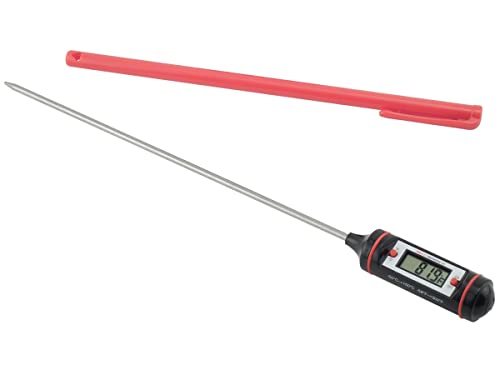 General Tools DT310LAB 8-Inch Digital Thermometer
|
9.5/10 | Buy | |
| Editor's Pick |
 Klein Tools ET05 Digital Pocket Thermometer
|
9.2/10 | Buy | |
| Best Value |
 Thomas 4146 Mini Thermometer with 7-Inch Probe
|
8.8/10 | Buy | |
| Top Rated |
 Relaxweex 10-Pack Lab Thermometer, -20 to 150°C
|
6.9/10 | Buy | |
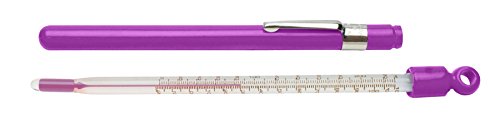 SP Scienceware DURAC Plus Pocket Thermometer, -30 to 120F
|
6.8/10 | Buy | ||
 Saysurey 4-Pack Lab Thermometer 12-Inch 0-200°C
|
6.7/10 | Buy | ||
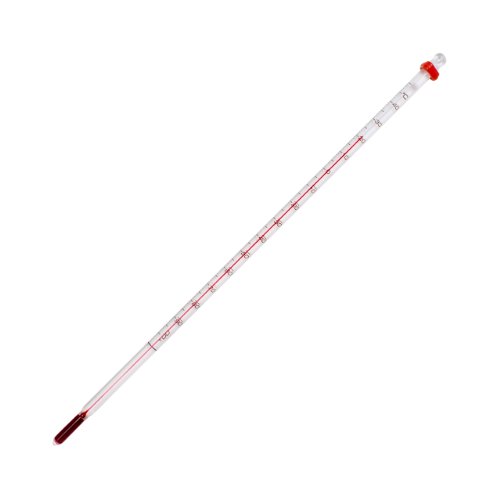 SP Scienceware H-B DURAC Lab Thermometer -20 to 150°C
|
6.5/10 | Buy | ||
 Temirup IR06 PRO Infrared Thermometer with Probe
|
6.3/10 | Buy | ||
 Temirup Infrared Thermometer, -58°F to 1472°F
|
6.2/10 | Buy | ||
 KNINE OUTDOORS Infrared Thermometer, -58°F to 1112°F
|
6.1/10 | Buy |
General Tools DT310LAB 8-Inch Digital Thermometer
A rugged stainless steel digital thermometer with an 8-inch probe designed for food prep, lab work, and industrial applications. Covers a wide temperature range from -58 to 302 degrees Fahrenheit with memory and data hold functions.
Pros
- Extra-long 8.38-inch stainless steel probe reaches deep into containers and materials
- Wide temperature range (-58 to 302°F) suits food safety, lab, and industrial use cases
- Rustproof and shock-resistant construction with auto power-off to extend battery life
- Minimum/maximum memory and data hold functions for tracking temperature changes
- Compact and portable with protective sheath and pocket clip included
Cons
- No verified buyer reviews available to confirm real-world durability or accuracy claims
- Limited to LR44 battery type, which may require frequent replacement depending on usage
- Lacks wireless or Bluetooth connectivity for remote monitoring or data logging
Klein Tools ET05 Digital Pocket Thermometer
A compact, non-medical digital thermometer designed for HVAC work and industrial applications with a -40 to 482°F measurement range. The backlit display and data functions like Max/Min and Average make it practical for field work, though accuracy tolerances are wider than medical-grade alternatives.
Pros
- Backlit display improves usability in dark or poorly lit environments
- Data analysis functions (Max/Min/Average/Hold) aid troubleshooting and trend analysis
- Lightweight and pocket-friendly form factor for technicians
- Selectable temperature units for international or personal preference
Cons
- Room temperature accuracy of ±27°F is relatively loose for precision work
- No customer reviews available to verify real-world field performance
- Explicitly not suitable for medical or animal use, limiting application scope
Thomas 4146 Mini Thermometer with 7-Inch Probe
A compact digital thermometer designed for measuring temperature across liquids, semisolids, and gases with a wide range from -50 to 150 degrees C. The stainless steel probe and ISO 17025 calibration make it suitable for professional or laboratory settings where measurement reliability matters.
Pros
- Wide temperature range (-50 to 150°C) covers most common applications
- ISO 17025 calibrated for traceable, reliable measurements
- 7-inch stainless steel probe with 18-inch cable provides flexibility in hard-to-reach areas
- Accuracy of ±1°C between -20 and 100°C keeps readings dependable
- Large 0.3-inch LCD digits enable reading from a distance
Cons
- No user reviews available to assess real-world durability or ease of use
- Limited information on battery life or power source specifics
- Premium positioning suggests higher cost relative to basic digital thermometers
Relaxweex 10-Pack Lab Thermometer, -20 to 150°C
A 12-inch general-purpose glass thermometer set with a safe red liquid fill, designed for laboratories, universities, and food processing. Wide temperature range and total immersion design make it suitable for scientific and industrial applications.
Pros
- Extensive temperature range covers most laboratory and industrial needs
- Mercury-free red liquid formulation prioritizes user safety
- Comes with protective cases for storage and transport
- Bulk quantity of 10 units offers value for institutions and facilities
- Applicable across multiple industries from pharmaceuticals to beverage processing
Cons
- Total immersion requirement means readings may be impractical if only partial submersion is needed
- No verified buyer reviews available to validate real-world accuracy and durability
- Accuracy specifications not listed in product data
SP Scienceware DURAC Plus Pocket Thermometer, -30 to 120F
A portable liquid-in-glass thermometer built for field work and outdoor applications where quick, accurate temperature readings matter. Comes in a protective plastic case with 2-degree divisions and NIST-traceable calibration.
Pros
- Calibrated against NIST standards with full traceability documentation
- Protective plastic case prevents breakage during transport and fieldwork
- Accurate to within 2 degrees Fahrenheit across -30 to 120F range
- Compact pocket size makes it practical for mobile temperature monitoring
- Organic liquid fill eliminates mercury safety concerns
Cons
- No customer reviews available to assess real-world durability and ease of reading
- Limited temperature range may not suit applications requiring below -30F or above 120F measurements
- Glass construction requires careful handling despite protective case
Saysurey 4-Pack Lab Thermometer 12-Inch 0-200°C
A practical set of four glass laboratory thermometers with red liquid fill and 0-200°C Celsius scale, designed for chemistry, biology, food processing, and brewing applications. Comes with protective cases and requires full immersion technique for accurate readings.
Pros
- Comes as a pack of four, providing good value for labs or institutions needing multiple units
- Non-toxic red liquid fill makes it safer than traditional mercury thermometers
- Wide temperature range (0-200°C) covers most laboratory liquid measurement needs
- Each unit includes a protective case for portability and damage prevention
Cons
- Requires proper total immersion technique with specific positioning to achieve accuracy, which may be inconvenient for quick measurements
- No verified buyer reviews available to confirm real-world performance and durability
- 12-inch length may be impractical for measuring temperatures in narrow or small containers
SP Scienceware H-B DURAC Lab Thermometer -20 to 150°C
A general-purpose laboratory thermometer with total immersion design and spirit-based liquid filling for safe, accurate temperature measurement across wide ranges. Meets ANSI/SAMA standards and suits labs, food processing, and educational settings.
Pros
- Covers broad temperature spectrum suitable for chemistry, food processing, and general lab work
- Spirit-based liquid eliminates mercury hazards while maintaining accuracy
- Calibrated for total immersion ensures reliable readings when properly submerged
- Meets established laboratory standards for consistency and dependability
Cons
- No verified buyer reviews available to confirm real-world durability or performance variance
- Total immersion requirement means inaccurate readings if not fully submerged to capillary level
- Lightweight construction (0.07 lbs) may feel fragile compared to heavier lab-grade alternatives
Temirup IR06 PRO Infrared Thermometer with Probe
Dual-mode thermometer combining laser and K-type probe for surface and internal temperature readings from -40°F to 1472°F, with customizable alerts and color LCD display. Ideal for cooking, grilling, HVAC, and industrial applications where non-contact accuracy matters.
Pros
- Versatile dual-mode design handles both surface and internal temperature measurement across cooking, auto repair, HVAC, and electrical applications
- Fast response time under 0.5 seconds with 12:1 distance-to-spot ratio for safe distance measurement
- Color LCD with backlight, MAX/HOLD retention, and laser targeting controls provide clear visibility in various lighting conditions
- Customizable temperature alerts with audible buzzer prevent critical temperature changes from going unnoticed
- Complete kit with protective case, probe, and batteries ready for immediate use
Cons
- No verified buyer reviews available to confirm real-world performance and reliability claims
- Device not suitable for human or animal temperature measurement, limiting household health monitoring use
- Probe measurement accuracy (±2.0%) is lower than laser mode (±1.5%), which may matter for precision applications
Temirup Infrared Thermometer, -58°F to 1472°F
Dual-mode IR thermometer with contact probe designed for surface measurements across cooking, automotive, and industrial applications. Features adjustable emissivity, HD display with backlight, and spoilage/temperature difference alarm modes for versatile monitoring.
Pros
- Combines non-contact IR measurement with contact probe for flexible temperature sensing
- Adjustable emissivity and dual alarm modes provide targeted functionality for food safety and material monitoring
- Backlit HD display and 13-point laser guidance simplify operation in varied lighting conditions
- Auto-off in 25 seconds and included batteries reduce maintenance burden
- Compact design (6 x 4 x 1 inches, 0.44 lbs) enhances portability
Cons
- Not suitable for body temperature measurement; accuracy on living subjects is explicitly unreliable
- No verified buyer reviews available to assess real-world durability or consistency
- Humidity display feature adds complexity but may not be essential for basic cooking or maintenance tasks
KNINE OUTDOORS Infrared Thermometer, -58°F to 1112°F
A wide-range infrared thermometer designed for cooking, ovens, and temperature checks from a safe distance. Features a 12:1 distance-to-spot ratio, adjustable emissivity, and eye-protect LCD display for practical kitchen and maintenance use.
Pros
- Extensive temperature range from -58°F to 1112°F covers cooking, candy making, pool maintenance, and industrial applications
- 12:1 distance-to-spot ratio allows measurements from safe distances without direct contact
- Adjustable emissivity (0.1 to 1.0) enables accurate readings across different materials
- Eye-protect LCD display reduces strain during extended use
- Unit switching (°C/°F) and AAA battery power for portability
Cons
- No customer reviews available to verify real-world reliability or durability claims
- Single laser targeting may require more precision than dual-laser alternatives for small target areas
- Emissivity adjustment adds complexity that may overwhelm casual home cooks
Lab Thermometers Buying Guide
Choosing a lab thermometer is not as straightforward as picking the cheapest option with the widest range printed on the box. The right choice depends on your measurement environment, required precision, sample type, and how the data will be used.
Below are the criteria that consistently separate a reliable instrument from one that will frustrate you in the field or at the bench.
If precision measurement is important across your broader lab setup, pairing a quality thermometer with a well-calibrated analytical balance and a reliable digital scale ensures your entire workflow holds up to scrutiny.
Thermometer Type and Measurement Principle
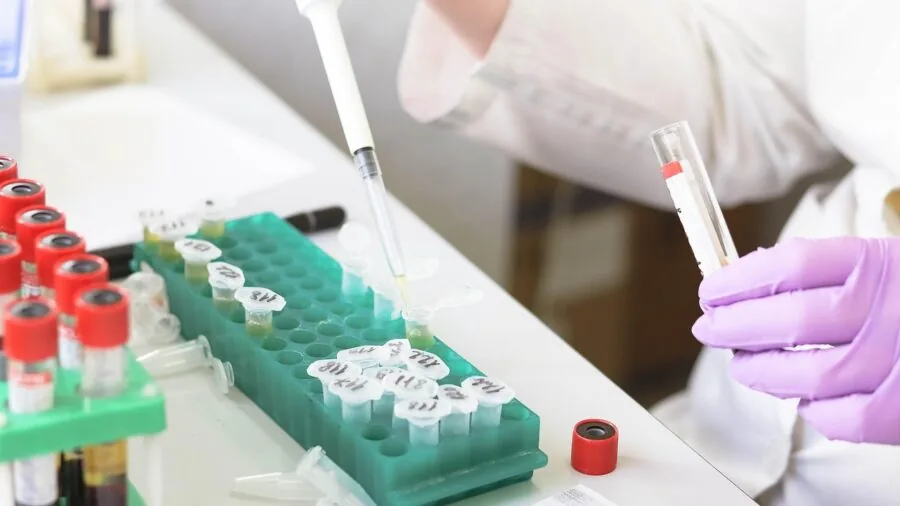
The three dominant categories in this space are glass liquid-in-glass thermometers, digital contact probes, and infrared (non-contact) temperature guns. Each has a distinct use case.
Glass thermometers excel in slow, steady-state readings where absolute immersion accuracy matters, such as total-immersion laboratory protocols. They require no battery, have no electronics to fail, and their organic liquid or red spirit fill provides a clear visual reading.
However, they are fragile and cannot log data or trigger alarms.
Digital contact probes, especially those with stainless steel stems, are the workhorse choice for most modern labs. They deliver fast readings, often within seconds, and commonly include min/max memory, data-hold, and programmable high/low alarms.
Infrared thermometers measure surface temperature without contact, which is valuable for scanning equipment surfaces, checking oven walls, or situations where contamination is a concern.
Their key limitation in lab settings is that emissivity variation across materials can introduce error, so they are best reserved for surface scanning rather than precise liquid or gas measurements.
Understanding which principle fits your protocol will save you from buying the wrong tool entirely. A researcher monitoring fermentation broth needs a probe thermometer, not an infrared gun. A technician scanning conveyor belt motors for heat anomalies needs the opposite.
Define your application first, then evaluate models within the correct category.
Measurement Range and Resolution
Lab thermometers vary enormously in their temperature range. General-purpose glass thermometers covering roughly -20 to 150°C are appropriate for most water-based chemistry, food science, and biological applications.
If your work involves cryogenic samples, high-temperature reactions, or industrial furnace monitoring, you will need a purpose-built instrument rated far beyond this range. Verify the stated range matches your actual working extremes, with some margin on both ends.
Resolution is equally important but often overlooked. Most consumer-grade digital thermometers display readings to 0.1°C or 1°F, which is adequate for most lab purposes.
Traceable and calibrated instruments often provide tighter resolution and come with a certificate of traceability to a national metrology standard, which matters greatly in regulated industries, quality assurance labs, and research environments that require documented instrument accuracy.
Always check the resolution spec rather than assuming all digital displays are equally precise.
Probe Length, Material, and Sample Compatibility
Probe length directly affects how you can use a thermometer.
A short probe is fine for shallow liquids or thin samples, but reaching the center of a deep vessel, a large food batch, or an industrial container requires an extended stem.
Stainless steel probes resist corrosion from most aqueous solutions, mild acids, and food products, making them the default choice for versatility.
Verify that the probe material is compatible with whatever media you plan to measure, particularly if your work involves aggressive solvents or electrochemically active solutions.
For glass thermometers, the distinction between total-immersion and partial-immersion design matters. Total-immersion thermometers are designed to be submerged to the liquid surface level for accurate readings; using them in partial immersion introduces a stem correction error.
Most laboratory glass thermometers sold today are total-immersion unless specifically labeled otherwise. Always match the immersion specification to your actual measurement setup.
Accuracy, Calibration, and Traceability
In laboratory contexts, accuracy is not just a feature, it is often a regulatory requirement.
Many quality-controlled production environments and accredited labs require thermometers that come with a calibration certificate traceable to NIST (National Institute of Standards and Technology) or an equivalent national body.
The Thomas Traceable Mini Thermometer in our list is a strong example of a product explicitly designed to meet this standard, which is why it commands a significantly higher price than general-purpose alternatives.
For less regulated environments such as classrooms, hobbyist fermentation, or general educational labs, a certified traceable instrument may be unnecessary.
However, even in these contexts it is worth periodically verifying your thermometer against an ice-point check (0°C in a properly prepared ice slurry) to catch drift.
Glass thermometers, once calibrated at manufacture, tend to be stable over time if stored properly, but digital instruments can drift due to component aging or physical impact.
Display, Alarms, and Data Features
Digital lab thermometers increasingly offer features that go well beyond a simple readout.
High and low temperature alarms are particularly useful when monitoring processes that must stay within a defined window, such as incubation temperatures, cold storage compliance, or reaction thermal limits.
The General Tools DT310LAB, our top-ranked pick, includes both high and low alarms alongside min/max memory and a data-hold function, making it a practical tool for process monitoring without the cost of a full data logger.
A backlit display is a small but meaningful quality-of-life feature when working in dim environments.
For infrared thermometers, adjustable emissivity is an important feature that allows you to correct readings for different surface types. A fixed-emissivity IR gun will give reliable results on matte black surfaces but will read low on shiny metal or glass.
If your application involves diverse surface materials, prioritize models that let you dial in the emissivity value rather than those locked at a single factory default.
Durability, Portability, and Value for Context
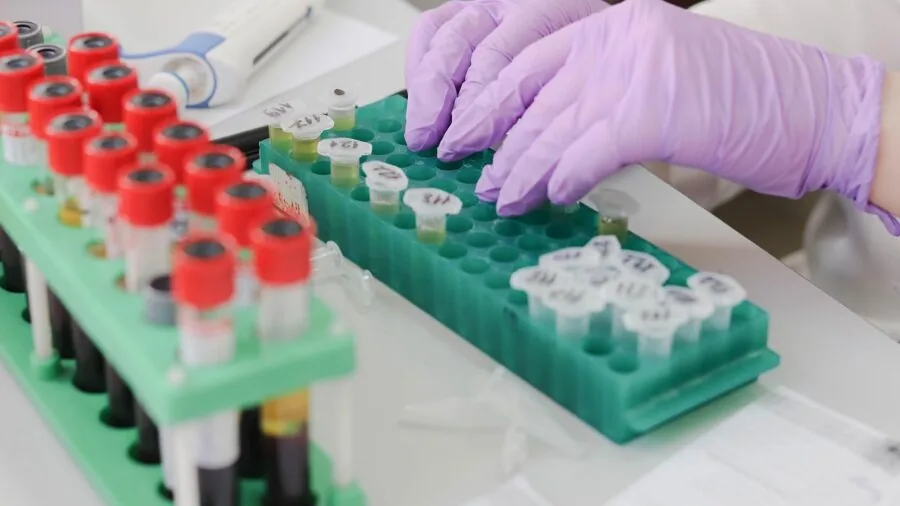
A lab thermometer lives a harder life than most people anticipate. Probes get bumped, glass stems get knocked against glassware, and pocket thermometers end up in lab coat pockets alongside pens and spatulas.
Protective sheaths and pocket clips on digital models are not mere conveniences; they extend instrument lifespan considerably. Glass thermometers benefit from sturdy plastic or padded storage cases, especially in field or teaching settings where multiple people handle equipment.
Value should always be assessed relative to use case. A multi-pack of general-purpose glass thermometers from brands like Relaxweex or Saysurey makes excellent sense for a teaching lab where breakage is frequent and calibration-traceable performance is not critical.
A single Traceable-certified digital probe may be the more economical long-term choice for a regulated production environment where instrument failure carries real compliance risk.
Matching instrument quality to actual application requirements is smarter budgeting than always buying the cheapest or always buying the most expensive option.
For broader bench-level measurement needs, pairing your thermometer with quality lab microscopes and other scientific instruments rounds out a capable educational or research setup.
Why You Should Trust Us
ProductFind is an independent editorial operation with no manufacturer affiliations.
Every product in this roundup was assessed by our editorial team using a structured, consistent methodology: we analyze published specifications, synthesize expert review consensus drawn from scientific instrument communities and professional reviewers, and incorporate verified buyer feedback from documented purchasers including researchers, educators, and laboratory technicians.
We do not conduct our own product trials; our evaluations are grounded in research, published data, expert review consensus, and verified buyer feedback.
Each product receives a PF Score on a 0 to 10 scale, applied uniformly across the same criteria within each category: measurement accuracy and stated specifications, build quality and durability signals, user experience and feature set, and overall value relative to real-world use cases.
Higher PF Scores reflect a consistently stronger performance across all these dimensions as evidenced by the data we collect, not by manufacturer claims alone.
ProductFind may earn an affiliate commission when you purchase through links in this article. That relationship has zero influence on how products are ranked, scored, or selected.
Our editorial decisions are made independently, and no brand can pay for a higher placement or a better PF Score. We note this transparently so you can evaluate our recommendations with full context.
Final Thoughts
After analyzing the full field of options across digital probes, glass liquid thermometers, and infrared guns, a few clear standouts emerge for different buyer needs.
Here are our top picks by use case, each earning its place based on PF Score and documented performance relative to category peers.
- Best Overall: General Tools Digital Thermometer DT310LAB earns the top spot with the highest PF Score in our lineup. Its extra-long stainless steel probe, programmable high/low alarms, min/max memory, and auto-off combine into a feature set that serves researchers, food scientists, and educators alike at an accessible price point.
- Best Budget Digital Pick: Klein Tools ET05 Digital Pocket Thermometer delivers a wide measurement range, instant readout, and a backlit display in a compact pocket format. For buyers who need a reliable digital thermometer without spending significantly more, this is the smart choice.
- Best for Regulated or Traceable Applications: Thomas Traceable Mini Thermometer is built specifically for environments where instrument accuracy must be documented. Its NIST-traceable calibration and stainless steel probe make it the right tool for quality-controlled production labs and accredited research settings.
- Best Multi-Pack Glass Thermometer: Relaxweex 10 Pcs General Purpose Lab Thermometer is the practical choice for teaching labs, universities, and facilities where glass breakage is a routine reality. Buying in bulk at this quality level covers replacements without budget strain.
- Best Pocket Glass Thermometer: SP Bel-Art H-B DURAC Plus Pocket Liquid-In-Glass Thermometer offers the trusted SP Scienceware build quality in a compact, closed-case design that travels well and suits fieldwork or spot checks where a digital instrument is impractical.
Whatever your application, the best lab thermometer is the one matched precisely to your protocol requirements, not simply the one with the widest range or the lowest price.
Use the buying guide criteria above to narrow your choice, and let the PF Scores guide your final decision with confidence.
Frequently Asked Questions
What is the difference between a total-immersion and a partial-immersion glass thermometer?
A total-immersion thermometer is calibrated under the assumption that the entire liquid column, from the bulb to the meniscus, is submerged in the medium being measured.
A partial-immersion thermometer is designed to be inserted only to a marked depth, with the remainder of the stem exposed to ambient air. Using a total-immersion thermometer in partial-immersion conditions introduces a stem correction error that can be significant.
Most general-purpose laboratory glass thermometers sold today are total-immersion; always check the product label before use in precision applications.
Can I use an infrared thermometer to measure liquid temperatures in lab settings?
Generally, no, not for precise liquid measurement. Infrared thermometers read the surface temperature of whatever they are aimed at.
For a liquid in a beaker, they measure the surface layer rather than the bulk temperature, which can differ substantially depending on how well the liquid is mixed and its thermal conductivity.
Infrared instruments are much more reliable for scanning solid surfaces, equipment housings, or checking uniformity across large areas. For accurate liquid or gas temperature measurement in a lab protocol, use a contact probe or glass thermometer.
Do I need a NIST-traceable thermometer for my lab?
It depends on the regulatory and quality requirements of your environment. Accredited labs, ISO-certified production facilities, pharmaceutical environments, and any setting subject to formal audit typically require instruments with documented, traceable calibration.
Educational labs, hobby fermentation setups, and general research without strict compliance requirements usually do not. If you are unsure, check your facility’s standard operating procedures or quality management documentation.
When in doubt, the Thomas Traceable Mini Thermometer provides calibration documentation that satisfies most formal requirements without requiring a laboratory-grade data logger.
How should I store and care for glass lab thermometers?
Glass thermometers should always be stored in a protective case or padded holder when not in use, particularly in shared lab environments. Keep them away from edges where they can roll and fall.
Never subject a glass thermometer to rapid temperature changes, such as plunging a room-temperature thermometer directly into very hot liquid, as thermal shock can cause the glass to crack or the liquid column to separate.
If the liquid column becomes separated due to a sudden temperature excursion, some manufacturers provide guidance on re-uniting the column; in many cases, a separated column means the instrument should be retired.
Proper care extends service life considerably and keeps measurement quality consistent over time.
What does adjustable emissivity on an infrared thermometer mean and why does it matter?
Emissivity is a material’s efficiency at radiating thermal energy relative to a perfect blackbody. Shiny metals have low emissivity while matte black surfaces have high emissivity.
An infrared thermometer with a fixed emissivity setting, typically 0.95, works well on most organic materials and matte surfaces but will read inaccurately on polished metal, glass, or reflective surfaces.
Adjustable emissivity allows you to dial in the correct value for the specific material you are measuring, significantly improving accuracy across diverse surfaces. For lab applications involving varied materials, prioritize models with this adjustment capability.
If you are building out a broader measurement toolkit for fieldwork or environmental monitoring, portable instruments like field compasses and other precision tools benefit from the same specification-first evaluation approach.
Are multi-pack glass thermometers a good choice for school or university labs?
Absolutely, for most teaching contexts, multi-pack glass thermometers represent excellent value. Breakage in student labs is inevitable, and maintaining a stock of replacements at a reasonable per-unit cost keeps demonstrations and experiments running without constant supply delays.
Options like the Relaxweex 10-pack and Saysurey 4-pack glass thermometers in our list are well-suited for classroom environments where NIST-traceable accuracy is not a requirement but consistent, readable, general-purpose performance is.
For institutions also sourcing other scientific equipment, classroom microscopes and lab thermometers often ship together and should be evaluated with the same criteria of durability and ease of student use.
About the author
Daniel is a reviewer and writer for ProductFind who specializes in Lab & Scientific. Daniel evaluates products through independent research: specifications, expert review consensus, and verified buyer feedback, and rates each one on the PF Score. Daniel focuses on helping readers pick the right lab & scientific for their needs and budget.