The 8 Best Sound Level Meters
Accurate noise measurement matters whether you're checking workplace compliance or a noisy neighbor. Our research covers eight sound level meters across every budget and use case.
 By Noelle Gray
Updated July 23, 2026
By Noelle Gray
Updated July 23, 2026
Noise is everywhere, and knowing exactly how loud your environment is can matter far more than most people realize.
Whether you are checking workplace compliance with OSHA regulations, evaluating a classroom for sound quality, investigating a noisy neighbor complaint, or fine-tuning a home studio, a dedicated sound level meter gives you objective, repeatable readings that a smartphone app simply cannot match.
The market offers everything from compact budget units for occasional home use to professional-grade Class 1 instruments with onboard data logging for industrial hygiene surveys.
To help you cut through the noise, the team at ProductFind analyzed specifications, expert review consensus, and verified buyer feedback across dozens of models before narrowing the field to eight standout picks spanning every major use case and budget.
If you also rely on precision electrical instruments alongside your acoustic work, our guide to digital multimeters for every skill level is worth a read.
Scroll down to see our top-ranked sound level meters, followed by a detailed buying guide to help you match the right meter to your exact needs.
| Award | Product | PF Score About PF ScoreThe PF Score is our own rating from 0 to 10, based on performance, design and build, ease of use, and value. It reflects independent research and is never influenced by manufacturers, retailers, or affiliate commissions. Learn more › | Price | |
|---|---|---|---|---|
| Best Overall |
 SOFT DB Class 2 Sound Level Meter with Data Logger
|
8.7/10 | Buy | |
| Editor's Pick |
 Lutron SL-4036SD Class-1 Sound Meter (30-130 dB)
|
8.1/10 | Buy | |
| Best Value |
 TopTes TS-501B Decibel Meter, 30-130dB
|
7.4/10 | Buy | |
| Top Rated |
 Amprobe SM-10 Sound Meter, IEC 651 Type 2
|
7.2/10 | Buy | |
 Goldeep SL750A Sound Level Meter 30-130dB
|
6.9/10 | Buy | ||
 Protmex PT6708 Sound Level Meter, 30-130 dB
|
6.8/10 | Buy | ||
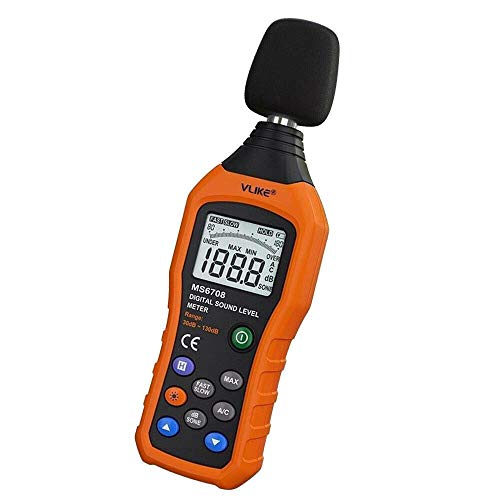 VLIKE LCD Sound Level Meter 30-130dB
|
6.5/10 | Buy | ||
 JuviPerpric Decibel Meter 30-130dB with Data Logger
|
6.3/10 | Buy |
SOFT DB Class 2 Sound Level Meter with Data Logger
A professional-grade noise measurement device built to IEC 61672/ANSI S1.4 Class 2 standards, capturing simultaneous Leq, Lmax, Lmin, Lpeak, and SEL readings across multiple weightings. Includes integrated audio recording, FFT analysis, and post-processing software, making it suitable for environmental monitoring, occupational safety, and acoustic research.
Pros
- Comprehensive simultaneous measurement of five key noise parameters reduces testing time
- Large onboard storage enables extended monitoring without frequent data transfers
- Software suite included for audio post-processing and spectrum visualization
- Octave band and FFT capabilities support detailed frequency analysis
- Class 2 certification meets professional acoustic standards for workplace and environmental assessments
Cons
- No verified user reviews available to confirm real-world reliability and ease of use
- Frequency range limited to 20Hz-16kHz, which excludes infrasound monitoring below 20Hz
- Learning curve likely steep for users unfamiliar with multi-weighting noise metrics and FFT interpretation
Lutron SL-4036SD Class-1 Sound Meter (30-130 dB)
A Class-1 certified sound level meter designed for industrial, automotive, and environmental noise measurement across a 30-130 dB range. Ships with calibration certificate and targets professionals who need standards-compliant acoustic readings.
Pros
- Class-1 certified accuracy meets industry standards for professional applications
- Broad 30-130 dB range handles diverse noise environments from quiet offices to heavy machinery
- Comes with calibration certificate, eliminating need for initial calibration expense
- Portable size suitable for on-site environmental and occupational noise surveys
Cons
- No user reviews available to assess real-world reliability or long-term durability
- Premium-class certification positions this at higher price point than consumer-grade alternatives
- Limited feature details in available specification data
TopTes TS-501B Decibel Meter, 30-130dB
A portable sound level meter with a backlit LCD display and dual A/C weighting options for measuring noise across residential, commercial, and industrial settings. Includes max/min peak tracking and data hold functionality for capturing fluctuating sound levels.
Pros
- Large backlit display improves readability in dim environments
- Dual weighting (A/C) suitable for diverse noise monitoring applications
- Max/Min recording captures peak sound levels without manual observation
- Comes with batteries and protective carry case included
- Automatic power-off preserves battery life
Cons
- No verified buyer reviews available to confirm real-world durability and accuracy
- Limited frequency range (30-8000Hz) may not capture ultrasonic or very low-frequency noise
- Accuracy tolerance of 1.5dB is modest compared to professional-grade meters
Amprobe SM-10 Sound Meter, IEC 651 Type 2
A compact sound measurement tool built to IEC 651 Type 2 standards, featuring windscreen protection for outdoor use and max/min tracking modes. Suited for professionals and technicians who need reliable decibel readings in variable conditions.
Pros
- Windscreen included to minimize environmental noise interference in outdoor settings
- Max/min mode simplifies tracking of sudden sound level spikes or dips without manual logging
- Meets IEC 651 Type 2 certification for reliable acoustic measurements in professional contexts
Cons
- No user reviews available to confirm real-world performance or durability feedback
- Limited feature set compared to advanced sound meters with data logging or frequency analysis
- Specifications show modest weight and size without details on battery life or display type
Goldeep SL750A Sound Level Meter 30-130dB
The Goldeep SL750A is a digital decibel meter covering 30-130dB with A/C weighting modes and dual unit display (dB and SONE) for flexible noise assessment. Suited for homeowners monitoring ambient noise, office workers checking sound environments, and facility managers tracking industrial compliance.
Pros
- Dual weighting options (A/C) handle both light environmental and heavy industrial sound sources appropriately
- SONE unit conversion useful for understanding how humans perceive loudness relative to raw decibel readings
- MAX/MIN tracking captures peak and minimum levels without manual note-taking during variable noise periods
- Includes practical accessories like windbreak ball and comes with batteries, eliminating setup barriers
Cons
- No verified user reviews available yet, limiting real-world performance validation
- Frequency response limited to 31.5Hz-8KHz, which may miss very low-frequency or ultrasonic noise sources
- FAST/SLOW response modes serve different purposes but may require user decision-making to select appropriately
Protmex PT6708 Sound Level Meter, 30-130 dB
A portable decibel meter with AD636 chip offering 1.5 dB accuracy and 0.1 dB resolution across a 30-130 dB range. Features fast/slow response modes, A/C weighting selection, and backlit LCD display for professional noise monitoring in industrial, educational, and residential settings.
Pros
- High accuracy (1.5 dB) with fast 0.5-second response time for quick measurements
- Dual response modes (fast/slow) and A/C weighting options for diverse measurement scenarios
- Durable anti-drop design with backlit display for low-light environments
- IEC651 Type 2 and CE/RoHS certified for professional-grade reliability
- Includes batteries and offers 24/7 customer support
Cons
- Cannot generate or store reports directly on the device, limiting data logging capability
- No customer reviews available to verify real-world performance or user experience
- Limited to manual data hold and MAX reading functions without advanced data management features
VLIKE LCD Sound Level Meter 30-130dB
A portable handheld decibel meter designed for measuring noise across factories, offices, schools, and residential areas. Features a 30-130dB range, backlit LCD display, and durable injection-molded casing, making it practical for environmental monitoring and quality control work.
Pros
- Wide measurement range accommodates diverse noise environments from workshops to residential areas
- Backlight feature enables sound monitoring at night with automatic shutoff to save power
- Rugged construction with anti-drop design withstands industrial workplace conditions
- Compact and lightweight enough for field technicians to carry easily
Cons
- Cannot generate or store reports directly from the device, requiring manual data recording
- Batteries not included, adding to upfront cost
- No customer reviews available to verify real-world performance and reliability
JuviPerpric Decibel Meter 30-130dB with Data Logger
A portable sound level meter designed for home and factory noise monitoring, equipped with a 43,000-record data logger and PC connectivity for analysis. The three-color alarm system and dual weighting modes make it suitable for various sound environments, though it lacks verified user feedback to confirm real-world performance.
Pros
- Substantial data logging capacity allows extended monitoring sessions without manual recording
- Windows 7, 10, 11 compatibility enables straightforward data transfer and analysis on common systems
- Adjustable alarm thresholds and dual weighting modes provide flexibility across different noise environments
- Backlit display and visual three-color alarm system aid usability in varied lighting conditions
- Compact 6 x 1.5 x 2 inch form factor makes transport between locations practical
Cons
- No verified buyer reviews available despite 4.8 rating, making real-world reliability assessment difficult
- ±1.5dB accuracy may be insufficient for precise professional or regulatory compliance applications
- Limited information on battery life, microphone sensitivity specifications, or durability under field conditions
Sound Level Meters Buying Guide
Picking the right sound level meter comes down to understanding exactly what you need to measure, how accurately you need to measure it, and what you plan to do with the data afterward.
The sections below walk through every criterion that separates a genuinely useful instrument from one that will frustrate you with inconsistent readings or missing features.
Accuracy Class and Measurement Standard
Sound level meters are classified under international standards (IEC 61672 and the older IEC 651) as either Class 1 (Type 1) or Class 2 (Type 2).
Class 1 instruments carry a tighter tolerance, typically around plus or minus 0.7 dB, and are required for legally defensible environmental noise assessments, community noise surveys, and formal industrial hygiene documentation.
Class 2 instruments, with tolerances of roughly plus or minus 1.5 dB, are suitable for general-purpose monitoring, workplace spot-checks, and most non-regulatory applications.
If you are simply checking whether your open-plan office is uncomfortably loud or confirming that your baby’s room stays below a reasonable threshold, a Class 2 meter is perfectly adequate.
If your readings will be submitted to a regulatory body, cited in a legal dispute, or used to design noise mitigation infrastructure, a Class 1 instrument with a calibration certificate is non-negotiable.
Always verify that the meter you are considering ships with documentation traceable to a national metrology standard.
Frequency Weighting: A-Weighting vs. C-Weighting

Raw sound pressure levels do not reflect how human ears perceive loudness across the frequency spectrum. Frequency weighting filters correct for this.
A-weighting (dBA) rolls off low and very high frequencies to approximate human hearing sensitivity and is the standard for occupational noise exposure assessments under OSHA and NIOSH guidelines.
C-weighting (dBC) provides a much flatter response that captures low-frequency energy, making it better for measuring loud machinery, vehicle noise at close range, or the thump of a bass-heavy sound system.
Most consumer and prosumer meters offer both A and C weighting modes, and switching between them can reveal useful information.
If a reading climbs significantly when you switch from dBA to dBC, there is substantial low-frequency content in the sound source, which is relevant for both hearing protection decisions and building acoustics work.
Some units in this roundup also report in SONE, a psychoacoustic loudness unit that can be useful for product sound quality assessments.
Measurement Range and Resolution
Most general-purpose meters cover the range from 30 dB to 130 dB, which comfortably spans quiet bedroom ambience (around 30 to 40 dB) through the threshold of pain (around 130 dB).
Resolution of 0.1 dB is standard across virtually all digital meters and is sufficient for all but the most demanding laboratory work.
What varies more meaningfully between models is the linearity across the full measurement range: budget meters may be calibrated accurately at mid-range levels but drift at the extremes.
For specialized applications such as monitoring very quiet HVAC systems in recording studios or measuring extremely loud industrial equipment, look for a meter with a documented linearity specification and ideally the ability to connect an external microphone capsule.
Some professional models allow you to swap capsules optimized for specific frequency ranges or environmental conditions, dramatically extending versatility beyond what the default configuration offers.
Data Logging and Connectivity
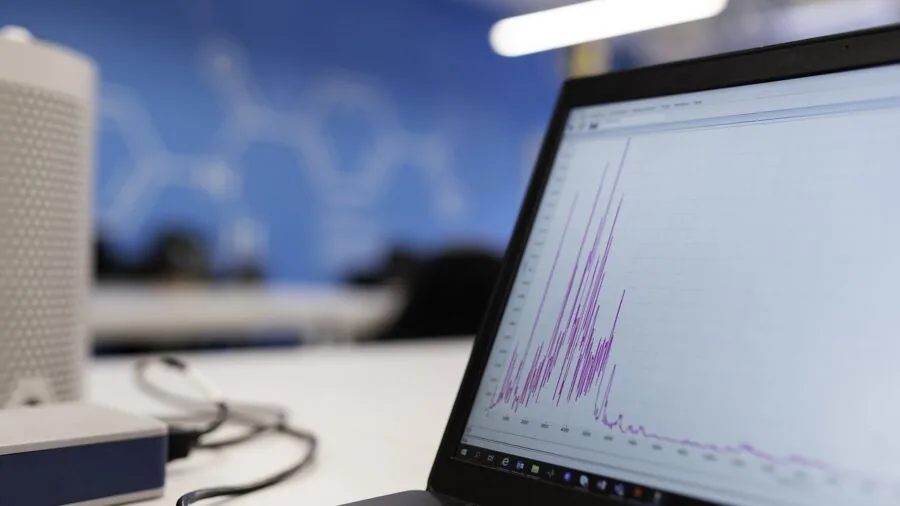
For anyone conducting a formal noise survey, data logging is not optional. The ability to record time-stamped SPL readings over hours or days, then export that data for analysis, transforms a simple meter into a genuine measurement instrument.
Entry-level models from brands like Protmex and VLIKE provide real-time readouts and basic MAX/MIN hold, which is fine for spot-checking. Mid-range meters may offer a few thousand data points stored internally.
Professional models such as the SOFT dB integrating-averaging meter and the Lutron SL-4036SD can log tens of thousands of readings and include noise analysis software for generating compliant reports.
Consider also how data gets off the device. USB connectivity allows direct export to a PC. Some meters provide a DC analog output for integration with other measurement systems, a feature relevant to engineers building custom monitoring rigs.
If you work in environments where continuous monitoring matters alongside other instrumentation, pairing your meter with reliable oscilloscopes for your workbench can give you a more complete picture of electrical and acoustic phenomena simultaneously.
Response Time: Fast vs. Slow
Sound level meters offer two standard temporal response modes. Fast response (125 ms time constant) tracks rapidly changing sounds such as impact noise, a door slam, or a transient machinery event.
Slow response (1 second time constant) averages fluctuating noise and is the standard mode for steady or slowly varying sources such as HVAC noise or traffic.
Most regulatory standards specify which response mode to use for a given measurement type, so having both available on a single meter is important for versatile fieldwork.
Integrating-averaging meters add a further capability: they calculate the equivalent continuous sound level (Leq), which represents the total noise energy over a measurement period as a single number. This metric is central to occupational exposure assessments and environmental impact studies.
If your use case involves any kind of time-averaged noise dose calculation, an integrating meter is essential rather than a convenience.
Display, Portability, and Build Quality

A backlit LCD screen is the baseline expectation for any meter you might use in dim factory environments or low-light field settings.
Screen size and contrast vary considerably: the TopTes TS-501B’s 2.25-inch backlit display earns consistently positive verified buyer feedback for legibility, while smaller screens on budget models can be difficult to read in bright outdoor daylight.
Some newer models incorporate color-coded alarm indicators (typically a three-color LED or screen border) that change from green to yellow to red as readings cross preset thresholds, making them useful in monitoring roles where a quick glance matters more than a precise number.
Build quality separates instruments meant for desk use from those designed for regular fieldwork. Look for a rubberized grip, a tripod mounting thread (useful for unattended measurements), and an IP rating if you will be measuring outdoors in variable weather.
Battery life and auto-shutoff behavior are also worth checking: a meter that powers itself off after a few minutes of inactivity can be maddening during long measurement sessions.
Also consider whether the microphone capsule is protected by a windscreen, which prevents wind noise from corrupting outdoor readings.
Why You Should Trust Us
ProductFind is an independent review publication. We do not conduct our own product trials; our evaluations are grounded in research, published data, expert review consensus, and verified buyer feedback.
Every sound level meter in this roundup was assessed against a consistent set of criteria covering measurement accuracy, feature set, build quality, data management capability, and value for the intended use case.
Each model receives a PF Score on a scale of 0 to 10, calculated by weighting those criteria according to their importance to real-world users in the category.
Our research process draws on publicly available manufacturer specifications, IEC and ANSI standard documentation, professional audio and industrial hygiene publications, and the aggregated experiences of verified purchasers across major retail platforms.
Where expert reviewers from the fields of occupational safety, acoustical engineering, and audio production have reached a clear consensus on a model’s strengths or weaknesses, that consensus is factored into the PF Score alongside quantitative spec comparisons.
ProductFind may earn a commission when you purchase through links on this page. That affiliate relationship has no influence on which products are included, how they are ranked, or what PF Score they receive.
Our editorial recommendations are based solely on the quality of our research findings.
Final Thoughts
The eight meters in this roundup cover the full spectrum of sound measurement needs, from simple home monitoring to professional regulatory compliance. Here is how the strongest picks shake out by role:
- Best Overall: SOFT dB Professional Integrating-Averaging Class 2 Sound Level Meter with Data Logger earns the top PF Score in this roundup with its combination of integrating-averaging capability, onboard data logging, and bundled noise analysis software, making it the most capable all-in-one instrument across a wide range of professional applications.
- Best for Regulatory and Industrial Work: Lutron SL-4036SD Class 1 Sound Level Meter is the right choice when your measurements need to meet the stricter Class 1 tolerance standard and come with a calibration certificate for compliance documentation in industrial or environmental contexts.
- Best Portable Pick for Everyday Use: TopTes TS-501B Decibel Meter consistently earns high praise from verified buyers for its readable backlit display, comfortable non-slip grip, and reliable A/C weighting at a budget-friendly price point, making it the easiest recommendation for home, classroom, and office monitoring.
- Best Mid-Range Value: Amprobe SM-10 Sound Meter sits at an accessible price for buyers who need the credibility of an established metrology brand and IEC 651 Type 2 compliance without stepping up to the cost of a full professional system.
- Best Budget Data Logger: JuviPerpric Decibel Meter with 43,000-Point Data Logger offers an unusually high data record capacity and a three-color alarm system at an entry-level price, making it a compelling option for buyers who need basic logging capability without a large investment.
No matter which meter you choose, pairing it with good measurement habits, consistent positioning, and appropriate windscreening outdoors will have a bigger impact on result quality than the meter specification alone.
And if your projects extend into audio playback and signal quality, a high-quality portable DAC can complement your acoustic measurement workflow nicely.
Frequently Asked Questions
What is the difference between a Class 1 and Class 2 sound level meter?
Class 1 (Type 1) meters meet tighter manufacturing and calibration tolerances under IEC 61672, typically achieving accuracy within about plus or minus 0.7 dB. They are required for formal regulatory submissions, legal noise disputes, and precision environmental assessments.
Class 2 (Type 2) meters have a tolerance of roughly plus or minus 1.5 dB and are well-suited to general workplace spot-checks, home monitoring, and non-regulatory noise surveys. For most everyday uses, Class 2 accuracy is more than sufficient.
Can I use my smartphone instead of a dedicated sound level meter?
Smartphone-based SPL apps can give useful ballpark readings for casual awareness purposes, but they are not a reliable substitute for a dedicated meter.
Built-in microphones are not calibrated to measurement standards, frequency response varies widely between phone models and cases, and automatic gain control in the phone’s audio system can silently distort readings at high or low levels.
For any application where accuracy matters, including OSHA compliance, building acoustics, or home studio calibration, a purpose-built meter with documented accuracy specifications is the appropriate tool.
Some professionals do pair a calibrated external microphone capsule with a measurement app as a lightweight field supplement, but this setup still requires validation against a reference instrument.
What does dBA mean and why is it used for occupational noise limits?
dBA stands for decibels measured with A-frequency weighting applied. The A-weighting filter mimics the sensitivity of the human ear, de-emphasizing very low and very high frequencies that we perceive as less loud at normal listening levels.
OSHA, NIOSH, and most international occupational health agencies specify dBA for noise exposure limits precisely because it correlates more closely with hearing damage risk than unweighted SPL.
The OSHA permissible exposure limit for an eight-hour workday is 90 dBA, with a five-dB exchange rate, while NIOSH recommends a more conservative 85 dBA limit.
Selecting a meter that displays dBA and is compliant with IEC 61672 or ANSI S1.4 ensures your readings are directly comparable to those regulatory thresholds.
How often does a sound level meter need to be calibrated?
For professional or regulatory use, most standards bodies recommend field calibration with a reference sound source (a pistonphone or acoustic calibrator) at the beginning and end of every measurement session.
Full laboratory calibration traceable to national standards should be performed at least annually, or whenever the meter has been subjected to a significant shock, extreme temperature change, or exposure to humidity beyond its rated range.
Budget meters intended for home use typically do not come with calibration documentation and are not designed for recalibration service, which is a key reason they are unsuitable for compliance work.
If you purchase a professional meter such as the Lutron SL-4036SD, retain the included calibration certificate and schedule recalibration through an accredited laboratory on a regular cycle.
Is a sound level meter useful for home applications like checking a noisy neighbor or monitoring a nursery?
Absolutely.
A budget-friendly Class 2 meter is well-suited for documenting neighbor noise complaints, verifying that a nursery or baby’s bedroom stays within comfortable ambient levels, checking whether your home theater system peaks at safe listening volumes, or evaluating how much street noise penetrates a new window installation.
For these uses, a compact meter with a clear display, A/C weighting, and a MAX hold function is all you need.
Models like the TopTes TS-501B or the Goldeep SL750A offer exactly that combination at accessible price points.
For nursery monitoring in particular, paying attention to safe sound levels for infant toys alongside your room readings gives a more complete picture of your child’s acoustic environment.
What is Leq and do I need a meter that measures it?
Leq, or equivalent continuous sound level, is the steady sound level that would deliver the same total acoustic energy as the actual fluctuating noise over a defined measurement period.
It is the cornerstone metric for occupational noise dose calculations, environmental impact assessments, and community noise ordinance compliance. Measuring Leq requires an integrating-averaging sound level meter that continuously calculates and accumulates energy over time.
Standard basic meters only show instantaneous SPL with fast or slow time weighting and cannot compute Leq. If your work involves formal noise surveys, OSHA compliance documentation, or environmental impact studies, an integrating meter is essential.
For casual home or office monitoring, standard SPL readings are sufficient.
About the author
Noelle is a reviewer and writer for ProductFind who specializes in Test & Measurement. Noelle evaluates products through independent research: specifications, expert review consensus, and verified buyer feedback, and rates each one on the PF Score. Noelle focuses on helping readers pick the right test & measurement for their needs and budget.