The 10 Best Smart Power Strips
Smart power strips let you automate outlets, cut standby waste, and control devices by voice. Here are the top picks across every price tier and ecosystem.
 By Jamie Shelton
Updated July 23, 2026
By Jamie Shelton
Updated July 23, 2026

Smart power strips sit at the intersection of home automation and practical energy management, letting you cut standby power waste, automate schedules, and control individual outlets from anywhere with your phone or voice.
As consumer electronics setups grow more complex, ranging from home theater stacks to home-office workstations packed with monitors, chargers, and peripherals, a single ordinary power strip no longer cuts it.
The best smart power strips from brands like Tapo, Kasa Smart, Amazon Basics, and Geeni give you granular control without requiring a hub, an electrician, or a steep learning curve.
At ProductFind, we researched and assessed every model in this guide using a synthesis of verified buyer feedback, published manufacturer specifications, and expert review consensus across the smart-home category.
Our goal is to cut through the marketing noise so you know exactly which strip is worth your money and which corners manufacturers quietly cut.
Whether you need Matter compatibility for a future-proof smart home, a compact three-outlet design for your nightstand, or an eight-outlet workhorse for a full desk setup, the ranked picks below cover every realistic use case.
| Award | Product | PF Score About PF ScoreThe PF Score is our own rating from 0 to 10, based on performance, design and build, ease of use, and value. It reflects independent research and is never influenced by manufacturers, retailers, or affiliate commissions. Learn more › | Price | |
|---|---|---|---|---|
| Best Overall |
 Tapo P316M Smart Power Strip with Energy Monitoring
|
8.8/10 | Buy | |
| Editor's Pick |
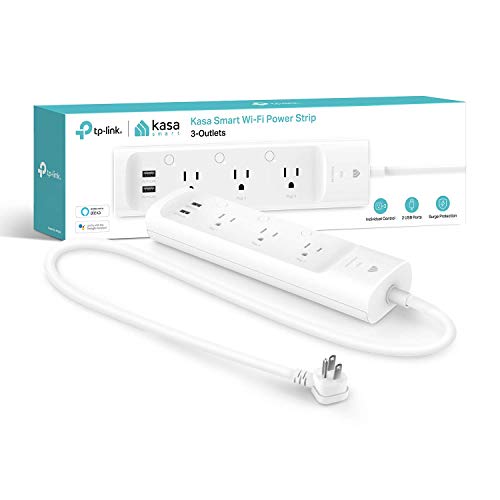 Kasa Smart KP303 Power Strip with 3 Smart Outlets
|
8.4/10 | Buy | |
| Best Value |
 Amazon Basics Smart Power Strip, 6 Outlets + 3 USB
|
8.1/10 | Buy | |
| Top Rated |
 GHome Smart Power Strip, 6 Outlets + 3 USB
|
7.5/10 | Buy | |
 Geeni Surge Ultra 8-Outlet Smart Surge Protector
|
7.2/10 | Buy | ||
 GHome Smart Power Strip 6-in-1 with WiFi Outlets & USB
|
6.8/10 | Buy | ||
 Govee Smart Plug Outlet Extender with RGB Night Light
|
6.5/10 | Buy | ||
 POWSAV 6 Ft WiFi Smart Power Strip, 8 Outlet
|
6.3/10 | Buy | ||
 Westinghouse WH-320 Wi-Fi Smart Power Strip
|
6.1/10 | Buy | ||
 Bits Limited Smart Strip ECG-7MVR 7-Outlet Surge Protector
|
5.2/10 | Buy |
Tapo P316M Smart Power Strip with Energy Monitoring
A Wi-Fi-enabled power strip with 6 individually controlled outlets, 3 USB ports, and real-time energy monitoring per outlet. Matter-certified for broad smart home compatibility and includes surge protection, scheduling, and overcharge prevention.
Pros
- Granular energy monitoring per outlet helps identify and reduce phantom power draw
- Matter certification ensures compatibility across different smart home ecosystems without vendor lock-in
- Compact flush-fitting plug design minimizes obstruction behind furniture or in tight spaces
- Automatic charging cutoff prevents battery degradation on phones and USB devices
- Local LAN control provides reliable operation independent of cloud connectivity
Cons
- No verified user reviews available to confirm real-world performance and reliability
- 3-foot cord length may limit placement flexibility in larger rooms or for daisy-chaining
- USB ports lack individual smart control, unlike the AC outlets
Kasa Smart KP303 Power Strip with 3 Smart Outlets
A WiFi-enabled power strip that lets you control three outlets individually through the Kasa app or voice commands via Alexa and Google Assistant. Two USB ports handle simultaneous charging, while built-in surge protection guards connected devices.
Pros
- Independent control of each outlet with scheduling and timer functions
- Voice control compatibility with major smart home platforms
- ETL-certified surge protection included
- No hub required, WiFi-only setup
- Five simultaneous device connections (3 outlets + 2 USB ports)
Cons
- No verified buyer reviews available to assess real-world reliability
- USB ports always remain powered (not individually controllable)
- Compact design limits outlet spacing for larger plugs
Amazon Basics Smart Power Strip, 6 Outlets + 3 USB
This WiFi-enabled power strip delivers independent control over 6 outlets plus 3 USB ports (2 USB-A, 1 USB-C) without requiring a separate hub. Setup integrates directly with Alexa for scheduling and remote management, making it practical for users already invested in the Amazon ecosystem.
Pros
- Independent outlet control allows selective on/off management without affecting other connected devices
- Combines AC outlets with multiple USB ports to reduce clutter and adapter needs
- Hub-free setup simplifies installation for users with Alexa-compatible devices
- Scheduling and automation features enable energy management and convenience routines
Cons
- Alexa-only compatibility limits options for those using other smart home platforms
- No verified customer reviews available to confirm real-world reliability and performance
- USB-C port is singular, limiting simultaneous fast charging of multiple USB-C devices
GHome Smart Power Strip, 6 Outlets + 3 USB
WiFi-enabled power strip with six individually controlled outlets and 30W USB-C charging, compatible with Alexa and Google Assistant for voice and app control. Space-saving flat plug design works well for managing multiple devices, though it requires 2.4GHz WiFi and has no customer reviews yet to verify real-world reliability.
Pros
- Individual outlet control allows you to manage each device independently through app or voice commands
- 30W USB-C port supports fast charging for modern phones and tablets
- Low-profile angled plug and wide socket spacing accommodate larger adapters without blocking adjacent outlets
- Scheduling and timer features help reduce energy consumption and improve home automation efficiency
- Comprehensive safety features including surge protection and flame-retardant construction
Cons
- No verified customer reviews available, making it difficult to assess actual user experience and long-term durability
- Requires 2.4GHz WiFi connection only, which may cause connectivity issues if your network only supports 5GHz
- Maximum 15A per outlet and 1800W total capacity limits use with high-power appliances
Geeni Surge Ultra 8-Outlet Smart Surge Protector
This WiFi-enabled surge protector combines 6 individually controlled smart outlets with 2 always-on outlets and 1200 joules of protection, all without requiring a hub. Control via app or voice commands through Alexa and Google Assistant, making it straightforward for anyone adding smart power management to their setup.
Pros
- Hub-free setup simplifies integration into existing WiFi networks
- Good surge protection rating at 1200 joules for mid-range device safeguarding
- Flexible outlet configuration with smart and always-on options handles different device needs
- Voice control and app management offer convenient remote access
- Extended 6-foot cord reduces placement limitations
Cons
- No user reviews available to verify real-world reliability and performance claims
- Limited outlet count compared to larger surge protectors on the market
- Always-on outlets cannot be controlled remotely, restricting full automation
GHome Smart Power Strip 6-in-1 with WiFi Outlets & USB
A 6-in-1 smart power strip combining 3 WiFi-controlled outlets and 3 USB ports in one compact unit. Works with Alexa and Google Home for voice control, individual outlet management via app, and scheduling automation, making it practical for home offices and travel setups.
Pros
- Individual and group outlet control through dedicated app provides flexible smart home integration
- Combines WiFi outlets with USB charging to reduce cable clutter on desks
- Scheduling and timer features help automate routine appliances and reduce energy use
- ETL and FCC certification offers verified surge and overload protection for electronics
- Compatible with major voice assistants (Alexa and Google Home)
Cons
- No verified customer reviews available yet to assess real-world reliability or performance
- Limited to 3 WiFi outlets, which may constrain larger multi-device setups
- 3.1A total USB output is modest compared to dedicated multi-port USB chargers
Govee Smart Plug Outlet Extender with RGB Night Light
This 3-sided smart outlet extender packs 2 controllable outlets, 4 always-on outlets, and 2 USB ports into a compact footprint ideal for bedside tables or home offices. Voice control via Alexa and Google Assistant, plus app management, makes it convenient for remote power management. The built-in RGB night light adds functional ambiance while surge and overload protection keeps your devices safe.
Pros
- Compact 3-sided design fits snugly in tight spaces without blocking adjacent outlets
- 2 smart outlets controllable via app and voice assistants, plus 4 always-on outlets for flexibility
- Dual USB ports (5W standard + 10W Type-C) reduce need for separate chargers
- RGB night light with multiple color scenes adds decorative value beyond basic functionality
- Fire-retardant shell with surge and overload protection for added safety
Cons
- Only 2 of 6 outlets are smart-controllable, limiting automation for devices needing independent scheduling
- USB charging speeds are modest compared to dedicated multi-port chargers
- Requires Govee Home App for full smart features, adding another app dependency to your ecosystem
POWSAV 6 Ft WiFi Smart Power Strip, 8 Outlet
This smart power strip combines 8 outlets (4 smart, 4 always-on) with voice control via Alexa and Google Home, plus 4 USB ports and 1680 Joule surge protection. Best for users with 2.4G WiFi who want remote scheduling and automation without a separate hub.
Pros
- Dual outlet types eliminate need for separate always-on and smart outlets
- Integrated USB charging reduces cable clutter
- Voice control integration works with major assistants out of box
- App-based scheduling allows per-outlet individual control
- Strong surge protection rating at 1680 Joules
Cons
- Requires 2.4G WiFi only; incompatible with 5G networks and encrypted WiFi
- USB ports and 4 always-on outlets cannot be controlled via app, always powered
- No verified buyer reviews available to assess real-world reliability
Westinghouse WH-320 Wi-Fi Smart Power Strip
A budget-friendly smart power strip with three independently controlled outlets and one always-on slot, compatible with Alexa and Google Home without requiring a separate hub. Scheduling and geolocation features make it practical for automating common devices around the home.
Pros
- No hub required, connects directly to Wi-Fi for easier setup
- Individual voice control of each outlet through Alexa or Google Assistant
- Scheduling options including daily, weekly, and 24-hour countdown modes
- Geolocation-based automation to trigger devices on arrival home
- One always-on outlet for devices that should stay powered continuously
Cons
- Only three smart-controlled outlets limits number of devices you can automate
- No user reviews available to verify real-world performance and reliability
- Compact size (4 x 11.5 inches) may limit placement options for larger devices
Bits Limited Smart Strip ECG-7MVR 7-Outlet Surge Protector
A compact surge protector with 7 outlets split across control, always-on, and switched zones, designed for selective device management. The adjustable sensitivity threshold and flat-angle plug make it practical for tight spaces, though no verified buyer feedback is available to assess real-world reliability.
Pros
- Mixed outlet configuration allows independent control of different device groups
- Flat right-angle plug design reduces clutter behind furniture or tight spaces
- User-adjustable sensitivity dial increases compatibility with various electronics
- Reset button provides manual circuit restoration after power events
Cons
- No verified customer reviews available to confirm long-term durability or actual performance
- Adjustable threshold requires manual calibration, which may be unclear for some users
- Limited specifications on surge protection rating or maximum wattage capacity
Smart Power Strips Buying Guide
Picking a smart power strip is more nuanced than it looks.
Beyond the obvious outlet count, the differences between a frustrating and a genuinely useful device come down to how reliably it connects, how well it integrates with your ecosystem, and how safely it handles the real-world load of your devices.
Use the criteria below to match the right strip to your setup.
Number of Smart Outlets and Layout
Not all outlets on a strip are equal.
Some models, like the POWSAV eight-outlet strip, mix smart-controlled outlets with always-on outlets, which matters if you have devices that should never be cut (a network-attached storage drive, for instance) alongside ones you want to schedule (lamps, monitors).
Count your actual devices before buying: a three-outlet compact like the Kasa KP303 is ideal for a nightstand or small desk, while a six-outlet model suits a full entertainment center or workstation.
Also pay attention to outlet spacing. Wide-body wall warts and oversized adapters can block adjacent sockets on strips with tightly packed outlets. Check product images carefully and look for verified buyer comments about adapter compatibility before committing.
A strip with six theoretically usable outlets can become effectively three if the physical spacing is not generous.
Smart Home Ecosystem Compatibility

This is arguably the single most important decision factor. Most strips on the market work over 2.4 GHz Wi-Fi and support Alexa and Google Home, but compatibility beyond that varies sharply.
If you are building a home on Apple HomeKit or planning for the long term with Matter, your options narrow quickly.
The Tapo P316M stands out here: it carries full Matter certification, which means it works natively with Alexa, Google Home, Apple HomeKit, and Samsung SmartThings without any re-pairing if you switch ecosystems later.
The Amazon Basics strip is the opposite case: it works with Alexa exclusively. That is perfectly fine if you are all-in on Amazon’s ecosystem, but check the spec sheet before buying if you use mixed platforms.
Strips that require a proprietary hub add cost and another point of failure; every model in this guide works hub-free over standard Wi-Fi, which is the right call for most households.
If your home network setup includes advanced network switches and VLANs, also confirm the strip can still reach its cloud servers on a segregated IoT network.
Energy Monitoring and Scheduling
Basic smart strips let you turn outlets on and off remotely. Better ones let you schedule those outlets automatically.
The best ones also show you per-outlet energy consumption in real time, which is genuinely eye-opening: seeing that your gaming PC draws 180 watts at idle versus 12 watts for a lamp reframes how you think about standby power.
The Tapo P316M offers per-outlet energy monitoring alongside its Matter capabilities, a combination no competitor in this guide matches at a similar price tier.
Scheduling is a feature almost every buyer underestimates until they have it. Being able to set your desk lamps to come on at sunrise and your TV to cut power at midnight removes the mental overhead of manual control entirely.
Look for strips whose companion app supports countdown timers, sunrise/sunset-based schedules, and away mode (random on/off patterns to simulate occupancy), all of which appear in the Kasa and Tapo apps.
Those time-saving automations make smart strips fundamentally different from ordinary power strips and a natural complement to other power management gear like solar generators that track whole-home consumption.
Surge Protection Rating

A smart strip that fries your monitor in a power surge is worse than useless. Surge protection is rated in joules: the higher the number, the more energy the unit can absorb before failing.
For protecting expensive electronics such as desktop PCs, gaming consoles, or a home theater receiver, look for 1,000 joules minimum. Several models in this guide clear that bar comfortably.
The Geeni Surge Ultra, for example, is rated at 1,200 joules and pairs that protection with six individually controlled smart outlets.
Be aware that surge protection is a one-time sacrificial resource. Once a surge event absorbs the full joule capacity, most units stop protecting even though they continue to pass power.
Quality strips include an indicator light that goes dark when the protection circuit is spent. If a strip you are considering does not mention this feature or its joule rating at all, treat that as a red flag.
The Bits Limited Smart Strip ECG-7MVR takes a different approach with autoswitching technology that cuts controlled outlets when a primary device turns off, which is a clever energy-saving mechanism but a distinct feature from surge absorption.
USB Charging Ports and Port Types

Most smart power strips bundle USB charging ports alongside their AC outlets, which is a practical space saver. What differs significantly between models is the number of ports, whether any are USB-C, and the total combined output wattage.
The Amazon Basics strip is notable for including both USB-A and USB-C ports, which future-proofs the design for phones, tablets, and accessories that have moved to USB-C.
If you are charging a MacBook or iPad Pro at your desk, that distinction matters.
One important caveat: USB ports on smart strips are almost universally always-on and not individually switchable via the app. They are convenient charging hubs, not smart-controlled circuits.
If your use case demands remotely cutting power to a USB-charged device (say, a battery pack you want on a charge schedule), you will need a dedicated smart outlet for that device rather than relying on a USB port.
This applies equally to all models reviewed here.
App Quality and Long-Term Reliability

The companion app is where a smart strip either earns its keep or becomes a daily frustration.
Established ecosystems like TP-Link’s Kasa and Tapo apps have years of refinement behind them, reflected in high verified-buyer satisfaction scores and stable long-term connectivity.
Newer or smaller brands may ship capable hardware but pair it with apps that receive infrequent updates, lose cloud connectivity after firmware changes, or simply have poor UX for scheduling.
Reliability over a two-to-three year horizon is genuinely difficult to assess from a product page alone. Expert review consensus and verified buyer feedback aggregated over time tell a clearer story.
Strips from Tapo, Kasa Smart, and Amazon Basics consistently appear in positive long-term ownership reports. Newer entrants like GHome Smart show solid initial satisfaction but shorter track records.
For mission-critical setups (aquariums, medical equipment, server rooms) stick with established brands and consider whether you want local control fallback if cloud servers ever go offline.
For context on how always-on devices interact with home power systems, our overview of solar panels covers energy flow concepts that apply to smart home management broadly.
Why You Should Trust Us
ProductFind is an independent review publication. We do not conduct our own product trials; our evaluations are grounded in research, published data, expert review consensus, and verified buyer feedback.
Every smart power strip in this guide was assessed against a consistent set of criteria covering ecosystem compatibility, surge protection specifications, app reliability, outlet layout, USB port capability, and value relative to the competitive field.
Each model receives a PF Score on a 0 to 10 scale that reflects our composite assessment across all criteria, not just one or two headline features.
Our editorial team cross-references manufacturer-published specifications with aggregated buyer feedback from verified purchasers and published analysis from the smart-home expert community. When claims in marketing copy conflict with documented real-world behavior, we weight the latter more heavily.
We call out known limitations (single-ecosystem lock-in, joule ratings that are suspiciously absent, app update histories) as clearly as we call out genuine strengths.
Transparency on affiliate relationships: ProductFind may earn a commission if you purchase through a link in this article. That commercial relationship has no influence on which products appear, how they are ranked, or the scores they receive.
Our recommendations are editorially independent and driven by the quality of our research, not by margin or sponsorship. If a product does not earn its place on the list, it does not appear.
Final Thoughts
The smart power strip category has matured considerably, and the gap between a capable mid-range option and a top-tier pick is narrower than it was a few years ago.
That said, the differences in ecosystem breadth, energy monitoring depth, and long-term app reliability are real and worth getting right before you buy. Here is how our top picks shake out by use case:
- Best Overall: Tapo P316M Smart Wi-Fi Power Strip earns the top position by combining Matter certification (the broadest cross-platform compatibility available), per-outlet energy monitoring, surge protection, and six individually controlled outlets with three USB ports into one cohesive package. It is the rare device that genuinely serves both today’s setup and tomorrow’s smart home platform.
- Best for Most Buyers: Kasa Smart KP303 is the pick for anyone who wants individual outlet control and rock-solid Alexa and Google Home integration without paying for features they will not use. Its compact form factor and proven Kasa app reliability make it one of the most consistently recommended options in expert consensus across the category.
- Best for Alexa Households: Amazon Basics Smart Plug Power Strip is the right call if your home runs entirely on Alexa. Six individually controlled outlets, a USB-C port alongside USB-A, and seamless Alexa integration with no hub needed make it an easy choice for an Amazon-centric setup.
- Best for Surge-Sensitive Setups: Geeni Surge Ultra pairs a competitive joule protection rating with six smart outlets, making it the strongest option when protecting expensive electronics from power events is the primary concern alongside smart control.
- Best Compact Pick: GHome Smart Power Strip delivers individual Wi-Fi outlet control and USB ports in a travel-friendly form factor at a budget-conscious price point, a solid entry-level option for a single desk or nightstand.
Whichever model fits your needs, pairing a smart power strip with a broader energy awareness strategy pays dividends over time. A quality strip running scheduled automations can meaningfully cut standby draw from entertainment and office setups week after week.
For households thinking about whole-home energy independence, a smart strip is a natural first step before exploring larger investments like backup power or renewable generation.
Frequently Asked Questions
Do smart power strips work without Wi-Fi?
All of the strips in this guide require a 2.4 GHz Wi-Fi connection for initial setup and for remote and voice control features to function.
If your internet goes down, most models retain their last on/off state and can still be switched manually at the physical button on the strip. Scheduled automations that depend on cloud processing will not fire during an outage.
If local-network-only control is a priority, look specifically for Matter-certified devices like the Tapo P316M, which support local processing through compatible hubs and are more resilient to cloud service interruptions.
Can I use a smart power strip with a 5 GHz Wi-Fi network?
No. Every smart power strip currently on the consumer market, including all models in this guide, operates exclusively on the 2.4 GHz band.
The 2.4 GHz band offers better wall penetration and range for low-bandwidth IoT devices, making it the right technical choice for this category.
During setup, make sure your phone is temporarily connected to your 2.4 GHz network, or use a router that broadcasts a unified network name, since many setup apps will fail if your phone is on 5 GHz during the pairing process.
What is the difference between a smart power strip and a smart plug?
A standard smart plug occupies one wall outlet and gives you remote on/off control for a single device.
A smart power strip replaces your existing multi-outlet strip and gives you that same remote control for multiple devices simultaneously, often with individual outlet switching so you can turn one outlet off while leaving the rest on.
Smart strips also typically include USB charging ports, surge protection, and energy monitoring that a single smart plug cannot offer.
For households with complex entertainment centers or densely populated desk setups, a strip is almost always the more practical and cost-effective solution compared to buying several individual smart plugs.
What does Matter compatibility mean for a smart power strip?
Matter is an open smart-home interoperability standard backed by Apple, Google, Amazon, and Samsung.
A Matter-certified device like the Tapo P316M can be added natively to any of those ecosystems without separate apps, proprietary bridges, or re-pairing if you switch platforms.
It also enables local network processing, which reduces dependence on cloud servers and generally improves response speed and reliability.
For anyone who is not fully committed to a single ecosystem or who plans to upgrade their smart home platform in the next few years, Matter certification is a meaningful future-proofing investment.
How do I know when a surge protector’s protection has worn out?
Quality surge protectors include a protection indicator light that illuminates green when the surge absorption circuit is active. When that light goes out, the device continues to pass power normally but no longer absorbs surges.
At that point it should be replaced, not just reset. Surge capacity is consumed gradually by small transients on the line, not only by dramatic events.
Strips without any indicator light offer no way to know when protection has lapsed, which is a significant shortcoming.
Check for this feature specifically when reviewing product listings, and look for joule ratings in the specification table as a baseline for how much protection headroom you are starting with.
Are smart power strips safe to use with high-draw appliances like space heaters or air conditioners?
Most smart power strips are rated for a maximum load of 10 to 15 amps at 120 volts, which translates to roughly 1,200 to 1,800 watts total across all outlets simultaneously.
Space heaters, window air conditioners, and similar resistive heating loads often draw 1,500 watts or more on their own, leaving essentially no headroom for other devices on the same strip.
Exceeding the rated amperage risks tripping the internal breaker, degrading the surge circuit, or in worst cases causing overheating. For high-draw single appliances, use an appropriately rated smart plug on a dedicated wall circuit instead of a shared power strip.
The smart strips in this guide are best suited for electronics, lighting, and charging loads rather than major heating or cooling appliances.
About the author
Jamie is a reviewer and writer for ProductFind who specializes in Power & Charging. Jamie evaluates products through independent research: specifications, expert review consensus, and verified buyer feedback, and rates each one on the PF Score. Jamie focuses on helping readers pick the right power & charging for their needs and budget.