The 10 Best Uninterruptible Power Supplies
Power outages and voltage surges can destroy unsaved work and damage hardware instantly. Our research covers top UPS models from APC, CyberPower, and more to keep your gear protected.
 By Jamie Shelton
Updated July 23, 2026
By Jamie Shelton
Updated July 23, 2026

A sudden power outage can corrupt unsaved work, crash a NAS drive mid-backup, or leave your home network completely dark at the worst possible moment.
Uninterruptible power supplies protect against all of that by bridging the gap between a blackout and either a generator kicking in or a graceful system shutdown.
They also double as surge protectors, shielding sensitive electronics from voltage spikes that silently shorten hardware lifespans.
Whether you are running a home office, a gaming rig, a media server, or simply want to keep your router and modem alive during a storm, the right UPS pays for itself the first time it saves your data or your equipment.
This guide covers models from APC, CyberPower, Amazon Basics, Eaton Tripp Lite, Vertiv, and GOLDENMATE, ranging from compact entry-level units to high-capacity sine wave systems built for demanding workloads.
Our team evaluated each model using a structured research process: manufacturer specifications, expert review consensus from the broader tech press, and verified buyer feedback from thousands of confirmed purchases.
The picks below represent the strongest performers across price tiers, use cases, and runtime requirements.
| Award | Product | PF Score About PF ScoreThe PF Score is our own rating from 0 to 10, based on performance, design and build, ease of use, and value. It reflects independent research and is never influenced by manufacturers, retailers, or affiliate commissions. Learn more › | Price | |
|---|---|---|---|---|
| Best Overall |
 APC SMT2200C 2200VA Smart UPS
|
8.7/10 | Buy | |
| Editor's Pick |
 CyberPower CP1500AVRLCD3 1500VA UPS Battery Backup
|
8.6/10 | Buy | |
| Best Value |
 APC BX1500M 1500VA UPS Battery Backup
|
8.4/10 | Buy | |
| Top Rated |
 Amazon Basics 1500VA UPS Battery Backup
|
8.3/10 | Buy | |
 APC BE600M1 600VA UPS Battery Backup
|
8.2/10 | Buy | ||
 Tripp Lite SMART1500LCDT 1500VA UPS Battery Backup
|
7.5/10 | Buy | ||
 Vertiv Liebert PowerUPS 200 Essential 1500VA
|
7.4/10 | Buy | ||
 GOLDENMATE 1500VA Lithium UPS with Emergency Light
|
7.3/10 | Buy | ||
 APC BE425M 425VA UPS Battery Backup
|
7.1/10 | Buy | ||
 CyberPower GX150C2-E 1500VA Gaming UPS
|
9.9/10 | Buy |
APC SMT2200C 2200VA Smart UPS
A 2200VA line-interactive UPS with pure sine wave output and automatic voltage regulation, designed for protecting computers and network equipment from power disruptions. SmartConnect remote monitoring and a substantial 3-year warranty add practical value for businesses or serious home office setups.
Pros
- Pure sine wave output safer for sensitive equipment than simulated wave alternatives
- AVR helps extend battery lifespan by regulating voltage swings
- Remote monitoring and automatic firmware updates via SmartConnect
- Solid warranty coverage with equipment protection policy
- Multiple outlet types accommodate various plug configurations
Cons
- No customer reviews available to assess real-world reliability or runtime performance
- Heavy unit at 134 lbs, requires dedicated space or mounting solution
- SmartConnect monitoring reverts to paid subscription after 6-month trial period
CyberPower CP1500AVRLCD3 1500VA UPS Battery Backup
A mid-range UPS system designed for home offices and small workstations, offering 1500VA capacity with 12 outlets and an LCD display for monitoring power status. Includes automatic voltage regulation to handle minor fluctuations without draining the battery.
Pros
- Sufficient outlet count and mix of battery-backed and surge-only options for diverse device needs
- Color LCD panel provides clear visibility into power conditions and potential issues
- AVR technology reduces unnecessary battery drain from minor voltage fluctuations
- Includes USB charging ports for mobile devices alongside traditional outlets
- 3-year warranty with battery coverage and $500,000 connected equipment guarantee
Cons
- No customer reviews available yet, making real-world performance validation difficult
- 900W continuous power output may be limiting for power-hungry devices or multiple high-wattage equipment simultaneously
- Relatively heavy at 23.8 pounds, reducing portability for frequent relocation
APC BX1500M 1500VA UPS Battery Backup
A mid-capacity UPS designed for home offices and small setups, offering 68 minutes of backup runtime at 100W load across 10 outlets with automatic voltage regulation. Best suited for users needing reliable power protection for computers, routers, and connected devices without breaking budget.
Pros
- Adequate runtime for basic computing tasks and network devices during outages
- Split outlet design smartly separates essential devices from peripherals
- AVR feature protects against voltage fluctuations without battery drain
- ENERGY STAR certified for lower operating costs than standard UPS units
- Built-in coaxial and Ethernet surge protection included
Cons
- 68 minutes runtime is modest for extended outages or multiple devices running simultaneously
- 24.25 pounds and bulky footprint (15 x 10 inches) may strain desk space
- No customer reviews available to validate real-world performance and reliability claims
Amazon Basics 1500VA UPS Battery Backup
A line interactive UPS with 10 outlets and simulated sinewave technology designed to keep devices running during power outages and protect against surges. Best suited for home offices, entertainment systems, or small server setups where brief backup power is needed.
Pros
- Affordable entry-level UPS from a trusted retailer
- Adequate outlet count with separate surge-only and battery-backup zones
- Compact footprint with 6-foot power cord for flexible placement
- AVR technology helps stabilize voltage fluctuations before switching to battery
Cons
- Very limited runtime: only 1.5 minutes at full load, which is minimal for extended outages
- No customer reviews available to verify real-world reliability or performance claims
- Relatively heavy (22.9 pounds) despite compact design
APC BE600M1 600VA UPS Battery Backup
A compact UPS designed to keep your computer, router, and internet connection running during power outages. The 600VA capacity delivers about 23 minutes of runtime at typical loads, making it practical for safe shutdowns and maintaining connectivity during brief outages.
Pros
- Adequate runtime for safe computer shutdown and brief connectivity maintenance
- Well-spaced outlets accommodate bulky power adapters without crowding
- Replaceable battery design avoids full unit replacement as battery ages
- Includes equipment protection warranty for connected devices
Cons
- 23-minute runtime covers only short outages; not suitable for extended power loss
- No reviews available to verify real-world performance and reliability claims
- 330W capacity limits what can be powered simultaneously during an outage
Tripp Lite SMART1500LCDT 1500VA UPS Battery Backup
A 900W UPS with 10 outlets and LCD display designed for computers, servers, and network equipment. Combines surge protection, automatic voltage regulation, and user-replaceable batteries with solid warranty coverage.
Pros
- 10 outlets with 650 joules of surge protection covers multiple devices
- Automatic Voltage Regulation (AVR) handles brownouts without draining battery
- LCD screen shows real-time power metrics including battery runtime and load wattage
- User-replaceable batteries simplify maintenance without professional service
- 3-year warranty plus $250,000 equipment insurance provides comprehensive protection
Cons
- No customer reviews available yet, limiting real-world performance feedback
- 27.3 pounds makes it heavier than some competing UPS models of similar capacity
- Limited to 1500VA capacity with non-expandable design for future growth
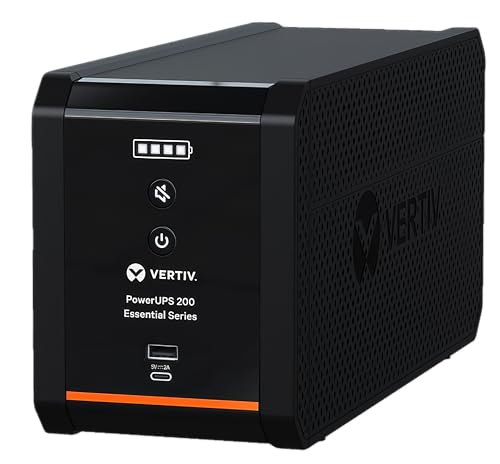
Vertiv Liebert PowerUPS 200 Essential 1500VA
A line-interactive UPS designed for small office and home setups needing reliable backup power and surge protection. Features automatic voltage regulation, user-replaceable batteries, and a three-year warranty to minimize downtime during outages.
Pros
- AVR technology protects devices from power surges and stabilizes unstable utility power
- User-replaceable battery design eliminates vendor lock-in and reduces long-term costs
- Comprehensive three-year warranty provides peace of mind for extended use
- Multiple outlet types and USB charging support diverse device needs
Cons
- No verified buyer reviews available to confirm real-world reliability and runtime performance
- 1500VA capacity may be insufficient for high-power devices or extended runtime requirements
- Line-interactive topology may have slightly longer transfer time compared to double-conversion units
GOLDENMATE 1500VA Lithium UPS with Emergency Light
A wall-mountable UPS system built around LiFePO4 battery technology, designed to keep computers, routers, and other essentials running during outages. Offers pure sine wave output, eight outlets, USB charging, and an auto-activating emergency light for hands-free visibility in the dark.
Pros
- LiFePO4 chemistry outlasts traditional lead-acid batteries by years, saving money over time
- Emergency light automatically activates in power loss, eliminating need for manual switches
- Fast <10ms transfer time ensures minimal disruption to computers and sensitive devices
- Eight outlets plus dual USB ports consolidate multiple devices on one unit
- Auto-shutdown capability via USB connection prevents data loss during extended outages
Cons
- 230Wh capacity limits runtime for power-hungry devices or extended outages
- No verified buyer reviews available to assess real-world performance and reliability
- Emergency light feature requires manual mode selection (AUTO vs OFF) for proper operation
APC BE425M 425VA UPS Battery Backup
A compact UPS designed for protecting home internet and small office equipment during power outages. Delivers up to 15 minutes of runtime on a 100W load, with 6 outlets split between battery backup and surge-only protection.
Pros
- Space-saving form factor suitable for apartments and dorm rooms
- Combination of battery-backed and surge-only outlets provides flexibility
- Built-in voltage regulation minimizes unnecessary battery drain
- Clear status notifications help track power events
- Generous equipment protection plan included
Cons
- Limited 15-minute runtime assumes only 100W load, insufficient for larger devices
- No reviews available to verify real-world performance and reliability
- Battery capacity may be too small for extended outage protection
CyberPower GX150C2-E 1500VA Gaming UPS
A 1500VA battery backup system designed specifically for gaming setups, offering 13 outlets with seven battery-protected slots and sine wave output to keep PCs and consoles running through power outages. Includes fast USB-C charging, adjustable RGB lighting, and a compact high-efficiency design suited for streaming and home office environments.
Pros
- Generous outlet count and spacing accommodates oversized gaming power supplies without blocking adjacent outlets
- USB-C charging keeps gaming peripherals powered even during outages
- Compact, efficient design reduces footprint and energy waste compared to traditional UPS systems
- 3-year coverage including battery replacement and substantial equipment protection guarantee
- Sine wave output protects sensitive gaming and streaming equipment from power fluctuations
Cons
- No verified customer reviews available to assess real-world reliability or runtime performance
- 24.32-pound weight and 13.78 x 11.02-inch footprint requires dedicated floor or desk space
- Requires separate software download for advanced management features beyond basic backup functionality
Uninterruptible Power Supplies Buying Guide
Choosing the right UPS comes down to matching its capacity, output waveform, runtime, and connectivity features to your specific equipment and usage scenario.
The sections below break down each decision point so you can identify the model that actually fits your setup rather than simply buying by brand name or price alone.
VA Rating and Wattage: How Much Capacity Do You Actually Need?

Every UPS lists two numbers: a VA (volt-ampere) rating and a wattage figure. The wattage is the real load limit. The VA rating accounts for power factor inefficiencies in the devices being backed up.
A common rule of thumb is to add up the wattage of everything you plan to run simultaneously, then choose a UPS rated at least 20 to 25 percent above that sum.
This headroom prevents the unit from running at full load during an outage, which degrades battery health faster and generates more heat.
For a typical home network setup (modem, router, a small switch), a 425VA to 600VA unit is usually sufficient and keeps costs low. A desktop PC with a monitor and a few peripherals will generally need 1000VA to 1500VA.
A workstation with multiple drives, a large display, and active USB peripherals may push toward 2000VA or beyond.
Gaming desktops with high-wattage GPUs are particularly power-hungry, so pair your UPS choice with a realistic estimate of peak draw rather than idle consumption.
If you are building out a more powerful home setup, consider how it sits alongside other power infrastructure like solar generators for extended outage coverage.
Do not confuse runtime with capacity. A higher VA rating does not automatically mean longer runtime. Runtime depends on how much load you are actually drawing.
Running a 1500VA UPS at 20 percent load will keep devices alive far longer than running it at 80 percent. Manufacturers publish runtime curves in their datasheets, and those figures are worth checking before purchase.
Pure Sine Wave vs. Simulated Sine Wave

The output waveform a UPS delivers during a power event matters more than most buyers realize. Simulated (or stepped approximation) sine wave output is produced by most line-interactive UPS units in the budget to mid-range segment.
It works reliably with most desktop PCs, monitors, routers, and basic electronics. However, active PFC power supplies, which are found in higher-end desktop PCs and workstations, can behave unpredictably on simulated sine wave during a transfer event.
In some cases, active PFC PSUs will shut down immediately rather than run on the distorted waveform.
Pure sine wave output replicates utility power almost exactly and is compatible with every device class, including active PFC power supplies, medical-grade equipment, laser printers, and audio hardware with sensitive power conditioning.
If you are protecting a modern gaming desktop, a workstation, or any device with an active PFC power supply, prioritize UPS models that output a pure sine wave even when running from battery.
The APC SMT2200C and the GOLDENMATE lithium model both fall into this category within this roundup.
Line Interactive vs. Standby Topology
Standby (offline) UPS units stay passive until a power event is detected, then switch to battery in a few milliseconds. This is fine for most home electronics but can occasionally cause brief glitches in sensitive equipment.
Line-interactive UPS units go further by incorporating an automatic voltage regulator (AVR) that actively corrects brownouts and overvoltages without touching the battery at all.
This significantly extends battery life in areas with unstable grid power and is the dominant topology in the mid-range to high-end residential and small-office market.
Double-conversion (online) UPS units provide the most robust protection by continuously converting incoming AC power to DC and back to AC, meaning the connected devices never see raw utility power at all.
This topology is typically found in server room and data center equipment and is overkill for most home scenarios.
For a home office, a NAS array, or a gaming setup, a line-interactive unit with AVR covers all practical threats without the added cost or complexity.
Battery Technology: Sealed Lead-Acid vs. Lithium

The vast majority of residential UPS units ship with sealed lead-acid (SLA) batteries.
SLA is mature, affordable, and recyclable, but it has real limitations: typical replacement cycles run every three to five years, SLA batteries are sensitive to heat, and deep cycling them shortens lifespan.
Most manufacturers recommend keeping load below 50 percent of rated capacity to maximize battery longevity. Replacement batteries for popular APC and CyberPower models are widely available and relatively inexpensive.
Lithium iron phosphate (LiFePO4) batteries, as found in the GOLDENMATE unit in this roundup, offer a dramatically different profile: manufacturers claim cycle life of several thousand cycles versus a few hundred for SLA, lighter weight, faster charge times, and better performance in warm environments.
The trade-off is a higher upfront cost. For buyers who want a longer-term investment or who live in warmer climates where SLA degrades quickly, lithium UPS units are worth the price premium.
Think of the battery technology choice similarly to how you might evaluate energy storage when comparing solar panel systems for a home setup.
Outlet Count, Load Distribution, and Connectivity

UPS units split their outlets into two groups: battery-backed outlets and surge-only outlets. Battery-backed outlets are where your critical devices go, and they are the ones that stay alive during an outage.
Surge-only outlets protect gear like desk lamps or phone chargers from spikes without drawing from the battery. Count how many battery-backed outlets you genuinely need before selecting a model.
Running out of backed-up outlets defeats the purpose of the UPS for devices you actually need to protect.
USB connectivity (both Type-A for data/power and USB-C on newer models) is increasingly common and useful for device charging during outages.
Many units also include a USB data port that connects to a PC or NAS for automatic shutdown software integration, which safely powers down equipment before the battery is exhausted.
If you run a NAS or a server that handles important data, this feature is not optional. Look for compatibility with the shutdown software your NAS vendor supports.
LCD Display, Monitoring, and Form Factor

Entry-level UPS units communicate status through simple LED indicators. Mid-range and higher-end models add LCD panels that display real-time load percentage, estimated battery runtime, input voltage, and fault codes. For a set-and-forget home network backup, LEDs may be perfectly adequate.
For a home office or any setup where you need to make informed decisions during an outage (such as whether to keep working or start shutting down), an LCD readout is genuinely valuable information at a glance.
Form factor also matters more than buyers expect. Tower units suit under-desk or shelf placement. Rack-mount units are designed for server racks and not practical in a residential context unless you already have the infrastructure.
Some models, like the Vertiv Liebert PowerUPS in this roundup, offer wall-mount capability that frees up floor space in utility closets or behind entertainment centers.
Consider where the unit will live, how accessible it needs to be, and whether its cooling vents will have adequate airflow in that location. A unit that runs hot will degrade its battery faster regardless of spec sheet ratings.
If you are building out a gaming room, pairing a reliable UPS with a sturdy gaming desktop setup makes for a resilient workstation that survives both outages and surges.
Why You Should Trust Us
ProductFind is an independent editorial platform. We do not sell products, fulfill orders, or handle returns. Every recommendation on this site is the result of structured research, not commercial relationships.
Each UPS in this roundup was assessed using a consistent, repeatable methodology.
We analyze manufacturer-published specifications, cross-reference expert review consensus from the broader technology press, and systematically evaluate verified buyer feedback from confirmed purchasers, weighting feedback patterns rather than individual anecdotes.
We do not conduct our own product trials; our evaluations are grounded in research, published data, expert review consensus, and verified buyer feedback.
Every model is then assigned a PF Score on a 0 to 10 scale that reflects overall value, reliability signals, feature completeness relative to price tier, and real-world satisfaction patterns across the buyer population.
ProductFind may earn a commission when you purchase through links on this page. That affiliate relationship has zero influence on scores, rankings, or which products are included.
Our editorial process is kept separate from commercial considerations, and no manufacturer pays to appear in or be excluded from any ProductFind roundup. The rankings you see reflect research quality, not commission rates.
Final Thoughts
The uninterruptible power supply market covers a wide range of needs, and the models in this roundup reflect that diversity.
Whether you need a compact unit to keep your home network alive through a brief outage or a high-capacity sine wave system to protect a workstation through a sustained blackout, there is a well-matched option in this list.
Below are the standout performers by use case, based on PF Scores and verified buyer consensus.
- Best Overall: CyberPower GX150C2-E Gaming UPS Battery Backup and Surge Protector earns the top spot with the highest PF Score in this roundup, reflecting strong expert consensus, gaming-specific feature tuning, and robust surge and battery performance that resonates across a wide range of verified buyers.
- Best Premium Pick: APC 2200VA Smart UPS with SmartConnect (SMT2200C) is the go-to recommendation for workstations, active PFC power supplies, and demanding home-office environments where pure sine wave output and intelligent monitoring are non-negotiable.
- Best Mid-Range Value: CyberPower CP1500AVRLCD3 delivers an excellent combination of capacity, LCD monitoring, AVR, and verified buyer satisfaction at a mid-range price that suits most desktop PC and home-office use cases.
- Best Budget-Friendly Option: APC UPS 600VA/330W (BE600M1) remains one of the most trusted entry-level choices for protecting a router, modem, or small electronics, with one of the largest verified buyer bases in its category and a compact footprint that fits anywhere.
- Best for Lithium Battery Technology: GOLDENMATE 1500VA/1000W Lithium UPS Battery Backup stands apart for buyers who want LiFePO4 longevity, wall-mount flexibility, and built-in emergency lighting in a single unit, particularly in warm environments where sealed lead-acid batteries degrade fastest.
Pairing a quality UPS with dependable power infrastructure gives your home office or entertainment setup genuine resilience. For those thinking beyond battery backup toward longer-term energy independence, exploring solar generator options alongside a UPS strategy is a logical next step.
Frequently Asked Questions
How long will a UPS keep my devices running during a power outage?
Runtime depends almost entirely on two variables: the capacity of the UPS battery and the actual wattage being drawn by connected devices. A 1500VA unit running a light load (router and modem only) can provide runtime well beyond an hour.
That same unit powering a full desktop workstation at peak load might deliver only ten to fifteen minutes, enough to save work and shut down safely.
Always check the manufacturer’s published runtime curve at your expected load percentage, not just the headline runtime figure quoted at minimum load.
Do I need a pure sine wave UPS or will a simulated sine wave unit work?
For routers, modems, NAS drives, older desktop PCs, and most consumer electronics, a simulated sine wave UPS is adequate and meaningfully less expensive.
The critical exception is any device with an active PFC power supply, which includes most modern mid-range to high-end desktop gaming PCs and workstations.
These PSUs can shut down or malfunction when fed a simulated sine wave during a power event.
If you are unsure whether your PSU is active PFC, check the specifications or look for the PFC compliance label on the unit itself. When in doubt, a pure sine wave UPS eliminates the compatibility question entirely.
How often do UPS batteries need to be replaced?
Standard sealed lead-acid UPS batteries typically last three to five years under normal operating conditions, though heat accelerates degradation significantly. Most modern UPS units include a battery health indicator or self-evaluation function that will alert you when replacement is due.
Replacement batteries for major brands like APC and CyberPower are widely available and straightforward to swap without professional help.
Lithium-based UPS units claim substantially longer cycle life, often rated for thousands of charge cycles, which translates to a longer service interval before replacement becomes necessary.
Can I use a UPS to protect my gaming PC and peripherals?
Yes, and it is strongly recommended for any serious gaming setup. Power events including surges, brownouts, and full outages can corrupt game saves, damage high-end hardware, or interrupt online sessions at critical moments.
The key consideration for gaming PCs is matching the UPS to the actual power draw of your GPU and CPU under gaming load, which is typically the highest sustained draw your system will see.
A high-wattage graphics card can consume several hundred watts on its own. Factor in your display, audio equipment, and peripherals to get an accurate load estimate.
A gaming headset or other audio gear plugged into surge-only outlets on the same UPS also benefits from spike protection without drawing from the battery.
What is the difference between a UPS and a surge protector?
A surge protector only addresses voltage spikes, diverting excess energy away from connected devices. It provides zero protection during a power outage because it has no battery.
A UPS includes surge protection as a baseline feature but adds battery backup, and in line-interactive models, active voltage regulation that corrects both overvoltages and undervoltages (brownouts) without touching the battery at all.
For any device where sudden power loss would cause data loss, hardware damage, or significant disruption, a UPS is the appropriate choice over a standalone surge protector.
Is a UPS the same as a portable power station or solar generator?
They overlap in function but serve different primary purposes. A UPS is purpose-built for near-instantaneous power transfer during outages, with transfer times measured in milliseconds, making it suitable for computers and network equipment that cannot tolerate even a brief interruption.
Portable power stations and solar generators typically have much larger battery capacities but slower transfer times, making them better suited for extended outage coverage of larger loads like refrigerators, CPAP machines, or general household circuits rather than protecting sensitive computing equipment from momentary interruptions.
About the author
Jamie is a reviewer and writer for ProductFind who specializes in Power & Charging. Jamie evaluates products through independent research: specifications, expert review consensus, and verified buyer feedback, and rates each one on the PF Score. Jamie focuses on helping readers pick the right power & charging for their needs and budget.