The 8 Best Pedestal Fans
Cooling a room without central air starts with finding the right standing fan. Our research covers quiet DC motors, smart controls, and heavy-duty airflow to match every space.
 By Constance Jenkins
Updated July 23, 2026
By Constance Jenkins
Updated July 23, 2026

A good pedestal fan can transform a stuffy bedroom, home office, or living room into a genuinely comfortable space without the energy cost and installation hassle of a central air system.
Unlike window or tower units, standing fans are portable, height-adjustable, and built to move air across a wide area, making them one of the most versatile cooling tools you can own.
Whether you’re dealing with a heat wave, trying to sleep better, or circulating air in a large workshop, the right pedestal fan makes a measurable difference in how a room feels.
This guide covers eight pedestal fans across a wide range of price points and use cases, from quiet DC-motor models designed for light sleepers to heavy-duty industrial units built for warehouses and garages.
Our picks come from brands including DREO, Rowenta, Lasko, Maxx Air, Comfort Zone, PELONIS, and EZ-Chill.
ProductFind assembled this list through in-depth research across specifications, expert review consensus, and verified buyer feedback, so you get a shortlist that’s genuinely worth your time. Scroll down for our top picks, ranked and ready to compare.
| Award | Product | PF Score About PF ScoreThe PF Score is our own rating from 0 to 10, based on performance, design and build, ease of use, and value. It reflects independent research and is never influenced by manufacturers, retailers, or affiliate commissions. Learn more › | Price | |
|---|---|---|---|---|
| Best Overall |
 DREO TurboPoly 513S Pedestal Fan, 120° Oscillating
|
8.7/10 | Buy | |
| Editor's Pick |
 Rowenta VU5670 53-Inch Pedestal Fan
|
8.5/10 | Buy | |
| Best Value |
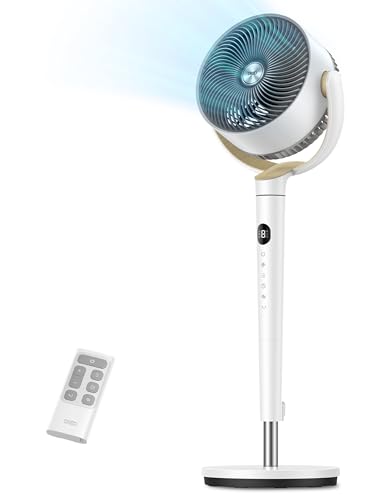 DREO 120° Pedestal Fan, 9 Speeds, 20dB DC Motor
|
8.3/10 | Buy | |
| Top Rated |
 Maxx Air 30-Inch Industrial Pedestal Fan
|
7.8/10 | Buy | |
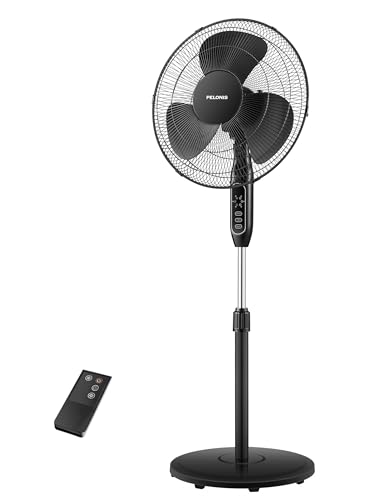 PELONIS 16-Inch Pedestal Fan with Remote Control
|
7.5/10 | Buy | ||
 Comfort Zone 16-Inch Pedestal Fan with Oscillation
|
7.2/10 | Buy | ||
 Lasko 2520 16-Inch Pedestal Fan
|
7.1/10 | Buy | ||
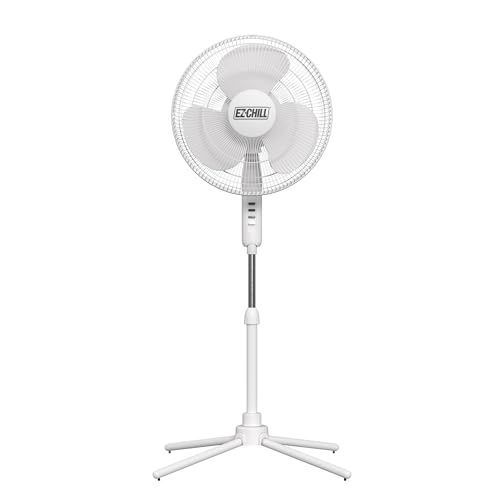 EZ-Chill 16-Inch Oscillating Pedestal Fan
|
6.8/10 | Buy |
DREO TurboPoly 513S Pedestal Fan, 120° Oscillating
A smart pedestal fan with extensive control options (8 speeds, 6 modes, Wi-Fi/voice compatible) and wide 120° horizontal plus 105° vertical oscillation for whole-room air circulation. Designed for quiet operation with a brushless DC motor, though actual noise levels may vary from marketing claims.
Pros
- Extensive oscillation range covers more room area than typical fans
- Multiple control methods (app, voice, remote, manual) suit different preferences
- High air volume and circulation distance for a pedestal fan
- Adjustable height accommodates various room setups
Cons
- No verified customer reviews available to confirm real-world noise and performance claims
- Marketing specs show 20dB but description mentions 25dB, creating conflicting noise level information
- Premium pricing likely reflects smart features rather than proven superior build quality
Rowenta VU5670 53-Inch Pedestal Fan
A tall pedestal fan designed for quiet operation in bedrooms, delivering airflow across a wide area with multiple speed options including a dedicated Silent Night mode. Best suited for users who prioritize low noise levels and convenience features like remote control and an 8-hour timer.
Pros
- Ultra quiet operation at 35 dB(A), notably quieter than standard fans
- Wide coverage with 16-inch head and 5 blades, reaching up to 23 feet
- Five speed options including Turbo Boost and Silent Night mode for flexibility
- Energy-efficient timer and auto-adjustment mode reduce power consumption
- Remote control with onboard storage for easy adjustment from distance
Cons
- No customer reviews available to verify real-world performance and durability
- Heavier at 19.6 pounds, less portable despite being labeled portable
- Limited information on actual noise levels in different speed settings beyond the 35 dB(A) baseline
DREO 120° Pedestal Fan, 9 Speeds, 20dB DC Motor
A quiet pedestal fan combining oscillation, vertical tilt, and air circulation with a brushless DC motor that reaches up to 100 feet while operating at just 20dB. Best for bedroom and office use where noise matters and flexible directional control is needed.
Pros
- Exceptional quietness at 20dB makes it suitable for bedtime and focused work without distraction
- Dual directional control: 120 degree horizontal oscillation (remote/panel controlled) plus manual vertical tilt covers entire room
- DC motor delivers 30 percent more air circulation while consuming 40 percent less energy than conventional fans
- Reaches up to 100 feet away, suitable for large bedrooms and office spaces
- Adjustable height and 9-hour timer add flexibility to daily routines
Cons
- Vertical tilt requires manual adjustment, unlike horizontal oscillation which has remote control
- No verified buyer reviews available to confirm real-world noise levels and durability
- Limited to white color option based on available specifications
Maxx Air 30-Inch Industrial Pedestal Fan
Heavy-duty pedestal fan engineered for warehouses, factories, and large commercial spaces. Delivers powerful airflow circulation with adjustable height and angle settings to customize coverage across expansive areas.
Pros
- Large 30-inch blade diameter designed for expansive room coverage
- Adjustable pedestal allows customization of height and airflow direction
- Rugged construction built to withstand rigorous continuous use
- High-velocity performance reduces hot spots in large spaces
Cons
- No customer reviews available yet to verify real-world performance claims
- 47-pound weight may require two people for setup and repositioning
- Fixed blade size limits flexibility if you need smaller fan options later
PELONIS 16-Inch Pedestal Fan with Remote Control
A mid-range pedestal fan designed for medium to large rooms, offering 90-degree oscillation, adjustable height, and remote control functionality. Combines practical cooling features like a 7-hour timer and three-speed settings with a stable base and quiet operation.
Pros
- 90-degree oscillation with tilt adjustment provides flexible airflow coverage throughout spaces
- Remote control and height adjustability offer convenience for bedroom, living room, and office use
- Built-in safety features including sturdy weighted base and automatic overheat protection
- 7-hour timer allows for unattended operation overnight or while away
- Three-speed settings enable personalized cooling intensity
Cons
- No verified buyer reviews available to assess real-world performance or reliability
- Limited color options, available only in black
- Weight of 11.4 pounds may require consideration for portability between rooms
Comfort Zone 16-Inch Pedestal Fan with Oscillation
A straightforward pedestal fan offering three-speed settings, 90-degree oscillation, and adjustable height from 41 to 47 inches for flexible room cooling. Built with a protective metal safety grill and simple push-button controls, it suits bedrooms and offices where customizable airflow direction matters.
Pros
- Flexible height and tilt adjustments allow customization for different room layouts and seating positions
- Wide oscillation coverage distributes air across broader areas efficiently
- Metal safety grill provides reliable blade protection for households with children or pets
- Multiple speed options give control over energy use and noise levels
Cons
- No customer reviews available to verify real-world noise levels or durability claims
- Limited to basic push-button controls without remote or timer functions
- Relatively compact 16-inch blade size may require closer positioning for whole-room cooling
Lasko 2520 16-Inch Pedestal Fan
A budget-friendly oscillating pedestal fan with adjustable height up to 47 inches and three quiet speed settings, suitable for bedrooms and home offices. Tool-free assembly and lightweight design make it portable, though it lacks advanced features like remote control or timer functionality.
Pros
- Wide height adjustability makes it adaptable to different room layouts and sitting positions
- Oscillation feature distributes air throughout the room rather than a single direction
- No-tool assembly and light weight enable quick setup and repositioning
- Multiple speed options allow users to balance cooling needs with noise levels
- Safety certification and Blue Plug technology provide electrical protection
Cons
- No timer or remote control for added convenience
- Limited to three speed settings compared to some competitors
- No verified buyer reviews available to assess real-world durability and noise consistency
EZ-Chill 16-Inch Oscillating Pedestal Fan
A mid-range pedestal fan with three-speed settings, 90-degree oscillation, and adjustable height from 41 to 47 inches for flexible room cooling. The metal safety grill and simple push-button controls prioritize user safety and ease of operation.
Pros
- Multiple speed and adjustment options let you customize cooling to your space and comfort level
- Metal safety grill and push-button design make it straightforward and safe for household use
- Oscillation and height range provide effective air distribution across different room sizes
Cons
- No customer reviews available to verify real-world durability or noise levels
- Limited information on energy consumption or motor specifications
- 5.2-pound weight may require steady placement on certain surfaces
Pedestal Fans Buying Guide
Shopping for a pedestal fan is less straightforward than it looks. Blade diameter, motor type, oscillation range, noise level, and smart features all interact with each other in ways that matter a great deal depending on your specific setting.
The sections below break down the most important criteria our research surfaced, so you can match the right fan to your needs rather than defaulting to whatever happens to be on sale.
Motor Type: AC vs. DC

The single biggest performance and efficiency divide in the pedestal fan market today is between traditional AC motors and newer brushless DC motors. AC motors are reliable, inexpensive, and ubiquitous in budget and mid-range fans.
They do the job, but they tend to run louder and draw more power, particularly at lower speed settings where AC motors can hum noticeably.
DC motors, by contrast, use roughly 50 to 70 percent less energy and allow for a far wider range of precise speed increments.
That’s why you’ll find nine or more speed settings on DC-powered fans like the DREO models in this list, compared to the three speeds typical of AC units.
Quieter operation matters most in bedrooms and home offices where fan noise competes with sleep or focus.
If you’re primarily using a fan in a garage, workshop, or large open area where raw airflow matters more than silence, an AC-powered industrial unit is often the better value.
For most households, a DC fan is worth the price premium, especially if the fan will run for long hours every day throughout a warm season.
Over a few months, the energy savings are meaningful, and the quieter operation is immediately noticeable. Pairing a well-circulated room with a quality air purifier can push indoor comfort even further during high-pollen or high-humidity periods.
Oscillation Range and Air Coverage
Standard pedestal fans oscillate horizontally up to about 90 degrees, which is sufficient for a single person sitting directly in front of the fan or for a small room with one occupant.
If you need to cool multiple zones, a larger seating area, or a room where you move around, you want a wider sweep.
Some premium models now offer combined horizontal and vertical oscillation, which creates a much more three-dimensional airflow pattern.
The DREO Smart Fan (B0BSH7YKHT) is the standout here, offering 120-degree horizontal plus 105-degree vertical oscillation simultaneously, which creates coverage that approaches what you’d expect from a ceiling fan.
Rowenta’s VU5670 (B071JBX9MQ) claims a 23-foot air refresh distance, a spec that’s been corroborated across multiple expert reviews for large room coverage.
For industrial spaces, Maxx Air’s 30-inch unit (B07X8L53DG) skips oscillation entirely in favor of high-velocity directional airflow suited to warehouses and commercial settings.
Pay attention to the distinction between oscillation angle and effective coverage area. A fan that oscillates 120 degrees in a small bedroom can actually feel less focused than a 90-degree fan set directly toward your sitting position.
Match oscillation range to room size and layout, not just to a bigger-is-better assumption.
Noise Level and Sleep-Friendly Performance
Noise is one of the most commonly cited complaints in verified buyer reviews for pedestal fans, and it’s an area where published specifications vary widely in usefulness. Some manufacturers publish decibel ratings at specific speeds; others don’t.
Where noise specs are published, a rating of 35 dB or below at the lowest setting is generally considered acceptable for bedroom use, and anything below 25 dB is genuinely quiet.
Both DREO models in this guide publish a 20 dB minimum noise rating, which places them among the quietest pedestal fans available at any price.
Rowenta has a long-standing reputation for quiet operation backed by expert review consensus, with the VU5670 consistently praised for its near-silent low-speed setting.
Budget AC-motor fans like the Lasko 2520 and Comfort Zone 16-inch unit will produce more mechanical noise at low speeds, but many buyers find the white noise effect actually helpful for masking ambient sound.
If you share a bedroom or have a light sleeper in the household, prioritize published dB ratings and look for DC-motor models.
A fan that runs quietly through the night is more valuable than one with a higher top speed you’ll rarely use.
Combining a quiet fan with one of the better memory foam mattresses designed for temperature regulation is one of the most effective budget-friendly approaches to hot sleeper comfort.
Height Adjustability and Build Quality

Most pedestal fans adjust height somewhere between 37 and 54 inches, which covers the range from desk-level airflow to standing circulation. What matters is whether the adjustment mechanism is smooth, secure, and easy to operate without tools.
Cheap height locks can slip under vibration, causing the fan head to drift downward over time. Look for reviews that specifically mention the stability of the pole lock mechanism.
For home use, a height range of 37 to 53 inches is generally versatile enough to serve both seated and standing positions.
Industrial units like the Maxx Air 30-inch fan are built with heavier-gauge materials to handle continuous commercial operation, which also translates to a more stable base even on uneven surfaces.
The PELONIS 16-inch model (B0GLP82PKT) earns positive marks in verified buyer feedback specifically for its assembly process and the firmness of its height lock, two factors that budget fans often get wrong.
Base footprint is worth checking before you buy. Pedestal fans with a wide, low base are more stable but take up more floor space.
If you’re using the fan in a tight apartment or a home office with limited floor clearance, confirm the base diameter before ordering.
Smart Features and Remote Control
Wi-Fi connectivity, app control, and voice assistant integration have moved from novelty to genuine convenience in the pedestal fan segment.
The ability to set schedules, adjust speed without getting up, or integrate a fan into a broader smart home routine is now available at a mid-range price point, not just on premium models.
If you already use Alexa or Google Home, a smart fan fits naturally into existing routines.
The DREO Smart Fan (B0BSH7YKHT) supports Wi-Fi, app control, Alexa, and Google Assistant, with a notable design choice of no status indicator light, which matters when the fan is running in a dark bedroom.
For buyers who want remote convenience without full smart-home integration, the PELONIS model includes a physical remote and a seven-hour programmable timer at a lower price point.
Basic budget fans from Lasko and Comfort Zone offer manual controls only, which is perfectly adequate for straightforward use cases.
Timer functionality is underrated. Being able to set a fan to shut off after a few hours helps avoid overcooling a room at night and saves energy.
Even budget models like the Comfort Zone 16-inch include a basic timer, which is one of the reasons it holds its own as a value pick despite simpler overall construction.
Blade Size and Airflow Volume

Blade diameter determines the volume of air a fan can move per rotation. Standard residential pedestal fans use 16-inch blades, which deliver adequate airflow for bedrooms and living rooms up to roughly 250 to 300 square feet.
For larger spaces, open-plan areas, or commercial environments, a 20-inch or 30-inch blade becomes necessary.
The Maxx Air 30-inch industrial fan (B07X8L53DG) is the high-velocity outlier in this roundup, designed for spaces where moving a high volume of air quickly is more important than quiet operation or aesthetics.
It’s worth noting that blade size alone doesn’t determine real-world airflow performance. Blade pitch, motor power, and housing design all contribute to how efficiently a fan actually moves air.
Rowenta’s engineering, for instance, produces strong airflow from a 16-inch blade by optimizing blade geometry, which is part of why it commands a higher price than comparable-diameter models.
Expert reviewers consistently highlight the Rowenta VU5670’s airflow-to-noise ratio as genuinely class-leading in the residential segment.
If you’re cooling a space that also has air quality concerns, pairing a high-airflow fan with air purifiers built for allergy relief or a dedicated HEPA air purifier creates a meaningful improvement in both temperature and particulate levels.
Good air circulation helps filtration systems work more efficiently by keeping air moving through the filter rather than leaving pockets of stagnant air.
Why You Should Trust Us
ProductFind is an independent review platform.
Every product in this guide was evaluated using a consistent research framework that draws on published manufacturer specifications, expert review consensus from credible sources across the industry, and verified buyer feedback aggregated from real purchasers.
We do not conduct our own product trials; our evaluations are grounded in research, published data, expert review consensus, and verified buyer feedback.
Each fan was assigned a PF Score on a scale of 0 to 10, reflecting how well it performs across the criteria most relevant to buyers in this category: motor efficiency and noise output, airflow coverage, build quality and adjustability, feature set relative to price, and long-term reliability signals from owner feedback.
Scores are assigned independently of any commercial relationship. ProductFind may earn a commission when you purchase through a link in this article, but affiliate arrangements have no influence on rankings, scores, or which products are included.
Our only standard is whether a product is genuinely worth recommending.
Final Thoughts
The pedestal fan market in 2026 covers a wider range of genuine quality than it did just a few years ago.
DC motors and smart connectivity have come down sharply in price, and even mid-range models now offer features that were once exclusive to premium units.
The picks in this roundup reflect that range, so there’s a strong option regardless of whether you’re outfitting a studio apartment on a tight budget or looking for the quietest possible fan for a light sleeper’s bedroom.
Here’s how our top picks break down by standout category:
- Best Overall: DREO Smart Fan for Bedroom earns the top spot with the highest PF Score in the roundup, combining omni-directional oscillation, a whisper-quiet 20 dB DC motor, full smart-home integration, and a no-light design purpose-built for sleep environments.
- Best Premium Pick: Rowenta Pedestal Fan VU5670 is the benchmark for airflow-to-noise engineering in the residential segment, with five speeds and a verified 23-foot air refresh range that few competitors at any price can match.
- Best Runner-Up Smart Fan: DREO Fan for Bedroom (DC Motor, 9 Speeds) delivers nearly identical DC-motor performance and nine-speed precision at a lower price than its sibling, making it the smarter buy for shoppers who don’t need full Wi-Fi control.
- Best for Large and Industrial Spaces: Maxx Air Industrial 30″ Pedestal Fan is purpose-built for warehouses, garages, and commercial settings where raw high-velocity airflow matters more than quiet operation or smart features.
- Best Budget Pick: Lasko Oscillating Pedestal Fan 2520 delivers dependable three-speed oscillating performance at the lowest price in the roundup, making it the most practical entry-level option for buyers who need straightforward cooling without frills.
Whichever direction you go, a well-chosen pedestal fan is one of the highest-value climate comfort investments you can make for a home.
If you’re also thinking about overall indoor air quality alongside temperature, air purifiers are a natural companion product worth exploring once your cooling setup is sorted.
Frequently Asked Questions
What is the quietest type of pedestal fan for a bedroom?
DC-motor pedestal fans are significantly quieter than traditional AC-motor models, particularly at low and medium speeds.
Fans with published noise ratings at or below 30 dB are generally considered suitable for bedroom use, and anything at 20 dB is essentially inaudible in a typical sleeping environment.
Models from DREO and Rowenta consistently rank highest in this area across expert reviews and owner feedback. If complete silence is a priority, look for fans that specifically advertise a “sleep mode” with a capped speed and no illuminated indicators.
How much electricity does a pedestal fan use compared to an air conditioner?
A standard AC-motor pedestal fan typically consumes between 45 and 65 watts at medium speed. A DC-motor model runs on as little as 15 to 25 watts at comparable airflow.
By contrast, a window air conditioner uses roughly 500 to 1,500 watts depending on size and setting.
Running a pedestal fan for eight hours a day costs a fraction of what an air conditioner costs for the same period, which is why fans remain the most energy-efficient first line of cooling for moderate temperatures.
For extreme heat, fans work best when combined with other strategies like drawing cool outside air at night and blocking direct sunlight during the day.
What blade size do I need for my room?
For bedrooms and small to medium living rooms up to about 250 to 300 square feet, a 16-inch blade pedestal fan is the standard and appropriate choice.
For larger open-plan living spaces, home gyms, or garages, a 20-inch model provides meaningfully more air volume.
Industrial spaces like warehouses, workshops, or large commercial floors benefit from the high-velocity output of 30-inch units like the Maxx Air in this roundup.
Blade pitch and motor efficiency also affect real-world performance, so blade diameter alone is not the only factor to consider.
Are smart pedestal fans worth the extra cost?
Smart pedestal fans are worth the investment if you already use a voice assistant platform or frequently adjust fan settings throughout the day.
The ability to schedule shutoff times, change speeds from bed, and integrate the fan into broader home automation routines adds genuine convenience, not just marketing features.
If you primarily use a fan in one static setting at one consistent speed, the extra cost of Wi-Fi connectivity is harder to justify.
For most buyers who run a fan overnight in a bedroom or through a full workday in a home office, the scheduling and app features tend to get regular use once set up.
How do I keep a pedestal fan running well over time?
The most important maintenance step is cleaning the blade assembly and grille every four to six weeks during active use. Dust buildup on blades creates imbalance, which increases motor strain, vibration, and noise.
Most pedestal fans allow the grille to be removed without tools for easy wiping. Keeping the motor housing vents clear is equally important since restricted airflow around the motor causes heat buildup that shortens its lifespan.
Store the fan in a dust-free environment off-season and avoid leaving it in direct sunlight for extended periods, which can degrade plastic components and cause discoloration.
Can I use a pedestal fan outdoors or on a covered patio?
Standard residential pedestal fans are designed for indoor use only and are not rated for moisture exposure.
Using them outdoors, even under a covered patio, risks water ingress from humidity, rain splash, or condensation that can damage the motor or create a safety hazard.
If you want moving air on an outdoor patio or deck, look for fans specifically rated for outdoor or damp-rated environments.
For covered outdoor living spaces more broadly, patio furniture sets designed for outdoor comfort often pair well with purpose-built outdoor misting fans or ceiling fans rated for damp locations.
About the author
Constance is a reviewer and writer for ProductFind who specializes in Heating, Cooling & Air Quality. Constance evaluates products through independent research: specifications, expert review consensus, and verified buyer feedback, and rates each one on the PF Score. Constance focuses on helping readers pick the right heating, cooling & air quality for their needs and budget.