The 12 Best Air Purifiers for Allergies
Sneezing indoors? Pollen, pet dander, and dust mites are likely the culprits. Our research-backed picks cover every room size and budget, with true HEPA filtration at the core.
 By Constance Jenkins
Updated July 23, 2026
By Constance Jenkins
Updated July 23, 2026
Seasonal pollen surges, year-round pet dander, and microscopic dust mites can turn your home into an allergy minefield.
For the millions of people who deal with sneezing, congestion, and itchy eyes indoors, a capable air purifier is one of the few interventions with real, measurable impact.
The technology has matured considerably: today’s best air purifiers for allergies combine true HEPA filtration (proven to capture 99.97% of airborne particles down to 0.3 microns) with activated carbon layers, real-time air-quality sensors, and smart controls that let the machine respond automatically to changing conditions.
At ProductFind, we assembled this guide through rigorous research synthesis, analyzing manufacturer specifications, expert review consensus from across the industry, and verified buyer feedback from confirmed purchasers.
We evaluated each model against a consistent set of allergy-specific criteria, from CADR ratings and room-size coverage to filter replacement costs and noise levels at sleep settings, then scored every unit on our 0-to-10 PF Score scale.
Whether you live in a studio apartment or need whole-floor coverage, our ranked picks below give you a clear starting point.

Blueair Blue Pure 311i Max Smart Air Purifier
A mid-size smart air purifier with HEPASilent filtration that captures 99.97% of particles down to 0.1 microns, covering up to 2,107 sq ft per hour. Combines quiet operation (23-50 dB), app-based controls with auto mode, and a compact Scandinavian design ideal for bedrooms and pet-friendly homes.
Pros
- Effective particle capture verified by HEPASilent technology covering particles as small as 0.1 microns
- Smart app integration enables remote monitoring and scheduling without manual adjustment
- Certified quiet performance makes it suitable for sleep environments and noise-sensitive spaces
- Fast air cycling handles medium-to-large rooms efficiently
- Modern design minimizes visual footprint in living spaces
Cons
- No customer reviews available to assess real-world durability or filter replacement costs
- Limited to medium rooms, requiring larger models for open-concept or extra-large spaces
- WiFi functionality requires compatible app ecosystem and stable connectivity

Coway AP-1512HH HEPA Air Purifier for 361 sq ft
The Coway Mighty AP-1512HH uses a 4-stage filtration system to capture 99.97% of particles as small as 0.3 microns and includes real-time air quality monitoring with auto mode that adjusts fan speed based on pollution levels. Best suited for mid-sized rooms, it runs quietly at 24.4-53.8 dB and offers eco mode to reduce energy consumption when air is clean.
Pros
- Comprehensive filtration system with pre-filter, deodorization filter, True HEPA, and Vital Ion technology
- Smart air quality sensor communicates pollution levels in real time with intuitive LED color display
- Auto mode and eco mode reduce manual adjustments and save energy automatically
- Low power consumption at 77W with quiet operation across all fan speeds
- Won Best Air Purifier of 2018 at Wirecutter and ranked 1st at TopTenReviews
Cons
- No verified customer reviews available to confirm real-world performance and durability
- Filters are excluded from warranty coverage and replacement costs not specified
- Limited to rooms up to 361 sq ft, requiring multiple units for larger homes

Winix 5530 Air Purifier, 1882 Sq Ft/Hour Coverage
The Winix 5530 handles large rooms efficiently, capturing 99.99% of airborne allergens down to 0.01 microns through a three-stage filtration system. Its advanced carbon filter tackles odors from pets and cooking, while the air quality indicator gives real-time feedback on room conditions.
Pros
- Substantial coverage area suitable for large rooms and open spaces
- Multi-stage filtration approach effectively handles both particles and odors
- Real-time air quality monitoring provides immediate feedback
- Advanced filtration design helps maximize filter longevity
- App connectivity for remote operation
Cons
- No verified user reviews available to assess real-world durability and noise levels
- Requires regular filter replacement to maintain performance, which carries ongoing costs
- 13.3-pound weight and footprint may limit placement flexibility in smaller spaces
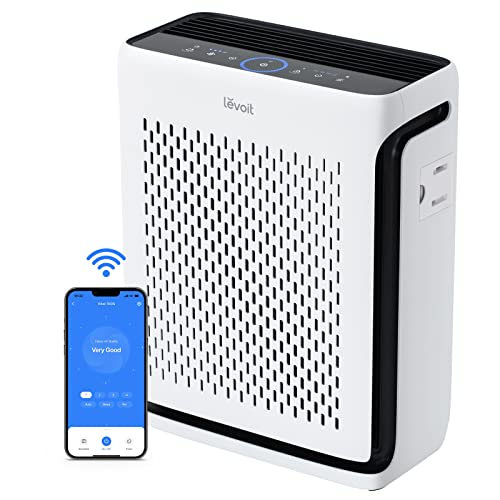
Levoit Vital 100S-P Air Purifier for Large Rooms
AHAM VERIFIDE certified air purifier covering up to 1,073 sq ft with 99.97% filtration efficiency for pet hair, dust, and pollen. Features Smart WiFi control, Sleep Mode as quiet as 25dB, and a washable pre-filter for cost-effective maintenance.
Pros
- AHAM certified performance provides third-party verification of air cleaning effectiveness
- Exceptional coverage for large open-concept spaces without sacrificing quiet operation
- Pet-focused design with dedicated mode and wide inlet optimized for fur and dander
- Washable pre-filter reduces replacement costs compared to fully disposable systems
- Smart home integration allows remote control and scheduling through mobile app
Cons
- No verified user reviews available to assess real-world durability and long-term performance
- Replacement filter ecosystem requires using official Levoit filters, limiting third-party alternatives
- Sleep Mode quietness at 25dB is a performance trade-off, not suitable for maximum air cleaning speed

Levoit Core 400S-P HEPA Air Purifier, 1733 Sq Ft
AHAM-certified air purifier covering large rooms up to 1,733 sq ft with 3-in-1 filtration for allergens, dust, and smoke. Features Smart WiFi control, quiet Sleep Mode at 24 dB, and real-time air quality monitoring via laser dust sensor.
Pros
- AHAM certification provides third-party validation of cleaning performance and energy efficiency
- Large room capacity with verified CADR ratings makes it suitable for bedrooms, living rooms, and open layouts
- Sleep Mode operates at whisper-quiet 24 dB, allowing continuous overnight operation without disruption
- Smart WiFi control via free VeSync app enables remote adjustments and filter life tracking
- 3-in-1 filter targets multiple pollutants including pet allergens, smoke, and dust
Cons
- No user reviews available to evaluate real-world performance and reliability
- Requires 120V power supply, limiting use to United States only
- Filter replacement costs and frequency not specified in product data

Levoit Core 300-P Air Purifier, 1073 sq ft
AHAM verified air purifier with a 56W motor and 143 CFM CADR designed for large rooms up to 1,073 square feet. Operates at 24dB in Sleep Mode and includes a 3-in-1 HEPA filter that captures 99.97% of fine particles, making it suitable for homes with pets and allergies.
Pros
- AHAM VERIFIDE certification with independently verified CADR ratings for smoke, dust, and pollen
- Covers large spaces efficiently, refreshing a 1,073 sq ft room once per hour
- Near-silent operation at 24dB in Sleep Mode with optional display light-off feature
- 99.97% filtration efficiency for particles 0.1 to 0.3 micrometers, including pet dander and allergens
- Multiple filter options available, including Pet Allergy, Toxin Absorber, and Smoke Remover variants
Cons
- Limited to 120V US-only operation, not suitable for international use
- Product carries 4.7 rating with zero verified reviews, making long-term reliability difficult to assess
- Requires genuine Levoit replacement filters for optimal performance, as off-brand alternatives may reduce efficiency

Levoit Core 200S-P Air Purifier for Bedrooms
Compact AHAM-certified air purifier designed for bedrooms and small rooms up to 140 sq ft, with a 3-in-1 filter system that removes 99.97% of particles down to 0.1 microns. Operates quietly at 27dB with smart controls and filter monitoring via app.
Pros
- AHAM-certified performance gives independent verification of cleaning effectiveness
- Exceptionally quiet at 27dB, suitable for uninterrupted sleep or focused work
- Efficient 360-degree intake and compact footprint for small to mid-size rooms
- Smart app integration tracks filter life and enables remote voice control
- 3-stage filtration handles particles, odors, and fumes in one system
Cons
- Limited to 140 sq ft coverage, not suitable for large living spaces or open floor plans
- Requires genuine Levoit replacement filters for optimal performance and warranty
- No user reviews available yet to assess real-world durability or long-term satisfaction

Blueair Blue Pure 511 HEPA Air Purifier, 432 sq ft
Blueair's Blue Pure 511 combines compact design with HEPASilent dual filtration to remove 99.97% of particles down to 0.1 microns, making it suitable for bedrooms, nurseries, and home offices. Energy Star certified and whisper-quiet at 24 dB on low speed, it cleans medium rooms efficiently without consuming much power.
Pros
- Highly efficient particle removal down to 0.1 microns captures dust, pollen, smoke, and pet dander
- Compact footprint at 7.9 x 7.9 x 13.9 inches fits easily into small spaces
- Quiet operation makes it suitable for bedrooms and nurseries without disruption
- Energy Star certification confirms low power consumption
- Personalized design with three washable pre-filter color options
Cons
- No customer reviews available yet to validate real-world performance claims
- Designed for North America only, requires 110-120V input limiting international use
- Coverage limited to 432 sq ft maximum, may require multiple units for larger homes

VENTISOL P295W Large Room Air Purifier 2500 sq.ft
A dual-intake air purifier designed for pet owners and large spaces, featuring 4 washable H13 filters and real-time PM2.5 monitoring. Covers up to 2500 square feet with 400 m³/h CADR and operates as quietly as 26dB in sleep mode.
Pros
- Dual-sided intake design maximizes air circulation in large spaces
- Washable filters lower ongoing maintenance costs compared to filter-only models
- Built-in PM2.5 sensor with auto mode eliminates manual speed adjustments
- Extensive app control and 6-speed modes including quiet sleep setting
- Multiple safety certifications and 1-year warranty with 24/7 support
Cons
- No verified buyer reviews available to confirm real-world performance
- Filter replacement still recommended every 3-6 months despite washable design
- Relatively large footprint (12 x 7.16 x 16.49 inches) may not suit compact rooms
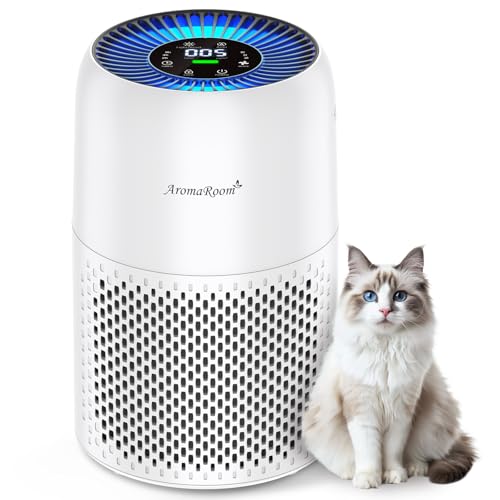
AromaRoom 430 Sq. Ft. Pet Air Purifier with H13 HEPA
Compact air purifier designed for pet owners, combining H13 HEPA filtration with real-time air quality monitoring to tackle pet dander, hair, and odors across rooms up to 430 square feet. Smart auto mode adjusts fan speed based on detected pollutants, though filter replacement every 3-6 months is necessary for optimal performance in pet-heavy homes.
Pros
- Specifically engineered 3-in-1 filtration system addresses pet-related pollutants including smoke and allergens
- Built-in TVOC sensor tracks volatile organic compounds in real time with color-coded air quality display
- Auto mode automatically adjusts fan speed without manual intervention based on air quality readings
- Lightweight and compact footprint suitable for multiple room types
Cons
- Requires filter replacement every 3-6 months, which adds ongoing maintenance costs for pet owners
- Not suitable for high-humidity environments like bathrooms, limiting placement flexibility
- No verified customer reviews available to assess long-term durability or real-world performance

KNKA APH4000 HEPA Air Purifier for Large Rooms
AHAM-certified purifier covering up to 1,695 sq ft with dual intake design and 3-in-1 filtration. Features Pet Mode, Sleep Mode at 22-24 dB, real-time AQI display, and washable pre-filter for practical maintenance.
Pros
- AHAM certification provides third-party verification of purification rates
- Dual filter cartridges and washable pre-filter lower long-term maintenance costs
- Real-time AQI display with color-coded lights shows air quality instantly
- Sleep Mode at 22-24 dB enables quiet overnight operation
- Pet Mode specifically engineered to tackle pet-related allergens and odors
Cons
- At 1,695 sq ft coverage, efficiency drops to 45%, requiring longer purification time in very large spaces
- No customer reviews available yet to validate real-world performance claims
- Filters require replacement every 3-6 months, requiring purchase of genuine KNKA replacement cartridges

Dhyala 3000 Sq Ft HEPA Air Purifier with Smart WiFi
This large-room air purifier covers up to 3000 sq ft with dual-sided intake and a 3-stage filtration system designed for pet owners and allergy sufferers. It includes smart WiFi control, voice assistant compatibility, and a quiet 15dB sleep mode, though it lacks verified user reviews to validate real-world performance.
Pros
- Large coverage area ideal for spacious homes and open layouts
- Washable pre-filter extends main filter life and lowers costs
- Comprehensive smart features including remote app control and voice commands
- Three-stage filtration captures pet hair, dust, pollen, and fine particles
- Safety features like child lock and auto shut-off for families with children and pets
Cons
- No verified buyer reviews yet, making real-world performance claims unverified
- Aromatherapy feature may not appeal to users preferring unscented air
- Washable filters require regular maintenance for optimal performance
Air Purifiers for Allergies Buying Guide
Choosing an air purifier for allergy relief is not as simple as picking the most expensive model or the one with the most fan speeds.
The specifications that actually move the needle on symptom relief are specific, and understanding them will save you money and frustration. The sections below break down each factor our research identified as critical for allergy sufferers.
True HEPA Filtration and What It Actually Means
The term “HEPA” is heavily marketed but not always applied accurately. A genuine true HEPA filter, as defined by the U.S. Department of Energy standard, captures at least 99.97% of airborne particles at 0.3 microns, the most penetrating particle size.
This threshold matters enormously for allergen removal: common pollen grains range from 10 to 100 microns, pet dander from 2 to 10 microns, and dust mite fecal particles from 10 to 40 microns, all comfortably above 0.3 microns and therefore reliably trapped by a true HEPA filter.
Be skeptical of labels like “HEPA-type,” “HEPA-style,” or “99% HEPA,” which indicate filters that may capture far fewer particles.
Every model on our list uses genuine true HEPA (or HEPASilent technology in Blueair’s case, a patented electrostatic-mechanical hybrid that meets or exceeds true HEPA capture rates).
If you are comparing units not on our list, verify the filtration claim against independent certification, not just the product listing.
A multi-stage filter system adds further protection. Look for a pre-filter to catch larger debris and extend the HEPA layer’s life, a true HEPA stage for fine allergens, and an activated carbon layer for volatile organic compounds and odors.
This three-stage approach is standard on every pick we recommend, and it is the configuration consistently praised in expert reviews for allergy households.
CADR Ratings and Room-Size Coverage

Clean Air Delivery Rate (CADR) is the most objective performance metric available for air purifiers.
Measured in cubic feet per minute (CFM) and published by AHAM (Association of Home Appliance Manufacturers), CADR tells you how quickly a unit can filter a specific pollutant from a standardized room.
Separate scores are published for smoke, dust, and pollen. For allergy use, the pollen and dust scores matter most.
AHAM recommends choosing a purifier with a CADR rating at least two-thirds of your room’s square footage. A 300 sq ft bedroom, for example, needs a CADR of at least 200 CFM.
All the units in our lineup carry AHAM VERIFIDE certification or verified manufacturer CADR data, which means the room-coverage figures are not just marketing claims.
Units like the Levoit Core 400S-P and the Blueair Blue Pure 311i Max cover well over 1,700 sq ft per hour, making them suitable for open-plan living spaces and large bedrooms alike.
One nuance worth noting: manufacturers often publish “coverage” numbers based on a single air change per hour (ACH). For allergy sufferers, AHAM and the EPA recommend four to five ACH for meaningful symptom relief.
That means the effective clean-air coverage for your use case is typically one-quarter to one-fifth of the advertised maximum. Factor this into your room-size calculations, and you will likely want to size up rather than down.
Activated Carbon and Odor Control
A true HEPA filter handles particulate allergens extremely well, but it does nothing for gaseous pollutants: volatile organic compounds (VOCs) from cleaning products, cooking fumes, formaldehyde from furniture off-gassing, and pet odors.
For households with pets, smokers, or new furniture, an activated carbon layer is nearly as important as the HEPA stage itself.
Carbon filter effectiveness depends heavily on the quantity and quality of the carbon media. A thin activated carbon mesh (common on budget units) provides some surface area for adsorption but saturates quickly.
Thicker granular carbon pellets, used in premium units, last longer and handle a wider range of compounds.
If pet odors or cooking smells are a primary concern, look for units that specify the carbon layer’s weight or thickness in their technical documentation, not just the presence of “activated carbon.”
Air Quality Sensors and Auto Mode
A real-time air quality sensor transforms a passive appliance into a responsive one.
Units equipped with PM2.5 laser sensors can detect particle concentrations in the air, automatically ramping fan speed up when allergen levels spike (during cooking, when a pet shakes off dander, or when pollen blows in through an open window) and dialing back when air quality improves.
This not only maximizes allergen capture when it matters most but also reduces energy consumption and noise during clean-air periods.
Auto mode, which pairs sensor data with automatic fan adjustment, is one of the features most consistently praised by allergy sufferers in verified buyer reviews.
Models like the Levoit Vital 100S-P and the Winix 5530 include both a PM2.5 sensor and a polished auto mode that verified buyers describe as genuinely “set it and forget it” for daily use.
If you will not manually adjust your purifier throughout the day, an auto mode is not a luxury; it is a practical necessity.
Pair a smart purifier with other connected home air-quality tools and you build a more complete picture of your indoor environment.
For households already invested in automation, models with Wi-Fi and app control (the Levoit Core 400S-P, Blueair Blue Pure 311i Max, and Winix 5530 all offer app integration) let you monitor air quality remotely and set schedules.
If you are managing a broader smart home ecosystem, consider pairing your purifier setup with smart light switches to put ventilation on the same automations as lighting.
Noise Levels and Sleep Mode

For bedroom use, noise is a deal-breaker if it is not managed well. Most purifiers operate between 25 dB and 65 dB depending on fan speed.
Sleep modes, which reduce fan speed and dim LED indicators, are now nearly universal on mid-range and premium units, but the quality varies.
Some sleep modes drop performance so dramatically that allergen capture suffers; others find a genuine balance between quiet operation and meaningful filtration.
Expert reviewers consistently note that units with larger fan diameters can move more air at lower RPM, meaning quieter operation at equivalent CADR.
This is why the Levoit Core 400S-P’s 56W high-torque motor and the Blueair HEPASilent technology both receive strong marks for low-speed noise in bedroom settings.
When evaluating any purifier for a bedroom, look for a sleep-mode noise specification of 25 dB or below at the lowest fan setting. Anything above 35 dB at sleep speed will likely be noticeable in a quiet room.
Allergy sufferers who are also managing sleep quality may want to consider their full bedroom environment. A purifier is one piece of the puzzle; a quality mattress with allergen-resistant materials and regular cleaning routines for bedding will compound the benefits of clean air significantly.
Filter Replacement Costs and Long-Term Value
The purchase price of an air purifier is only part of the total cost of ownership.
HEPA filters typically require replacement every six to twelve months depending on air quality and usage, and replacement filter sets range from modestly priced to surprisingly expensive.
Before committing to any unit, look up the replacement filter cost and multiply it by the expected annual replacement frequency.
A budget unit with expensive proprietary filters can easily cost more per year than a premium unit with affordable, widely available filters.
Units with washable pre-filters, such as the Levoit Vital 100S-P and the KNKA APH4000, extend the life of the main HEPA stage by capturing larger debris before it reaches the fine-fiber layer.
This is a meaningful long-term saving, especially in pet households where hair and coarse dander accumulate rapidly.
Check whether the pre-filter is genuinely washable (as in, designed for regular rinsing) or merely removable for vacuuming; true washability makes a practical difference over years of use.
Running costs extend to electricity as well. Purifiers that run 24 hours a day at moderate fan speeds account for a meaningful share of a household’s energy bill over a year.
ENERGY STAR-certified models and units with efficient motors (look for watt ratings rather than just fan speed claims) will save money over time. Our research factored long-term running costs into PF Score ratings, not just the upfront specification sheet.
Why You Should Trust Us
ProductFind is an independent review publication. We have no affiliation with any manufacturer or retailer featured in this guide, and our editorial team operates separately from any commercial relationships the site holds.
Every product in this roundup was evaluated and scored using our PF Score methodology, a 0-to-10 scale applied consistently across a standardized set of criteria relevant to the product category.
For air purifiers aimed at allergy relief, those criteria include filtration technology and certification, CADR performance relative to coverage claims, air quality sensing and auto-mode quality, noise output at sleep settings, filter replacement cost and availability, and smart feature implementation.
We do not conduct our own product trials; our evaluations are grounded in research, published data, expert review consensus, and verified buyer feedback.
We cross-reference manufacturer specifications against AHAM certification data, independent expert assessments from multiple industry sources, and large pools of verified purchaser reviews to identify consistent patterns of praise or complaint.
Where expert consensus and buyer feedback diverge, we note the discrepancy and weight our score accordingly.
This approach lets us cover a broader range of products and price points than any single evaluation environment could manage, and it allows us to update picks as new data emerges without being tied to a single snapshot in time.
ProductFind may earn a commission if you purchase through a link in this article. That affiliate relationship has no bearing on which products we include, how we rank them, or what scores we assign.
Our recommendations are determined entirely by research quality and PF Score outcomes. We never accept payment for placement, and no brand has editorial input into our ratings or copy.
Final Thoughts
The air purifier market has matured to the point where meaningful allergy relief is available across a wide range of budgets.
Brands like Levoit, Coway, Winix, and Blueair each bring distinct engineering approaches to the same core problem, and our research found strong performers at every price tier.
After scoring every model in this roundup on our PF Score scale, a few standout picks deserve special recognition:
- Best Overall: Dhyala Large Room Air Purifier earned the highest PF Score in this roundup, with double-sided HEPA filtration, whisper-quiet 15 dB sleep mode, smart Wi-Fi, AQI display, and whole-home coverage up to 3,000 sq ft making it the most comprehensively capable option we assessed.
- Best for Large Open-Plan Spaces: Levoit Core 400S-P combines a verified high CADR rating, real-time PM2.5 sensing, smart Wi-Fi, and a polished auto mode into a package that expert review consensus and verified buyers consistently praise for whole-room coverage and reliable allergen capture.
- Best Smart Purifier for Medium Rooms: Blueair Blue Pure 311i Max brings Blueair’s HEPASilent technology to a Wi-Fi-connected package covering up to 2,107 sq ft per hour, with app-based auto mode and whisper-quiet operation that reviewers consistently highlight for bedroom use.
- Best Budget Pick: Levoit Core 300-P delivers genuine three-stage HEPA filtration, AHAM VERIFIDE performance, and a quiet sleep mode at a price point accessible to most households, making it the strongest research-supported choice for budget-conscious allergy sufferers with smaller rooms.
- Best for Pet Owners: Coway Airmega AP-1512HH pairs true HEPA filtration with an eco mode, real-time air quality monitoring, and a filter indicator in a compact footprint that verified buyers in pet households frequently cite as a reliable, low-maintenance daily driver.
If you are also exploring whole-home air quality improvements, our guides to HEPA air purifiers and air purifiers for every budget cover a broader range of use cases, room sizes, and technology types beyond allergy-specific filtration.
For households managing pet hair and allergens at floor level in addition to the air, pairing a purifier with a capable robot vacuum addresses both airborne and surface allergen sources simultaneously.
Frequently Asked Questions
What Is the Difference Between True HEPA and “HEPA-Type” Filters?
True HEPA filters are independently verified to capture at least 99.97% of particles at 0.3 microns, the most penetrating particle size for fiber-based filters.
“HEPA-type” or “HEPA-style” filters are not held to this standard and may capture substantially fewer particles, particularly in the sub-micron range. For allergy relief, true HEPA (or a certified equivalent like Blueair’s HEPASilent) is the meaningful threshold.
Our entire lineup meets this bar.
How Many Air Changes per Hour Do I Need for Allergy Relief?
AHAM and the EPA both recommend four to five air changes per hour (ACH) for meaningful allergen reduction in spaces used by allergy or asthma sufferers.
Most manufacturer “room coverage” figures are based on just one or two ACH, which sounds impressive but falls short for allergy use.
To calculate the right unit for your space, divide the purifier’s CADR rating by your room’s cubic footage (length x width x ceiling height) and multiply by 60 to get hourly air changes. Aim for at least four.
Do Air Purifiers Help With Pet Dander and Pet Odors?
Yes, but the filter configuration matters. Pet dander particles are captured effectively by true HEPA filters. Pet odors, however, are gaseous, not particulate, and HEPA filters do nothing for them.
You need an activated carbon layer to adsorb odor-causing VOCs and ammonia compounds.
Units with both a true HEPA stage and a substantial activated carbon layer, such as the Levoit Core 400S-P and the Coway Airmega AP-1512HH, handle both concerns well.
Thin carbon mesh found on some budget units provides limited and short-lived odor control.
Should I Run My Air Purifier Continuously?
For allergy sufferers, continuous operation is generally recommended, at least at a low fan setting. Allergens re-accumulate in the air between cycles, so running intermittently allows particle levels to rebound.
Most modern purifiers are designed for 24-hour operation, with sleep modes and eco modes that reduce energy consumption and noise during low-activity periods.
Review your unit’s annual energy consumption figure (usually listed in watts) to estimate running costs; ENERGY STAR-rated models keep this manageable over time.
How Often Do I Need to Replace the Filters?
Most HEPA filters in residential purifiers are rated for six to twelve months under average conditions. In high-pollution environments, homes with multiple pets, or during heavy pollen seasons, the actual lifespan may be shorter.
Pre-filters on units that have them should be cleaned monthly to protect the HEPA stage and extend its effective life.
Always follow the manufacturer’s recommended replacement schedule and check the filter indicator if your unit has one; a saturated HEPA filter can actually re-release trapped particles if air resistance forces bypass.
Factor replacement filter pricing into your total cost calculation before purchasing any unit.
Are Air Purifiers Enough, or Do I Need Other Measures Too?
Air purifiers are a highly effective tool but work best as part of a broader allergen-reduction strategy.
Regular vacuuming with a sealed HEPA vacuum (or a robot vacuum and mop combo for consistent daily coverage) removes allergens from carpets and hard floors before they become airborne.
Allergen-proof mattress and pillow covers reduce dust mite exposure at the source. Keeping windows closed during high pollen days prevents outdoor allergens from overwhelming an indoor purifier.
An air purifier addresses what is already airborne; these complementary measures reduce how much allergen enters the air in the first place.
About the author
Constance is a reviewer and writer for ProductFind who specializes in Heating, Cooling & Air Quality. Constance evaluates products through independent research: specifications, expert review consensus, and verified buyer feedback, and rates each one on the PF Score. Constance focuses on helping readers pick the right heating, cooling & air quality for their needs and budget.