The 9 Best Air Quality Monitors
Indoor air can harbor pollutants you cannot see or smell. These air quality monitors track PM2.5, CO2, VOCs, radon, and more so you can take action before problems compound.
 By Constance Jenkins
Updated July 23, 2026
By Constance Jenkins
Updated July 23, 2026

The air inside your home can be more polluted than the air outside, and most people never know it.
Cooking fumes, off-gassing from furniture, pet dander, mold spores, wildfire smoke drifting through window gaps, and poor ventilation all contribute to indoor air pollution that is invisible to the naked eye. According to the U.S.
Environmental Protection Agency, indoor pollutant levels can run two to five times higher than outdoor concentrations, yet the average American spends roughly 90 percent of their time indoors.
Chronic exposure to particulate matter, volatile organic compounds (VOCs), elevated CO2, and formaldehyde has been linked to respiratory disease, cardiovascular stress, and cognitive fatigue.
An air quality monitor turns that invisible risk into legible data you can actually act on, whether that means opening a window, running a capable air purifier, or simply changing your cooking habits.
This guide covers the best air quality monitors available right now, from affordable entry-level units to professional-grade multi-sensor devices.
Our team at ProductFind researched nine leading models by synthesizing manufacturer specifications, expert review consensus from across the industry, and verified buyer feedback from thousands of confirmed purchasers.
Each monitor was scored on our 0-to-10 PF Score scale using consistent evaluation criteria, giving you an apples-to-apples comparison across very different price points.
Whether you need a simple CO2 and particulate tracker for a bedroom or a comprehensive radon-plus-PM2.5 station for a whole home, the picks below represent the strongest options we found.
| Award | Product | PF Score About PF ScoreThe PF Score is our own rating from 0 to 10, based on performance, design and build, ease of use, and value. It reflects independent research and is never influenced by manufacturers, retailers, or affiliate commissions. Learn more › | Price | |
|---|---|---|---|---|
| Best Overall |
 Airthings View Plus Radon & Air Quality Monitor
|
8.8/10 | Buy | |
| Editor's Pick |
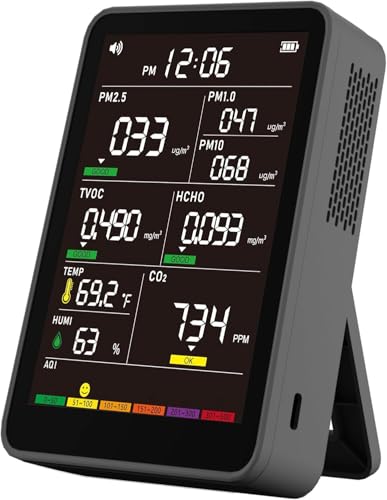 AQItech 16-in-1 Air Quality Monitor with HD Display
|
8.3/10 | Buy | |
| Best Value |
 AQItech 16-in-1 Air Quality Monitor with PM2.5 and CO2 Detection
|
8.2/10 | Buy | |
| Top Rated |
 Temtop LKC-1000S+ Air Quality Monitor with PM2.5/PM10 & Formaldehyde
|
8.1/10 | Buy | |
 BREATHE Airmonitor Plus Multi-Sensor Air Quality Monitor
|
7.4/10 | Buy | ||
 SAF Aranet4 Home CO2 Monitor with E-Ink Display
|
7.2/10 | Buy | ||
 Bonoch 16-in-1 Air Quality Monitor, 7-inch Display
|
6.3/10 | Buy | ||
 YNAK 16-in-1 Air Quality Monitor with 7-inch Display
|
6.2/10 | Buy | ||
 GoveeLife H5106 Smart Air Quality Monitor
|
5.1/10 | Buy |
Airthings View Plus Radon & Air Quality Monitor
Battery-powered WiFi monitor that tracks radon, PM2.5, CO2, VOCs, humidity, and temperature with real-time alerts through a mobile app. Backed by Airthings' 15 years of air quality expertise, though it requires continuous internet access and an account to function.
Pros
- Comprehensive sensor suite covers multiple indoor air pollutants in one device
- No cables required with battery power, enables placement anywhere
- App provides trend tracking and actionable insights over time
- Radon detection specifically addresses the leading non-smoking lung cancer cause
Cons
- Requires internet connection and mandatory account registration to operate
- No user reviews available yet to verify real-world performance
- Depends entirely on Airthings app, limiting data access outside their ecosystem
AQItech 16-in-1 Air Quality Monitor with HD Display
All-in-one air quality meter tracking PM, CO2, TVOC, formaldehyde, temperature and humidity with real-time color display. One-button operation and 4-5 hour battery life make it practical for home, office, and vehicle use.
Pros
- Monitors multiple pollutants simultaneously, eliminating need for separate testers
- Intuitive single-button controls and quiet mode suitable for bedrooms and offices
- Type-C charging compatibility with included adapter and cable
- Real-time updates with color-coded display for quick air quality assessment
Cons
- 4-5 hour battery life limits extended outdoor or continuous monitoring sessions
- No customer reviews available yet to validate real-world performance claims
- HD display quality and color accuracy depend on actual screen specifications not fully detailed
AQItech 16-in-1 Air Quality Monitor with PM2.5 and CO2 Detection
A portable air quality detector tracking 16 parameters including PM2.5, PM10, CO2, TVOC, and formaldehyde with real-time readings every 3 seconds. Built-in alarms and 4-5 hour battery life make it practical for home, car, and office monitoring.
Pros
- Comprehensive 16-parameter monitoring covers most common air quality concerns
- Multiple alert options help users respond quickly to poor air conditions
- Simple interface and one-button operation suitable for everyday users
- Portable design with adequate battery runtime for day-long monitoring
- Includes fast-charge cable and adapter in the box
Cons
- No verified buyer reviews available to validate real-world sensor accuracy
- 4-5 hour runtime limits extended use without frequent recharging
- HD display specifications not detailed, unclear visibility in bright conditions
Temtop LKC-1000S+ Air Quality Monitor with PM2.5/PM10 & Formaldehyde
A multi-sensor air quality monitor that tracks PM2.5, PM10, formaldehyde, VOCs, temperature, and humidity with data export capability. Designed for users who need continuous indoor and outdoor air quality tracking with historical data review.
Pros
- Comprehensive multi-parameter monitoring in one compact device
- Data export and histogram features support informed air quality decisions
- Durable laser sensor rated for extended long-term use
- Pre-calibrated and ready to use out of the box
- Clear display interface for quick reading interpretation
Cons
- Formaldehyde sensor readings can be affected by alcohol, air fresheners, and cleaning products, requiring careful measurement conditions
- No verified buyer reviews available to assess real-world performance consistency
- Consumer-grade formaldehyde sensor has inherent accuracy limitations compared to industrial equipment
BREATHE Airmonitor Plus Multi-Sensor Air Quality Monitor
A comprehensive indoor air quality monitor that tracks CO2, particulates (PM1/2.5/10), VOC, formaldehyde, temperature, and humidity through multiple sensors. The free app provides 30-day history and alerts, making it useful for home offices, bedrooms, and allergy-prone households seeking detailed air quality data beyond basic CO2 readings.
Pros
- Comprehensive sensor array captures CO2, PM1/2.5/10, TVOC, formaldehyde, temperature, and humidity in one device
- App integration with 30-day history and customizable alerts enables trend tracking and informed decisions
- Compact 1.4 x 2.8 x 3.3 inch design fits unobtrusively in any room
- Quick 30-second app setup with built-in calibration simplifies installation for non-technical users
- Identifies specific air quality triggers (cooking, cleaning products, ventilation issues) for actionable improvements
Cons
- No verified buyer reviews available to confirm real-world sensor accuracy and app reliability
- Multi-sensor complexity may require understanding of multiple air quality metrics to interpret readings effectively
- Connectivity dependent on free app; limited information on offline functionality or data backup options
SAF Aranet4 Home CO2 Monitor with E-Ink Display
A compact wireless CO2 meter that tracks air quality in real-time with temperature and humidity readings, powered by a battery lasting up to 4 years. The e-ink display and optional app make it practical for homes, offices, and classrooms where ventilation awareness matters.
Pros
- Extended battery life eliminates constant charging hassle
- NDIR sensor provides reliable, precise CO2 readings
- Lightweight and portable at 0.23 pounds, easy to move between rooms
- Free companion app offers 90-day data history with visual graphs for tracking patterns
Cons
- No reviews currently available to verify real-world performance claims
- App limited to 90 days of data storage, older readings are not preserved
- E-ink display is minimal and may lack detailed information visibility compared to LCD screens
Bonoch 16-in-1 Air Quality Monitor, 7-inch Display
This portable air quality monitor tracks nine essential parameters including CO2, PM2.5, formaldehyde, and TVOC with high-precision external sensors and a large 7-inch display. Best suited for homeowners concerned about indoor air quality during wildfire season or those monitoring multiple rooms with its 8-hour battery.
Pros
- Large, easy-to-read 7-inch display eliminates menu scrolling and provides instant air quality insights
- External high-precision sensors detect slight air quality changes reliably
- Customizable alerts for multiple pollutants keep you informed of specific concerns
- Portable with decent 8-hour battery life for room-to-room monitoring
- Temperature and humidity readings offer certified accuracy within stated ranges
Cons
- No verified user reviews available yet to confirm real-world performance claims
- Requires careful sensor maintenance; manufacturer warns against touching sensors or exposing them to perfumes and strong odors
- Battery life of 8 hours limits extended all-day cordless use without recharging
YNAK 16-in-1 Air Quality Monitor with 7-inch Display
This portable air quality meter monitors nine key parameters including CO2, PM2.5, TVOC, and formaldehyde with a large 7-inch display and real-time alert system. The external high-precision sensors offer 0.001 accuracy, making it suitable for home use during poor outdoor air quality periods like wildfire season.
Pros
- Comprehensive monitoring covers multiple pollutants and environmental factors in one device
- High-precision external sensors designed for direct air sampling and accuracy
- Generous 7-inch display eliminates menu navigation for quick readings
- Portable battery operation allows monitoring throughout different rooms
- Industry-standard calibration ensures reliable measurements across conditions
Cons
- Battery life limited to 8 hours, requiring regular recharging for continuous monitoring
- External sensors require careful handling and isolation from perfumes or strong odors to maintain accuracy
- No verified buyer reviews available to assess real-world reliability and long-term performance
GoveeLife H5106 Smart Air Quality Monitor
This wired indoor air quality monitor tracks PM2.5, temperature, and humidity with two-second data refresh and integrates with GoveeHome smart appliances for automated control. Best for users seeking real-time air quality data and device automation without battery maintenance.
Pros
- Fast two-second data correction shows immediate PM2.5, temperature, and humidity changes
- Seamless automation pairing with compatible GoveeHome smart appliances reduces manual adjustments
- Extended data storage and export lets you track air quality trends over 24 months
- High sensor accuracy across all three measured parameters
Cons
- Wired-only operation requires permanent power connection and USB Type-C cable placement
- Limited device compatibility, works only with specific GoveeHome models
- No user reviews available yet to validate real-world performance claims
Air Quality Monitors Buying Guide
Choosing the right air quality monitor requires understanding which pollutants matter most for your living situation, how you want to receive data, and how much complexity you are willing to manage.
The nine monitors in our lineup range from wired budget units to battery-powered, app-connected smart hubs that track seven or more parameters simultaneously.
The criteria below will help you match a device to your actual needs rather than overpaying for sensors you will never use, or underpaying and missing the readings that matter most.
Pollutants Monitored: Match Sensors to Your Risk Profile

The single most important question to ask is: what are you actually trying to measure? Entry-level monitors typically cover PM2.5, temperature, and humidity. Mid-range units add CO2, TVOC (total volatile organic compounds), and formaldehyde (HCHO).
Premium devices layer in radon, particulate matter at multiple size fractions (PM1.0, PM2.5, PM10), barometric pressure, and nitrogen dioxide.
Radon is a naturally occurring radioactive gas that is the second-leading cause of lung cancer in the U.S., yet it requires a dedicated sensor that most budget devices omit entirely.
If you live in an older home with a basement, radon monitoring is worth prioritizing. If you are primarily concerned about wildfire smoke or urban particulate pollution, a high-quality PM2.5 laser sensor is your first priority.
For home offices where cognitive performance matters, CO2 tracking is especially valuable because elevated CO2 concentrations above roughly 1,000 parts per million have been associated with measurable drops in concentration and decision-making ability.
Think through your specific environment before choosing a sensor count, because more sensors does not always mean more actionable information for your situation.
Households with pets, new furniture, or renovation work underway should pay particular attention to TVOC and formaldehyde readings.
Off-gassing from adhesives, paints, and synthetic materials can spike HCHO levels significantly in the first months after installation, making a monitor with dedicated formaldehyde detection a worthwhile investment if you have recently remodeled.
Pairing a monitor with a well-chosen HEPA air purifier gives you both detection and remediation in the same workflow.
Sensor Accuracy and Calibration

Not all sensors are created equal. Consumer-grade electrochemical and laser-scattering sensors are inherently less precise than laboratory reference instruments, but the gap has narrowed considerably in recent years.
Look for monitors that specify the sensor type and, where possible, cite independent accuracy validation.
Brands like Airthings publish calibration methodologies and, in some cases, have had their radon sensors validated against national reference standards, which is meaningful third-party evidence of reliability.
NDIR (non-dispersive infrared) sensors for CO2 are generally more accurate and drift-resistant than cheaper electrochemical alternatives, so they are worth seeking out if CO2 monitoring is a priority.
For particulate matter, laser-scattering sensors vary widely in their ability to distinguish between particle types and sizes, and some budget units are better described as smoke presence indicators than true PM2.5 quantifiers.
Expert review consensus consistently shows that monitors from established brands with documented sensor sourcing perform more reliably over time than generic multi-parameter units with unspecified components.
Long-term drift is another consideration. Many consumer sensors lose accuracy over months to years without recalibration. Check whether the manufacturer offers firmware-based auto-calibration (common in CO2 sensors that use a baseline-reset algorithm) or recommends periodic manual calibration.
A monitor that was accurate on day one but drifts 30 percent over a year is not giving you useful data when you need it most.
Display, App, and Data Access
Air quality monitors fall into roughly two categories when it comes to data delivery: standalone display units and app-dependent devices.
Standalone units with large LCD or e-ink screens give you at-a-glance readings without requiring a smartphone, which is valuable in shared spaces like kitchens, classrooms, or waiting rooms.
The Aranet4 Home is a well-known example of an e-ink display design that prioritizes clarity and battery longevity over visual flair.
Several of the AQItech and YNAK units in this roundup feature large seven-inch color displays with multi-parameter dashboards readable from across a room.
App-connected monitors open up historical trend analysis, push notifications, and integration with smart home platforms like Apple HomeKit, Google Home, or Amazon Alexa.
The Airthings 2960 View Plus, our top-rated pick, pairs a physical display with a fully featured cloud dashboard that stores years of historical data and lets you correlate air quality events with calendar entries or weather data.
For households that want to understand patterns over time rather than just spot-check current readings, this level of data access is genuinely useful rather than a marketing checkbox.
Consider whether you want your monitor to push alerts. Several units in this guide support beep alarms or push notifications when a threshold is exceeded, which can be the difference between noticing a problem immediately and discovering it hours later.
Look for customizable alert thresholds rather than fixed factory presets, since “safe” levels vary by household and occupant health status.
Power Source and Placement Flexibility

Battery-powered monitors offer maximum placement flexibility. You can move them between rooms, take them to a hotel, or install them in locations without convenient outlets.
The Aranet4 Home runs for up to a year on standard AA batteries, making it genuinely set-and-forget for most users.
The tradeoff is that battery-powered units sometimes use lower-power sensors or reduce polling frequency to extend runtime, which can mean slower response to rapid air quality changes.
Wired monitors, like the GoveeLife H5106, are always powered and can poll sensors more frequently, but placement is constrained by outlet proximity.
If you need continuous monitoring in a fixed location such as a nursery, home office, or HVAC return duct area, a wired unit is perfectly practical.
Some monitors offer both USB-C or micro-USB connectivity for desk use and a battery option for portability, giving the best of both worlds.
For those who already track wellness metrics through wearable fitness trackers, pairing one with a room-level air quality monitor creates a more complete picture of your environmental health.
Portability and Form Factor

If you plan to move a monitor between rooms or use it in a car or during travel, size and weight become real factors. Compact monitors like the Aranet4 and Temtop units slip into a bag without issue.
Larger seven-inch display units like those from AQItech, YNAK, and bonoch are better suited as room stations because their footprint and power requirements make frequent relocation impractical.
Think about whether you need one device that moves around or multiple smaller units placed throughout your home.
Build quality and materials are also worth considering, particularly if the monitor will live in a kitchen or bathroom where humidity and temperature fluctuations are more extreme.
Monitors rated for wider temperature and humidity operating ranges tend to deliver more consistent readings in those environments. A device that performs beautifully in a climate-controlled living room may drift noticeably when placed near a stove or bathroom exhaust fan.
Value and Total Cost of Ownership

Price range in this category spans from budget-friendly wired units to premium cloud-connected multi-sensor stations, and the price gap does not always correlate neatly with sensor quality.
Some mid-range monitors pack impressive sensor arrays at a fraction of the cost of premium alternatives by trading off app sophistication or build finish.
Our PF Score methodology weights real-world value heavily, which is why several mid-range picks in this guide score as well as or better than certain premium-priced competitors.
Consider whether a monitor requires ongoing subscription fees for cloud storage or historical data access. Most devices in this roundup offer free app access, but a small number of premium brands gate advanced analytics behind annual plans.
Factor that into your total cost assessment, especially if you plan to use historical trend data as a core feature.
Also weigh the cost of replacement sensors if applicable, since some modular designs allow sensor upgrades while others are sealed units with a fixed sensor lifespan.
If your monitor reveals a particulate problem, investing in one of the best air purifiers for allergy relief is the logical next step.
Why You Should Trust Us
ProductFind is an independent review platform with no manufacturer relationships, no sponsored placements, and no editorial input from brands.
Every product in this guide was scored using our PF Score system, a 0-to-10 scale that evaluates each monitor against a consistent set of criteria: sensor breadth and quality, display and data accessibility, app and smart home integration, build quality and placement flexibility, long-term reliability signals, and overall value relative to price.
Scores are derived from synthesizing publicly available specifications, expert review consensus drawn from credible industry sources, and verified buyer feedback from confirmed purchasers across major retail platforms.
We do not conduct our own product trials; our evaluations are grounded in research, published data, expert review consensus, and verified buyer feedback.
This research-synthesis model allows us to assess a broader range of products more consistently than any single reviewer could, while remaining transparent about how conclusions are reached.
Where expert reviewers disagreed meaningfully, we weighted independent assessments more heavily than brand-provided claims.
ProductFind may earn a commission when you purchase through links in this article. That affiliate relationship does not influence rankings, PF Scores, or which products are included or excluded.
Our recommendations are based solely on the merit of each product as determined by our evaluation criteria. We have no obligation to recommend any specific product and we do not accept payment for placement.
Final Thoughts
Indoor air quality monitoring has matured from a niche concern into an accessible, genuinely useful tool for health-conscious households.
The monitors in this roundup cover a wide range of needs and budgets, and all of them offer meaningful improvements over having no visibility into your air at all. Here are our standout picks by category:
- Best Overall: Airthings 2960 View Plus earns the top PF Score in this roundup by combining radon detection with six additional parameters, a reliable battery-powered design, and one of the most polished cloud dashboards in the consumer category. It is the most complete single-device solution we found.
- Best Mid-Range Multi-Sensor: AQItech 16-in-1 Indoor Air Quality Monitor delivers an impressive array of sensors on a high-resolution color display at a mid-range price, earning a strong PF Score that places it at the top of the large-display segment.
- Best for Formaldehyde and Particle Tracking: Temtop Air Quality Monitor stands out for its dedicated HCHO and PM10 sensors alongside data export capability, making it especially useful for users who want records of air quality events over time.
- Best for Smart Home Integration: BREATHE Airmonitor Plus bridges professional-grade sensor coverage with a well-designed companion app, making it a strong choice for connected households that want air quality data alongside other smart home readings.
- Best Budget Entry Point: GoveeLife Smart Air Quality Monitor H5106 is the most affordable pick in the lineup and suits users who want basic PM2.5 visibility in a wired format without a complex setup process.
No single monitor is right for every household. If radon is your primary concern, the Airthings is the clear recommendation.
If you want a room-station display with broad sensor coverage at a moderate price, the AQItech or AQItech Professional models deliver strong value. If portability and battery life matter most, the Aranet4 Home remains a benchmark for e-ink display monitors.
Use the buying guide criteria above to match the right device to your specific situation, and remember that a monitor is only as useful as the action you take based on what it shows you.
Frequently Asked Questions
What is the most important pollutant to monitor indoors?
It depends on your home and lifestyle, but fine particulate matter (PM2.5) is widely considered the most universally relevant metric because it affects nearly every indoor environment, from cooking smoke to tracked-in outdoor pollution to wildfire infiltration.
CO2 is the second most actionable reading for most households because it is a direct proxy for ventilation quality.
If you live in an area with known radon risk, particularly on lower floors or in basements, radon becomes a high priority given its status as a leading cause of lung cancer.
How often should I check my air quality monitor?
For general awareness, a daily check is sufficient for most users. However, the real value of a connected monitor is historical trend data rather than point-in-time readings.
Reviewing weekly trends helps you identify patterns linked to specific activities like cooking, cleaning, or sleeping with the windows closed.
Monitors with push alerts are particularly useful for catching acute events, such as a PM2.5 spike during a nearby wildfire, without requiring you to actively check the device.
Can an air quality monitor replace a smoke detector or carbon monoxide alarm?
No. Air quality monitors are environmental awareness tools, not life-safety devices. They are not designed or certified to provide emergency alerts for fire or dangerously high carbon monoxide levels.
Always maintain dedicated, certified smoke detectors and CO alarms in your home regardless of what air quality monitor you use. These serve fundamentally different purposes and are complementary, not interchangeable.
Do I need one monitor for the whole house or multiple units?
Air quality can vary significantly from room to room, so a single monitor placed in one location will miss events happening elsewhere in the home.
A common approach is to start with one high-quality monitor in the room where you spend the most time, typically a bedroom or home office, and expand from there.
If you have specific concerns about a basement (radon), kitchen (PM2.5 and HCHO from cooking), or a nursery, placing dedicated monitors in those locations gives you more complete coverage.
Battery-powered, portable units make it practical to rotate a single device between rooms before committing to a multi-unit setup.
What should I do if my air quality monitor shows high pollutant levels?
First, try to identify the source. A sudden PM2.5 spike after cooking suggests improving kitchen ventilation or using a range hood more consistently.
Elevated CO2 across the day indicates insufficient fresh air exchange, solvable by opening windows or improving HVAC circulation.
Persistently high TVOC or HCHO readings often point to off-gassing materials and may benefit from increased ventilation and an air purifier with an activated carbon filter.
For radon, remediation typically involves professional sealing of foundation cracks and sub-slab depressurization, which should be handled by a certified contractor rather than a DIY approach.
About the author
Constance is a reviewer and writer for ProductFind who specializes in Heating, Cooling & Air Quality. Constance evaluates products through independent research: specifications, expert review consensus, and verified buyer feedback, and rates each one on the PF Score. Constance focuses on helping readers pick the right heating, cooling & air quality for their needs and budget.