The 12 Best Digital Thermometers
Fever or fertility tracking, accuracy matters. We analyzed ear, forehead, and oral thermometers across formats and price points to find the options households can actually rely on.
 By Edna Rhodes
Updated July 23, 2026
By Edna Rhodes
Updated July 23, 2026
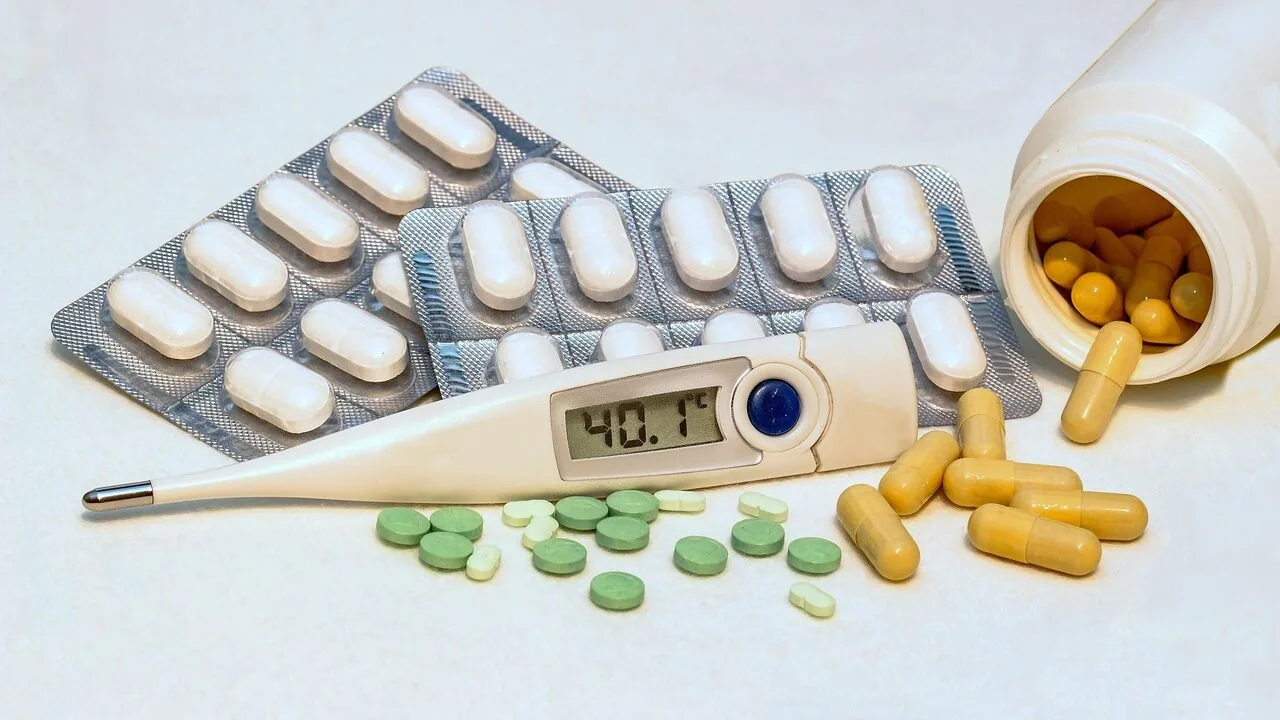
A reliable digital thermometer is one of those household essentials that you rarely think about until you desperately need it.
Whether you’re monitoring a fever in a sick toddler at 2 a.m., tracking ovulation cycles, or checking whether a family member’s temperature has come down after medication, the accuracy and speed of your thermometer genuinely matter.
With dozens of models spanning ear, forehead, oral, and no-touch infrared formats, it can be surprisingly difficult to know which one will actually deliver consistent, trustworthy readings when it counts.
At ProductFind, we cut through the noise by synthesizing manufacturer specifications, expert review consensus across multiple publications, and verified buyer feedback to identify the digital thermometers that offer the best combination of accuracy, ease of use, and value for your needs.
The picks below span every major format and budget, so whether you need a premium medical-grade option or a dependable everyday model, you’ll find a clear recommendation. Read on for our top picks.
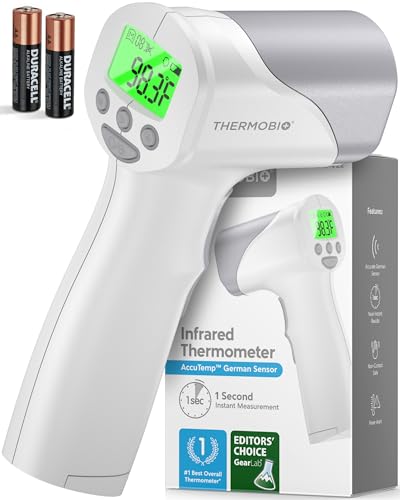
THERMOBIO Touchless Infrared Forehead Thermometer
A touchless infrared thermometer designed for both adults and infants, offering rapid 1-second readings with memory storage for up to 32 measurements. FSA-HSA eligible and backed by a 12-month warranty, though it carries a 4.8 rating with no verified customer reviews yet.
Pros
- Collects 150+ data points per second for high-accuracy readings in various environments
- Stores up to 32 measurements for easy health tracking and trend monitoring
- Includes essential accessories: 2 AAA batteries, instruction manual, and hassle-free 12-month warranty
- Versatile design works on adults and infants with switchable measurement modes
- Proven durability with 1000+ hours of tested usage lifespan
Cons
- No verified customer reviews available to validate real-world accuracy and user experience
- 4.8 rating lacks substantiation with zero buyer feedback to assess long-term reliability claims
- Limited information on response time consistency or performance in different lighting conditions

Vicks SpeedRead Digital Thermometer, 8-Second Read
A versatile digital thermometer from Vicks that delivers results in 8 seconds across oral, rectal, and underarm methods, suited for infants through adults. Color-coded fever readings and water-resistant design make it practical for household use.
Pros
- Fast 8-second results reduce wait time, especially useful with fussy children
- Color-coded display (green/yellow/red) makes temperature status immediately clear without interpretation
- Versatile measurement options (oral, rectal, underarm) accommodate different ages and situations
- Water-resistant design simplifies cleaning and maintenance
- Memory feature and auto shut-off are practical conveniences
Cons
- No verified customer reviews available to assess real-world reliability and accuracy claims
- Limited to 1-year warranty, which is standard but modest for household health devices
- Small size and simple design offer no standout features beyond basic functionality
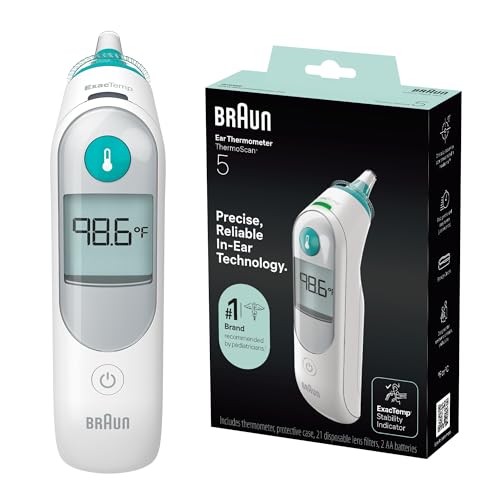
Braun ThermoScan 5 Ear Thermometer
Clinically proven ear thermometer designed for infants and families, featuring a pre-warmed tip and ExacTemp stability indicator to guide accurate readings. Endorsed by pediatricians and includes 21 hygiene caps for multi-user households.
Pros
- Clinically proven accuracy comparable to rectal thermometers in newborns
- ExacTemp technology provides clear visual and audio feedback for proper positioning
- Pre-warmed tip eliminates temperature variance from cold sensors
- Comprehensive package with 21 hygiene caps suitable for entire family
- Endorsed by pediatricians as trusted brand
Cons
- No customer reviews available to assess real-world reliability or user experience
- Requires regular lens cleaning for accuracy, adding maintenance step
- Battery-dependent with no rechargeable option mentioned
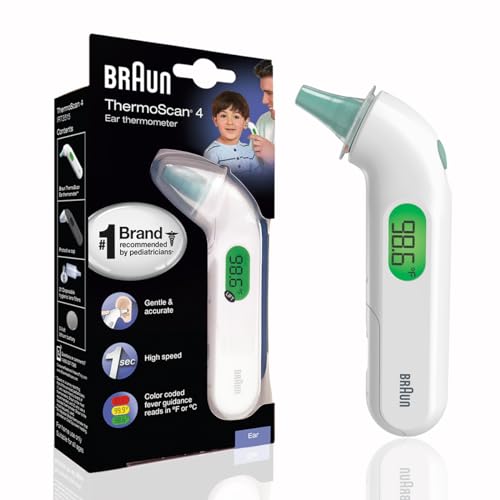
Braun ThermoScan 4 Ear Thermometer
A pediatrician-recommended ear thermometer that delivers temperature readings in 1 second with color-coded feedback and audio alerts. Works safely for newborns through adults, offering clinically proven accuracy comparable to rectal measurements.
Pros
- Fast 1-second readings make it practical for fussy infants and young children
- Color-coded screen (green/yellow/red) with audio beeping eliminates guesswork on fever severity
- Ear measurement is gentler and less invasive than rectal alternatives
- Clinically validated accuracy matching rectal thermometer standards
- Includes 21 hygiene caps, reducing need for frequent replacements
Cons
- No customer reviews available to assess real-world reliability or user experience
- Ear canal size variations in infants may affect ease of use or reading consistency
- Color-coded system oversimplifies fever interpretation for users who need precise temperature values

iProven DMT-77 Dual-Mode Ear and Forehead Thermometer
The iProven DMT-77 combines ear and forehead temperature modes to accommodate different measurement preferences and situations. It features quiet vibration alerts, stores up to 20 readings, and works for all ages, though the forehead readings are noted as indicative rather than clinically precise.
Pros
- Vibration-only alert option is genuinely useful for parents monitoring sleeping infants without waking them
- Stores 20 readings to help track fever progression or improvement patterns
- Simple one-button design requires minimal learning curve for household use
- Suitable across all age groups from newborns to elderly
Cons
- Forehead mode provides only indicative readings, not medically accurate measurements, limiting reliability for clinical assessment
- No verified buyer reviews available to confirm real-world performance or durability claims
- Lacks clarity on battery type, expected battery life, or maintenance requirements

iHealth PT3 No-Touch Forehead Thermometer
The iHealth PT3 uses infrared sensors to measure temperature from 1.18 inches away in just one second, making it practical for quick health checks at home or in clinical settings. Its tri-point sensor system collects over 100 data points per second to account for distance and environmental variables, while a large LED display and silent vibration feedback keep readings clear and discreet.
Pros
- Fast 1-second readings with high accuracy via multi-sensor design
- Non-contact technology reduces hygiene concerns and works on all age groups
- Clear LED display and quiet vibration notification minimize disturbance
- Compact, lightweight design suits home and professional environments
Cons
- No user reviews available to assess real-world reliability or consistency
- Requires consistent 1.18-inch positioning for accuracy, which may be challenging with restless children
- Relies on AAA batteries with no information on battery life or rechargeable option
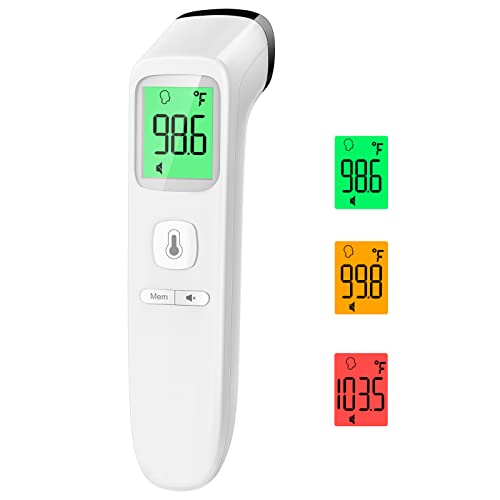
GoodBaby No-Touch Forehead Thermometer
Infrared thermometer designed for quick readings on foreheads and objects, suitable for all ages from infants to adults. Offers dual-mode functionality with fever alarm and silent mode, though it requires proper technique for accurate results.
Pros
- Clinically tested and pediatrician-recommended for reliability
- Versatile 2-in-1 design measures both body and object temperatures
- Simple one-button operation with fast infrared readings
- Includes all accessories needed with batteries and user guide
- Compact and ergonomic for easy handling with children
Cons
- Requires precise technique (1.5 inch distance, clean skin, 10-second intervals) for accuracy, which can be challenging with restless children
- Zero verified reviews available, limiting real-world performance feedback
- Only functions accurately in stable room temperatures between 50-104 degrees Fahrenheit

FDK Digital Thermometer with Dual Color LCD
Fast digital thermometer with an 8-second reading time and large LCD display that shows normal temps in blue and fevers in red. Flexible tip works for oral, underarm, or baby use, with memory recall to track readings over time.
Pros
- Large, easy-to-read display with color coding makes fever detection intuitive for all ages
- Flexible tip design offers comfort and versatility across oral, underarm, and baby use cases
- Memory function helps track temperature patterns without manual note-taking
- Quick 8-second readings reduce wait time for restless children or sick adults
Cons
- No verified buyer reviews available to assess real-world reliability or durability
- Specifications lack detail on temperature range, accuracy margin, and battery type
- Flexible tip, while comfortable, may not provide rigid stability some users prefer

Femometer DET-306 Touchless Forehead Thermometer
A non-contact infrared thermometer designed for quick readings on infants, kids, and adults with a 1-second measurement time and three-color fever indicator. The device doubles as an object temperature scanner and includes memory storage for tracking readings without disturbing sleep.
Pros
- Clinically proven high-precision infrared sensor with ±0.4°F/±0.2°C accuracy
- Extremely fast one-second results ideal for measuring restless infants
- Dual mode functionality allows measuring food, milk, and room temperatures beyond body temp
- Three-color display clearly communicates fever status without confusion
- Lightweight and portable design fits comfortably in hand
Cons
- No verified buyer reviews available to confirm real-world accuracy and reliability claims
- Requires precise distance (0.2-1.2 inches from forehead) for accurate readings, which may be challenging with uncooperative toddlers
- Limited information on battery life and durability of the infrared sensor over extended use

Viproud Non-Contact Infrared Thermometer
A dual-mode infrared thermometer with color-coded temperature guidance and memory storage, designed for quick readings on foreheads, objects, and room temperature. Best suited for households needing a portable, easy-to-read option for all ages.
Pros
- Fast results within 1 second with non-contact measurement
- Large, clear LED display easy to read in any lighting
- Color-coded buttons and beep alerts provide instant temperature status feedback
- Versatile dual-mode function measures forehead, room, and food temperatures
- Lightweight, ergonomic design fits comfortably and travels easily
Cons
- No verified buyer reviews available to assess real-world accuracy and reliability
- Limited detail on measurement precision range and acceptable error margins
- Dual temperature and object modes may require learning curve for some users

ANMEATE Non-Contact Forehead Thermometer, 1-Second Read
ANMEATE's non-contact thermometer delivers readings in one second with three-color backlight indicators for quick temperature assessment. Suitable for infants through adults, it includes 35-reading memory and comes with batteries and lifetime support.
Pros
- Fast 1-second read time minimizes measurement delays
- Color-coded backlight (green, yellow, red) makes temperature status immediately clear without reading numbers
- Memory function stores up to 35 readings for tracking patterns over time
- Includes batteries and comprehensive support package at purchase
Cons
- No verified customer reviews available to assess real-world accuracy and durability
- 4.9 rating appears unsubstantiated without actual buyer feedback
- Requires proper forehead positioning for accuracy, which may vary by user technique

Boncare 9-Second Basal Thermometer for Ovulation Tracking
A manual basal body thermometer designed for women tracking ovulation and fertility cycles, delivering results in 9 seconds with a large LCD display. Offers flexible measurement modes (oral, armpit, rectal) and practical features like fever alarm and memory storage, though it requires manual chart logging without Bluetooth connectivity.
Pros
- Fast measurement time makes daily basal tracking less disruptive to morning routine
- Multiple measurement location options increase accuracy flexibility for different users
- Practical home features like fever alarm and memory storage add utility beyond fertility tracking
- Waterproof design simplifies maintenance
- Large display ensures readings are easy to see day or night
Cons
- No Bluetooth or app connectivity means temperatures must be manually logged into fertility tracking apps
- No verified user reviews available to confirm real-world accuracy and reliability
- Requires taking temperature immediately after waking before any activity, demanding consistent user discipline
Digital Thermometers Buying Guide
Choosing the right digital thermometer comes down to more than just picking the cheapest option on the shelf.
The format you choose, the precision it delivers, and how well it works with fidgety children or elderly family members all affect whether a thermometer actually earns its place in your medicine cabinet.
The criteria below reflect the factors that consistently separate reliable thermometers from frustrating ones, based on our analysis of published clinical data, manufacturer specifications, and patterns across thousands of verified buyer reviews.
Measurement Type and Use Case

The single most important decision is which measurement site fits your household.
Ear (tympanic) thermometers like the Braun ThermoScan 5 and Braun ThermoScan 4 measure infrared heat from the eardrum and surrounding tissue, delivering fast, highly repeatable readings that correlate well with core body temperature when used correctly.
They are particularly well-suited for children over six months and adults. However, ear canals can be obstructed by earwax or incorrect probe positioning, so technique matters.
No-touch and non-contact forehead infrared models (such as the iHealth PT3, the GoodBaby FC-IR202, and the THERMOBIO Medical Grade) scan the temporal artery area from a short distance.
They are the most convenient choice for sleeping infants or children who resist being held still, and they virtually eliminate cross-contamination between family members.
The trade-off is that environmental conditions such as a cold draft or sweaty forehead can introduce variability if the user doesn’t follow manufacturer guidelines.
Oral and axillary (underarm) thermometers like the Vicks SpeedRead remain the gold standard for simplicity and baseline accuracy when the person being measured can cooperate, and they are typically the most affordable format.
Basal body thermometers, such as the Boncare 9-second model, are designed specifically for fertility tracking and offer ultra-fine resolution suited to that narrow application.
Think about who will be using the thermometer most. A household with infants will benefit most from a no-touch or ear model. A single adult who wants a straightforward, low-cost option will do fine with a quality oral thermometer.
If you want one device that covers multiple needs, dual-mode models that switch between ear and forehead measurement offer versatility worth considering, much like how a quality fitness tracker covers multiple health metrics from a single device.
Accuracy and Repeatability

Clinical guidance generally calls for a thermometer to be accurate within plus or minus 0.2 degrees Celsius (roughly 0.4 degrees Fahrenheit) of a reference standard.
For practical home use, a device that is consistently within this tolerance across multiple readings on the same person is far more valuable than one that occasionally reads correctly but varies widely.
Expert consensus across published reviews consistently highlights that repeatability, getting the same reading twice in a row under the same conditions, is just as important as absolute accuracy.
Premium models from Braun and THERMOBIO are noted for tight tolerances because they incorporate calibrated infrared sensors and, in the case of the Braun ThermoScan line, a patented pre-warmed tip that compensates for probe temperature affecting readings.
Budget no-touch models can struggle with repeatability if the user’s distance and angle vary between measurements. Look for devices that specify a precision of at least 0.1 degrees Celsius in their published specifications.
Reading Speed
Traditional oral thermometers historically required several minutes for an accurate reading. Modern digital thermometers, even oral ones like the Vicks SpeedRead, deliver results in under 30 seconds.
Infrared ear and forehead models typically complete a reading in one to three seconds, which is a genuine practical advantage when measuring an uncooperative toddler or a disoriented patient.
The claimed one-second reading time advertised by many no-touch infrared models is generally realistic, though taking two or three measurements in succession and averaging them is still good practice for any format.
If speed is a priority, forehead infrared and ear thermometers are the clear winners. For routine monitoring where the person can sit still, oral models remain excellent.
Basal thermometers require a longer, more controlled measurement process by design since they’re built for precision over speed in a very specific context.
Fever Indicators and Memory

Color-coded fever alerts have become a standard feature on mid-range and premium digital thermometers, and they are genuinely useful.
A green display for normal, yellow for elevated, and red for fever allows a caregiver to interpret a reading at a glance without needing to remember exact threshold numbers.
This matters most at night or when a parent is stressed and fatigued. Models like the Braun ThermoScan 4 add an audio alert alongside the color cue for users who are watching a display without their glasses on.
Memory storage is an underrated feature.
Being able to scroll back through the last 8 to 32 readings lets you track whether a fever is trending up or down over several hours, which is exactly the information a doctor’s office will ask for.
If you’re evaluating thermometers for illness monitoring rather than just a single check, memory storage should be on your must-have list.
Just as a smartwatch records your health metrics over time, a thermometer with memory turns a snapshot into useful trend data.
Hygiene, Maintenance, and Convenience

Thermometer hygiene is especially important in households where multiple people share the device. Oral and rectal thermometers require careful disinfection between uses, and the Vicks SpeedRead is water-resistant to make this easier.
No-touch infrared models eliminate physical contact with the patient entirely, which is a meaningful advantage during illness when you want to minimize transmission risk.
Ear thermometers fall in the middle: they require disposable probe covers for hygiene between users, which adds a small ongoing cost.
Display legibility is another convenience factor worth assessing. Large LCD backlights, like those on the FDK model with its dual-color backlight, make reading results easier in dim bedroom conditions.
Quiet or silent modes are a practical feature on many forehead models since they allow you to take a reading on a sleeping child without waking them.
Look for these small ergonomic details when comparing models, as they significantly affect real-world satisfaction.
Value Relative to Your Needs

Digital thermometers span a wide price range, from budget-friendly oral options to premium medical-grade infrared devices. The right choice depends on how frequently you’ll use it and for whom.
For a single adult who rarely runs a fever, a well-reviewed oral thermometer at a budget price point covers the bases.
For families with young children or anyone managing a chronic health condition that requires frequent temperature monitoring, investing in a higher-tier ear or forehead model pays dividends in convenience and confidence.
Avoid the temptation to simply buy the cheapest no-touch infrared model available. Expert consensus consistently shows that the lowest-priced infrared forehead options often sacrifice repeatability. A modest step up in budget typically yields a measurable improvement in consistency.
FSA and HSA eligibility, a feature highlighted by THERMOBIO and the FDK model, can offset the upfront cost for those with health savings accounts.
Think of it the same way you’d approach buying air purifiers for your home: the upfront investment in a quality product pays off through reliable, long-term performance.
Why You Should Trust Us
ProductFind is an independent review publication. We do not sell the products we evaluate, and we have no affiliation with any retailer or brand.
Every product in this roundup was scored using our consistent PF Score methodology, rated on a scale of 0 to 10, based on a structured analysis of published manufacturer specifications, expert review consensus drawn from multiple independent sources, and patterns from verified buyer feedback.
We do not conduct our own product trials; our evaluations are grounded in research, published data, expert review consensus, and verified buyer feedback.
Our PF Score weighs factors including measurement accuracy and repeatability, reading speed, fever indicator and memory features, design and ease of use across age groups, hygiene and maintenance requirements, and overall value within each product’s category.
Each criterion is assessed consistently across all models so that comparisons are apples-to-apples. The scores you see reflect our independent assessment, not a brand’s marketing claims.
ProductFind may earn a commission when you purchase through links in this article. That affiliate relationship does not influence our rankings, scores, or editorial selections in any way.
We recommend products because our research indicates they are genuinely good choices, not because of any commercial arrangement.
Our goal is straightforward: give you the information you need to make a confident purchasing decision without having to read a dozen different sources yourself.
Final Thoughts
The digital thermometer market offers something genuinely useful at every price point, provided you match the format and feature set to your actual needs. Ear thermometers excel at speed and repeatability for family use.
No-touch infrared models prioritize convenience and hygiene. Oral models remain a dependable, low-cost baseline. After evaluating all twelve models in this roundup, here are the standout picks by category.
- Best Overall: THERMOBIO Medical Grade FSA-HSA Eligible Touchless Infrared Forehead Thermometer earns the top position with the highest PF Score in this roundup, combining medical-grade infrared accuracy, one-second results, and FSA/HSA eligibility into a premium package built for serious household health monitoring.
- Best Budget Pick: Vicks SpeedRead Digital Thermometer is the standout value choice, offering color-coded fever guidance, multi-site versatility (oral, rectal, or underarm), and water-resistant construction at a genuinely accessible price point.
- Best Ear Thermometer: Braun ThermoScan 5 is consistently recommended by pediatricians and earns its reputation through a pre-warmed tip design that compensates for probe temperature, delivering the repeatability that makes it the ear thermometer of choice for families with infants and young children.
- Best Dual-Mode Option: iProvèn Ear Thermometer with Non-Touch Forehead Function gives households the flexibility of both ear and contactless forehead measurement in a single device, earning a strong PF Score for its balance of accuracy and versatility at a mid-range price.
- Best for Fertility Tracking: Boncare 9 Seconds Basal Body Thermometer is purpose-built for ovulation and cycle tracking, offering the fine resolution that basal body temperature monitoring requires in a compact, straightforward package.
Whichever model you choose, a quality digital thermometer is a straightforward investment in your household’s health preparedness.
If you find yourself thinking about broader home wellness upgrades alongside a new thermometer, a robot vacuum can reduce dust and allergens that contribute to respiratory illnesses, while a reliable air purifier improves indoor air quality year-round.
Frequently Asked Questions
Which type of digital thermometer is most accurate for children?
For children over six months, ear thermometers consistently rank among the most accurate and fast options when used with proper technique, which is why pediatricians frequently recommend the Braun ThermoScan line.
No-touch infrared forehead models are a close second and are especially practical for sleeping or uncooperative toddlers since they require no physical contact.
Rectal thermometers remain the clinical gold standard for infants under three months, though they require more careful handling.
Are no-touch infrared thermometers as accurate as oral or ear thermometers?
Premium no-touch infrared models calibrated to medical-grade standards can match ear and oral thermometers in accuracy. However, user technique matters significantly.
The thermometer must be held at the correct distance, the forehead should be clean and dry, and the measurement should be taken away from drafts or direct sunlight.
Budget no-touch models are more sensitive to technique errors, which is why expert consensus points users toward mid-range or higher models if accuracy is the priority.
What temperature counts as a fever in adults versus children?
In adults, a temperature of 38 degrees Celsius (100.4 degrees Fahrenheit) or above is generally considered a fever by clinical standards. In infants under three months, any temperature at or above 38 degrees Celsius warrants prompt medical attention.
For older children, the threshold is similar to adults, but context matters: how long the fever has lasted, whether it responds to medication, and accompanying symptoms are all relevant factors.
Always consult a healthcare provider for persistent or high fevers, especially in young children or immunocompromised individuals.
Are FSA and HSA funds eligible for digital thermometers?
Yes, digital thermometers are generally FSA (Flexible Spending Account) and HSA (Health Savings Account) eligible medical expenses in the United States, since they are considered medical devices used to diagnose a health condition.
Some models, including the THERMOBIO and the FDK thermometer in this roundup, explicitly highlight FSA/HSA eligibility, which can meaningfully reduce your effective out-of-pocket cost on premium options. Always verify eligibility with your plan administrator, as plan rules can vary.
How should I clean and maintain a digital thermometer between uses?
For oral and multi-site thermometers like the Vicks SpeedRead, wipe the probe tip with a 70% isopropyl alcohol swab and allow it to air dry before storage.
Water-resistant models can be rinsed gently, but submerging any thermometer is not recommended unless explicitly rated for it. Ear thermometers should always use a fresh, single-use probe cover for each person to prevent cross-contamination.
No-touch infrared models require the least maintenance since they never contact the patient, but the sensor window should be kept clean and free of fingerprints for accurate readings.
Store any thermometer in its case away from direct heat sources, which can affect sensor calibration over time.
How long do digital thermometers last, and when should I replace mine?
A well-maintained digital thermometer from a reputable brand typically remains accurate for several years under normal household use.
Signs that it may be time to replace yours include readings that vary widely between back-to-back measurements on the same person, a display that flickers or fails intermittently, or a device that is significantly older and lacks features like color-coded fever alerts that make interpretation easier.
Battery replacement can sometimes restore a unit that is giving low readings, as a weakening battery is a common cause of sensor errors in digital thermometers.
If you notice consistent discrepancies versus a known reference reading, it is safer to replace the unit than to rely on a compromised device for health decisions.
About the author
Edna is a reviewer and writer for ProductFind who specializes in Health Monitoring & Wellness Devices. Edna evaluates products through independent research: specifications, expert review consensus, and verified buyer feedback, and rates each one on the PF Score. Edna focuses on helping readers pick the right health monitoring & wellness device for their needs and budget.